

Blog
Why We Wrote The Indispensable EHS Officer Book (A Realist Guide for India) | EHSSaral
EHSSaral is an Environmental Compliance Intelligence Platform for Industries. Consent Intelligence • Alerts & Tasks • Incident Reporting • Form IV & V • Audit-Ready Records
See how EHSSaral works
22 Dec 2025
EHSSaral Research Series - SME Compliance in India
Part 1 - Why Good People Still Struggle With Compliance in Indian SMEs
Part 2 - Why Safety Culture Fails in Indian SMEs: People & Compliance Challenges
Part 3 - Systems & Technology Barriers in Indian SME Compliance (You're reading this)
Part 4 - Transforming SME Compliance: Zero Surprise Failures in India
Series Objective: Simplifying compliance challenges faced by SMEs and supporting EHS professionals with practical solutions.
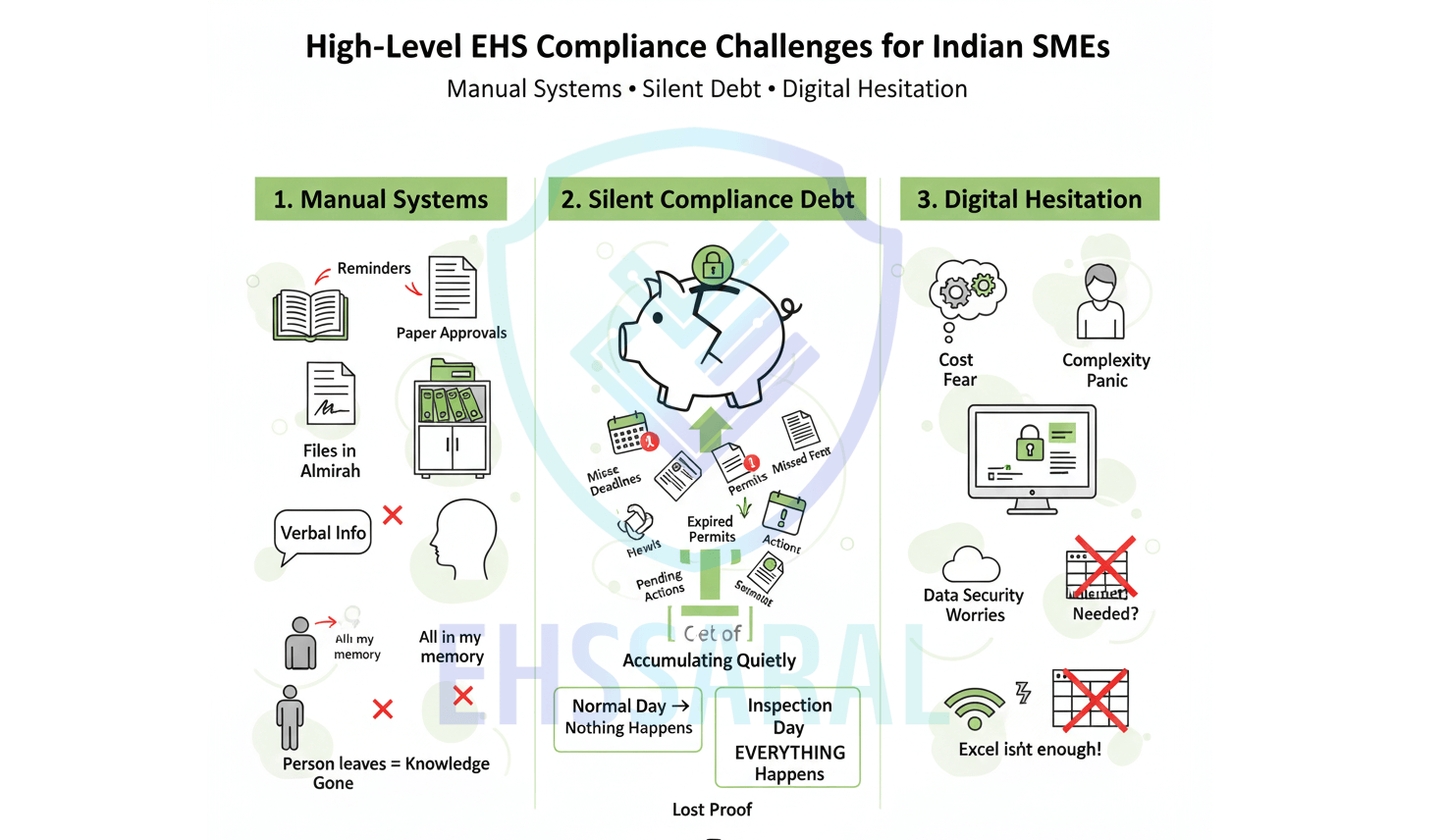
Most SMEs in India still run compliance like it’s 1995:
Nothing feels broken…
until suddenly everything breaks at once.
Manual systems don’t fail loudly -
they fail silently and permanently.
In finance, there is loan debt.
In compliance, there is missed obligation debt.
Every time a task is delayed or note isn’t recorded:
This debt accumulates quietly.
On a normal day - nothing happens.
During inspection - everything happens.
The officer asks:
“Show me proof for last 2 years.”
That’s when manual compliance debt becomes visible.
| Manual Method | Immediate Effect | Real Risk | Big Loss Later |
|---|---|---|---|
| Excel reminders | One file, one person | Missed deadlines if person leaves | Penalties + closure risk |
| Physical files | Scattered docs | Lost proof | “Non-compliance” verdict |
| WhatsApp approvals | No record tracking | Audit failure | Order loss + reputation impact |
| Verbal communication | No clarity | Unsafe actions | Accidents + injury |
| Local laptop storage | System crash | Data gone | Rebuild everything under stress |
100% SMEs believe documentation is safe
100% auditors find gaps in documentation
Common assumptions owners make:
“We already have all records.”
“Last year we passed inspection.”
“We know what to do.”
“Our EHS guy is handling everything.”
Reality hits later:
Compliance memory was a person.
Now it’s gone.
Manual = No Business Continuity
Every EHS officer has lived this nightmare:
At 9 am → Auditor arrives
At 9:03 am → He asks for a 2-year-old document
At 9:10 am → Panic begins
They run:
to store → to office → to WhatsApp → to computer → to inbox → to contractor → to lab → to old staff
Meanwhile management asks:
“Why were we not prepared?” 😅
Manual = Firefighting
Digital = Always Audit-Ready
A pharma SME in Nashik:
Excel cost → ₹0
Small miss → ₹12,00,000 loss
Manual system punished them despite sincerity.
| System Weakness | Example | Result |
|---|---|---|
| No Alerts | Nobody remembered Form IV deadline | Expired return → fine |
| No Central Storage | Lab report saved on WhatsApp | Couldn’t show data → audit NC |
| No Ownership Tracking | “I thought he handled it” | Corrective action incomplete |
One assumption → One disaster
Because manual compliance failure is like:
Termites in furniture
When manual systems crack -
they don’t give warning.
Manual systems create people dependency:
“If THIS person is absent → work stuck.”
“If THIS person resigns → compliance collapses.”
That is not a system.
That is a gamble.
Instead:
People should run the work.
Systems should support the people.
Score Yes/No:
| Question | If “No”, Risk Level |
|---|---|
| Are compliance tasks tracked centrally? | Very High |
| Are reminders automated? | High |
| Can anyone find any document in 2 minutes? | High |
| Does compliance continue smoothly if someone quits? | Severe |
| Are approvals recorded digitally? | High |
| Are audit trails always ready? | Severe |
Score 5–6 YES → Excellent 🔰
Score 3–4 YES → At risk ⚠️
Score 0–2 YES → Compliance emergency 🚨
Manual systems are fragile, slow and unforgiving.
Compliance is not about effort -
It’s about visibility, continuity & timing.
Without digital support:
SMEs fail not because they don’t care…
but because the system is not designed to help them succeed.
Ask any SME owner:
“Are your compliance documents complete?”
He will confidently say:
“Yes, everything is in files.”
Then ask:
“What if your EHS officer resigns today…
can someone else find those files in 2 minutes?”
Silence.
That silence = the real risk.
…but in SMEs, it’s treated like background noise.
In regulatory language:
“If proof is missing → non-compliance”
Even if:
📌 Without documentation → it’s as if nothing happened.
Documentation = Legal shield
Missing documentation = Legal trouble
| SME Habit | What It Causes | Risk |
|---|---|---|
| Paper files stored in cupboards | Missing or damaged documents | Audit panic |
| Saving files in laptops/USBs | Hardware crash → data gone | Forced rework |
| WhatsApp as record storage | No traceability | “Not acceptable proof” |
| No version control | Outdated SOPs in use | Critical safety mistakes |
| No digital backup | Zero continuity | Total collapse during inspection |
| No serial numbering | Hard to prove consistency | Audit non-conformance |
The biggest weakness:
Only one person knows where everything is.
That person = compliance memory.
If they leave → memory vanishes.
A metal fabrication SME in Pune:
Then the EHS officer resigned.
No handover.
Documents scattered.
New EHS officer clueless.
ESG audit after 2 months:
Buyer asked:
Nobody could find them.
Status changed:
Vendor Rating: D
Orders paused for 45 days.
The factory did everything right…
but just couldn’t prove it.
| Type | What Auditors See | SME Internal Reaction |
|---|---|---|
| File Missing | “Where is proof?” | Panic |
| Wrong Version in Use | “Why outdated form?” | Blame game |
| No Signature/Seal | “Not valid” | Redo everything |
| Wrong Folder Structure | “This is unorganized” | 2-day rush to sort |
Documents exist…
but don’t work.
In most SMEs:
So when staff change →
experience resets to zero
This leads to:
We call this:
“Institutional Amnesia”
The factory forgets its own compliance journey.
A simple framework SMEs can implement:
| Requirement | Meaning | Benefit |
|---|---|---|
| Centralization | One place for all records | No search stress |
| Continuity | Knowledge survives staff change | Stable compliance |
| Clarity | Anyone can understand and retrieve | Faster audits |
If even one C is missing →
system fails.
| Question | If “No”, Red Flag |
|---|---|
| Can any person locate any compliance document in <2 minutes? | High |
| Do we have digital backup of every record? | Severe |
| Are SOP and JSA latest versions? | High |
| Does the new EHS officer know all due dates? | Critical |
| Do corrective actions remain visible till closure? | High |
| Are WhatsApp proofs moved into system weekly? | High |
3+ red flags → sudden audit shock possible anytime
| Habit | Time Needed | Impact |
|---|---|---|
| Create one master folder structure | 1 day | 70% chaos solved |
| Monthly documentation review | 15 min/month | Always audit-ready |
| Use naming convention for files | 1 hour | Faster search |
| Digital handover sheet for EHS role | 2 hours | Continuity |
| Photo evidence folders by date | Ongoing | Stronger proof |
Systems don’t need to be expensive.
They need to be consistent.
Old thinking:
“We submit when asked.”
New thinking:
“We maintain daily - so we never fear asking.”
Documentation = Confidence
Confidence = Stability
Stability = Growth
EHS work done without records
is like money kept without a bank.
You might have it -
but you cannot use it when needed.
Successful SMEs protect their compliance memory
as seriously as they protect production.
Because:
Compliance depends on people…
but must not collapse because of people.
Every SME owner wants:
✔ Zero penalties
✔ Happy auditors
✔ Smooth approvals
✔ Peace of mind
And most owners know that:
“Digital systems can help”
Then why isn’t compliance digitised in 90% of Indian SMEs?
Because adoption sounds easy in meetings…
but gets difficult in reality.
Here’s the real thinking inside factories:
| Concern | How Owner Thinks | Result |
|---|---|---|
| Cost fear | “Software = recurring expense” | Delay decision |
| Change fear | “What if team doesn’t use it?” | Stick to old methods |
| Complexity fear | “Hamare jaisa koi simple cheez chahiye” | Avoid digital solutions |
| Internet dependence | “Net gaya toh kaam bandh?” | Low trust on cloud |
| Data security | “Govt ko sab live data jayega?” | Myth-driven fear |
| Reputation risk | “If system fails, auditor will blame us” | Avoid risk |
These fears don’t come from ignorance.
They come from practical experience running on thin margins.
Excel feels:
But in compliance…
Excel = 90% invisible risk
Because Excel does NOT provide:
Excel is great for data
but terrible for compliance.
SMEs often rely on:
✔ Labs
✔ Consultants
✔ Contractors
But when digital decisions depend on vendors:
Vendor delay
→ Document delay
→ Submission delay
→ SME faces penalty
SME owner thinks:
“Humne sab time pe diya… phir bhi humko saja?”
Fear grows:
“If digitising shifts control - we may lose more.”
Not everyone in an SME feels comfortable with technology:
| Role | Common Digital Issue |
|---|---|
| Older supervisors | Fear phone-based tasks |
| Contract workers | Low literacy + no login accounts |
| Floor workers | No habit of digital reporting |
| Managers | 100 WhatsApp groups already overloaded |
| EHS officers | Tools too complex for daily use |
If one link fails → whole chain weak.
Technology must help, not burden them.
EHS tools designed for MNCs assume:
But SMEs have:
So adoption becomes:
Software purchased → Files remain in cupboards
User experience must be field-first
not corporate-first.
A system succeeds only if it is:
| Quality | What it Means | Why Important |
|---|---|---|
| Simple | 3-click workflow | No training needed |
| Mobile-first | Works on shop floor | Compliance happens live |
| Reminder-driven | Alerts before expiry | No missed deadlines |
| Role-based | Supervisor → worker → EHS mapping | Accountability |
| Offline-ready | Works without Wi-Fi | India reality |
If tech needs a consultant to operate it →
it will die in SMEs.
A small engineering SME in Dombivli:
Problem:
Solution:
Result:
✔ 100% traceability
✔ Audit praise
✔ Zero extra manpower
✔ No additional paperwork
Tech doesn’t need to be big.
It needs to be useful.
Owner thinking:
“If we survive so many years without system…
why take risk now?”
But modern compliance is changing:
Without digital trail -
factories struggle to prove fairness and safety.
Trust is shifting from:
“What we did”
to
“What we can prove with data”
| Question | If “No” → Risk |
|---|---|
| Do we get alerts before every compliance deadline? | High |
| Can we assign tasks and track closure digitally? | Severe |
| Can any document be accessed within 1 minute? | High |
| Is user access controlled and secure? | Medium |
| Can new staff learn system in 1 day? | High |
| Does the system reduce workload? | Critical |
3+ “No” → urgent need for digital support
Digitisation is not about software.
It is about protecting business continuity.
Technology should:
✔ Reduce workload
✔ Improve visibility
✔ Protect compliance memory
✔ Prevent surprises
✔ Make audits smooth
✔ Build customer trust
In short:
The right compliance system doesn’t replace people.
It empowers them.
| Problem | Why It Happens | Result |
|---|---|---|
| Manual processes | No alerts, single owner | Deadlines silently missed |
| Documentation fragility | Scattered records | Memory lost with people |
| Digital hesitation | Fear + complexity | Business vulnerable |
SMEs are working hard But systems are not working hard for SMEs.
This article is part of the EHSSaral Research Series exploring practical solutions for SME compliance challenges in India.
Most SMEs fear high cost, complexity, and low team adoption. Dependency on manual processes feels safe but increases compliance risk.
No. Excel lacks reminders, audit trails, role-based access, and knowledge continuity. It creates silent compliance debt in SMEs.
Digital systems prevent missed deadlines, centralize documents, maintain audit readiness, and ensure compliance continuity even during staff turnover.
New-age systems designed for SMEs are affordable, mobile-first, and require low training, making them easy to adopt in factories.

Founder, EHSSaral
Founder - EHSSaral | Partner - Perfect Pollucon | ISO 14001 Lead Auditor | GHG Protocol Scope 2 | Chemist | Data Scientist | Second-generation environmental professional simplifying EHS compliance for Indian industries through practical, automated, tech-enabled, data driven compliance workflows.
Why We Wrote The Indispensable EHS Officer Book (A Realist Guide for India) | EHSSaral

Why EHS Experience Is Being Filtered Out - The Real Hiring Logic | EHSSaral
Environmental Compliance in India: Beginner Roadmap | EHSShala
 by EHSSaral v1.webp)
EADA Portal & Environment Audit Rules 2025: A Practical Guide for Indian Factories | EHSSaral
CTO Auto-Renewal: Capital Investment Rules 10% & 30% | EHSSaral
Water & Effluent Sampling Basics for Indian Factories | EHSSHala
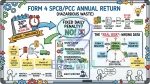
Late Filing Penalty for Form 4 SPCB: What Happens If You Miss the 30 June Deadline?
 Guide for Indian Factories EHSShala by EHSSaral.webp)
Ambient Air Quality Monitoring (AAQM) Guide for Indian Factories | EHSShala

EHSShala Consent - SPCB Consent System Explained| EHSShala
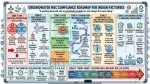
Groundwater NOC for Factories in India: CGWA Guidelines, State Rules and Borewell Compliance