
Blog
BRSR Core 2026: Why Compliance Automation Is Now Mandatory | EHSSaral
EHSSaral is an Environmental Compliance Intelligence Platform for Industries. Consent Intelligence • Alerts & Tasks • Incident Reporting • Form IV & V • Audit-Ready Records
See how EHSSaral works
16 Jul 2026
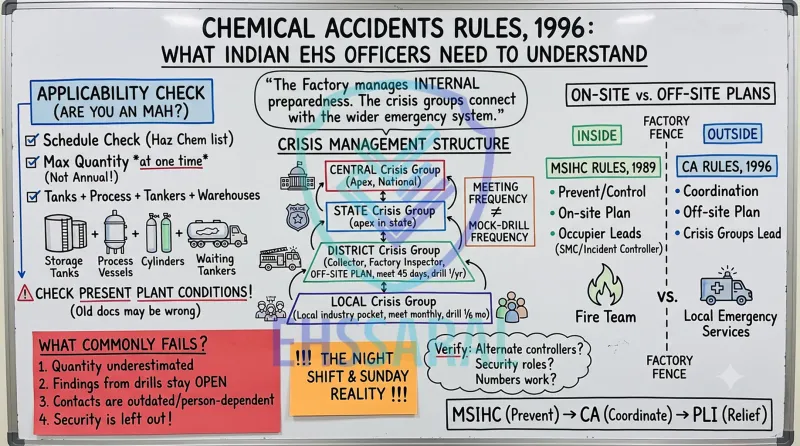
The Chemical Accidents Rules, 1996 create a four-level crisis-management system in India through Central, State, District and Local Crisis Groups. They support chemical accident prevention, off-site emergency planning, public information, coordination and mock drills. Factories handling hazardous chemicals must assess MAH applicability, maintain correct chemical information and support district and local emergency planning.
The Chemical Accidents Rules are often misunderstood.
Some EHS officers treat them as another emergency-plan requirement. Others assume that they apply only to very large chemical factories.
Both views are incomplete.
The Chemical Accidents (Emergency Planning, Preparedness and Response) Rules, 1996 create a system for preventing, preparing for and coordinating the response to major chemical accidents.
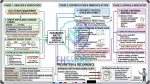
This system operates at four levels:
For an EHS officer, the basic understanding should be:
“The factory manages its internal preparedness. The crisis groups connect the factory with the wider emergency system.”
This article explains the law, its applicability and the factory’s role in the crisis-management structure.
It does not explain detailed actions during an actual gas leak, chemical fire, spill or explosion. Those actions should be covered separately under emergency-response guidance for Chemical Accident Emergency.
Read more Our Environmental laws in India by EHSShala
A major chemical accident may not remain inside one factory.
Toxic gas may move towards nearby areas. Smoke may affect surrounding industries. Contaminated firefighting water may enter an external drain. A chemical tanker accident may affect a public road.
The factory can manage its own:
However, a factory cannot independently manage:
The Chemical Accidents Rules were introduced to create this wider planning and coordination system.
They were notified under the Environment (Protection) Act, 1986 through G.S.R. 347(E) dated 1 August 1996. The Rules state that they come into force on the date of publication in the Official Gazette.
The Rules establish four levels of crisis-management groups:
Together, these groups support:
These groups do not replace the factory’s emergency organisation.
The factory must still understand its risks, maintain its on-site emergency arrangements and provide correct information to the concerned authorities.
The Rules define a chemical accident as a sudden, unintended occurrence involving one or more hazardous chemicals during industrial activity, handling, storage or transportation.
Such an event may lead to:
It may involve a major emission, fire or explosion.
In practical terms, this may include:
Not every minor spill becomes a major chemical accident.
The chemical properties, quantity released, likely impact and possibility of consequences outside the factory must be considered.
Read more about Ozone-Depleting Substances Rules, 2000 - A Practical Guide for Industries
The Rules are especially relevant to factories that manufacture, process, handle or store hazardous chemicals.
Typical examples include units having:
However, every factory using chemicals is not automatically a Major Accident Hazard installation, commonly called an MAH installation.
This distinction is important.
No.
A factory may handle hazardous chemicals without crossing the threshold applicable to an MAH installation.
The assessment depends on:
The Rules contain schedules covering hazardous chemicals, specified industrial activities and threshold quantities.
An EHS officer should not check only annual chemical consumption.
The assessment should consider the maximum quantity that can be present at one time.
This may include:
A factory may consume a chemical slowly throughout the year but receive it in large batches.
Annual consumption and maximum storage are different figures.
“Applicability is generally checked against the maximum quantity present, not only the quantity consumed during the year.”
A detailed MAH applicability assessment should be completed chemical by chemical against the relevant schedules under the Chemical Accidents Rules and the MSIHC Rules.
An MAH installation is generally an industrial installation where specified hazardous chemicals are present at or above the applicable threshold quantities.
The exact assessment must be based on the relevant schedules.
Do not decide MAH applicability only because:
The chemical risk remains connected to the site even when internal responsibility is divided between production, maintenance, stores and EHS.
A practical assessment should include:
| Check | Question to Ask |
|---|---|
| Chemical identity | What is the exact chemical name? |
| Concentration | Is it pure, diluted or part of a mixture? |
| Maximum quantity | What is the highest possible quantity present at one time? |
| Storage locations | Is it stored in more than one area? |
| Process quantity | How much is present inside vessels and pipelines? |
| Tanker quantity | Can loaded tankers remain inside the premises? |
| Applicable threshold | Which schedule and quantity apply? |
| Plant changes | Has storage or process capacity increased? |
Do not rely only on the quantity mentioned in an old emergency plan.
Verify the present plant conditions.
This is one of the most common areas of confusion.
The Manufacture, Storage and Import of Hazardous Chemicals Rules, 1989, commonly called the MSIHC Rules, focus mainly on hazardous installations and the responsibilities of occupiers.
The Chemical Accidents Rules, 1996 establish the wider crisis-management structure around those installations.
Both are part of the Environment (Protection) Act framework. India Code lists both Rules under that Act.
| Area | MSIHC Rules, 1989 | Chemical Accidents Rules, 1996 |
|---|---|---|
| Main focus | Safe manufacture, storage and handling of hazardous chemicals | Wider emergency planning and coordination |
| Main factory connection | Hazard identification, safety information and on-site preparedness | Support to District and Local Crisis Groups |
| Main responsible parties | Occupier and identified authorities | Central, State, District and Local Crisis Groups |
| On-site emergency planning | Important occupier responsibility | Connected with the wider crisis system |
| Off-site planning | Factory provides risk and installation information | District and Local groups coordinate wider plans |
| Public preparedness | Information about possible effects and safety measures | Crisis groups support public awareness and information |
| Practical purpose | Prevent and control risks at the installation | Coordinate response beyond one installation |
A simple way to remember the difference is:
“The MSIHC Rules look closely at the hazardous installation. The Chemical Accidents Rules connect that installation with the wider emergency system.”
Factories should not treat these laws as competing requirements.
They work together.
The Rules require the Central Government to establish a Crisis Alert System.
This is the information and communication arrangement supporting chemical accident management across the country.
The Crisis Alert System includes:
The purpose is to ensure that important information can move between the Central, State and District levels during a chemical emergency.
For a factory EHS officer, the practical lesson is:
“Correct information must be ready before an accident. It cannot be collected properly during the emergency.”
The factory should therefore keep the following information current:
The factory does not control the crisis groups.
However, covered installations are expected to support them with correct information, participation and resources.
The Central Crisis Group operates at the national level.
Its broad functions include:
The Central Crisis Group must meet at least once every six months. Its prescribed composition was amended in 2015.
For a factory EHS officer, direct interaction with this group may be limited.
However, it is important to understand that chemical accident planning has a national coordination structure.
The State Crisis Group operates at State level and is chaired by the Chief Secretary.
Its work includes:
The State Crisis Group must meet at least once every three months.
The District Crisis Group is highly relevant to factories.
It operates under the district administration and is chaired by the District Collector. The prescribed composition includes the Inspector of Factories as the Member Secretary.
Its functions include:
The District Crisis Group must meet once every 45 days.
The factory should be ready to participate and provide the required technical and operational support.
The Local Crisis Group works closer to an industrial area where MAH installations are located.
It connects:
Its functions include:
The Local Crisis Group must meet at least once every month.
MAH installations in the industrial pocket are required to aid, assist and facilitate the functioning of the Local Crisis Group.
This means the factory should not remain passive.
This difference is easy to miss.
| Crisis Group | Minimum Meeting Frequency | Full-Scale Mock-Drill Requirement |
|---|---|---|
| Central Crisis Group | At least once every six months | Not prescribed as a site drill responsibility |
| State Crisis Group | At least once every three months | Reviews district preparedness and reports |
| District Crisis Group | Once every 45 days | At least once every year at a site |
| Local Crisis Group | At least once every month | At least once every six months at a site |
A meeting and a mock drill serve different purposes.
A crisis-group meeting may review:
A mock drill physically tests whether the planned arrangements work.
“Attending a crisis-group meeting does not mean the required mock drill has been completed.”
Both records should therefore be maintained separately.
The Chemical Accidents Rules mainly establish the crisis-management structure.
However, that structure cannot work without accurate information from factories.
Depending on the installation and local requirements, the factory may need to maintain and share:
The information should match actual plant conditions.
An old document showing outdated tank capacity, old contact numbers or removed equipment can weaken the complete emergency plan.
The two plans cover different areas.
The on-site emergency plan covers actions inside the factory premises.
It normally addresses:
The occupier’s on-site emergency-planning duties arise mainly through the MSIHC Rules and applicable factory-safety requirements.
The on-site emergency plan should clearly identify roles such as:
The exact designations may differ between factories.
The Site Main Controller is commonly a senior authorised person who takes wider control of the emergency. The Incident Controller normally manages actions close to the accident location.
The EHS officer generally supports:
The EHS officer should not become the only person who knows how to activate the emergency plan.
The system must continue to work during leave, travel, weekly off and night shift.
The off-site emergency plan covers consequences outside the factory boundary.
It may involve:
The District Crisis Group plays an important role in preparing the district off-site emergency plan.
The Local Crisis Group prepares the local emergency plan and supports its connection with the district plan.
The factory supports this work by providing correct technical and site information.
“The factory prepares for what happens inside. The district prepares for what may happen outside.”
The individual factory should not claim that it has independently prepared the complete district off-site emergency plan.
Its role is to provide accurate information and support the planning process.
The Rules place full-scale mock-drill responsibilities on the District and Local Crisis Groups.
| Crisis Group | Full-Scale Mock-Drill Requirement |
|---|---|
| District Crisis Group | At least once every year at a site |
| Local Crisis Group | At least once every six months at a site |
These are crisis-group duties under the Rules.
This does not mean that the factory should wait silently for an outside authority to organise everything.
An MAH installation should be ready to:
Internal factory drills may also be required under the on-site emergency plan and applicable factory requirements.
The legal source and purpose of each drill should be understood correctly.
Factories may also conduct internal tabletop exercises.
In a tabletop exercise, the responsible team discusses a possible accident step by step.
This can help test:
A tabletop exercise is useful, but it does not replace a required full-scale mock drill.
Public information is part of the crisis-management system.
The Central and State Crisis Groups are required to provide information on request regarding chemical accident prevention, preparedness and mitigation.
At local level, the Local Crisis Group must:
The purpose is not to create fear.
The purpose is to prevent confusion during an actual emergency.
Information for nearby people may include:
The information should be:
A factory should avoid issuing public instructions that conflict with the district or local emergency plan.
The exact records depend on the installation.
The following list is useful for factories handling significant hazardous chemicals:
| Record | What to Verify |
|---|---|
| Hazardous chemical inventory | Matches actual chemicals and quantities |
| Maximum quantity assessment | Covers storage, process and temporary locations |
| Threshold assessment | Checked against applicable schedules |
| Safety Data Sheets | Current and accessible |
| Site layout | Reflects current tanks, plants, gates and drains |
| On-site emergency plan | Updated after plant changes |
| Major accident scenarios | Based on actual chemical risks |
| Emergency organisation chart | Current names and roles |
| External contact list | Numbers verified periodically |
| Emergency equipment list | Equipment exists and remains usable |
| Crisis-group meeting records | Dates, attendance and key decisions retained |
| Mock-drill reports | Scenario, observations and participation recorded |
| Corrective-action register | Findings closed with evidence |
| Mutual-aid information | Resources and contacts are current |
| Communication with authorities | Letters, submissions and meeting records retained |
| Crisis-group participation | Meeting and drill records available |
| Change-management records | New chemicals and capacity changes assessed |
| Public information records | Material shared through the agreed system |
Keep one common folder for these records.
Do not scatter the information across production, safety, maintenance, stores and security departments.
The following gaps are commonly seen in hazardous chemical preparedness.
Only the main storage tank is considered.
Material inside day tanks, process vessels, cylinders, warehouse stock and tankers is missed.
The original assessment may be several years old.
Since then, the factory may have added:
The consent, factory records, emergency plan, insurance documents and chemical inventory may show different capacities.
A difference does not always mean non-compliance.
But the reason must be understood and recorded.
The EHS team maintains the on-site plan but does not know:
Only one senior employee knows the concerned officials or meeting process.
When that person leaves, the connection is lost.
The same communication, equipment or access problem appears in several drill reports.
A drill report without corrective-action closure gives little practical value.
Security may be the first department to receive an outside call or guide an emergency vehicle.
But security personnel may not know:
Many emergency plans depend heavily on the Plant Head, EHS manager or senior maintenance team.
During a night shift, Sunday or public holiday, these persons may not be present.
The factory should verify:
An emergency arrangement is not complete if it works only when the full management team is present.
During an inspection or emergency-preparedness review, the EHS officer should be able to explain:
Do not begin by opening a 300-page emergency-plan file.
Start with a clear summary.
A one-page chemical and emergency profile can help:
| Area | Summary |
|---|---|
| Major hazardous chemicals | Name and maximum quantity |
| MAH status | Applicable or not applicable, with basis |
| Main accident scenarios | Short description |
| On-site plan | Revision number and date |
| District or local coordination | Latest known status |
| Last crisis-group meeting | Date and main action points |
| Last mock drill | Date and scenario |
| Open findings | Number and present status |
| Main contact person | Name and alternate |
Most officers respond better to clarity than to a pile of unorganised documents.
Use this checklist to keep the legal position current.
| Monthly Check | Status |
|---|---|
| Actual chemical inventory has been verified | Yes / No |
| Maximum quantities have been checked | Yes / No |
| No new hazardous chemical was added without review | Yes / No |
| Storage-capacity changes were assessed | Yes / No |
| MAH applicability remains valid | Yes / No |
| Safety Data Sheets are current | Yes / No |
| Site layout reflects present plant conditions | Yes / No |
| Emergency contact details are current | Yes / No |
| Crisis-group communication records are available | Yes / No |
| Meeting and mock-drill records are maintained separately | Yes / No |
| Mock-drill findings are being closed | Yes / No |
| Mutual-aid details are current | Yes / No |
| On-site emergency plan reflects recent changes | Yes / No |
| Night-shift responsibilities are clearly assigned | Yes / No |
| Relevant documents are stored in one folder | Yes / No |
This review does not need to become a large monthly exercise.
The purpose is to identify changes before the legal and emergency documents become outdated.
The Public Liability Insurance Act, 1991 has a different purpose.
It provides a framework for insurance and immediate relief to persons affected by an accident involving hazardous substances.
A simple way to understand the connection is:
These requirements are connected, but compliance with one does not automatically complete the others.
The Chemical Accidents Rules do not replace:
A factory may need to comply with several requirements because the same chemical can create:
One approval should not be treated as proof of compliance with every other requirement.
The Chemical Accidents Rules are not mainly about preparing another file.
They create a working connection between hazardous installations and the wider emergency system.
For a factory, good compliance means:
Most problems begin with small mismatches.
A tank capacity changes, but the emergency plan does not.
A contact person changes, but the list remains old.
A drill identifies a gap, but nobody closes it.
A plan names only one responsible person, but that person is unavailable.
“Chemical accident preparedness depends on correct information before it depends on emergency action.”
Good compliance does not need panic.
It needs clear responsibility, current records and regular review.
The Rules establish Central, State, District and Local Crisis Groups for chemical accident prevention, preparedness, emergency planning and coordinated response.
No. Applicability depends on the chemical, hazardous properties, industrial activity, maximum quantity present and the applicable threshold schedules.
An MAH installation is generally an industrial installation where specified hazardous chemicals are present at or above applicable threshold quantities.
The MSIHC Rules focus mainly on hazardous installations and occupier responsibilities. The Chemical Accidents Rules create the wider crisis-management and off-site coordination system.
The District Crisis Group plays the main role in preparing the district off-site emergency plan. The factory provides technical information and supports the planning process.
The Local Crisis Group must conduct at least one full-scale mock drill at a site every six months.
The District Crisis Group must conduct at least one full-scale mock drill at a site every year.
No. Meetings review preparedness and coordination. Mock drills physically test whether the emergency arrangements work.
Important records include the chemical inventory, maximum quantity assessment, MAH assessment, Safety Data Sheets, emergency plan, site layout, crisis-group records, mock-drill reports and corrective-action evidence.

Founder, EHSSaral
Founder - EHSSaral | Partner - Perfect Pollucon | ISO 14001 Lead Auditor | GHG Protocol Scope 2 | Chemist | Data Scientist | Second-generation environmental professional simplifying EHS compliance for Indian industries through practical, automated, tech-enabled, data driven compliance workflows.
BRSR Core 2026: Why Compliance Automation Is Now Mandatory | EHSSaral
Environmental Compliance KPIs for Manufacturing in India
MPCB CTO Refusal Patterns in Maharashtra (2023–2025) Analysis | EHSSaral Research
 Practical Guide for Indian Factories EHSShala.webp)
Hazardous Waste Management Rules in India: Forms, Storage & Compliance

Transforming SME Compliance: Zero Surprise Failures in India | EHSSaral Research

Environmental Compliance vs Environmental Accounting in India
Hazardous Waste Stored Beyond 90 Days: What to Do

Chemical Accident Emergency Response Guide for Indian Factories | EHSShala
 List, Rules & Compliance Guide ehssaral.webp)
Orange Category Industries in India (2026): List, Rules & Compliance Guide

Sampling Basics for Air, Water & Noise EHS Officer Guide | EHSShala