
Blog
Best Environmental Compliance Software in India (2026): A Practical SME Comparison | EHSSaral
EHSSaral is an Environmental Compliance Intelligence Platform for Industries. Consent Intelligence • Alerts & Tasks • Incident Reporting • Form IV & V • Audit-Ready Records
See how EHSSaral works
27 Apr 2026
 EHSSaral.webp)
A very common situation in factories goes like this.
Monitoring is completed.
Report comes from the lab.
Values are within limits.
Everyone relaxes.
Files are kept properly.
Compliance looks “under control.”
Then suddenly - a query comes.
Sometimes during inspection.
Sometimes during consent renewal.
Sometimes because of OCEMS data.
And the same question comes from management:
“Report toh within limit hai… phir problem kya hai?”
This is where most confusion starts.
Because in environmental monitoring, there are two different realities:
Monitoring done
Monitoring understood
And most factories operate only in the first.
Ground reality:
“Most problems don’t start when limits are crossed.
They start when data stops making sense.”
Monitoring mistakes are not like equipment breakdowns.
They don’t make noise.
They don’t stop production.
They don’t show immediate impact.
That is why they stay hidden for long time.
Reports come on time
Values are within limits
No complaints from outside
From outside, everything looks fine.
Even internally, nobody feels there is an issue.
This creates a false sense of confidence.
These same mistakes come out only in certain situations:
During inspection
During consent renewal
When OCEMS data does not match
When audit becomes more detailed
At that point, questions start coming.
And answers are not ready.
We have covered inspection expectations in detail in our environmental inspection guide
This is where most EHS officers feel pressure.
Data is there, but explanation is missing
Team starts blaming lab or consultant
Old reports cannot be justified
This is not because someone did something wrong.
It is usually because:
“System was not built to understand the data.”
These are not rare cases.
These are patterns seen again and again across different industries.
This is one of the most common mistakes.
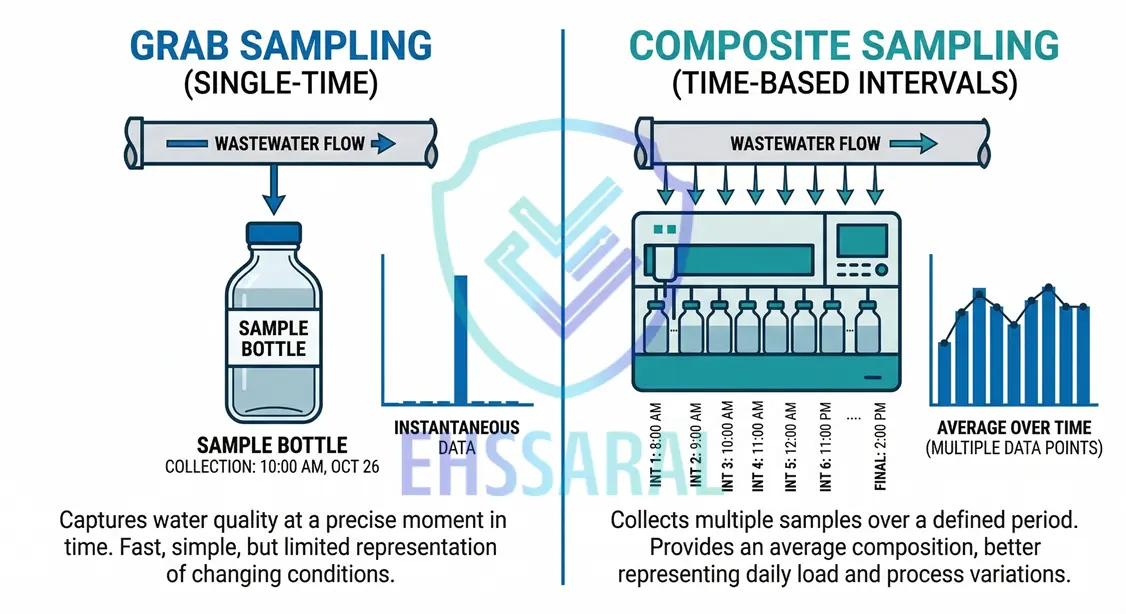
Many times, effluent samples are taken as grab samples
while consent requires composite sampling.
On paper, both look like “samples.”
But practically, they are very different.
Grab sample = one-time snapshot
Composite sample = average over time
When wrong method is used:
Data does not represent actual discharge
Trends become misleading
Questions arise during audit
In many cases, this mistake continues for months
because nobody checks the method, only the result.
This happens very often.
Sample is taken from:
Easy access point
Before treatment
Somewhere inside plant
Instead of actual discharge point.
Reason is simple:
“Wahan se sample lena easy hai.”
But during inspection, first question is:
“Yeh final discharge point hai?”
If answer is not clear, whole monitoring becomes questionable.
Monitoring data alone is not enough.
It must connect with:
Production data
Water consumption
Flow measurements
But in many factories:
Monitoring report exists
But no supporting records
So when question comes:
“Yeh value kaise aaya?”
There is no answer.
Data looks isolated.
This is very common.
Lab comes → sampling done → report submitted → file closed.
No internal review.
No questions asked.
In many cases:
Plant team is not present during sampling
Location not verified
Conditions not noted
Lab does their job.
But responsibility of correctness still stays with factory.
OCEMS is installed in many plants now.
But ground reality:
System runs
Data goes somewhere
Nobody checks daily
Only when query comes, dashboard is opened.
By that time:
Gaps already exist
Trends already inconsistent
OCEMS is treated like equipment, not like a monitoring tool.
This gap is explained in detail in our guide on manual vs OCEMS monitoring
Plants do not operate the same every day.
Load changes
Raw material changes
Shutdowns happen
But monitoring is usually done:
On stable days
Under controlled conditions
So reports always look “good.”
But they do not represent actual plant behaviour.
This is a silent red flag.
PM always same
BOD always same
Noise almost identical
It may look like good control.
But practically:
“No process is that stable.”
Repeated values raise questions during inspection.
Monitoring equipment needs regular attention.
But often:
Calibration is delayed
Instruments drift
Sensors give incorrect readings
And still data is trusted.
This is not visible immediately.
But over time, accuracy is lost.
Monitoring becomes a “deadline activity.”
Date comes → lab called
Sampling done → report submitted
No tracking in between.
No understanding of trends.
So compliance exists only on paper.
Noise monitoring is often neglected.
Common issues:
Measured inside boundary instead of at boundary
Only daytime monitoring done
Night data missing
Because noise is not seen as “critical,”
it gets less attention.
But during audit, it is still checked.
This is a simple but serious gap.
Sample collected
But no proper record of:
Date
Time
Person
Handling
If traceability is missing:
Data becomes difficult to defend
Lab results can be questioned
Ground reality:
“Most mistakes are not technical failures.
They are small gaps that were never checked.”
When an inspector visits, they don’t start by assuming you are wrong.
They start by trying to understand your system.
But if things don’t connect… questions start.
This is usually the first check.
Inspector will try to connect:
Emissions vs fuel usage
Effluent vs water consumption
Production vs pollution load
If your plant is running high production
but emissions look unusually low,
it raises a question.
Not because values are high or low.
But because:
“Do these numbers logically match?”
This is one of the most common gaps.
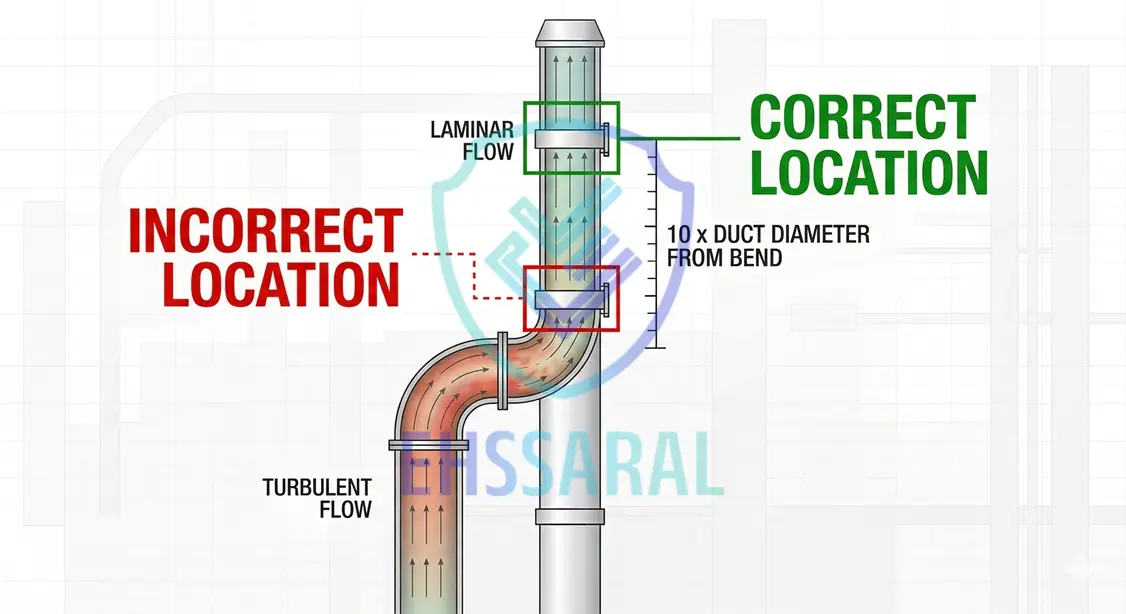
Inspector may physically check:
Stack sampling port
Effluent discharge point
Ambient air monitoring location
Noise monitoring boundary
And then compare with your report.
Typical questions:
“Yeh sampling yahin se liya tha?”
“Final discharge point kaunsa hai?”
If location is unclear or incorrect,
then even a good report loses value.
Inspectors don’t always need complex formulas.
Simple logic is enough.
They may check:
Flow vs sample volume
Sampling duration vs actual timing
Velocity vs stack size
If numbers don’t align,
it indicates:
“Data may not be reliable.”
One report is rarely the issue.
Trend is what matters.
Inspector may look at:
Last 6 months data
Repeated values
Sudden drop or improvement
If values are:
Too consistent
Too perfect
Suddenly improved
it raises doubt.
Because real systems fluctuate.
This is where many factories struggle.
Inspector may ask for:
Logbooks
Flow records
Calibration certificates
Sampling photos
If reports exist
but supporting records don’t,
then explanation becomes weak.
Ground reality:
“Inspectors don’t just check reports.
They check whether your system makes sense.”
These are not isolated incidents.
These are patterns seen again and again across different plants.
Sampling done from incorrect port
Velocity calculations not matching actual conditions
Emission values not aligning with fuel consumption
Sometimes reports look fine.
But when connected with plant data,
they don’t add up.
Sample not taken from final discharge
No linkage with flow data
Stable values despite process variation
In many cases:
Effluent data looks “perfect”
but system behind it is unclear.
Monitoring location not in downwind direction
Short duration sampling instead of required duration
This leads to:
Under-representation of actual conditions
Questions during inspection
Measurement taken inside plant boundary
No night monitoring data
Because of this:
Actual exposure is not captured
Compliance becomes questionable
Waste classified without proper testing
Samples not representative of actual waste
This creates confusion later:
During disposal
During audit
During documentation checks
Important line:
“Most issues are not violations.
They are validation problems.”
Before a problem becomes visible,
there are always signals.
Most of the time, they are ignored.
Check these honestly.
You cannot clearly explain last month’s values
Same numbers are repeating every month
OCEMS dashboard is not checked regularly
Lab submits reports without asking any questions
Sampling locations are not documented properly
Data does not match across reports and plant records
Monitoring happens only near due dates
If you relate to 2–3 of these, it is manageable.
If you relate to most of them:
System needs attention.
These problems are not because people don’t care.
They happen because systems are not designed properly.
Consent conditions not fully understood
Technical terms not clear to field team
Many times:
People follow process
without fully understanding purpose.
Understanding consent conditions properly is the first step in avoiding monitoring mistakes.
No clear monitoring plan
No cross-check system
No internal review
Everything depends on:
Lab
Consultant
But no internal control exists.
Monitoring done close to deadline
Sampling rushed
Reports submitted without review
This creates habit:
“Just complete and submit.”
Responsibility unclear
Over-dependence on consultant
When something goes wrong:
Blame starts moving.
Field team and office team not aligned
New EHS officer not aware of past practices
Consultant changes, context lost
Information does not flow properly.
Ground reality:
“Most monitoring mistakes are not due to negligence.
They are due to missing systems.”
You don’t need complex software or heavy processes.
On most sites, a few basic practices can solve majority of issues.
Start with one simple question:
“What exactly are we supposed to monitor?”
Take your consent document and extract:
Parameter (PM, SO₂, BOD, Noise, etc.)
Location (stack, discharge point, boundary, etc.)
Frequency (monthly, quarterly, etc.)
Method (grab / composite / duration)
Put this in one simple sheet.
This becomes your base.
Without this, monitoring becomes guesswork.
Keep one central tracker.
It can be Excel. No need to overcomplicate.
Include:
Last monitoring date
Next due date
Status (done / pending)
Report received or not
This avoids:
Last-minute panic
Missed timelines
Monitoring data alone is not enough.
Start connecting:
Production vs emissions
Water consumption vs effluent
Fuel usage vs stack parameters
Even basic comparison gives clarity.
If numbers don’t align,
you catch it early - not during inspection.
You don’t need deep analysis every day.
Just a quick look:
Is data coming?
Any gaps?
Any unusual spike?
This small habit prevents:
Long data gaps
Sensor issues going unnoticed
Before filing any report, pause for 5 minutes.
Check:
Units
Unusual values
Comparison with previous data
Ask one question:
“Does this make sense?”
This one habit avoids many future questions.
Maintain one simple folder (digital or physical):
Monitoring reports
Calibration certificates
Logbooks
Supporting records
When everything is in one place:
Retrieval becomes easy
Confidence increases during inspection
Before sampling:
Location confirmed
Equipment ready
Method clear
Time recorded
After sampling:
Logbook filled
Details recorded
This reduces dependency on memory.
Ground reality:
“Good monitoring does not need complex systems.
It needs simple systems used regularly.”
Most people think monitoring needs a lot of time.
It doesn’t.
Even 10–15 minutes spread across the week is enough.
What to do:
Check if data is flowing
Look for gaps or spikes
Why:
Early detection of issues
What to do:
Compare recent data with previous values
Check if anything looks unusual
Why:
Catch inconsistencies before reports come
What to do:
Review checklist
Confirm location and method
Why:
Avoid basic mistakes
What to do:
Quick review before filing
Compare with past data
Why:
Ensure data is explainable
This routine is simple.
But if followed regularly,
it builds strong control.
This is a situation many people face.
And this is where most panic happens.
Let’s keep it simple.
If you feel something is off:
Review your own data
Identify gaps
Note what needs correction
Start fixing internally.
Even small corrections help.
First step: don’t panic.
Second step: don’t immediately blame lab or consultant.
Instead:
Understand the issue
Explain clearly
Show what you are correcting
Inspectors usually respond better to clarity
than to defensive replies.
Ground reality:
“Clear explanation works better than perfect excuses.”
You don’t need perfection.
But a good system has some clear signs:
Data matches plant operations
Team understands basic numbers
Reports are explainable
No last-minute panic
When this happens:
Inspections become smoother
Confidence improves
Work pressure reduces
Monitoring is not about collecting data.
It is about understanding your plant.
Most factories don’t struggle because pollution is high.
They struggle because:
“They cannot explain their data when it matters.”
If you fix that one thing,
most monitoring problems automatically reduce.
Wrong sampling method or location. Data may look correct but not represent actual conditions.
By comparing monitoring data with plant operations like production, fuel use, and flow records.
No. Reports must match plant data and proper sampling practices.
A quick daily check (2–5 minutes) helps identify gaps and unusual trends early.

Founder, EHSSaral
Founder - EHSSaral | Partner - Perfect Pollucon | ISO 14001 Lead Auditor | GHG Protocol Scope 2 | Chemist | Data Scientist | Second-generation environmental professional simplifying EHS compliance for Indian industries through practical, automated, tech-enabled, data driven compliance workflows.
Best Environmental Compliance Software in India (2026): A Practical SME Comparison | EHSSaral

Managing Safety Without Authority: Handling Protected Contractors in Indian Plants | EHSSaral

Consent Conditions Explained: What Factories Must Actually Follow After Approval | EHSShala
CPCB OCEMS Flatline Notice: How Industries Should Respond (Safely) | EHSSaral
Environmental Compliance for Pharmaceutical Manufacturing in India | EHSSaral
 ehssaral.webp)
4-Stream Waste Segregation for Factories (SWM 2026) | EHSSaral
MPCB Consent Explained - Lessons from 25 Years of Environmental Compliance | EHSSaral
Environmental Consultancy Software: Beyond Excel & WhatsApp
Environmental Incident Response Guide for Indian EHS Professionals | EHSShala

Form 4 vs Form 5: Why Hazardous Waste Numbers Don't Match