

EHSShala
EHSShala Start – Begin Your EHS Learning Journey in India
EHSSaral is an Environmental Compliance Intelligence Platform for Industries. Consent Intelligence • Alerts & Tasks • Incident Reporting • Form IV & V • Audit-Ready Records
See how EHSSaral works
19 Feb 2026
Walk into most Indian factories and ask one simple question:
“Are you compliant with your Consent to Operate?”
In most cases, the answer will be confident.
“Yes, sir. All parameters within limit.”
But over the years, across textile units in Maharashtra, pharma plants in Gujarat, engineering units in Tamil Nadu, and food processing facilities in North India, one pattern has remained constant:
Most compliance friction does not begin with emission exceedance.
It begins with interpretation.
A single line in the consent.
Read one way internally.
Understood differently during inspection.
This article is not about violation.
It is about misinterpretation - and how to prevent it.
Consent conditions issued by State Pollution Control Boards (SPCBs) are legally valid documents. But they are not operational manuals. They are written in formal language, often broad, sometimes template-based, and always assumption-heavy.
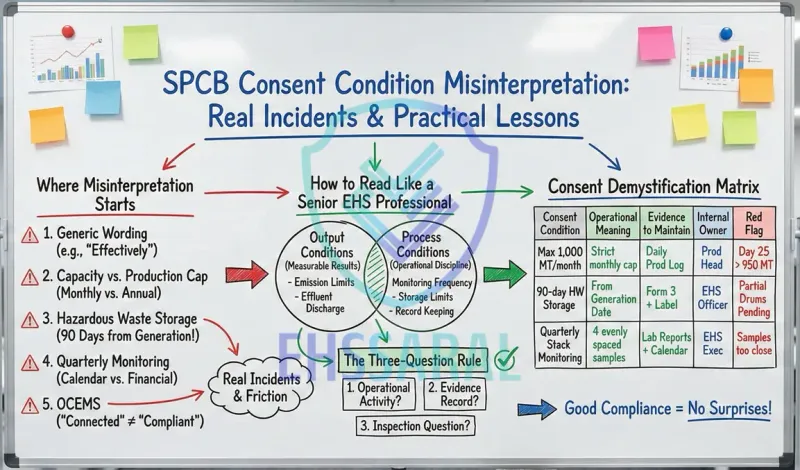
In day-to-day operations, confusion typically starts in five recurring areas.
Example consent line:
“The unit shall operate the ETP effectively at all times.”
Inside the plant, this is often interpreted as:
Lab results are within limits
Pump is running
Logbook entries are maintained
But during inspection, the focus may shift.
Regulator logic:
“Effective operation” means the ETP runs whenever effluent is generated - not only when sampling is scheduled.
If production runs 12 hours but ETP power consumption reflects 6 hours, questions arise.
If sludge generation is unusually low compared to chemical dosing, questions arise.
The word “effectively” is simple.
Its operational meaning is not.
Consent line example:
“Production shall not exceed 1,000 MT/month.”
In practice, units interpret this in different ways:
Average monthly production across the year
Installed capacity allows temporary excess
Annual output matters more than monthly figure
But most SPCBs interpret this strictly.
Regulator logic:
The cap applies to each individual calendar month unless otherwise specified.
If a unit produces 1,150 MT in March and 850 MT in April, internal logic may say “average is fine.”
Inspection logic may say “March exceeded consent limit.”
This difference in interpretation has triggered multiple show-cause notices during renewals.
Consent condition:
“Hazardous waste shall not be stored beyond 90 days.”
This appears straightforward.
But in many plants, counting begins from:
Invoice date
Manifest date
Date of transporter booking
Instead of:
Date of actual generation
Partial drum situations complicate this further. A drum may be 70% full for 60 days, then filled completely later. If tracking is weak, the first generation date is forgotten.
Regulator logic:
The 90-day period starts from the date waste is generated, not dispatched.
During inspections, officers often check yard markings, Form 3 entries, and physical drum labels to verify timelines.
This is one of the most common friction points across industries.
Read 90-day hazardous waste storage rule
Consent often states:
“Stack monitoring shall be carried out quarterly.”
The word “quarterly” seems harmless.
But confusion appears quickly.
One unit sampled on 20 December and again on 15 March, assuming financial quarters.
From their perspective:
Q3 done
Q4 done
But the inspector pointed out that the gap between samples was less than 90 days, effectively leaving one calendar quarter without coverage.
Regulator logic:
Quarterly means four reasonably spaced samples across a year - not clustered sampling.
Five days of delay is rarely the issue.
Structural clustering is.
When internal calendars are not clearly defined, interpretation gaps become visible.
Read our Stack Monitoring Basics Guide
Consent condition:
“Online monitoring data shall be connected to SPCB server.”
Inside the plant, management often checks the vendor dashboard. It shows “connected.” Graphs are visible. Everything appears normal.
But there is a second layer.
Network packet drops
Flatline readings
Calibration gaps
Data inconsistencies
Sometimes the data reaching the SPCB backend differs from what the local screen shows.
In recent years, officers increasingly apply basic mass balance logic.
If:
Boiler fuel consumption is high
Production volume is high
But emission values remain unnaturally constant
Questions arise.
Not because someone assumes wrongdoing.
But because data must make sense operationally.
CPCB OCEMS Flatline Notice - How to draft Respond
Most misinterpretations reduce dramatically when one mental shift happens.
Separate consent conditions into two buckets:
These define measurable results.
Examples:
Emission limits (mg/Nm³)
Effluent discharge limits
Noise standards
These are lab-report-driven.
These define operational discipline.
Examples:
Monitoring frequency
Storage limits
Operating requirements
Record-keeping obligations
Online data connectivity
In many inspections, friction arises more from process conditions than output exceedance.
Understanding this distinction changes preparation strategy entirely.
Consent to Operate compliance guide
For every line in your consent, ask three simple questions:
What operational activity does this require?
What record proves compliance?
What inspection question could arise from this?
For example:
Consent line:
“Hazardous waste shall not be stored beyond 90 days.”
Operational activity:
Maintain date-wise generation tracking.
Record required:
Form 3 register
Yard tagging system
Possible inspection question:
Show oldest drum and generation entry.
This small discipline converts passive reading into active compliance management.
Most plants read consent once during renewal.
Very few translate it into an operational matrix.
That gap is where misunderstanding grows.
Over the years, we have seen that once the “three-question rule” is applied properly, consent documents stop feeling intimidating.
They start feeling manageable.
The next step is converting interpretation into a simple internal system.
Instead of keeping consent as a PDF stored in a folder, convert it into a working sheet.
A simple five-column internal matrix can prevent most interpretation errors.
| Consent Condition | What It Means Operationally | Evidence to Maintain | Internal Owner | Early Warning Sign |
|---|---|---|---|---|
| Max 1,000 MT/month | Strict calendar month cap | Daily production log | Production Head | Day 25 crosses 950 MT |
| 90-day HW storage | 90 days from generation date | Form 3 + yard label | EHS Officer | Partial drums pending |
| Quarterly stack monitoring | Four evenly spaced samples | Lab reports + calendar | EHS Executive | Two samples too close |
| Operate ETP effectively | ETP runs whenever effluent generated | Power logs + dosing record | Utility Head | ETP run hours < production hours |
This matrix does three important things:
Converts vague language into operational clarity
Assigns responsibility
Creates early warning triggers
Most compliance breakdowns are not dramatic events.
They are small drifts that go unnoticed.
The matrix makes drift visible.
The following are recurring patterns observed across industries. These are not rare cases. They are common operational misunderstandings.
A manufacturing unit had a consent limit of 1,000 MT per month.
In March, due to year-end orders, production reached 1,150 MT.
April dropped to 850 MT.
Internally, management believed the annual average was compliant.
During renewal review, monthly data was examined.
March was flagged as exceedance.
The issue was not emission-related.
It was interpretation-related.
Regulator logic:
Consent cap applies month-wise unless specifically stated otherwise.
Correction involved:
Internal production planning control
Automated alert when production approaches 90% of cap
The cost was not penalty.
The cost was avoidable friction.
A plant stored used oil in drums. Generation was gradual.
A drum started filling in January and was dispatched in April.
The team calculated 90 days from dispatch booking date.
Inspection calculation counted from first generation entry in January.
Result: Storage exceeded 90 days.
No malicious intent.
Only counting logic difference.
Regulator logic:
Storage clock starts from date of generation.
Correction involved:
Drum-wise tagging with start date
Weekly aging review of hazardous waste yard
Simple system. Big difference.
Effluent parameters were always within limit.
However, production ran two shifts.
During inspection, officers compared:
Production records
ETP power consumption
Sludge generation
They noticed ETP run hours appeared significantly lower than production hours.
Lab reports were clean.
But process consistency raised questions.
Regulator logic:
ETP must operate whenever effluent is generated. Data must align logically.
Correction involved:
Synchronizing ETP log with production shifts
Installing hour meters
Cross-checking sludge generation ratios
This is where “mass balance thinking” becomes important.
Compliance is not only about results.
It is about operational coherence.
A unit conducted stack sampling in:
20 December
15 March
25 March
Internally, the assumption was:
“We have done quarterly monitoring.”
But two samples were taken within 10 days.
One calendar quarter effectively remained uncovered.
Regulator logic:
Quarterly monitoring requires reasonably distributed intervals across the year.
Correction involved:
Fixing sampling months in advance
Avoiding financial-year-end clustering
Again, the issue was not emission exceedance.
It was calendar discipline.
In many inspections, officers are not searching for technical grammar loopholes.
They look for consistency.
Three patterns commonly observed:
Data logic alignment
Traceability
Operational seriousness
For example:
If boiler fuel consumption increases by 40%,
ETP chemical dosing remains flat,
And sludge generation remains unchanged -
It invites questions.
This is not suspicion.
It is material balance logic.
Similarly, if hazardous waste quantity suddenly drops without process change, officers may check disposal records.
When compliance systems are logical and internally aligned, inspections become smoother.
When data looks disconnected, interpretation gaps surface.
Earlier, certain minor deviations might go unnoticed until renewal stage.
Now, online systems make patterns visible.
But it is important to understand the mechanism calmly.
In many plants:
The vendor dashboard shows “connected”
Data graphs appear stable
However:
Network interruptions may cause flatlines
Calibration may not be updated
Data reaching the SPCB server may differ from local view
Increasingly, backend systems compare trends.
If emissions remain unnaturally constant despite varying production,
Or if fuel use rises sharply without corresponding emission movement -
Questions arise.
This is not about fear.
It is about understanding that digital systems evaluate patterns, not just numbers.
Interpretation mistakes become easier to detect when systems cross-reference data.
When digital cross-verification increases, the safest approach is not defensive.
It is structured clarity.
The next practical question most EHS professionals ask is:
“What if the consent condition itself is genuinely ambiguous?”
This situation is more common than many admit.
Not every consent line is perfectly worded.
Sometimes language is broad.
Sometimes units evolve after consent is issued.
Sometimes process realities change.
In such cases, guessing silently is risky.
A mature approach includes five simple steps.
Write down:
What you believe the condition means
Why you interpret it that way
Which operational control you have implemented
This creates internal consistency.
If interpretation is questioned later, you can demonstrate reasoning - not assumption.
Ask:
Does this interpretation align with environmental purpose?
Does it reduce risk or increase it?
If your reading weakens environmental control, it is unlikely to be defensible.
If your reading strengthens compliance discipline, it usually aligns better with regulator intent.
For critical ambiguities:
Write formally to the SPCB
Seek clarification through official channels
Even if clarification takes time, written communication demonstrates seriousness.
Avoid relying only on verbal conversations.
Environmental compliance is document-driven.
Inspection discussions change tone significantly when officers see:
Structured interpretation matrix
Assigned responsibility
Internal monitoring system
It signals seriousness.
Most officers respond better to discipline than perfection.
One of the biggest risks is quiet assumption.
If a line is unclear and no internal decision is documented, confusion multiplies when staff changes.
Institutional memory should not depend on one individual.
Before inspection season, review the following calmly:
Are monthly production caps tracked against calendar months?
Is hazardous waste aging tracked from generation date?
Are monitoring frequencies evenly distributed across the year?
Do ETP operating hours logically match production hours?
Does OCEMS data reflect realistic variation?
Are ambiguous conditions internally documented?
Most issues become visible internally if you look early enough.
Inspection pressure reduces when internal clarity increases.
Across hundreds of factory interactions over the years, one pattern repeats:
Very few compliance issues arise from deliberate disregard.
Most arise from:
Operational pressure
Staff turnover
Weak internal interpretation systems
Calendar discipline gaps
Consent conditions are rarely complex.
But they are often read once and assumed understood.
That assumption is where friction begins.
When consent is translated into:
Operational meaning
Evidence requirement
Ownership
Early warning signals
It becomes manageable.
Good compliance does not eliminate scrutiny.
It removes surprises.
And in day-to-day factory life, fewer surprises mean calmer operations.
Written from field experience across Indian manufacturing units over 25+ years of environmental compliance exposure.
Misinterpretation can lead to show-cause notices, inspection remarks, or renewal delays even if emission levels are within limits.
Yes, if the consent specifies a monthly cap, exceeding it in any calendar month may be treated as non-compliance.
The 90-day period typically starts from the date of waste generation, not dispatch or invoice date.
It generally means the ETP must operate whenever effluent is generated, with proper records and logical operational consistency.
Quarterly monitoring should be evenly distributed across the year, not clustered around financial year-end.
Yes. Increasingly, backend systems analyze patterns, trends, and logical consistency across production and monitoring data.

Founder, EHSSaral
Founder - EHSSaral | Partner - Perfect Pollucon | ISO 14001 Lead Auditor | GHG Protocol Scope 2 | Chemist | Data Scientist | Second-generation environmental professional simplifying EHS compliance for Indian industries through practical, automated, tech-enabled, data driven compliance workflows.
EHSShala Start – Begin Your EHS Learning Journey in India
Maharashtra SME Plastic Waste EPR Guide: Are You a Brand Owner | EHSSaral
Groundwater NOC for Factories in India: CGWA Guidelines, State Rules and Borewell Compliance
 List, Rules & Compliance Guide ehssaral.webp)
Orange Category Industries in India (2026): List, Rules & Compliance Guide

Environmental Compliance Calendar Software – Simplify MPCB Renewals & Due Dates | EHSSaral
Environmental Monitoring Guide for Indian Factories | EHSShala
Form V Data Collection: Monthly System for Factories
Environmental Consultancy Software: Beyond Excel & WhatsApp
CPCB OCEMS Flatline Notice: How Industries Should Respond (Safely) | EHSSaral
MSME Supply Chains & BRSR 2026: Where Compliance Breaks | EHSSaral