Groundwater NOC for Factories in India: CGWA Guidelines, State Rules and Borewell Compliance

Groundwater NOC for Factories in India: CGWA Guidelines, State Rules and Borewell Compliance

CGWA NOC for industries groundwater NOC for industries industrial borewell permission CGWA guidelines for industries borewell NOC for factory groundwater abstraction NOC CGWA
Last updated:

18 Jul 2026

|
Read time: 26 min read

A borewell mentioned in the Pollution Control Board consent is not automatically a permitted borewell. This practical guide explains CGWA and state groundwater NOC requirements, industrial exemptions, flow meters, piezometers, water audits, BhuNeer applications, renewals and monthly compliance controls for Indian factories.


A borewell may have been operating inside a factory for many years.

Its water may appear in the Pollution Control Board consent. A flow meter may also be installed. Production and domestic water requirements may depend on it.

Still, one important question may remain unanswered:

Does the factory have valid permission to extract groundwater?

This is where many EHS officers become confused.

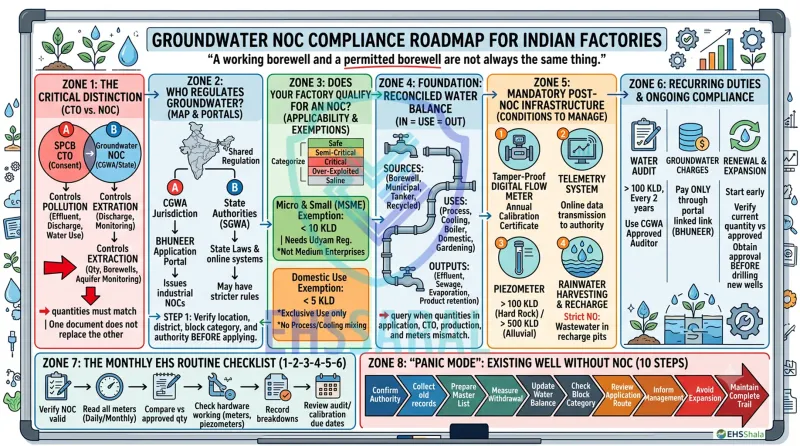
A Consent to Operate issued by the State Pollution Control Board and a groundwater NOC are not the same approval.

The consent controls pollution-related conditions such as water consumption, effluent generation, treatment and discharge.

The groundwater NOC controls extraction of underground water.

“A working borewell and a permitted borewell are not always the same thing.”

This guide explains how groundwater NOC requirements work for Indian factories.

It covers:

  • Central Ground Water Authority requirements
  • State groundwater authorities
  • Industrial exemptions
  • Over-exploited areas
  • Flow meters
  • Telemetry
  • Piezometers
  • Water audits
  • Renewals
  • Existing borewells without valid permission
  • Practical monthly records

The central framework currently includes the CGWA Guidelines notified on 24 September 2020, read with the amendment dated 29 March 2023.

Factories should also check the latest CGWA standard operating procedures, public notices and BhuNeer portal instructions before applying or renewing.

State groundwater laws may impose additional or stricter conditions.

Read more about Environmental Laws in India for Factories

What Does Groundwater Abstraction Mean?

Groundwater abstraction simply means drawing water from below the ground.

Inside a factory, groundwater may be extracted through:

  • Borewells
  • Tubewells
  • Dug wells
  • Open wells
  • Collector wells
  • Any other groundwater extraction structure

The water may be used for:

  • Manufacturing process
  • Cooling
  • Boiler feed
  • Equipment washing
  • Floor washing
  • Domestic use
  • Toilets
  • Canteen
  • Gardening
  • Fire-water makeup
  • Product formulation
  • Other factory utilities

Factories sometimes assume that groundwater used for domestic purposes does not need to be counted.

That assumption can create problems.

Every groundwater source should be identified. Its quantity and purpose should be recorded clearly.

Who Regulates Groundwater Extraction?

Groundwater regulation in India is shared between the Central Ground Water Authority and state or Union Territory groundwater authorities.

The applicable authority mainly depends on the factory location.

Role of CGWA

The Central Ground Water Authority regulates groundwater extraction in areas falling under its jurisdiction.

It issues groundwater NOCs to:

  • Industries
  • Infrastructure projects
  • Mining projects
  • Other covered groundwater users

The NOC may include conditions relating to:

  • Approved abstraction quantity
  • Number of borewells
  • Flow meters
  • Telemetry
  • Piezometers
  • Groundwater-level monitoring
  • Water-quality testing
  • Rainwater harvesting
  • Groundwater charges
  • Water audits
  • Periodic reporting

CGWA groundwater NOC applications are currently handled through the BhuNeer application portal.

Older approvals, guidance documents and online articles may still refer to the earlier NOCAP system.

Read The Groundwater NOC Trap: Why Industrial Renewal Applications Are Rejected?

Role of state groundwater authorities

Some states regulate groundwater through their own:

  • Groundwater Acts
  • Groundwater authorities
  • Water resources departments
  • District-level committees
  • Registration systems
  • Online NOC systems
  • Borewell-permission procedures

A factory should not automatically apply to CGWA simply because the CGWA portal is available online.

It must first confirm whether groundwater extraction in that state and location is regulated by CGWA or the concerned state authority.

State provisions may also be stricter than the central requirements.

How to identify the correct authority

Before preparing an application:

  1. Identify the state, district, taluka and village of the factory.
  2. Check whether the state has its own groundwater law or authority.
  3. Confirm whether the location is presently handled through CGWA.
  4. Check the groundwater assessment-unit category.
  5. Review any local notification affecting the area.
  6. Verify the current application portal.
  7. Check which authority issued the previous approval.
  8. Confirm whether state registration is required even where a central exemption applies.

Do not rely only on an old application, consultant report or Pollution Control Board consent.

Authority responsibilities and portal procedures can change.

Does Every Factory Borewell Require an NOC?

As a general position, new and existing industries extracting groundwater must obtain permission from CGWA or the applicable state or Union Territory authority unless they fall within a stated exemption.

The word exemption must be handled carefully.

An exemption applies only when every condition of that exemption is satisfied.

A small borewell is not automatically exempt.

Micro and Small Enterprise Exemption

Under the central framework, micro and small enterprises drawing less than 10 cubic metres of groundwater per day are exempt from obtaining a groundwater NOC.

This is equal to 10 KLD.

This exemption is specifically for micro and small enterprises.

It should not be described as a general exemption for every MSME.

A medium enterprise is not covered by this particular below-10-KLD exemption.

The factory should keep the current Udyam Registration Certificate available to establish its micro or small enterprise status.

Do not rely only on:

  • An old SSI certificate
  • An outdated MSME registration
  • A CA letter
  • An internal declaration
  • An MSME Databank printout

The unit should also maintain:

  • Actual groundwater withdrawal
  • Purpose of water use
  • Number of borewells
  • Meter readings, where applicable
  • Continued compliance with the exemption limit

If actual withdrawal crosses the limit, the exemption position must be reviewed immediately.

“The exemption applies to the factory category and the actual quantity. Both must remain correct.”

Drinking and Domestic-Use Exemption

The central Guidelines also provide an exemption for industries, infrastructure projects and mining projects drawing groundwater only for drinking and domestic purposes up to 5 cubic metres per day.

This is equal to 5 KLD.

This is a narrow exemption.

It applies only when groundwater is used for drinking or domestic purposes.

A factory cannot rely on this exemption if the same groundwater is also used for:

  • Process
  • Cooling
  • Boiler
  • Scrubber
  • Equipment washing
  • Production
  • Product formulation
  • Industrial gardening demand
  • Other utility operations

A common pipeline supplying both domestic and process use can make the exemption difficult to demonstrate.

Where possible, domestic and process-water systems should be separately measured.

Exemption Should Not Be Assumed

Even when an exemption appears applicable, the factory should verify:

  • Whether the central or state framework applies
  • Whether registration is still required
  • Whether a self-declaration is required
  • Whether an exemption certificate is available
  • Whether a digital flow meter is required
  • Whether reporting conditions apply
  • Whether state rules impose additional controls
  • Whether the exemption continues after expansion

“Exemption from an NOC does not mean exemption from knowing how much groundwater is being used.”

What Changes in an Over-Exploited Area?

Groundwater assessment units are commonly classified as:

  • Safe
  • Semi-critical
  • Critical
  • Over-exploited
  • Saline, where applicable

An over-exploited area is one where groundwater extraction pressure is already high compared with available recharge.

This classification can directly affect whether a new industrial groundwater proposal is considered.

New industries in over-exploited areas

New major industries are generally not granted groundwater NOCs in over-exploited assessment units under the central framework.

However, eligible industries falling under the MSME category may be considered.

This does not mean automatic approval.

The unit still has to:

  • Submit the required application
  • Establish valid MSME status
  • Justify the water requirement
  • Meet technical conditions
  • Pay applicable charges
  • Install required monitoring systems
  • Receive formal approval

New packaged drinking-water units do not become eligible simply because they fall under the MSME category.

Expansion in an over-exploited area

An existing factory planning expansion should not increase borewell pumping first and regularise it later.

Before increasing groundwater use:

  1. Prepare the revised production plan.
  2. Calculate the revised water requirement.
  3. Identify water-saving measures.
  4. Check recycled-water potential.
  5. Review the existing groundwater permission.
  6. Check the current assessment-unit category.
  7. Apply for amendment or fresh approval where required.
  8. Increase extraction only after approval is available.

MSME status should never be treated as permission to operate an unapproved borewell.
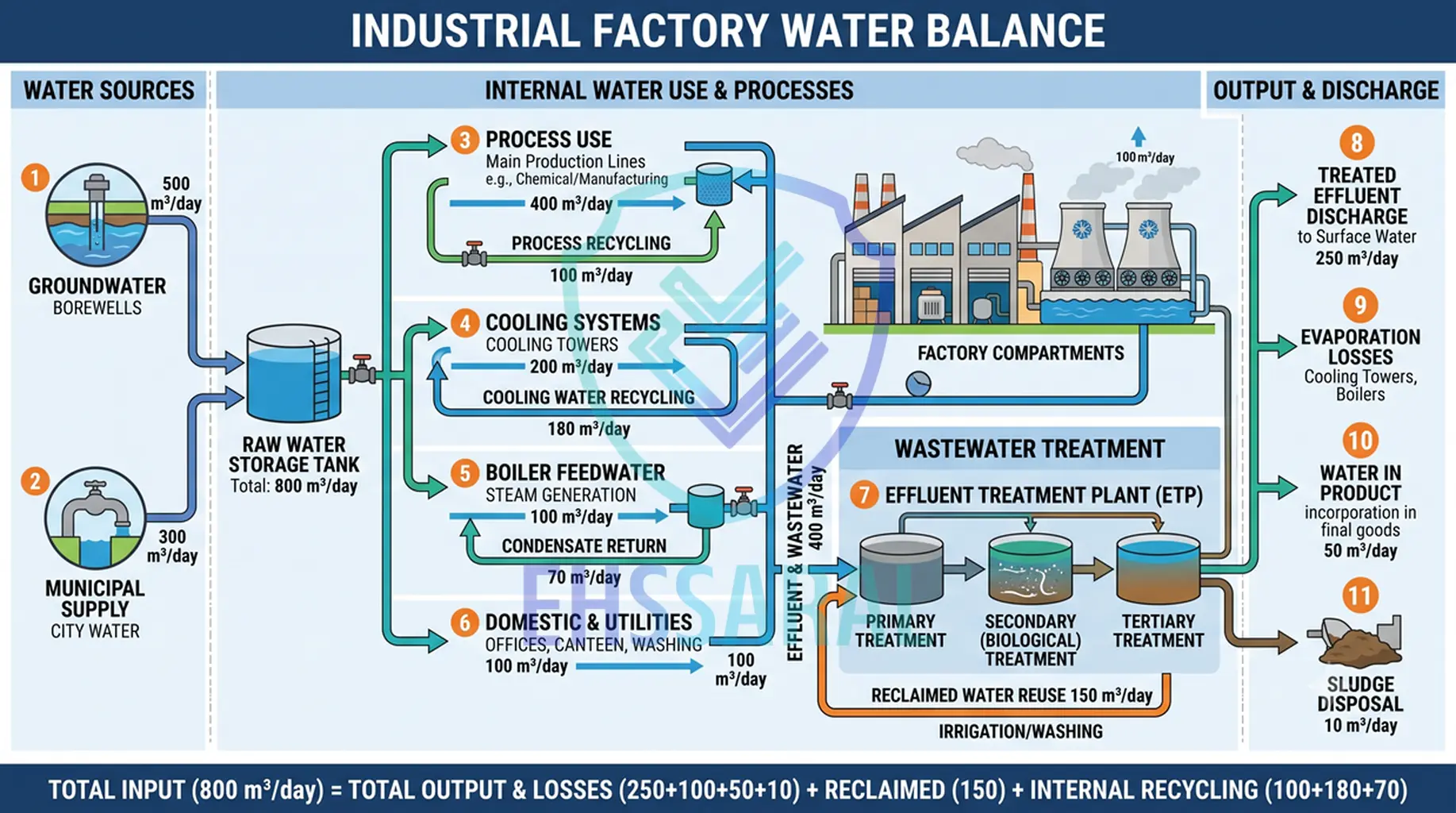
Prepare the Water Balance Before Applying

Industrial factory water balance showing groundwater, municipal supply, process use, recycling, effluent and discharge. EHSShala

A reliable water balance is the foundation of a groundwater application.

It shows:

  • Where water comes from
  • Where water is used
  • How much is recycled
  • How much becomes effluent
  • How much is lost through evaporation
  • Where the remaining water goes

Many application queries do not start with the borewell itself.

They start because different documents show different quantities.

For example:

  • The groundwater application shows 80 KLD.
  • The Pollution Control Board consent permits 60 KLD.
  • The ETP is designed for 40 KLD.
  • Production records suggest a higher requirement.
  • Meter records show only 25 KLD.
  • Tanker water is not included anywhere.

This creates doubt about the reliability of the application.

Record all incoming water

Include:

  • Groundwater
  • MIDC water
  • Municipal water
  • Tanker water
  • Surface water
  • Rainwater used
  • Recycled water
  • Water received from another authorised source

Record all water uses

Include:

  • Process
  • Cooling tower
  • Boiler
  • Scrubber
  • Equipment washing
  • Floor washing
  • Domestic use
  • Canteen
  • Gardening
  • Product retention
  • Fire-water makeup
  • Other utilities

Account for where water goes

Include:

  • Trade effluent
  • Sewage
  • Evaporation
  • Cooling loss
  • Boiler blowdown
  • Scrubber bleed
  • Product retention
  • Sludge moisture
  • Recycled water
  • Reused treated water
  • Permitted discharge
  • Authorised tanker disposal, where applicable

Test whether the water balance makes sense

The water balance should match:

  • Production quantity
  • Number of employees
  • Operating hours
  • ETP capacity
  • STP capacity
  • Flow-meter readings
  • Water bills
  • Tanker records
  • Consent quantities
  • Groundwater NOC quantity

“A water balance should explain factory operations. It should not be prepared only to complete the application form.”

Documents Commonly Required for a Groundwater NOC

The exact document list depends on:

  • Applicable authority
  • Project category
  • Groundwater quantity
  • Area classification
  • Existing or new project status
  • Current portal requirements

Still, most industrial applications require information from the following groups.

Factory and legal documents

  • Company-registration documents
  • PAN and organisational details
  • Authorised-signatory document
  • Land ownership document
  • Registered lease, where applicable
  • Factory licence
  • Pollution Control Board consent
  • Environmental clearance, where applicable
  • Udyam Registration Certificate, where MSME status is claimed
  • Site address
  • Site coordinates

Site and borewell documents

  • Site plan
  • Factory layout
  • Borewell-location plan
  • Latitude and longitude of each borewell
  • Number of existing borewells
  • Number of proposed borewells
  • Borewell depth
  • Diameter
  • Pump capacity
  • Pump-operating hours
  • Year of construction
  • Working or non-working status
  • Photographs of the borewell
  • Photographs of the meter

Water-related documents

  • Detailed water balance
  • Total groundwater requirement
  • Source-wise water details
  • Purpose-wise consumption
  • Existing abstraction records
  • Flow-meter readings
  • Water bills
  • Tanker-water records
  • Recycling and reuse details
  • Proposed water-conservation measures

Technical documents

Depending on the location and proposed quantity, the authority may require:

  • Hydrogeological report
  • Groundwater impact-assessment report
  • Groundwater-modelling report
  • Aquifer details
  • Groundwater-level data
  • Groundwater-quality report
  • Rainwater-harvesting plan
  • Recharge proposal
  • Piezometer details
  • Digital water-level recorder details
  • Flow-meter details
  • Telemetry details

Existing-unit and renewal documents

  • Previous NOC
  • Previous renewal
  • Earlier application
  • Compliance reports
  • Groundwater-charge receipts
  • Meter-calibration certificates
  • Groundwater-level records
  • Water-quality reports
  • Water-audit report, where applicable
  • Details of expansion
  • Details of new borewells
  • Details of abandoned borewells
  • Explanation for quantity mismatch

Always check the current BhuNeer or state portal checklist before filing.

Do not assume that a document accepted during the previous renewal will be sufficient again.
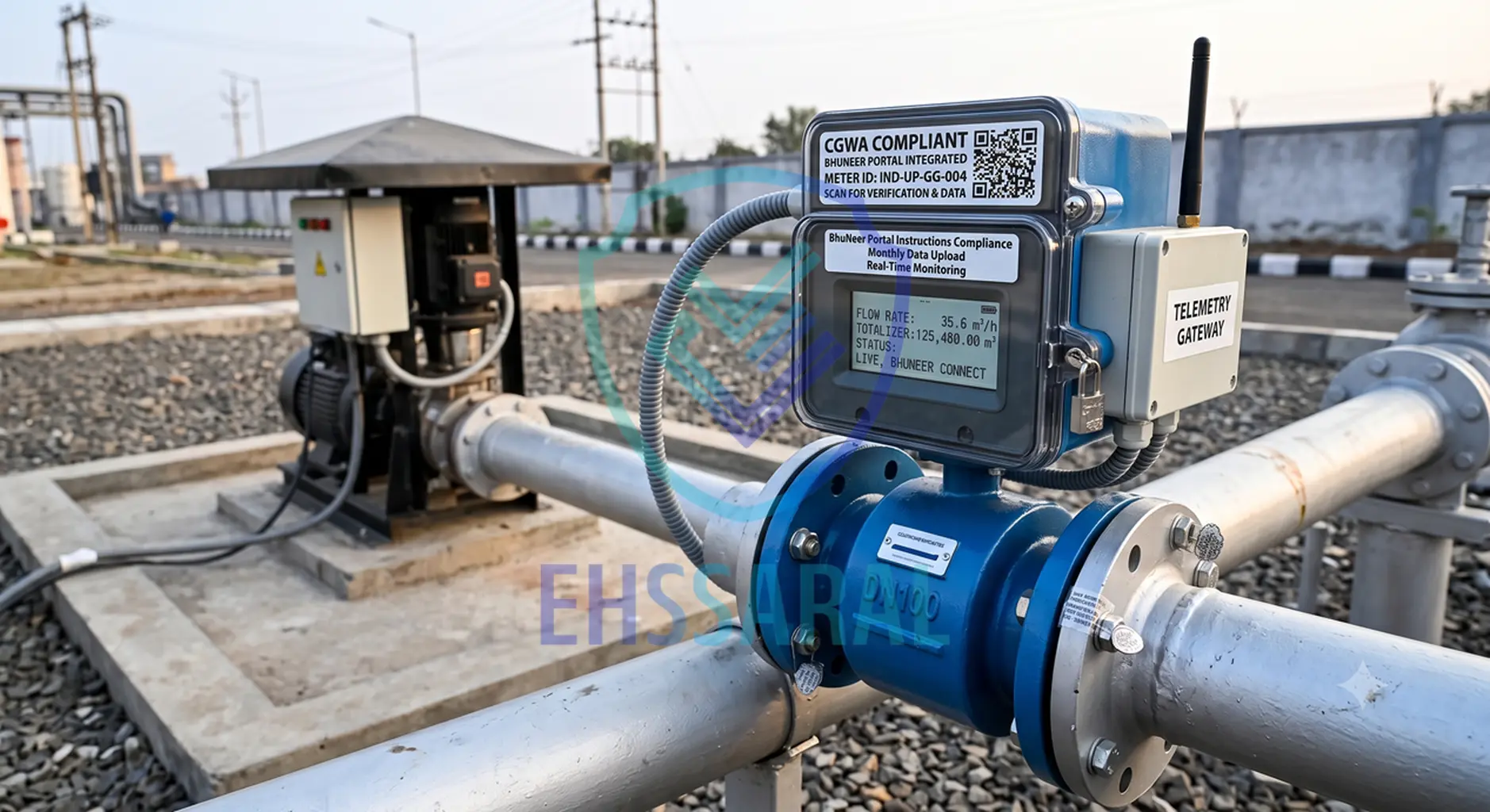
Flow Meter, Telemetry and Extraction Records

Digital flow meter installed on an industrial groundwater borewell for CGWA compliance. EHSShala

A flow meter tells the factory how much groundwater has actually been extracted.

It is one of the most important controls in groundwater compliance.

The meter should not be treated as a decorative item installed only for inspection photographs.

What should be controlled

For each abstraction structure, maintain:

  • Meter make
  • Meter model
  • Serial number
  • Installation date
  • Opening reading
  • Closing reading
  • Daily or monthly consumption
  • Calibration date
  • Calibration certificate
  • Breakdown history
  • Repair details
  • Replacement details
  • Photographs
  • Telemetry status, where applicable

The central framework includes requirements for tamper-proof digital water-flow meters or prepaid meters, telemetry and annual calibration for NOC holders.

The exact condition applicable to the factory should be checked from its NOC and current portal instructions.

Annual calibration

The flow meter should be calibrated through an authorised agency at the required frequency.

Under the central framework, annual calibration is an important condition for covered NOC holders.

Check that the certificate correctly mentions:

  • Meter serial number
  • Meter location
  • Borewell identification
  • Calibration date
  • Calibration result
  • Next due date
  • Agency details

A certificate carrying a different serial number can create more confusion than a missing certificate.

What to do when the meter stops working

Do not allow an unreadable meter to continue for several months.

Take these steps:

  1. Record the last available reading.
  2. Take a photograph of the faulty meter.
  3. Inform the concerned internal authority.
  4. Arrange repair or replacement.
  5. Record pump-operating hours during the breakdown.
  6. Estimate use only through a documented method.
  7. Record the new meter opening reading.
  8. Preserve repair and replacement invoices.
  9. Update the authority where the NOC requires it.
  10. Retain the full breakdown trail.

Do not silently fill the logbook with assumed readings.

Cross-check against pump hours

Flow-meter readings should be broadly reasonable when compared with:

  • Pump capacity
  • Pump-operating hours
  • Production days
  • Production volume
  • Tank levels
  • Utility records

A 20-m³-per-hour pump running for eight hours cannot reasonably show only 5 m³ of daily abstraction.

Such mismatches should be investigated.

Piezometers and Groundwater-Level Monitoring

A piezometer is an observation well used to monitor groundwater level.

It is normally not used as a production borewell.

The purpose is to observe how groundwater levels respond to:

  • Pumping
  • Seasonal changes
  • Rainfall
  • Long-term extraction

What changed in 2023

The original 2020 Guidelines used a lower threshold for industrial piezometer requirements.

The amendment dated 29 March 2023 revised this position.

This is important because many older articles still mention the earlier 10-KLD trigger.

Current central threshold outside designated industrial areas

For industries and infrastructure projects outside designated industrial areas, piezometers become mandatory when the proposed groundwater withdrawal is:

  • More than 100 m³/day from hard-rock aquifers
  • More than 500 m³/day from alluvial aquifers

The exact requirement should still be checked against:

  • Project location
  • Aquifer type
  • Current NOC conditions
  • Applicable state requirements
  • Current portal instructions

Location of the piezometer

The monitoring well should not be placed too close to the pumping borewell.

Under the amended central framework, the minimum separation includes:

  • At least 15 metres in hard-rock areas
  • At least 50 metres in alluvial areas

The depth should normally represent the aquifer from which groundwater is being extracted.

A competent hydrogeologist should confirm the location and construction where a technical study is required.

Records to maintain

Maintain:

  • Piezometer coordinates
  • Construction details
  • Depth
  • Installation photograph
  • Water-level readings
  • Date and time of reading
  • Pre-monsoon level
  • Post-monsoon level
  • Monthly readings, where required
  • Digital water-level recorder data
  • Maintenance records
  • Monitoring-equipment verification records

The piezometer should never quietly become an additional production borewell.

Groundwater Impact Assessment and Modelling

Piezometer requirements and groundwater impact studies are separate conditions.

They should not be mixed.

Depending on the assessment-unit category, aquifer type and proposed abstraction, larger projects may require:

  • Groundwater impact assessment
  • Hydrogeological study
  • Analytical modelling
  • Mathematical groundwater modelling
  • Study of the surrounding area

The purpose is to understand whether the proposed withdrawal may affect:

  • Nearby wells
  • Groundwater levels
  • Local aquifers
  • Existing users
  • Long-term water availability

The factory should not copy an old hydrogeological report prepared for another unit or another location.

The report must match:

  • Actual site coordinates
  • Proposed quantity
  • Borewell depth
  • Aquifer type
  • Production plan
  • Present groundwater category

Rainwater Harvesting and Groundwater Recharge

Rainwater harvesting and groundwater recharge are related, but they are not the same.

Rainwater harvesting

Rainwater harvesting means collecting rainwater for:

  • Storage
  • Gardening
  • Cooling makeup
  • Washing
  • Fire-water storage
  • Other suitable uses

Groundwater recharge

Groundwater recharge means allowing suitable rainwater to enter the ground through a designed structure.

This may involve:

  • Recharge pit
  • Recharge trench
  • Recharge shaft
  • Recharge well
  • Percolation arrangement

Keep polluted water away

Do not connect the following streams to a groundwater-recharge structure:

  • ETP outlet
  • STP outlet
  • Process wastewater
  • Chemical-area runoff
  • Hazardous-waste storage runoff
  • Oil-contaminated stormwater
  • Cooling-tower bleed
  • Boiler blowdown
  • Scrubber wastewater

Treated or untreated wastewater should not be used for groundwater recharge under the CGWA framework.

This means treated ETP or STP water should not be diverted into a recharge borewell merely to show zero discharge.

Treated wastewater should be reused or managed through an approved route suitable for its quality and the applicable consent conditions.

Read more about ETP & STP Troubleshooting: The Complete Indian Guide in EHSShala

Practical maintenance controls

Before every monsoon:

  • Remove silt.
  • Clean filters.
  • Inspect chambers.
  • Repair cracks.
  • Check inlet and overflow arrangements.
  • Remove solid waste.
  • Confirm that contaminated drains are separate.
  • Take dated photographs.
  • Record cleaning activity.
  • Check whether the structure is functional.

A recharge pit filled with plastic, sludge or leaves provides little value.

Water Audit Requirement Above 100 KLD

Industries extracting more than 100 m³ of groundwater per day must undertake a water audit once every two years under the amended central framework.

This is equal to more than 100 KLD.

The water audit should be conducted through an auditor approved under the current CGWA system.

The report should generally cover:

  • Source-wise water intake
  • Process-wise water use
  • Domestic consumption
  • Cooling-water use
  • Boiler-water use
  • Effluent generation
  • Recycling
  • Reuse
  • Water losses
  • Metering
  • Conservation opportunities
  • Reduction plan

The report should be submitted within the applicable period after completion.

Implementation of recommendations from the previous audit may also be reviewed after one year.

The amended framework also expects large users to work towards reducing groundwater use through practical conservation measures.

Do not wait for renewal

A common mistake is to start the water audit only when the renewal portal asks for it.

Instead:

  1. Track whether extraction has crossed 100 KLD.
  2. Record the date of the previous audit.
  3. Identify the next due date.
  4. Engage an approved auditor early.
  5. Collect meter and production data.
  6. Close major data gaps before fieldwork.
  7. Track recommendations after the report.
  8. Record the water savings achieved.

The value of the audit is not only in producing a report.

It should help the plant reduce avoidable groundwater use.

Groundwater Charges and Portal Payment

Groundwater abstraction charges may depend on factors such as:

  • Groundwater assessment-unit category
  • Quantity extracted
  • Purpose of use
  • Type of industry
  • Fresh or renewal application
  • Delay
  • Unauthorised extraction
  • Applicable central or state provisions

Do not rely on an old fee chart.

Rates and calculation methods should be verified through the current authority portal.

Groundwater-related fees and charges should be paid only through the payment link provided inside the current CGWA application portal.

CGWA has shifted groundwater NOC applications from the earlier NOCAP system to the BhuNeer application portal.

Factories should therefore follow the current BhuNeer payment process instead of making a direct payment based on an old Bharatkosh instruction.

After making the payment:

  • Save the receipt immediately.
  • Record the transaction number.
  • Record the application number.
  • Check whether the portal status shows payment successful.
  • Confirm that the amount is mapped to the correct application.
  • Preserve screenshots if the status does not update.
  • Use the official support channel where mapping fails.
  • Do not make a second payment without checking the first transaction.

A successful bank transaction does not always mean that the application portal has recorded the payment successfully.

Payment alone also does not authorise groundwater extraction.

The formal NOC and its conditions remain important.

Monthly Groundwater Compliance Routine

Groundwater compliance becomes manageable when it is reviewed every month.

A simple monthly routine is enough for most factories.

Check the permission

  • Is the NOC valid?
  • Is the correct authority mentioned?
  • Is the renewal date approaching?
  • Is the approved quantity understood?
  • Is any condition overdue?

Check every borewell

  • Is the borewell authorised?
  • Is it working?
  • Is the identification number visible?
  • Is the meter working?
  • Is telemetry working, where applicable?
  • Is there any additional or temporary borewell?

Check the quantity

  • Record the opening reading.
  • Record the closing reading.
  • Calculate monthly abstraction.
  • Compare it with the approved quantity.
  • Compare it with production.
  • Compare it with pump hours.
  • Investigate abnormal changes.

Check other water sources

Include:

  • MIDC water
  • Municipal supply
  • Tankers
  • Recycled water
  • Rainwater used

Groundwater should not be reviewed separately from the total plant water balance.

Check monitoring and conservation

  • Piezometer record
  • Groundwater-level data
  • Water-quality report
  • Meter calibration
  • Rainwater-harvesting structure
  • Water-audit due date
  • Portal submissions
  • Groundwater charges

Report the trend

The EHS officer should not wait until the approved limit is crossed.

Inform management when:

  • Abstraction is steadily increasing.
  • Production has increased.
  • Alternate supply has reduced.
  • The meter is repeatedly failing.
  • A new borewell is being planned.
  • The NOC is nearing expiry.
  • A condition cannot be completed on time.

“Good compliance starts before the limit is crossed.”

Renewal, Expansion and Increased Water Demand

Renewal should not begin near the expiry date.

It should begin with a review of actual groundwater use.

Before renewal, check

  • Current approved quantity
  • Actual daily and monthly abstraction
  • Production increase
  • Employee increase
  • New process lines
  • New utilities
  • Additional borewells
  • Closed or failed borewells
  • Meter performance
  • Telemetry performance
  • Calibration records
  • Piezometer data
  • Groundwater-quality reports
  • Rainwater-harvesting compliance
  • Charges paid
  • Water-audit status
  • Previous compliance submissions

When production increases

Higher production may increase:

  • Process-water demand
  • Cooling requirement
  • Boiler requirement
  • Washing water
  • Domestic consumption
  • Effluent generation

The revised water requirement must be checked against:

  • Groundwater NOC
  • Pollution Control Board consent
  • ETP capacity
  • STP capacity
  • Environmental clearance, where applicable
  • Water availability
  • Assessment-unit restrictions

Do not increase pumping merely because the borewell can supply more water.

Pump capacity and legal permission are separate matters.

When a new borewell is proposed

Before drilling:

  1. Confirm whether a new borewell is permitted.
  2. Check the applicable authority.
  3. Check the assessment-unit category.
  4. Review the existing NOC.
  5. Verify whether amendment or fresh approval is needed.
  6. Update the site plan.
  7. Obtain the required technical report.
  8. Obtain formal approval before construction.

An existing NOC for one borewell should not automatically be treated as permission for another borewell.

Existing Borewell Without a Valid NOC

This is where most people panic.

The right response is not to hide the borewell or create backdated records.

Start by understanding the actual position.

Step 1: Confirm the authority

Check whether CGWA or the state groundwater authority controls the location.

Step 2: Collect old records

Search for:

  • Old NOC
  • Application
  • Renewal
  • Payment receipt
  • Consultant correspondence
  • Borewell-permission letter
  • District-authority approval
  • Consent documents
  • Site plans

Sometimes an old approval exists but was never transferred to the present EHS team.

Step 3: Prepare a borewell master

Record:

  • Borewell number
  • Location
  • Coordinates
  • Depth
  • Pump capacity
  • Construction year
  • Meter number
  • Current status
  • Purpose of use

Step 4: Measure actual withdrawal

Install or repair the flow meter where required.

Do not submit an unsupported estimate merely to complete the application.

Step 5: Prepare the present water balance

Show all sources and uses honestly.

Step 6: Check the assessment-unit category

The category may affect whether and how an application can be considered.

Step 7: Review the available application route

Depending on the facts, the requirement may involve:

  • Fresh application
  • Renewal
  • Amendment
  • Registration
  • Exemption documentation
  • Regularisation route
  • State-specific process

Do not promise management that every old borewell can be regularised.

Step 8: Explain the position clearly

Present management with:

  • Current facts
  • Missing approval
  • Actual water dependence
  • Available alternate sources
  • Immediate controls
  • Application route
  • Records required
  • Operational risk

Keep the explanation factual.

Step 9: Avoid further uncontrolled expansion

Until the position is clarified:

  • Do not add another borewell.
  • Do not increase pumping without review.
  • Do not alter records.
  • Do not disconnect the meter.
  • Do not mix process and domestic data.
  • Do not submit inconsistent quantities.

Step 10: Maintain the complete trail

Keep copies of:

  • Applications
  • Payments
  • Replies
  • Portal acknowledgements
  • Technical reports
  • Internal approvals
  • Compliance submissions

Most officers respond better to complete and consistent information than to avoidance.

Borewell Mentioned in CTO but Groundwater NOC Is Missing

A borewell may be mentioned in the Consent to Operate.

That does not automatically replace groundwater permission.

The two approvals have different purposes.

DocumentMain purpose
Pollution Control Board Consent to OperateControls water-use limits, effluent generation, treatment, discharge and pollution-related conditions
Groundwater NOCControls groundwater extraction quantity, abstraction structures, monitoring and related conditions

The quantities in both documents should still match.

For example:

  • CTO water requirement: 50 KLD
  • Groundwater NOC: 30 KLD
  • Municipal supply: 10 KLD
  • Tanker supply: 5 KLD

The remaining 5 KLD must be explained.

Similarly, if the groundwater NOC permits 100 KLD but the consent reflects only 40 KLD, the difference should be reviewed.

Do not simply choose the higher number.

Prepare one reconciled water statement showing:

  • Permitted total water requirement
  • Permitted groundwater quantity
  • Other permitted sources
  • Actual use
  • Production basis
  • Effluent generation

What Commonly Gets Checked

During application review, renewal or inspection, the following items are commonly examined.

Permission and borewell details

  • Valid NOC
  • Correct factory name
  • Correct location
  • Number of borewells
  • Borewell coordinates
  • Existing versus approved structures
  • New or abandoned borewells
  • Approved quantity

Measurement

  • Digital flow meter
  • Serial number
  • Working condition
  • Calibration
  • Telemetry
  • Meter readings
  • Pump-operating hours
  • Actual abstraction

Water management

  • Water balance
  • Production quantity
  • Alternate water sources
  • Recycling
  • Reuse
  • ETP and STP quantities
  • Consent consistency
  • Tanker records

Monitoring

  • Piezometer
  • Groundwater-level readings
  • Water-quality reports
  • Rainwater-harvesting structures
  • Recharge-system condition
  • Water-audit report
  • Portal submissions

Financial and administrative records

  • Charges
  • Portal payment receipt
  • Compliance-report acknowledgement
  • Previous correspondence
  • Renewal application
  • Conditions from earlier approvals

Common Groundwater Compliance Mistakes

The same patterns are seen in many factories.

Treating the Pollution Control Board consent as groundwater permission

A consent may recognise water use.

It does not automatically authorise groundwater extraction.

Using an expired NOC

An old NOC in the compliance folder can create false confidence.

Always check its validity.

Operating an additional borewell

A replacement, standby or temporary borewell may still require approval.

Meter installed but not working

A non-working meter weakens every abstraction record prepared after the breakdown.

No annual calibration

The meter may be functioning, but its accuracy is not demonstrated.

Estimated readings entered as actual readings

Estimates should not be presented as measured values.

Mismatch between records

Common mismatches include:

  • NOC versus consent
  • Meter versus pump hours
  • Water intake versus effluent
  • Production versus water consumption
  • Application versus previous renewal

Tanker water not included

Tanker water is still part of the factory water balance.

Keep:

  • Supplier details
  • Quantity
  • Date
  • Source details
  • Bills
  • Gate records

Recycled water ignored

If treated water is reused, show it clearly.

Otherwise, the water balance may wrongly suggest excessive fresh-water consumption.

ETP or STP outlet connected to a recharge pit

Treated or untreated wastewater should not be used for groundwater recharge.

Renewal started too late

Data gaps cannot be repaired in a few days.

Production expanded without checking water approval

The factory may remain within consented production but exceed the groundwater limit.

Applying through an old portal or process

Older documents may refer to NOCAP or direct Bharatkosh payment.

Factories should verify the current BhuNeer process before filing or making payment.

Applying to the wrong authority

A complete application submitted to the wrong authority still does not solve the compliance position.

What Changed Through the 2023 Amendment?

The CGWA Guidelines were originally notified on 24 September 2020.

An amendment was notified on 29 March 2023.

The present central position should therefore be read using the consolidated Guidelines rather than relying only on the original 2020 notification.

For factory teams, the practical changes include the following.

Area affectedPractical meaning for the factory
Piezometer thresholdsThe earlier lower industrial threshold was revised. Outside designated industrial areas, the amended thresholds depend on hard-rock or alluvial aquifers
Water-audit frequencyIndustries drawing more than 100 KLD must conduct the audit once every two years
Audit follow-upImplementation of previous audit recommendations may be checked
Impact-assessment requirementsLarger users may need detailed technical studies before approval
Groundwater modellingHigh-withdrawal projects may need to demonstrate likely impact on surrounding groundwater
Application scrutinyQuantity, source, production and monitoring data must be technically consistent
Monitoring arrangementsFlow meters, telemetry, piezometers and records remain important evidence
Consolidated readingThe 2020 Guidelines must be read together with the 2023 amendment

EHS officers do not need to interpret every amendment clause like a lawyer.

They should understand the factory impact:
  • Does the revised proposal cross a study threshold?
  • Is groundwater modelling required?
  • Is the hydrogeological report current?
  • Does the report match the proposed abstraction?
  • Is a piezometer required?
  • Is a biennial water audit required?
  • Has the correct consolidated guideline been used?

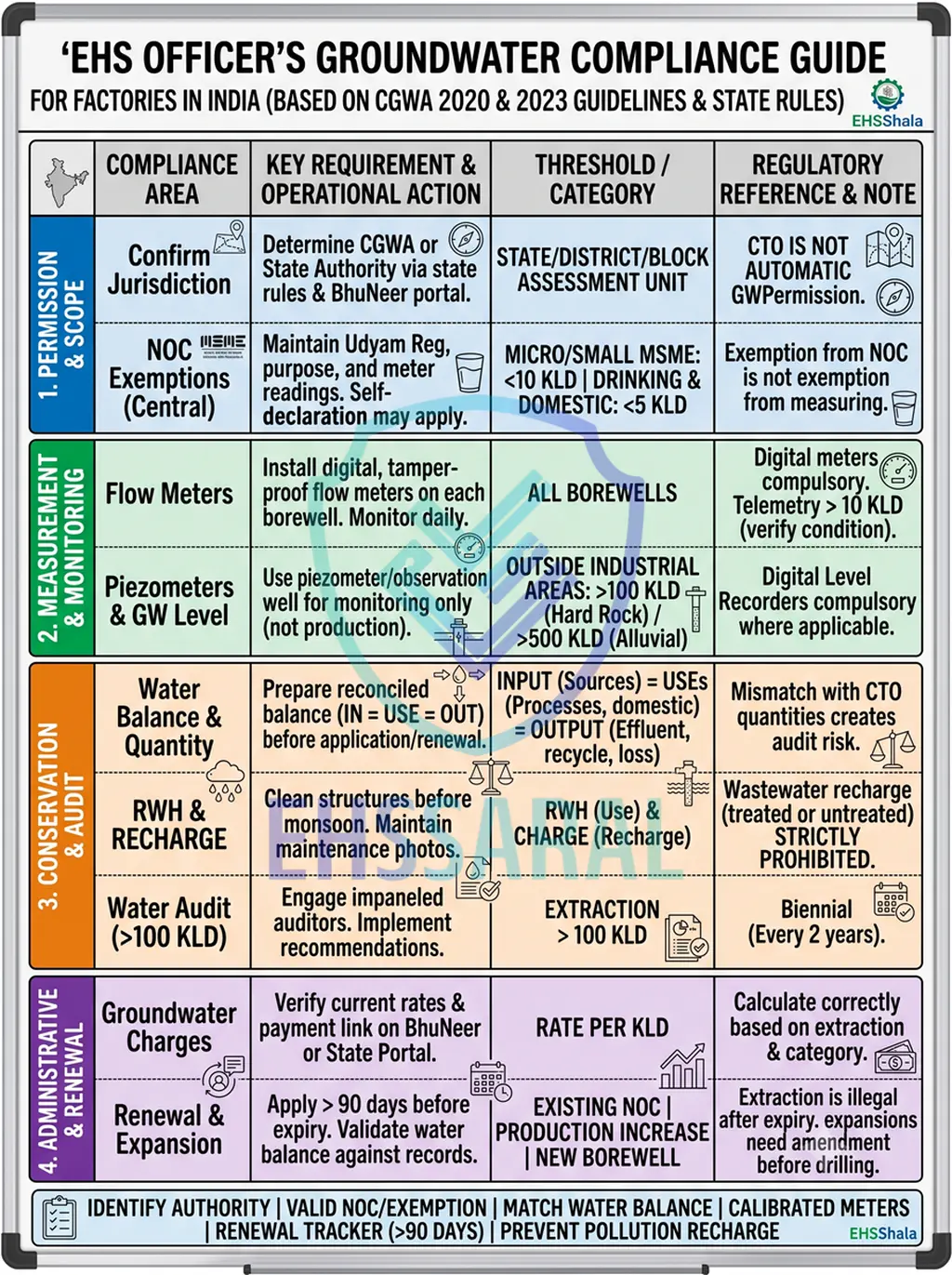
Groundwater Compliance Checklist for Factories

EHS Officers Groundwater Checklist EHSShala

Authority and permission

  • Correct authority identified
  • Current central or state requirements checked
  • Valid NOC available
  • Exemption properly documented, where applicable
  • Approved quantity understood
  • NOC expiry tracked

Borewells

  • All borewells listed
  • Coordinates available
  • Depth and capacity recorded
  • Approved status known
  • Failed or abandoned wells identified
  • No unapproved new borewell

Metering

  • Digital meter installed where required
  • Serial number recorded
  • Meter working
  • Telemetry working where applicable
  • Readings maintained
  • Annual calibration completed
  • Breakdown history available

Water balance

  • Groundwater recorded
  • Municipal or MIDC water recorded
  • Tanker water recorded
  • Recycled water recorded
  • Process use recorded
  • Domestic use recorded
  • Effluent and sewage quantities recorded
  • Consent and NOC quantities reconciled

Monitoring

  • Piezometer installed where required
  • Groundwater level recorded
  • Water quality tested
  • Digital water-level recorder working where required
  • Water audit completed where applicable
  • Audit recommendations tracked

Rainwater and recharge

  • Rainwater-harvesting structure maintained
  • Silt removed
  • Filters cleaned
  • Contaminated runoff kept separate
  • No ETP or STP outlet connected
  • Maintenance photographs available

Records and submissions

  • Application copy available
  • NOC conditions tracked
  • Payment receipts available
  • Compliance reports submitted
  • Acknowledgements saved
  • Renewal started early
  • Expansion reviewed before increased withdrawal

Frequently Asked Questions

Does every factory borewell require a groundwater NOC?

Normally, a factory extracting groundwater requires permission from CGWA or the applicable state authority unless it falls within a clearly stated exemption.

The authority, purpose, quantity and factory category must all be checked.

Is Pollution Control Board consent enough to operate a borewell?

No.

Pollution Control Board consent and groundwater permission serve different purposes.

The borewell may be mentioned in the consent, but separate groundwater approval may still be required.

Who issues the groundwater NOC?

It may be issued by CGWA or by the concerned state or Union Territory groundwater authority.

The answer depends on the factory location and applicable state framework.

Is a micro or small factory below 10 KLD automatically exempt?

The central framework provides an exemption for qualifying micro and small enterprises drawing less than 10 m³/day.

The factory must still confirm:

  • Applicable authority
  • Current Udyam status
  • Actual quantity
  • Purpose of use
  • State requirements
  • Any registration or reporting condition

Can a factory use the 5-KLD domestic exemption?

Only where groundwater is used exclusively for drinking and domestic purposes up to 5 m³/day.

It should not be used when groundwater is also supplied to process, cooling, boiler, washing or production activities.

Can an MSME apply in an over-exploited area?

An eligible MSME may be considered under the applicable central framework, subject to conditions.

MSME status does not automatically authorise groundwater withdrawal.

Is a flow meter compulsory?

Flow-meter requirements depend on the applicable framework, NOC conditions and exemption category.

For covered NOC holders under the central framework, tamper-proof digital metering, telemetry and annual calibration are important conditions.

When is a water audit required?

Under the amended central framework, an industry abstracting more than 100 m³/day must undertake a water audit once every two years through an auditor approved under the CGWA system.

When is a piezometer required?

For industries and infrastructure projects outside designated industrial areas, the amended central thresholds include:

  • More than 100 m³/day in hard-rock aquifers
  • More than 500 m³/day in alluvial aquifers

The exact requirement should be verified from the applicable NOC and current authority instructions.

What should be done if the NOC has expired?

First confirm the authority and collect:

  • Old approval
  • Meter readings
  • Water balance
  • Payment records
  • Compliance reports

Then check the applicable renewal, fresh-application or regularisation process.

Do not submit backdated or unsupported records.

Can treated ETP or STP water be sent into a recharge borewell?

No.

Treated or untreated wastewater should not be used for groundwater recharge under the CGWA framework.

Use treated water only through an approved reuse or disposal route.

Can a factory drill another borewell under an existing NOC?

Do not assume so.

The NOC may be specific to the approved number, location and capacity of borewells.

Check whether an amendment or fresh approval is required before drilling.

Final Ground Reality

Groundwater compliance is not managed by keeping one NOC inside a file.

It is managed by knowing:

  • Every borewell
  • Every water source
  • Actual daily withdrawal
  • Approved quantity
  • Meter condition
  • Water-use pattern
  • Monitoring requirement
  • Renewal date

Most groundwater problems start when factory operations change but the records and permissions remain unchanged.

Production increases.

Employee strength increases.

Municipal supply reduces.

Borewell pumping increases.

But nobody updates the water balance or checks the NOC.

That is where the mismatch begins.

“Once water is measured properly, groundwater compliance becomes much easier to manage.”

Good groundwater compliance does not require panic.

It requires correct authority identification, reliable measurement and consistent monthly records.

Harshal T Gajare

Harshal T Gajare

Founder, EHSSaral

Founder - EHSSaral| Partner - Perfect Pollucon | ISO 14001 Lead Auditor | Second-generation environmental professional simplifying EHS compliance for Indian manufacturers through practical, tech-enabled guidance.

Related Blogs

Why Safety Culture Fails in Indian SMEs: People & Compliance Challenges | EHSSaral Research

Why Safety Culture Fails in Indian SMEs: People & Compliance Challenges | EHSSaral Research

The Digital Compliance Cliff: EPR Traceability Challenges for Indian MSMEs | EHSSaral Research

The Digital Compliance Cliff: EPR Traceability Challenges for Indian MSMEs | EHSSaral Research

4-Stream Waste Segregation for Factories (SWM 2026) | EHSSaral

4-Stream Waste Segregation for Factories (SWM 2026) | EHSSaral

Ozone-Depleting Substances Rules, 2000 - A Practical Guide for Indian Industries

Ozone-Depleting Substances Rules, 2000 - A Practical Guide for Indian Industries

EHSShala Foundations - Core Environmental Basics for EHS Officers

EHSShala Foundations - Core Environmental Basics for EHS Officers

Free Environmental Compliance Software in India: A Clear, Honest Answer | EHSSaral

Free Environmental Compliance Software in India: A Clear, Honest Answer | EHSSaral

How EHS Managers Can Verify EPR Credits Before Audit (DIY Guide) | EHSSaral

How EHS Managers Can Verify EPR Credits Before Audit (DIY Guide) | EHSSaral

EADA Random Audit Assignment: Factory Readiness Guide (2025) | EHSSaral

EADA Random Audit Assignment: Factory Readiness Guide (2025) | EHSSaral

Common Hazardous Waste Mistakes in Indian Factories | EHSShala

Common Hazardous Waste Mistakes in Indian Factories | EHSShala

Water & Effluent Sampling Basics for Indian Factories | EHSSHala
Water & Effluent Sampling Basics for Indian Factories | EHSSHala