
EHSShala
Construction & Demolition Waste Management in India Guide | EHSSaral
EHSSaral is an Environmental Compliance Intelligence Platform for Industries. Consent Intelligence • Alerts & Tasks • Incident Reporting • Form IV & V • Audit-Ready Records
See how EHSSaral works
20 Aug 2026
Most hazardous waste problems in Indian factories do not start with pollution.
They start with how the waste looks.
Across inspections, one pattern repeats.
The officer enters the plant.
Walks straight to the hazardous waste storage area.
Looks around quietly.
Only after that do registers come out.
“If packaging and labels look careless, everything else is questioned.”
This article exists to stop that situation before it starts.
Not with fear.
With clarity.
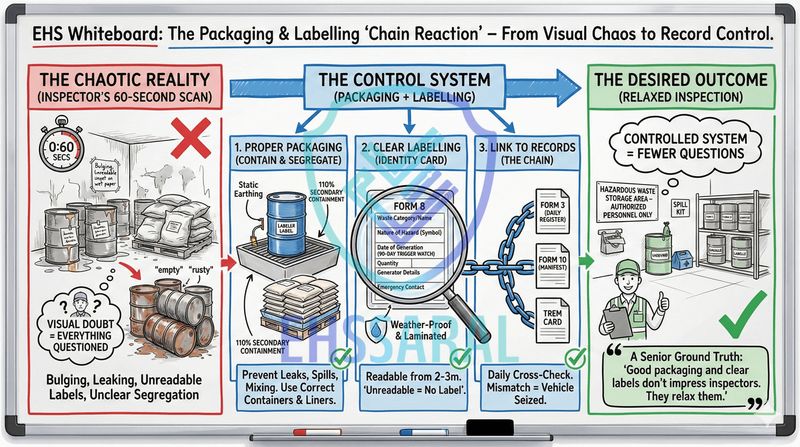
Before laws, sections, or forms, inspectors look for control.
In the first minute, three silent questions are answered:
Is the waste contained properly, or does it look like it can escape?
Can the waste be identified without asking anyone?
Does it appear systematic, or improvised?
If the answer feels positive, the inspection usually stays calm.
If the answer feels negative, every record is checked harder.
This is not personal.
This is inspection psychology.
Before reading further, imagine your storage area.
Ask yourself honestly:
Are containers bulging, leaking, or rusted?
Are lids fully closed, not loosely placed?
Can labels be read from 2–3 metres away?
Are different wastes clearly segregated?
Is the area clearly marked with a board like “HAZARDOUS WASTE STORAGE AREA – AUTHORIZED PERSONNEL ONLY”?
Is the floor clean, without old stains?
Is a basic spill response kept nearby (sand bucket / absorbent pads) so small leaks can be contained quickly?
If even one answer feels uncomfortable, packaging and labelling need attention.
This is where most problems quietly start.
Packaging is not only about transport.
It starts inside the plant, at the point of generation.
In simple words, packaging means:
How waste is contained
How long it can stay safely
How well it can be handled
How clearly it shows control
Good packaging should:
Prevent leaks
Prevent spills
Prevent mixing
Survive normal handling and weather
“Packaging is not a paperwork requirement. It is a control signal.”
When hazardous waste looks well-packaged:
Officers assume systems exist
Records are trusted more easily
Conversations stay factual, not suspicious
When packaging looks weak:
Officers assume shortcuts
Records are double-checked
Verbal explanations lose value
This is why two factories with the same quantity of waste can have very different inspection outcomes.
Most factories are not careless.
They are busy.
Packaging issues usually happen because:
Waste storage is treated as “temporary”
Containers are reused without thought
Labels are added later, not immediately
Weather damage is underestimated
None of this means bad intent.
But inspections don’t judge intent.
They judge visible control.
“Hazardous waste does not need to look perfect.
It needs to look managed.”
Managed waste:
Is contained
Is identified
Looks intentional
That alone reduces inspection pressure by half.
In real plants, hazardous waste is usually stored in:
HDPE drums
Mild Steel (MS) drums
Bags with inner liners
Plastic or MS containers / tanks
IBCs (limited but increasing)
On paper, all of these are acceptable.
Safety Note (for flammables like solvents): During transfer/pouring, static charge can build up. If you store or handle flammable solvents, prefer properly earthed metal drums (bonding/earthing during transfer), or use anti-static approved containers where applicable. This is less about paperwork and more about preventing a spark.
In practice, condition and use decide compliance — not container type.
Re-using drums is common in India.
Inspectors know this.
Re-use itself is not the problem.
Problems start when:
Old labels are still visible
Previous waste residue is present
The drum material does not suit the new waste
No one can explain what was stored earlier
At that point, the container becomes a question mark.
“A re-used container is acceptable only when its history is clear.”
Safe practice on site:
Remove all old labels fully
Clean visible residue
Re-label immediately after filling
Avoid mixing container types for the same waste
If the drum looks confused, the system is assumed to be confused.
This catches many factories off-guard.
An “empty” drum usually still has:
Residue
Vapour
Sludge at the bottom
From an inspection point of view:
Residue = hazardous waste
To treat a drum as truly “empty” (non-hazardous), it usually needs proper decontamination (often triple rinsing), and the rinse water must be handled safely (typically routed to ETP). Merely pouring out the liquid is not enough.
Empty container = hazardous waste container
This means:
It still needs proper storage
It still needs identification
It should not be treated as scrap casually
Many observations start with:
“Why are empty drums kept like scrap?”
Compatibility means the waste and the container must not react with each other.
This is where leaks and corrosion quietly begin.
Acidic waste in MS drums
→ MS corrodes quickly
→ Leaks appear within days
→ HDPE is usually safer
Flammable waste stored near oxidisers
→ Fire risk increases
→ Segregation is expected
Oil-soaked cotton / rags without lining
→ Seepage into floor
→ Fire and housekeeping issues
If packaging looks chemically wrong, inspectors assume loss of control, even before checking records.
You don’t need deep chemistry knowledge.
You need to avoid obvious reactions.
Container suitability is only one part of compatibility. EHS teams should also check what may happen if neighbouring waste streams leak into the same spill tray, bund or drainage path. Read our guide to hazardous waste compatibility and segregation.
Bags look harmless.
They are not.
Common issues:
Torn outer bags
No inner liner
Bags stacked directly on floor
Moisture ingress during monsoon
Once a bag tears:
Waste identity is lost
Mixing becomes possible
Cleanup becomes difficult
Simple improvement:
Always use inner liners
Keep bags on pallets
Avoid over-stacking
Secondary containment exists to catch leaks before they spread.
It becomes important when:
Liquid hazardous waste is stored
Storage is outdoors
Multiple drums are kept together
A widely accepted rule of thumb:
The containment pit or bund should hold 110% of the volume of the largest container stored inside it.
Example: If your largest drum is 200 litres, your bund should hold at least 220 litres.
This allows:
One full drum to leak
Without spreading outside the area
Inspectors often check this visually or by calculation.
Observed on many sites:
Outdoor drum storage without bunds
Temporary storage slowly becoming permanent
Small leaks ignored because “it is minor”
Minor leaks are not minor during inspections.
Another quiet risk.
Common problems:
Drums stacked too high
Uneven floors
No physical separation between waste types
If a drum falls:
Spill happens
Mixing happens
Emergency response is questioned
Good packaging also means stable packaging.
Ask yourself one question:
“If one container fails today, will the waste stay controlled?”
If the answer is “yes,” packaging is doing its job.
If the answer is “maybe,” inspections won’t be kind.
Packaging contains the waste.
Labelling explains the waste.
A container without a clear label is treated as:
Unknown
Uncontrolled
Risky
That is why inspectors often stop in front of labels, not drums.
“If I cannot identify the waste by looking at it, I assume the system is weak.”
A good label answers basic questions instantly:
What waste is this?
How dangerous is it?
When was it generated?
Who is responsible for it?
No discussion should be needed.
“Unreadable label = no label.”
This single rule explains most observations.
Labels do not need to look fancy.
This hazardous waste label is technically referred to as “Form 8” under the Hazardous and Other Wastes Rules, 2016.
Don’t overthink the format. Just ensure the required fields are present and readable.
They need to be complete and readable.
A practical 6-point checklist used across inspections:
Hazardous waste category and waste name
(As per authorization / internal classification)
Nature of hazard
Flammable / Toxic / Corrosive / Reactive (as applicable)
Date of generation
This is critical. Never skip it.
Approximate quantity
Helps traceability and cross-checking
Generator’s name and location
Must match the authorization
Emergency contact number
Simple but expected
+-------------------------------------------------------+
| HAZARDOUS WASTE LABEL (FORM 8) |
+-------------------------------------------------------+
| Waste Category & Name: ___________________________ |
| Nature of Hazard: ___________________________ |
| Date of Generation: ____ / ____ / ________ |
| Quantity (Approx.): ___________________________ |
|-------------------------------------------------------|
| Generator (Sender): |
| Company Name: ___________________________ |
| Location/Unit: ___________________________ |
|-------------------------------------------------------|
| Receiver (If known): |
| Recycler/TSDF Name: ___________________________ |
|-------------------------------------------------------|
| Emergency Contact No.: ___________________________ |
+-------------------------------------------------------+
If any one of these is missing, the label becomes weak.
Seen repeatedly on sites:
Marker ink fading
Paper labels taped loosely
Pencil-written details
Ink running after rain
During inspection, these are treated as:
Neglect
Last-minute compliance
Poor control
Labels must survive time and weather, not just audits.
Labels are not just identifiers.
They are time indicators.
If an inspector sees:
A generation date older than 90 days
Immediate questions start:
Why is waste still stored?
Is extension available?
Where is disposal proof?
This happens even if:
Packaging is good
Storage area is clean
“Time + label together decide risk.”
That is why dates must always be visible and accurate.
Hazardous Waste Storage Time Limits (90-Day Rule)
In India, weather is an enemy of labels.
Common failures during monsoon:
Paper dissolving
Ink bleeding
Tape coming off
Plastic covers tearing
Better practices seen on sites:
Laminated labels
Plastic sleeves tied properly
Weather-proof paint markers on drums
A label that survives rain shows seriousness.
Many people get confused here.
Indian rules focus on identification, not strict colour mandates.
In practice:
Some industries follow internal colour codes
Some follow CPCB-style conventions
Some use symbols only
What inspectors usually look for:
Consistency across the site
Clear hazard identification
No mixing confusion
“Choose one system and follow it everywhere.”
Changing colours randomly creates doubt.
Common Industry Practice (Safe Default – Not a legal mandate):
Yellow: General hazardous waste (sludge, process waste)
Red: Highly flammable / incinerable (solvents, oily waste)
Blue: Toxic / poisonous / oxidizers
If your SPCB has issued a specific direction, follow that. Otherwise, consistency matters more than colour choice.
Observed repeatedly:
Old labels not removed after reuse
Multiple labels on one container
Same label used for different wastes
Label present but unreadable from distance
From inspection point of view:
Multiple labels = confusion
Confusion = loss of control
One container should tell one clear story.
Good labelling is not an annual activity.
It is a daily habit.
A simple practice that works:
“Before leaving the storage area, check that the newest container’s label matches today’s entry.”
This small habit prevents:
Record mismatch
Date errors
Inspection stress
Inspectors don’t expect perfection.
They expect effort and consistency.
A faded but updated label is better than:
A perfect label with wrong information
Accuracy beats appearance every time.
Packaging and labelling are not standalone actions.
They are physical extensions of your records.
The first record they must match is Form 3
(the daily hazardous waste register).
If the label says:
“ETP Sludge”
But Form 3 says:
“Solid waste”
The officer assumes:
Either the label is wrong
Or the register is unreliable
Both create doubt.
“When labels and Form 3 disagree, paperwork loses its protection.”
This habit works better than audits.
At the end of the day:
Look at the newest container in storage
Cross-check its label with today’s Form 3 entry
That’s it.
30 seconds daily avoids hours of explanation later.
Inside the plant, packaging and labels show control.
Once waste leaves the gate, documents take over.
Before dispatch, three things must match:
Label description
Form 3 entry
If these do not match:
The transporter is stopped
Waste movement is questioned
Responsibility comes back to the generator
A common field issue:
Label says “Sludge”
Form 10 says “Solid waste”
This small mismatch is enough to seize a vehicle.
Transport Emergency (TREM) cards travel with the vehicle.
Inspectors sometimes check:
Waste description on TREM card
Hazard nature mentioned
Emergency contact details
If TREM information contradicts the label:
Emergency preparedness is questioned
Consistency across all three is key.
This confusion creates unnecessary stress.
Storage packaging focuses on:
Containment
Identification
Stability
Transport packaging focuses on:
Correct description
Authorized receiver
Document alignment
Overdoing storage because of transport fear leads to:
Extra cost
Wrong container choices
Underdoing transport because of storage comfort leads to:
Vehicle detention
Understand the difference. Control both.
These beliefs are widespread:
“Labels are needed only during transport”
“Inspector will understand verbally”
“Empty drums are harmless”
“Temporary storage rules are flexible”
These beliefs usually lead to observations.
Not because rules are harsh.
Because systems are unclear.
If you inherit a chaotic storage area, don’t panic.
Fix in this order:
Start with liquid and recent waste
Replace unreadable labels
Remove old or multiple labels
Segregate waste clearly
Clean visible spill marks
Take date-stamped photos for records
Control first. Perfection later.
Photos are not a legal requirement.
But they are useful.
Date-stamped photos:
Show improvement over time
Help during internal reviews
Support explanations during disputes
They work best when taken before inspections, not after.
“Good packaging and clear labels don’t impress inspectors.
They relax them.
Relaxed inspectors ask fewer questions.
And when fewer questions are asked, you stay in control.”
Good compliance is not about brilliance.
It is about consistency.
Form 8 is the prescribed format for hazardous waste labelling under Indian rules. It ensures waste is clearly identified at the storage and transport stage.
Yes. Labelling is required during storage itself, not only during transport. Unlabelled waste is treated as uncontrolled waste during inspections.
Mismatch between labels and Form 3 raises traceability concerns and often leads to inspection queries or observations.
Yes, if residue remains. Empty does not mean non-hazardous unless proper decontamination is done and residue is handled safely.
It means secondary containment (bund/pit) should hold 110% of the largest container volume to safely contain leaks.
Rain can damage labels, cause corrosion, and spread spills. Weather-proof labels and proper containment are critical during monsoon.

Founder, EHSSaral
Founder - EHSSaral | Partner - Perfect Pollucon | ISO 14001 Lead Auditor | GHG Protocol Scope 2 | Chemist | Data Scientist | Second-generation environmental professional simplifying EHS compliance for Indian industries through practical, automated, tech-enabled, data driven compliance workflows.
Construction & Demolition Waste Management in India Guide | EHSSaral

Can You Transfer Hazardous Waste Responsibility in India? (What the Law Says)

Battery Waste Registration for Equipment Importers (BWM Rules 2022 Explained) | EHSSaral

Environmental Compliance KPIs for Manufacturing in India
Form 10 Manifest System Explained: 7 Copies, Flow & SPCB Inspectors Checklist | EHSShala

Battery Waste Management Rules India - Factory Guide (2026) | EHSShala

EHSShala Foundations - Core Environmental Basics for EHS Officers
Environmental Non-Compliance Investigation: Process, RCA and Corrective Action

Why Safety Culture Fails in Indian SMEs: People & Compliance Challenges | EHSSaral Research

Is There Truly Free Environmental Compliance Software in India? (An Honest Answer) | EHSSaral