
EHSShala
150 Essential EHS Terms Explained Simply | EHSShala
EHSSaral is an Environmental Compliance Intelligence Platform for Industries. Consent Intelligence • Alerts & Tasks • Incident Reporting • Form IV & V • Audit-Ready Records
See how EHSSaral works
17 Feb 2026
Based on 25+ years of field experience from Perfect Pollucon Services and practical insights for junior EHS professionals.
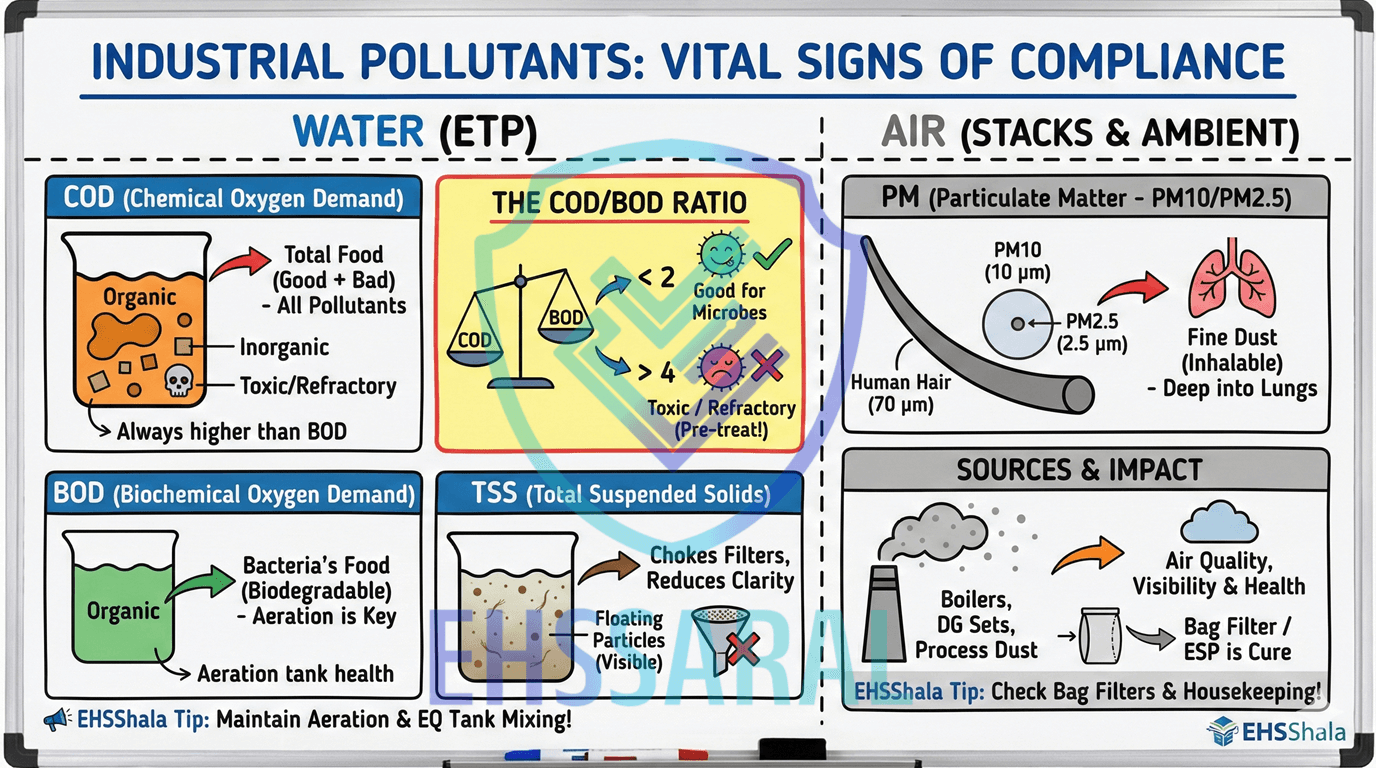
Whether you run an ETP, STP, boiler, furnace, DG set, or any industrial operation, you will always find these four parameters in your Consent to Operate (CTO):
These are not just “lab values.” They are the vital signs of your industry - like blood pressure, pulse, and oxygen saturation for the human body.
If these four parameters are under control:
✔ Your ETP/STP performs smoothly.
✔ SPCB monitoring visits become stress-free.
✔ You avoid non-compliances, show-cause notices, and penalties.
✔ Your management sees you as a reliable EHS professional.
But when they spike, even by a small margin, the entire plant feels the pressure - operators panic, management questions begin, and compliance fear spreads.
This guide explains it all - in simple, Indian English, with real experience, real failures, and real solutions.
| Parameter | Simple Meaning | Typical Source | Common Limit (General - check CTO) | Major Impact |
|---|---|---|---|---|
| COD | Total oxygen needed to oxidize everything (Good + Bad) | Dye, chemical load, solvents | 250 mg/L | Indicates total pollution load; dictates treatment design. |
| BOD | Oxygen needed by bacteria to eat biodegradable food | Canteen waste, sewage, food processing | 30 mg/L | Indicates if your biological treatment is healthy. |
| TSS | Floating particles you can see | Clarifier carryover, sludge, sand | 100 mg/L | Chokes filters, reduces clarity, visual violation. |
| PM | Fine dust particles in the air | Boilers, DG sets, coal dust | 50–100 mg/Nm³ | Triggers immediate SPCB action; health hazard. |
Note: Limits vary by industry category, receiving body, and CTO conditions. Always follow your consent limits first.
COD (Chemical Oxygen Demand): Total oxygen required to chemically oxidize all oxidizable pollutants in wastewater.
BOD (Biochemical Oxygen Demand): Oxygen required by microorganisms to break down biodegradable pollutants.
TSS (Total Suspended Solids): Undissolved particles floating in water that can be removed by settling/filtration.
PM (Particulate Matter): Fine solid particles suspended in air (PM10 and PM2.5 are the most tracked sizes).
EHSShala Tip: If you can explain these four lines to a plant manager in 60 seconds, you are already ahead of most EHS officers.
Read more about EHS Glossary - Key Environmental Health & Safety Terms
COD is one of the first parameters every industry looks at during ETP design, SPCB sampling, and daily monitoring. But most beginners only know the textbook line: "COD is the amount of oxygen required to chemically oxidize organic and inorganic matter."
This definition is correct - but useless for real-world troubleshooting.
Think of COD as “Total food load (good + bad) in the wastewater.”
Your bacteria in the aeration tank can only “eat” the good part. COD includes everything, even the tough, non-biodegradable pollutants.
Because COD tells the State Pollution Control Board:
Note: If COD fluctuates wildly, SPCB suspects batch discharge or improper equalization. COD = Pollution Load = Risk Indicator.
This is the section junior EHS professionals search for when panic hits.
"COD tells you the total pollution your plant is throwing out - good + bad. If COD is high, everything collapses: aeration, MLSS, clarity, BOD. Control COD at the source, and half your ETP headache disappears."
ETP & STP Failures and Troubleshooting from Industry Experts
If COD is the total load, BOD is the biodegradable part - the part your microbes can actually “eat.”
Think of BOD as “The portion of pollution your bacteria WANT to eat.”
This is why BOD is the heartbeat of your ETP.
There is massive confusion here.
This is the most important diagnostic tool in ETP operations. Most blogs never mention this, but every experienced operator depends on it.
It acts like an ECG for your plant. It tells you if biological treatment is even possible.
| COD/BOD Ratio | Interpretation | What It Means for ETP |
|---|---|---|
| < 2 (or BOD/COD > 0.5) | Highly biodegradable | Excellent for biological treatment. |
| 2 – 3 | Moderately biodegradable | Biological treatment works but is slower. |
| > 3 | Low biodegradability | Need chemical/physical pre-treatment. |
| > 4 | Toxic / Non-biodegradable | Biological system will fail. |
If you have a ratio of 5 or 6, stop looking at the aeration tank. The problem is upstream.
Senior Note: "The COD/BOD ratio tells you whether the ETP will ever work - before you even switch on the aeration blower."
In real plants, these three parameters move like a chain:
Think like this: COD/BOD is “treatment difficulty,” TSS is “clarity & discipline.” Both decide compliance.
TSS looks simple... until it chokes your filters and ruins your compliance report.
TSS in wastewater means the total amount of undissolved solid particles present in the water. These particles can be biological (sludge), physical (sand/grit), or chemical (precipitates).
If your treated effluent is cloudy, TSS is usually the first suspect.
“Whatever you can see as cloudiness or turbidity in water is mostly TSS.”
It includes sludge flocs, sand, grit, fiber, and chemical precipitates. SPCB officers look at clarity first - if the sample is cloudy, you are already in trouble.
Take a 1-liter beaker of treated effluent and let it sit for 30 mins.
We now switch from Water (ETP) to Air (Stacks & Ambient).
PM affects public health and visible emissions. If your PM spikes, the notices come fast because the public can see it.
Getty Images
"PM is the parameter everyone can see. If your bag filter, housekeeping, and combustion are in control, you will never fear air monitoring again."
These tips will save you from 90% of violations.
If you want a quick revision before an inspection, use this:
Tip: Many EHS teams print this section and keep it near the ETP logbook.
Q: What is BOD, COD and TSS?
A: COD shows total pollution load, BOD shows biodegradable load, and TSS shows undissolved solids/clarity. Together they decide ETP performance and compliance.
Q: What is TSS and COD?
A: COD measures chemical pollution load, TSS measures solid particles in water. A sample can fail due to either chemical load (COD) or solids carryover (TSS).
Q: What is TSS in wastewater?
A: TSS is the amount of undissolved solids in wastewater (sludge, grit, precipitates). High TSS makes water look cloudy and often indicates clarifier/filter issues.
Q: What is the relationship between BOD and TSS?
A: Poor biological health causes poor settling, which increases TSS. High TSS can also carry organics, increasing the risk of higher BOD/COD in treated effluent.
Q: What is the difference between COD and BOD?
A: COD is the total pollution (everything oxidizable). BOD is only the biodegradable pollution. COD is always higher.
Q: Why is my COD high even after aeration?
A: You likely have "refractory" (non-biodegradable) pollutants, or your bacteria are dead due to toxic shock.
Q: Can I meet PM limits without a Bag Filter?
A: For coal or biomass boilers in India? No. You need an ESP or Bag Filter to meet the strict 50–100 mg/Nm³ limits.
Q: What causes PM10 to increase in ambient air?
A: Usually road dust, raw material handling, and fugitive emissions-not just the boiler stack.

Founder, EHSSaral
Founder - EHSSaral | Partner - Perfect Pollucon | ISO 14001 Lead Auditor | GHG Protocol Scope 2 | Chemist | Data Scientist | Second-generation environmental professional simplifying EHS compliance for Indian industries through practical, automated, tech-enabled, data driven compliance workflows.
150 Essential EHS Terms Explained Simply | EHSShala
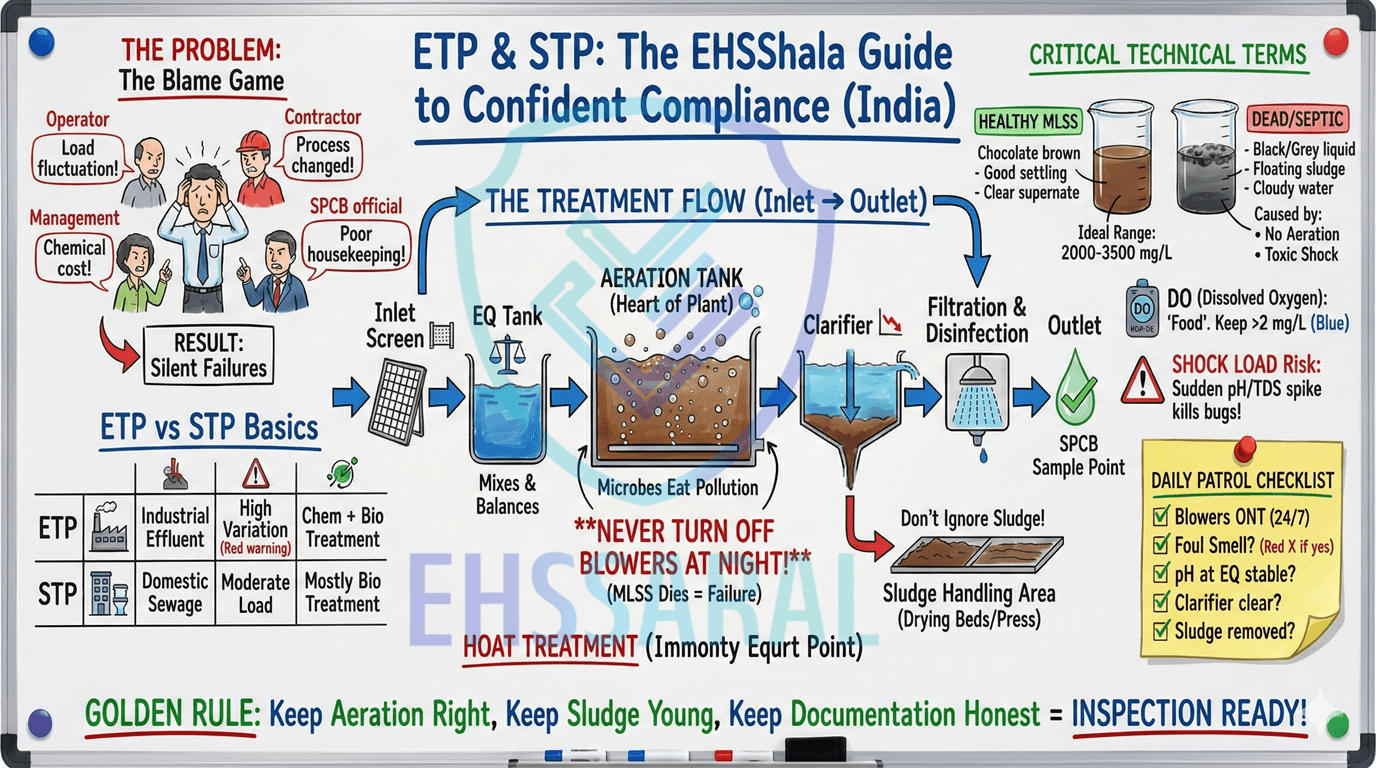
ETP & STP Troubleshooting: The Complete Indian Guide | EHSShala
Consent to Operate (CTO) Explained for Indian Factories | EHSShala
Plastic Waste Management Rules in India: A Practical Guide for Factories, Warehouses and Offices
Environmental Monitoring Guide for Indian Factories | EHSShala

Chemical Accident Emergency Response Guide for Indian Factories | EHSShala
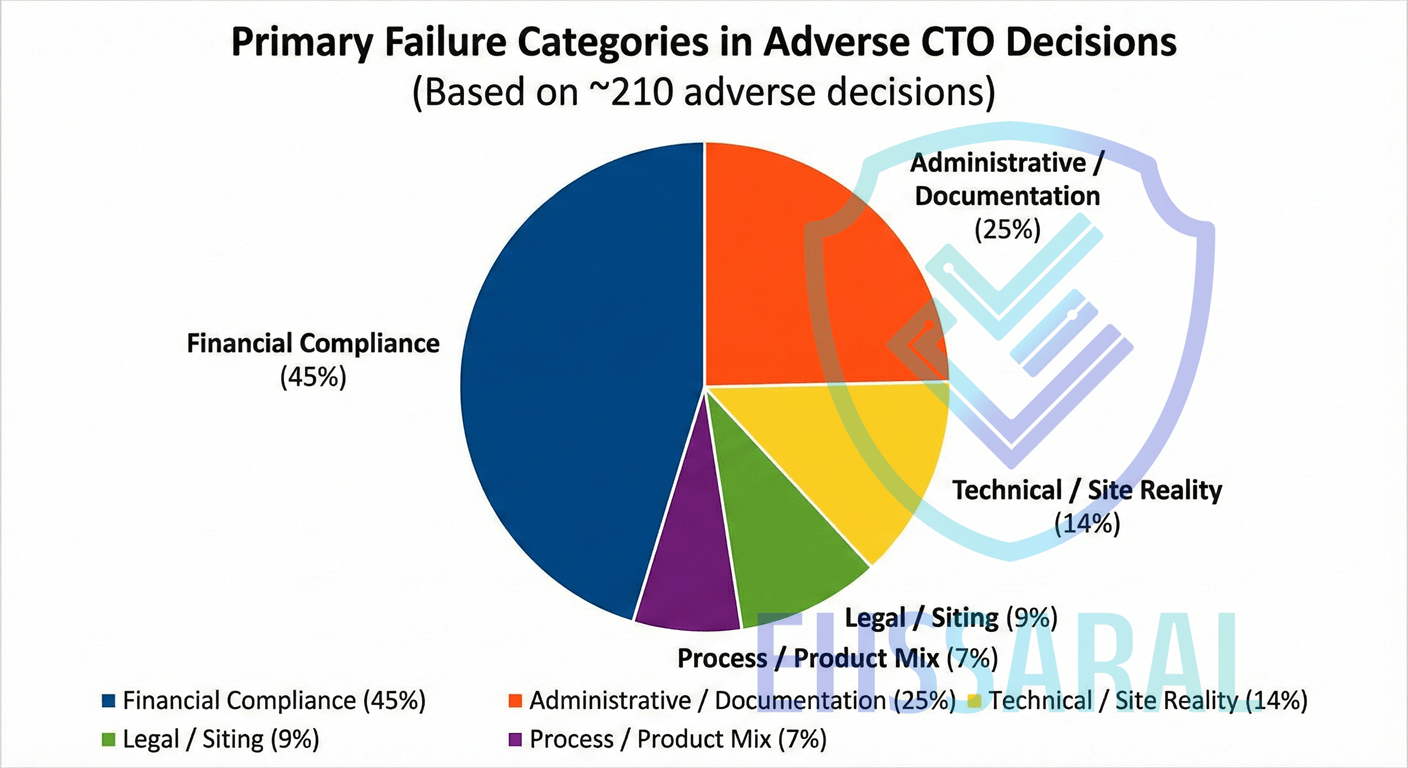
MPCB CTO Refusal Patterns in Maharashtra (2023–2025) Analysis | EHSSaral Research

EHSShala Start – Begin Your EHS Learning Journey in India
Manual Stack Monitoring vs OCEMS: Why Results Differ in Environmental Compliance
E-Waste Management Rules (2022) in India - Practical Guide for Factories | EHSShala