
Blog
EBWGR Certificate: Eligibility, Process, Cost & Records
EHSSaral is an Environmental Compliance Intelligence Platform for Industries. Consent Intelligence • Alerts & Tasks • Incident Reporting • Form IV & V • Audit-Ready Records
See how EHSSaral works
7 Jan 2026
Most EHS officers don’t panic because pollution is out of control.
They panic because they are not fully sure what their consent actually allows.
The consent copy sits in a file.
Sometimes scanned.
Sometimes emailed by a consultant.
Rarely opened fully.
And when inspection happens, suddenly everyone wants answers from that same document.
This is where stress starts.
Not because someone hid anything.
But because nobody was taught how to read this paper properly.
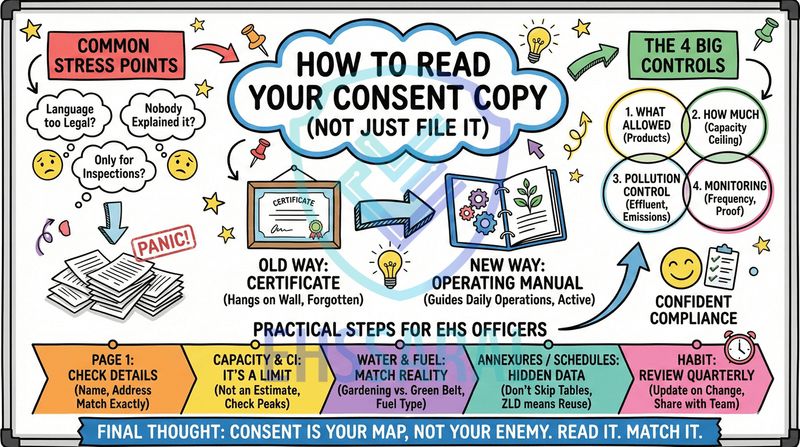
A consent copy is not a certificate.
A certificate is something you hang on the wall.
A consent copy is something you operate by.
Think of it like this:
Inspectors don’t treat it like an award.
They treat it like an operating manual.
If your plant reality and this paper don’t match, questions will come.
Read more about Consent Section on EHSShala
This problem is very common, especially with junior and mid-level EHS officers.
Here’s why:
So the document exists.
But understanding doesn’t.
“Most compliance problems don’t start on the shop floor.
They start in unread pages.”
Your consent copy controls four big things:
That’s it.
Everything else is detail.
Once you understand this, reading becomes easier.
This is important.
Inspectors do not read the consent from start to end like a novel.
In real inspections, what usually happens is:
They mainly focus on:
If these five areas make sense, inspections stay smooth.
If they don’t, more questions follow.
Many people ignore the first page thinking it is “basic”.
It is not.
The name must exactly match:
Even extra words like “Private Limited” missing or added can trigger questions.
Small spelling differences are common.
They are also commonly questioned.
This is not harassment.
This is record matching.
Every consent has:
What many people miss is this:
Expiry does not mean operations stop suddenly at midnight.
If renewal is applied on time, the application acknowledgment usually acts as temporary protection until the final order comes.
This is called deemed status in practice.
Many juniors panic unnecessarily because they don’t know this.
Still, don’t take chances.
Apply early.
Keep acknowledgment handy.
track consent conditions digitally
Red, Orange, Green, White.
Most people know the colour.
Few understand the impact.
Your category decides:
A common issue seen on sites:
On paper, the unit looks smaller than reality.
This gap creates questions later.
This is the most important section of the entire document.
Every product listed matters.
Every quantity mentioned matters.
A simple ground rule:
“If it is not written here, it is not approved.”
Very common real-life situation:
On paper, it is not fine.
Inspectors don’t check intent.
They check approval.
Don’t try to memorise everything.
Do this instead:
Your goal is simple:
Can you explain this consent to a plant head in 5 minutes?
If yes, you understand it.
If not, you need to read again.
This document is not meant to scare you.
It exists so:
Once you stop seeing it as a “legal paper” and start seeing it as an operations guide, stress reduces.
SPCB Consent Guide - CTE, CTO, Renewal, Fees & Conditions by EHSShala
Approved capacity is not an estimate.
It is a ceiling.
The board is not asking how much you usually produce.
It is approving the maximum you are allowed to produce.
Common on-site confusion:
On paper, none of that matters.
If actual production crosses approved capacity, even occasionally, it becomes a non-compliance question.
Inspectors usually check this against:
This is why capacity numbers must be treated seriously.
Read more about CPCB (Central Pollution Control Board) and SPCB (State Pollution Control Board)
Many units confuse these two.
Installing a bigger machine automatically increases installed capacity.
But approved capacity remains the same until consent is amended.
This gap is small on paper, but big during inspection.
Capital Investment is usually mentioned in one line.
Most people skip it.
They shouldn’t.
CI is linked to:
Very common scenario seen in practice:
CI increases in books.
Consent still shows old CI.
Later, during audit or renewal, this mismatch comes up.
This does not mean wrongdoing.
It means information was not updated.
Still, it leads to questions.
Raw material quantities are not written randomly.
They are used to check:
Example:
Consent allows:
If purchase records show 1,600 MT, questions will come.
Not because pollution is high.
But because numbers don’t align.
This is one of the easiest mistakes to make.
Consent usually specifies:
Look for fuel type carefully.
Example:
To operations team, this feels minor.
To the board, it is a change.
Fuel directly affects:
Always check fuel words, not just equipment name.
Water numbers look boring.
They are not.
Consent usually breaks water into:
Inspectors often check:
Example seen many times:
This mismatch raises doubt.
Not because gardening is wrong.
Because the number looks unrealistic.
This section tells:
Common disposal modes:
Words like “ZLD” are often misunderstood.
ZLD does not mean:
It means:
Misunderstanding this has caused many notices.
The ZLD Mass Balance - How Auditors Calculate Effluent Using Your Water Bills by EHSSaral
Stack details are often given in tables or annexures.
They include:
Inspectors usually:
If stack height on site does not match consent, it becomes a visible issue.
Consent mentions systems like:
Inspectors don’t expect perfection.
They expect presence and operation.
Common gaps seen:
Paper approval without operation does not help.
This section creates most follow-up queries.
It clearly mentions:
Missing one report rarely creates trouble.
Missing many creates a pattern.
Boards look for consistency, not volume.
In many consents, especially renewals, a Bank Guarantee (BG) is mentioned.
Usually:
The danger is this:
Missing BG submission is treated seriously.
If your consent mentions BG:
This is not optional.
Special conditions are:
They are written because something happened earlier.
Skipping them is risky.
General conditions are standard.
Special conditions are personal.
After reading this section, ask:
Do our production, water, fuel, and pollution numbers still match this paper?
If you are not sure, that’s okay.
It just means you need to check.
Many EHS officers read the main consent pages and stop.
Annexures are skipped.
This is risky.
Annexures usually contain:
Inspectors often directly open annexures.
Why?
Because numbers are clearer there.
If you ignore annexures, you may think everything is fine while the mismatch is clearly written in a table at the back.
Waste conditions are often treated lightly.
They shouldn’t be.
Consent usually lists:
Common issue seen:
Waste violations are easy to prove because manifests and registers exist.
Always cross-check waste quantities once a year.
Almost every consent mentions:
These look minor.
They are checked because they are easy to verify.
Missing display boards give inspectors an impression of poor control, even if pollution systems are fine.
These patterns are seen repeatedly across many units:
None of these come from bad intent.
They come from workload and habit.
This moment comes to almost everyone.
You realise:
First rule: don’t panic.
Second rule: don’t hide it.
Boards respond better to clarity than surprise.
Handle it calmly:
Most problems grow because they are delayed, not because they exist.
This causes unnecessary anxiety.
If:
Then the acknowledgment usually serves as proof that the unit has applied.
Operations do not suddenly become illegal the next day.
Still:
This balance between caution and calm is important.
A typical inspection flow looks like this:
If your consent is understood, answers come easily.
If not, stress shows.
You don’t need weekly study.
Do this instead:
Even 20 minutes is enough.
Use one-page internal checklist:
Share it with:
This removes dependence on memory.
“Good compliance does not need brilliance.
It needs consistency.”
Your consent copy is not your enemy.
It is your map.
Read it.
Match it.
Update it when reality changes.
That’s how compliance becomes manageable, not stressful.
A consent copy is permission to operate with conditions.
It tells you what you can do, how much you can do, and how pollution must be controlled.
It is not just a certificate.
It is an operating rulebook for your factory.
No.
Once production starts, CTO conditions matter more on a daily basis.
Because the consent copy shows what the factory promised.
During inspection, officers mainly check:
They match paper with reality.
Even if it happens occasionally, it becomes a compliance issue.
The board approves maximum limits, not average production.
If capacity increases, consent must be amended or renewed accordingly.
Yes, it can be.
If the machine increases:
Then it should be reflected in the consent, even if production has not started.
CI is linked to:
If CI increases but consent is not updated, it often comes up during audit or renewal.
A Bank Guarantee is asked when:
BG conditions are usually written in special conditions.
Missing BG submission can create serious issues, so timelines must be tracked carefully.
ZLD means Zero Liquid Discharge outside the premises.
It does not mean:
It means effluent must be treated and reused within the plant.
Annexures usually contain:
Inspectors often check annexures first because numbers are clearly listed there.
Skipping annexures is a common mistake.
First, don’t panic.
Then:
Problems grow only when they are ignored.
If renewal is applied before expiry and the application is complete,
the acknowledgment usually acts as temporary proof until the final order is issued.
Still, follow up regularly and keep records ready.
A practical rule:
Even 15–20 minutes is enough if you know what to check.
No.
Key limits should be shared with:
When only one person knows the consent, risk increases.
Consultants help with filing.
Daily compliance happens at the factory.
Understanding the consent must stay inside the plant, not outside.
Treating the consent as:
In reality, it should guide daily operations.

Founder, EHSSaral
Founder - EHSSaral | Partner - Perfect Pollucon | ISO 14001 Lead Auditor | GHG Protocol Scope 2 | Chemist | Data Scientist | Second-generation environmental professional simplifying EHS compliance for Indian industries through practical, automated, tech-enabled, data driven compliance workflows.
EBWGR Certificate: Eligibility, Process, Cost & Records

EHSShala Start – Begin Your EHS Learning Journey in India
Construction & Demolition Waste Management in India Guide | EHSSaral

150 Essential EHS Terms Explained Simply | EHSShala
Systems & Technology Barriers in Indian SME Compliance | EHSSaral Research
Form 10 Manifest System Explained: 7 Copies, Flow & SPCB Inspectors Checklist | EHSShala

Consent to Operate (CTO) Explained for Indian Factories | EHSShala
BRSR Core 2026: Why Compliance Automation Is Now Mandatory | EHSSaral
Evolution of EHS in India - (Part 2) Post-Bhopal | EHSShala
Plastic Waste Management Rules in India: A Practical Guide for Factories, Warehouses and Offices