

EHSShala
What Is EHS & Why India Needs It | EHSShala
EHSSaral is an Environmental Compliance Intelligence Platform for Industries. Consent Intelligence • Alerts & Tasks • Incident Reporting • Form IV & V • Audit-Ready Records
See how EHSSaral works
22 Dec 2025
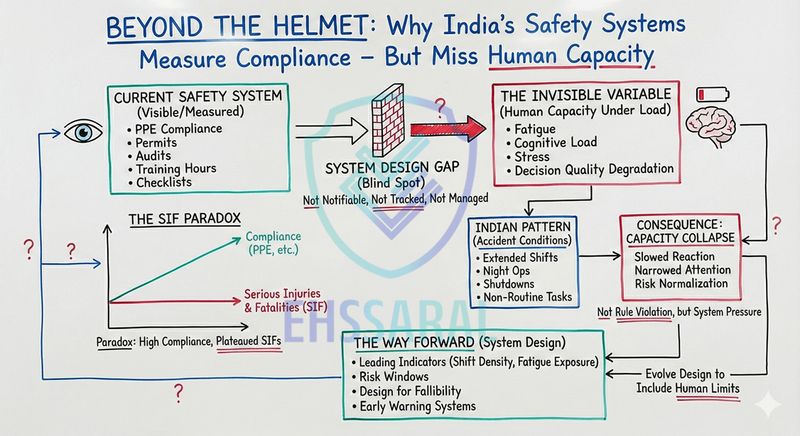
Indian industry has invested heavily in safety over the past two decades. Personal Protective Equipment (PPE) compliance, permit systems, safety training, toolbox talks, and audit mechanisms are now widely embedded across sectors. On paper, safety maturity has never been higher.
Yet a paradox remains.
Despite near-universal adoption of visible safety controls, Serious Injury & Fatality (SIF) rates have largely plateaued. Serious accidents continue to occur - often during routine operations, involving experienced workers, and in organisations that are otherwise “fully compliant.”
This raises a critical question that is rarely asked openly:
If compliance is high, why do serious accidents persist?
This paper argues that the answer lies not in a failure of discipline or intent, but in a system design gap within India’s safety framework - a gap that prevents organisations from seeing one of the most significant precursors to serious accidents: human capacity under load.
India’s safety systems are designed to measure what is visible, auditable, and enforceable:
These controls are necessary and have undoubtedly reduced minor injuries. However, they are built on an implicit assumption: that human decision-making capacity remains constant, regardless of working hours, fatigue, stress, or cognitive load.
In practice, this assumption does not hold.
Global safety research consistently shows that fatigue and cognitive overload degrade:
Yet within Indian regulatory and inspection frameworks, fatigue is largely unmeasured. Psychosocial stress and mental load are not classified as notifiable occupational risks, and therefore rarely become management metrics.
What is not legally defined cannot be systematically tracked.
What is not tracked cannot be managed.
This is not negligence by industry or EHS professionals.
It is a structural blind spot.
Serious accidents in Indian factories show a consistent pattern:
These are not failures of PPE or training.
They are moments of capacity collapse, where human limits are exceeded under system pressure.
This risk is further amplified for contract workers, who often carry “imported fatigue” - exhaustion accumulated outside the factory boundary due to long commutes, consecutive deployments, or secondary employment. Such fatigue remains invisible to biometric attendance systems but directly affects alertness during high-risk tasks.
Traditional behaviour-based safety approaches ask:
“Why did the worker make a mistake?”
A system-oriented lens asks instead:
“Why did the system allow conditions where failure became likely?”
This paper advocates a gradual but necessary shift in safety thinking - from blaming individuals to designing systems that respect human limits.
The next phase of safety excellence in India will not be achieved through stricter helmets or additional checklists. It will come from expanding safety measurement beyond compliance to include leading indicators of human capacity, such as fatigue exposure, shift density, and risk accumulation.
India’s safety systems have performed exactly as they were designed to.
The challenge - and the opportunity - now lies in evolving that design.
Over the last two decades, Indian factories have made measurable progress in formal safety systems. Across most organised sectors, safety today is defined and assessed through a familiar set of indicators:
These controls exist for good reason. They are visible, auditable, and legally defensible. They allow organisations to demonstrate due diligence and enable regulators to assess compliance efficiently.
From an enforcement standpoint, this model works.
From an outcome standpoint, it is no longer sufficient.
Despite rising compliance maturity, Serious Injury & Fatality (SIF) outcomes have not declined proportionately. In many sectors, they have stabilised or reduced marginally - but not at the rate one would expect given the scale of investment in safety programs.

This creates an uncomfortable but important observation:
The safety system is functioning - but its results have plateaued.
When systems mature yet outcomes stagnate, the explanation is rarely “lack of effort.”
More often, it indicates that key risk variables sit outside the measurement framework.
Indian safety systems continue to improve what they already measure well. But they struggle to influence risks that remain invisible to audits and inspections.
In factory environments, cognitive load is not an abstract psychological concept. It manifests in practical, everyday ways:
As cognitive load increases, attention narrows. Reaction time slows. The margin for error shrinks.
Importantly, this degradation is gradual and often unnoticed by the individual experiencing it.
Fatigue is frequently misunderstood as simple physical tiredness. In reality, fatigue represents a measurable reduction in decision quality.
Under fatigue:
This explains a common but counterintuitive pattern: serious accidents often involve experienced workers, not new or untrained ones.
Experience reduces uncertainty - but under fatigue, it can also reduce caution.
International safety frameworks increasingly recognise fatigue and cognitive overload as systemic risk factors, not personal weaknesses. Concepts such as Human & Organisational Performance (HOP) and Safety Differently emphasise that:
These frameworks are well-established globally. However, they are referenced here only to frame thinking, not to impose foreign models onto Indian industry.
India’s context - labour structure, inspection culture, and compliance priorities - is distinct.

Indian safety regulations are structured around tangible, observable hazards:
Psychosocial risks such as fatigue, cognitive overload, and mental stress are largely absent from statutory reporting mechanisms. They are neither classified as notifiable conditions nor systematically reviewed during inspections.
This creates a predictable outcome:
What is not legally defined does not become a performance indicator.
Recent Labour Law Reforms: Progress, Not Completion
India’s recent implementation of unified Labour Codes has significantly modernised employment structures through mandatory appointment letters, defined working hours, overtime provisions, expanded ESIC coverage, and clearer wage components. These reforms represent an important step toward formalisation, transparency, and worker protection.
However, while these changes regulate employment conditions, they do not yet translate into systematic measurement of human capacity under load. Working hours may be defined, but fatigue accumulation, cognitive overload, and recovery adequacy remain largely unmeasured within safety frameworks.
This distinction highlights both progress and limitation: the regulatory system is evolving, but its safety design still focuses on contractual compliance rather than operational readiness.
Most factories do not ignore fatigue out of indifference. They ignore it because the system offers no formal way to see it:
Attendance systems track presence, not readiness.
Shift rosters track hours, not cognitive load.
This is not a failure of intent.
It is a design limitation inherited from an earlier era of safety thinking.
It is important to state this explicitly:
The absence of fatigue measurement in Indian safety systems is a structural gap, not negligence by industry or EHS professionals.
Most safety teams operate within the boundaries of what the system allows them to manage. Expecting different outcomes without expanding those boundaries places unfair responsibility on individuals rather than on system design.
In the absence of integrated datasets linking fatigue to SIFs, the most reliable evidence available is pattern consistency. Across sectors, geographies, and company sizes, serious industrial accidents in India show recurring operational conditions.
These conditions are so familiar to EHS professionals that they often go unexamined.
Serious incidents in Indian factories disproportionately occur during:
These are not marginal scenarios.
They are core operating realities of Indian industry.
Yet they share one common feature: elevated cognitive and physical load at the time of execution.
Personal Protective Equipment is designed to reduce exposure to physical hazards. It does not compensate for:
PPE assumes that the person wearing it is alert, attentive, and capable of recognising danger in time to respond.
In high-fatigue conditions, this assumption fails.
This is why many serious incidents occur despite full PPE compliance and procedural adherence.
They are not rule violations.
They are capacity collapses.
One of the least discussed - yet most consequential - risk factors in Indian factories is imported fatigue, particularly among contract workers.
While permanent staff fatigue is partially visible through shift rosters and overtime records, contract labour often arrives at the workplace with pre-existing exhaustion caused by:
This fatigue originates outside the factory boundary, making it invisible to:
From a compliance perspective, the worker appears “fresh.”
From a human performance perspective, they are already depleted.
The safety system does not recognise this distinction - yet the risk is real.
Behaviour-Based Safety has delivered tangible improvements in Indian industry. It has helped:
For routine, low-complexity tasks, BBS remains effective.
Behaviour-based approaches assume that:
Under fatigue and cognitive overload, these assumptions no longer hold.
In such conditions:
When serious accidents are investigated solely through a behavioural lens, the outcome is predictable:
The system remains unchanged.
After most serious incidents, the question asked is:
“Why did the worker do this?”
A system-oriented question would be:
“Why did the system allow conditions where failure became likely?”

This shift is not semantic.
It determines whether the response prevents recurrence or simply assigns blame.
It is critical to distinguish between:
Indian safety systems are well-equipped to manage the first.
They are largely blind to the second.
As long as this distinction remains unrecognised, serious accidents will continue to recur - even in “highly compliant” organisations.
Traditional safety systems are built around an implicit expectation of human consistency - that trained workers will always perceive risk correctly, follow procedures precisely, and respond optimally under pressure.
Decades of operational experience show that this expectation is unrealistic.
Human error is not an anomaly.
It is a predictable outcome of system conditions.
Human & Organisational Performance (HOP) reframes safety by accepting a foundational truth:
People do not come to work intending to fail.
Failure emerges when systems place people in conditions where success becomes unlikely.
This perspective does not remove accountability. Instead, it shifts the focus of accountability upstream - toward the design of work, schedules, task sequencing, and recovery time.
Why people struggle with compliance in SME in India? Read more
A system-oriented safety approach asks different questions before incidents occur:
By anticipating error rather than reacting to it, safety becomes preventive by design, not corrective after harm.
Accident rates, injury counts, and lost-time metrics are lagging indicators. They tell organisations what has already gone wrong.
While necessary for reporting and benchmarking, they are poor tools for prevention.
By the time a serious incident appears in statistics, the system has already failed.
Future-ready safety systems will expand beyond compliance metrics to include early warning signals related to human performance, such as:
Individually, these indicators may appear benign.
Collectively, they signal elevated risk exposure.
A critical concern in fatigue-related safety discussions is the fear of intrusive monitoring. The intent of capacity-based safety is not surveillance or micromanagement.
The objective is system support, not worker monitoring.
Effective approaches focus on:
When fatigue risk is treated as a design issue rather than a personal weakness, trust is preserved.
As safety thinking evolves, organisations will begin tracking:
These metrics do not replace existing safety controls.
They complement them.
The future of industrial safety lies in anticipation:
In such systems, intervention occurs before capacity collapses, not after incidents demand explanation.
This transition does not require regulatory overhaul overnight. It begins with recognition - acknowledging that current systems, while well-intentioned, were designed for a different operational era.
The goal is evolution, not disruption.
For factory leadership and senior management, the persistence of serious accidents despite strong compliance performance presents a strategic risk.
Serious incidents:
In many cases, organisations respond by reinforcing existing controls - more training, stricter supervision, additional audits. While these actions demonstrate intent, they often fail to address why the system allowed risk to accumulate in the first place.
Recognising fatigue and cognitive load as safety risks enables leadership to:
This is not about lowering expectations.
It is about aligning expectations with human limits.
India’s safety regulatory framework has played a critical role in raising baseline compliance across industry. That achievement should not be understated.
At the same time, evolving industrial complexity presents an opportunity to:
The objective is not to expand enforcement burdens, but to modernise safety supervision in a way that reflects contemporary operational realities.
Incremental evolution - not abrupt reform - offers the most sustainable path forward.
An Opportunity to Extend Reform into Safety Design
The intent behind recent labour reforms - clearer contracts, regulated hours, and expanded social security - indicates a growing recognition of worker wellbeing as a governance priority. Extending this intent into safety systems presents a natural next step.
Without introducing new mandates, regulators can encourage risk-based safety thinking that complements existing compliance structures by recognising fatigue exposure, recovery time, and task complexity as contributors to serious accidents. Such an approach would strengthen prevention while preserving the clarity and enforceability of current frameworks.
This white paper does not present a statistical correlation study between fatigue and Serious Injury & Fatality outcomes in Indian factories.
That limitation is intentional.
At present:
The analysis presented here is based on:
This paper is intended as a problem-framing document, not a definitive measurement study.
Its purpose is to surface blind spots, not to assign blame.
Indian industry has made meaningful progress in safety. Helmets are worn. Procedures are followed. Audits are conducted.
Yet serious accidents persist.
This paper has argued that the explanation lies not in weak discipline or poor intent, but in a system design gap - a safety framework that measures compliance well, but human capacity poorly.
Fatigue, cognitive load, and imported exhaustion remain largely invisible within current systems, even as they shape risk at the moment it matters most.
The next chapter of safety excellence in India will not be written through stricter enforcement alone. It will be written through smarter system design - systems that anticipate human fallibility, respect human limits, and intervene before capacity collapses.
India does not need to abandon its existing safety foundations.
It needs to build upon them.
That evolution begins by looking beyond the helmet.
Cognitive Load
The mental effort required to perform tasks, make decisions, and maintain attention during work, especially under time pressure, multitasking, or non-routine conditions.
Fatigue Risk
The increased likelihood of errors or unsafe decisions arising from physical tiredness, mental exhaustion, extended working hours, inadequate rest, or cumulative workload.
Human & Organisational Performance (HOP)
A safety approach that recognises human error as a predictable outcome of system conditions and focuses on designing work systems that anticipate and reduce the likelihood and impact of failure.
Imported Fatigue
Pre-existing physical or mental exhaustion that a worker brings into the workplace due to factors outside the factory boundary, such as long commutes, consecutive site deployments, secondary employment, or insufficient rest between shifts.
The perspectives discussed in this paper are informed by globally recognised safety thinking and institutional guidance, including:
These references are used to frame concepts, not to draw direct statistical comparisons with Indian industry.
What This Paper Does Not Claim
Areas Requiring Future Data and Study
This paper is intended as a problem-framing and system-insight document, aimed at supporting more informed safety design and discussion.

Founder, EHSSaral
Founder - EHSSaral | Partner - Perfect Pollucon | ISO 14001 Lead Auditor | GHG Protocol Scope 2 | Chemist | Data Scientist | Second-generation environmental professional simplifying EHS compliance for Indian industries through practical, automated, tech-enabled, data driven compliance workflows.
What Is EHS & Why India Needs It | EHSShala

The ZLD Mass Balance Trap: How Auditors Calculate Effluent Using Your Water Bills | EHSSaral
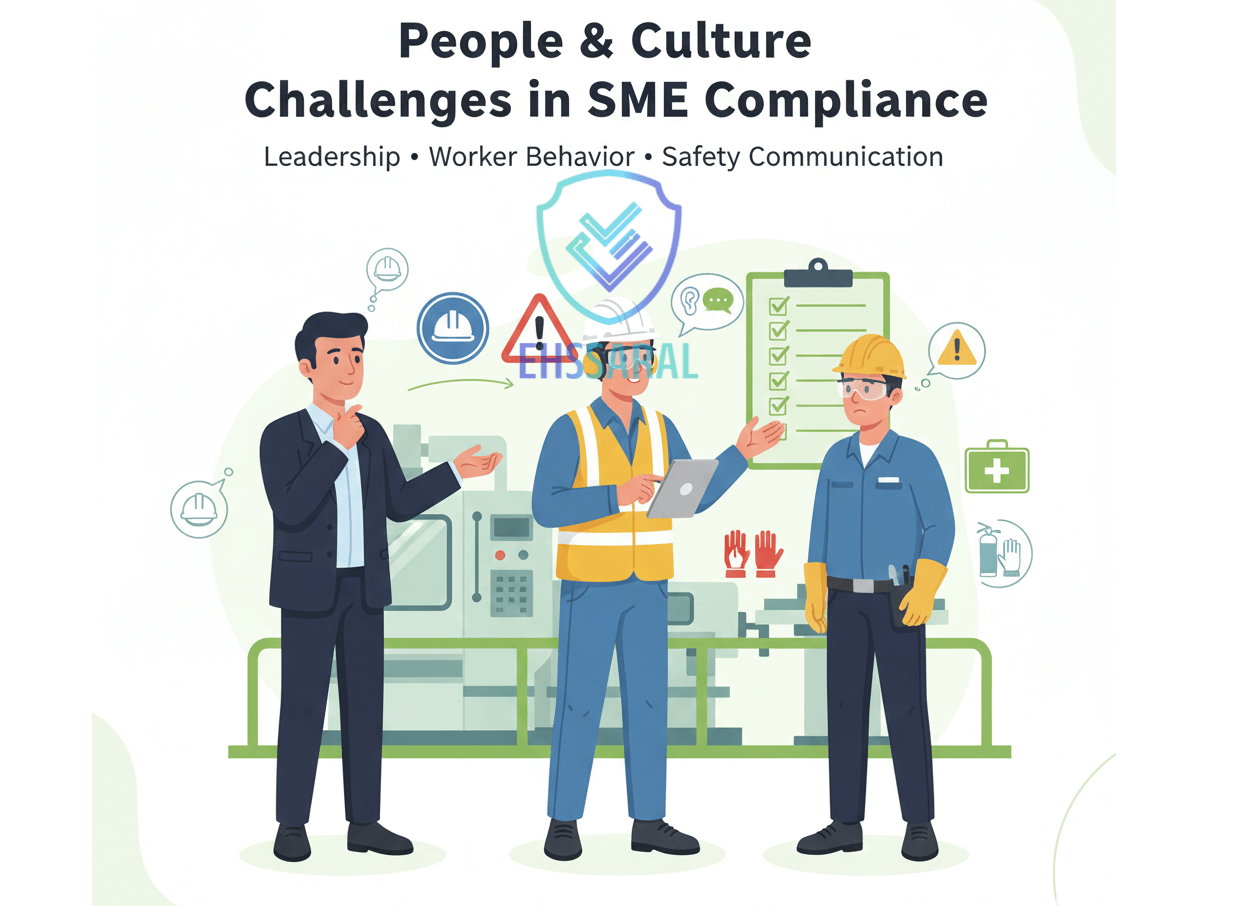
Why Safety Culture Fails in Indian SMEs: People & Compliance Challenges | EHSSaral Research
Manual Stack Monitoring vs OCEMS: Why Results Differ in Environmental Compliance
Used Oil & Waste Oil Management in India - Factory & EHS Guide | EHSShala
Isokinetic Sampling Basics: Simple Guide for Stack Monitoring | EHSShala
Hazardous Waste Storage Rules in Indian Factories | EHSShala
Hazardous Waste Compatibility & Segregation Guide India
Types of Pollution in Industries Expert Guide | EHSShala
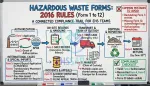
Hazardous Waste All Forms Form 1 to Form 12 Guide