
Blog
Environmental Compliance KPIs for Manufacturing in India
EHSSaral is an Environmental Compliance Intelligence Platform for Industries. Consent Intelligence • Alerts & Tasks • Incident Reporting • Form IV & V • Audit-Ready Records
See how EHSSaral works
10 Aug 2026
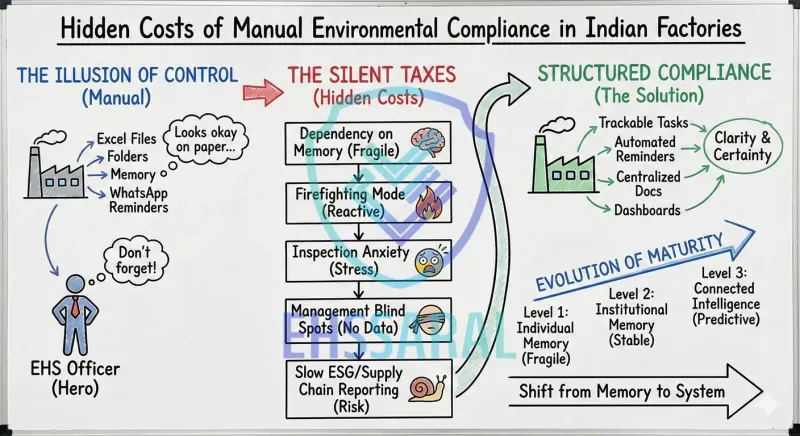
Most Indian plants don’t fail compliance because they don’t care. They fail because compliance is stored in memory, not in systems.
Manual compliance creates silent costs: stress, dependency, firefighting, blind spots, and slow reporting.
The biggest hidden risk is institutional fragility (one person leaves → knowledge leaves).
Structured compliance is not “fancy software.” It is clarity: tasks, reminders, traceable records, and dashboards.
Compliance maturity moves in 3 levels: Individual Memory → Institutional Memory → Connected Intelligence.
Manual environmental compliance in India refers to managing consent conditions, hazardous waste returns, monitoring schedules, and regulatory filings through Excel sheets, physical registers, and memory-based tracking instead of structured task systems. While it may function at small scale, it creates hidden operational, cultural, and strategic risks as complexity increases.
This increases chances of Google picking paragraph snippet.
Walk into most Indian factories and you will see effort.
Registers maintained.
Files arranged.
Consent copies printed and stamped.
Returns filed before deadlines.
On paper, compliance appears under control.
From a practical standpoint, however, something deeper is happening.
The real cost of compliance never appears in financial statements.
It shows up as:
Stress during inspection.
Dependency on one individual.
Last-minute scrambling before portal deadlines.
Repeated interpretation confusion.
Silent fear that something might have been missed.
This article is not written to criticize manual systems.
Manual compliance has served Indian industry for decades.
But the regulatory environment has matured.
Digital portals exist.
OCEMS data flows continuously.
EPR tracking is online.
ESG reporting is entering supply chains.
When the ecosystem evolves, internal systems must evolve too.
The question is not:
“Are we managing compliance?”
The question is:
“At what hidden cost are we managing it?”
Online Consent management systems
In many Indian SMEs, compliance typically looks like this:
Consent PDF saved on a desktop folder.
Conditions reviewed once during issuance.
Lab reports archived in email threads.
Renewal dates remembered by the EHS officer.
SPCB portal filings handled close to due date.
This works.
Until complexity increases.
Manual systems survive because:
“We have always managed.”
No major penalty has occurred yet.
One experienced person handles everything.
Management trusts the officer in charge.
The absence of visible failure creates confidence.
But confidence and system strength are not the same thing.
When knowledge lives inside people rather than processes, risk remains invisible.
And invisible risk is the most expensive kind.
Manual compliance does not create dramatic collapse.
It creates silent taxes.
These taxes accumulate gradually, often without anyone noticing.
Let us examine them carefully.

In many factories, compliance logic lives in people.
One officer remembers:
Which annexure applies to which return.
How hazardous waste categories were interpreted.
When renewal files were last submitted.
Which clarification was verbally agreed upon during inspection.
When knowledge lives in individuals:
Management has limited visibility.
Interpretation shifts when personnel change.
Historical commitments are difficult to trace.
Transition becomes unstable.
When an experienced EHS officer leaves:
Tracking methods change.
Informal monitoring habits disappear.
New officer may take 6-8 months to fully understand the historical logic.
The disruption is rarely dramatic.
It is subtle.
Deadlines are remembered slightly differently.
Records are filed in new formats.
Past inspection remarks are not fully understood.
Uncertainty increases.
And uncertainty increases mistakes.
A factory that depends on one memory is one resignation away from instability.
In many compliance environments, respect is linked to recall.
Authority often comes from:
Quoting rule numbers instantly.
Remembering circular updates by memory.
Citing section clauses without opening documents.
Memory earns authority.
But compliance excellence is not memory.
It is consistent execution.
When compliance depends on a single “knowledge hero”:
Others hesitate to question.
Processes remain undocumented.
Junior officers do not learn structured thinking.
Dependency increases quietly.
Over time, compliance becomes personality-driven instead of system-driven.
Structured compliance does not reduce the importance of experience.
It amplifies it.
It shifts authority from:
“Who remembers the most?”
to
“How consistently is the system followed?”
That shift is not technological.
It is cultural maturity.
Let us look at something practical.
In manual environments, time is consumed in small fragments:
Tracking upcoming deadlines.
Searching past lab reports.
Compiling inspection files.
Rewriting standard replies.
Cross-checking production against consent limits manually.
Individually, each activity feels manageable.
Collectively, they accumulate.
Over a year, this can mean:
50-100 hours spent on repetitive, non-strategic effort.
A simple way to see this cost:
If a senior EHS professional earns ₹8-12 lakh/year, 50 hours of avoidable manual work is roughly ₹20,000-₹35,000 in direct salary cost.
But the bigger cost is opportunity: those hours don’t go into prevention, training, and system improvement.
That is time not spent on:
Preventive risk assessment.
Process improvement.
Team training.
Strategic environmental planning.
Manual compliance does not only consume time.
It limits capacity building.
When professionals spend energy maintaining memory systems, they cannot invest energy in improvement systems.
That is the human cost few factories calculate.
When compliance becomes firefighting, calm compliance becomes impossible.
The human side is only the beginning.
When compliance remains manual, the daily operational rhythm of the factory begins to change.
Not visibly.
But structurally.
Manual systems are reactive by design.
Common patterns seen in day-to-day operations:
Hazardous waste annual return prepared close to the deadline.
Consent renewal initiated in the final month.
Calibration records gathered when inspection notice arrives.
Production vs consent quantity checked only during audit.
Nothing is technically “ignored.”
But everything is event-driven.
Excel does not send reminders.
Folders do not escalate risks.
Memory does not alert you 30 days in advance.
So compliance becomes a cycle of:
Notice → Reaction → Stabilization → Silence → Repeat.
Over time, this normalizes a firefighting culture.
Instead of asking:
“Are we consistently within limits?”
The question becomes:
“What will the inspector ask this time?”
When compliance operates in reaction mode, stress becomes embedded in the system.
In structured systems, inspections are routine.
In manual systems, inspections are high-pressure events.
You may recognize this pattern:
Files searched across multiple folders.
Registers cross-verified at the last moment.
Supporting documents printed overnight.
Clarifications drafted under time pressure.
The break is not dramatic.
It is quiet chaos:
A show-cause notice asks for six months of waste trend data. It takes three days to compile.
An inspector asks for historical calibration proof. Records exist in four different folders.
Production data needs reconciliation with consent limits. Cross-checking begins manually.
Each incident alone is manageable.
Together, they reveal system weakness.
But the impact rarely stays inside the EHS department.
Production pauses to compile data.
Maintenance searches for logs.
Accounts looks for payment proofs.
Management cancels meetings to coordinate response.
The cost is not only regulatory.
It is organisational friction.
The cost is not always penalty.
It is anxiety.
And anxiety spreads beyond the EHS department.
Production, maintenance, and management begin to feel it.
Stress is rarely shown in budgets.
But it affects decision quality.
Manual compliance systems rarely accumulate intelligence.
Every year:
Similar show-cause notices arise.
Similar renewal clarifications are requested.
Similar portal errors are faced.
Similar storage-day tracking issues reappear.
Why?
Because lessons remain local.
Files are archived.
But patterns are not analyzed.
There is no structured tracking of:
Recurring compliance gaps.
Repeated documentation weaknesses.
Common inspection queries.
Without feedback capture, improvement becomes accidental.
Compliance remains survival-based.
Not evolution-based.
A system that does not learn forces people to relearn the same lessons.
And relearning is expensive.
Beyond daily stress and operational friction, manual compliance creates strategic limitations.
These are less visible.
But more dangerous.
Plant heads often believe:
“Compliance is under control.”
And in many cases, officers genuinely try their best.
But without structured dashboards:
Production is not automatically compared against consent capacity.
Hazardous waste storage days are not visibly tracked.
Upcoming renewal timelines are not centrally visible.
Compliance task status is not summarized for leadership.
Decisions are made without live data.
Management confidence depends on verbal updates.
When visibility depends on conversation instead of system, blind spots form.
And blind spots grow quietly.
If the MD needs two days to know compliance status, the system is already breaking.
Consultants play an important role in Indian compliance ecosystems.
They bring interpretation clarity and regulatory updates.
But when internal systems are weak:
Even minor queries are outsourced.
Inspection preparation becomes consultant-driven.
Interpretation remains external knowledge.
The issue is not consultants.
It is dependency.
A strong internal structure allows consultants to advise strategically.
A weak internal structure forces consultants to substitute basic system gaps.
Over time, this increases cost and reduces internal confidence.
Consider aviation.
In aviation:
Every near miss is logged.
Every incident is analyzed.
Patterns are shared across the industry.
Systems evolve collectively.
That is sector intelligence.
In compliance ecosystems:
A notice received by one factory remains in one file.
A recurring interpretation issue stays within one office.
A portal glitch is solved locally, not documented widely.
Lessons are not systematically shared.
Compliance intelligence remains fragmented.
Each factory learns alone.
And often learns the hard way.
When intelligence is fragmented, mistakes repeat across geography.
Manual systems do not allow aggregation.
Without aggregation, prediction is impossible.
Compliance remains reactive.
Manual systems keep factories isolated.
So every factory learns the hard way, even when the same mistake has happened elsewhere.
Sector intelligence is not about fixing the whole industry. It is about reducing isolation.
When intelligence is fragmented, factories are forced to learn alone.
Real scenario (January 2026):
A large automotive buyer sends a supplier ESG questionnaire asking for:
24-month hazardous waste trend (category-wise)
Emission deviation summary + corrective actions
Monthly water consumption per unit production
Proof of monitoring frequency compliance
Calibration traceability records
Manual factory response time: 2-3 weeks
Structured factory response time: 2 hours
In competitive supply chains, compliance reporting speed becomes a business advantage.
This is not future risk. This is current market reality.

You recognize it when:
The MD asks “Are we compliant?” and the answer takes 2 days, not 2 minutes.
A show-cause notice demands trend data and everyone starts working backward through emails.
A buyer audit forces file compilation to take priority over operations.
The new EHS officer asks “Why do we do it this way?” and nobody can explain clearly.
Each incident feels like an exception.
Until exceptions become the pattern.
BRSR (Business Responsibility and Sustainability Reporting)
Before moving forward, let us clarify something important.
Structured compliance is not software.
It is not automation.
It is not complexity.
It is clarity.
It means:
Consent conditions converted into trackable tasks.
Clear responsibility mapping.
Automated reminders instead of memory-based alerts.
Centralized document archives.
Historical inspection logs with searchable references.
Dashboard-level visibility for management.
Decisions recorded with timestamps and context.
It shifts compliance from:
“Who remembers it?”
to
“How is it systemized?”
This shift reduces dependency.
It reduces uncertainty.
It reduces reaction cycles.
Structure does not replace experience.
It protects it.
In practical terms, many factories are now experimenting with simple digital tools that convert consent conditions into task-based workflows with reminders and document traceability. Platforms like EHSSaral are being built specifically for Indian environmental compliance realities - including consent tracking, hazardous waste timelines, and inspection readiness - with entry-level access available at no cost for single facilities.
The tool is secondary.
The structure is primary.
Consent conditions become trackable tasks
Tasks have owners and frequencies
Evidence is attached and archived
Reminders are system-generated
Inspection records are searchable
Management visibility is real-time

Compliance maturity evolves in stages.
Understanding this progression is important.
If Ramesh leaves, we lose 5 years of compliance knowledge.
Compliance knowledge lives in people.
Deadlines tracked mentally.
Registers maintained manually.
Interpretation varies with personnel.
This level depends heavily on individual competence.
It can function.
But it is fragile.
If Ramesh leaves, the next officer can continue the process immediately.
Consent conditions converted into structured tasks.
Monitoring schedules documented.
Historical replies archived systematically.
Management visibility established.
Knowledge shifts from individuals to the organisation.
Attrition risk reduces.
Consistency improves.
This level creates stability.
When a new rule comes, we already know how it is being interpreted across the sector.
Aggregated compliance patterns analyzed.
Recurring interpretation gaps identified.
Monitoring deviations studied over time.
Lessons shared across systems.
At this level:
Compliance becomes predictive.
Instead of waiting for a notice, patterns indicate risk.
Instead of repeating mistakes, systems prevent them.
The future of compliance does not lie in memorizing more rules.
It lies in reducing uncertainty through structure and intelligence.
Maturity in compliance is not about knowing more laws.
It is about knowing your status clearly - at any moment.
Before concluding, consider a few simple questions.
Can you see your next 90-day compliance tasks instantly?
Can you track production against consent limits without manual reconciliation?
Can someone step into the EHS role tomorrow and continue without disruption?
Can you generate last 12-month waste or emission trends within minutes?
If the answer to two or more of these is uncertain, the system is operating at Level 1.
Manual compliance is not wrong.
But it is limited.
Manual compliance made sense when:
Reporting was paper-based.
Inspections were infrequent.
ESG expectations were minimal.
Digital portals were limited.
The regulatory environment has matured.
Factories must mature alongside it.
The hidden costs of manual compliance are not future risks.
They are present realities that most balance sheets never capture.
Structured compliance does not add cost.
It reveals what was already being spent -
in stress, in dependency, in opportunity loss.
Certainty is not expensive.
Uncertainty is.
If your factory currently operates at Level 1 (Individual Memory), the first step is not transformation. It is visibility.
Start by converting your consent conditions into a trackable task list. Even a simple structured system creates clarity.
For factories looking to experiment with structured environmental compliance workflows, EHSSaral offers a free registration model designed for Indian SMEs. It is one way - among many - to begin moving from memory-based compliance toward institutional memory.
Clarity at the process level avoids confusion later.
Manual environmental compliance means managing consent conditions, hazardous waste returns, monitoring schedules, and regulatory filings through Excel sheets, physical registers, emails, and memory-based tracking instead of structured task systems.
It often works at small scale - but becomes fragile as complexity increases.
Manual systems rely heavily on experienced individuals.
As long as deadlines are remembered and inspections are routine, the system appears stable.
The weakness becomes visible only when:
A show-cause notice demands historical data
A key EHS officer resigns
A buyer requests structured ESG information
Multi-site expansion begins
Manual compliance fails quietly - not dramatically.
Learn ESG Data Management for Indian Factories by EHSSaral
The biggest hidden risk is institutional fragility.
When compliance knowledge lives inside people instead of processes:
Attrition becomes risky
Interpretation changes over time
Historical commitments are difficult to trace
Management lacks visibility
A factory dependent on one individual is one resignation away from instability.
When compliance tracking is manual:
Files are scattered across folders
Trend data must be compiled on request
Calibration and monitoring records are not centrally structured
This turns inspections into high-pressure events instead of routine reviews.
Structured systems reduce inspection anxiety by keeping documentation organized and visible.
No.
Complexity determines need - not size.
A 50-person factory with:
Multiple hazardous waste streams
DG sets and stack emissions
Online portal filings
Still requires structured tracking.
Compliance maturity is about clarity, not company size.
Institutional memory means compliance knowledge is stored in systems rather than individuals.
It includes:
Trackable consent condition tasks
Historical inspection replies
Document archives
Monitoring schedules with reminders
If one person leaves, the system continues without disruption.
Individual memory depends on a person remembering deadlines and interpretations.
Institutional memory depends on documented systems that:
Track tasks automatically
Record evidence
Maintain historical data
Provide management dashboards
Institutional memory reduces risk and improves continuity.
Large buyers now request structured environmental data, such as:
12-24 month hazardous waste trends
Emission compliance summaries
Water consumption per unit production
Calibration traceability
Manual systems often take weeks to compile this information.
Structured systems can generate it quickly - improving supply chain credibility.
Because manual systems are event-driven.
Deadlines are tracked in memory.
Tasks are handled when reminders surface.
Documentation is prepared when requested.
Without automated reminders and structured dashboards, compliance becomes reactive instead of predictable.
Ask four questions:
Can we see next 90-day compliance tasks instantly?
Can production vs consent limits be verified without manual reconciliation?
Can someone else step into the EHS role tomorrow without disruption?
Can we generate last 12-month monitoring trends within minutes?
If the answer is uncertain, the system is still operating at individual memory level.
Sector intelligence refers to aggregated learning from multiple facilities or industries, where recurring compliance gaps and interpretations are analyzed collectively.
In fragmented systems, each factory learns alone.
In connected systems, lessons reduce repeated mistakes across the sector.
Not necessarily.
Structured compliance means:
Clear task lists
Assigned responsibilities
Documented evidence
Timely reminders
Management visibility
It is about system clarity, not complexity.
Technology can support it - but structure is the foundation.

Founder, EHSSaral
Founder - EHSSaral | Partner - Perfect Pollucon | ISO 14001 Lead Auditor | GHG Protocol Scope 2 | Chemist | Data Scientist | Second-generation environmental professional simplifying EHS compliance for Indian industries through practical, automated, tech-enabled, data driven compliance workflows.
Environmental Compliance KPIs for Manufacturing in India
Manual Stack Monitoring vs OCEMS: Why Results Differ in Environmental Compliance
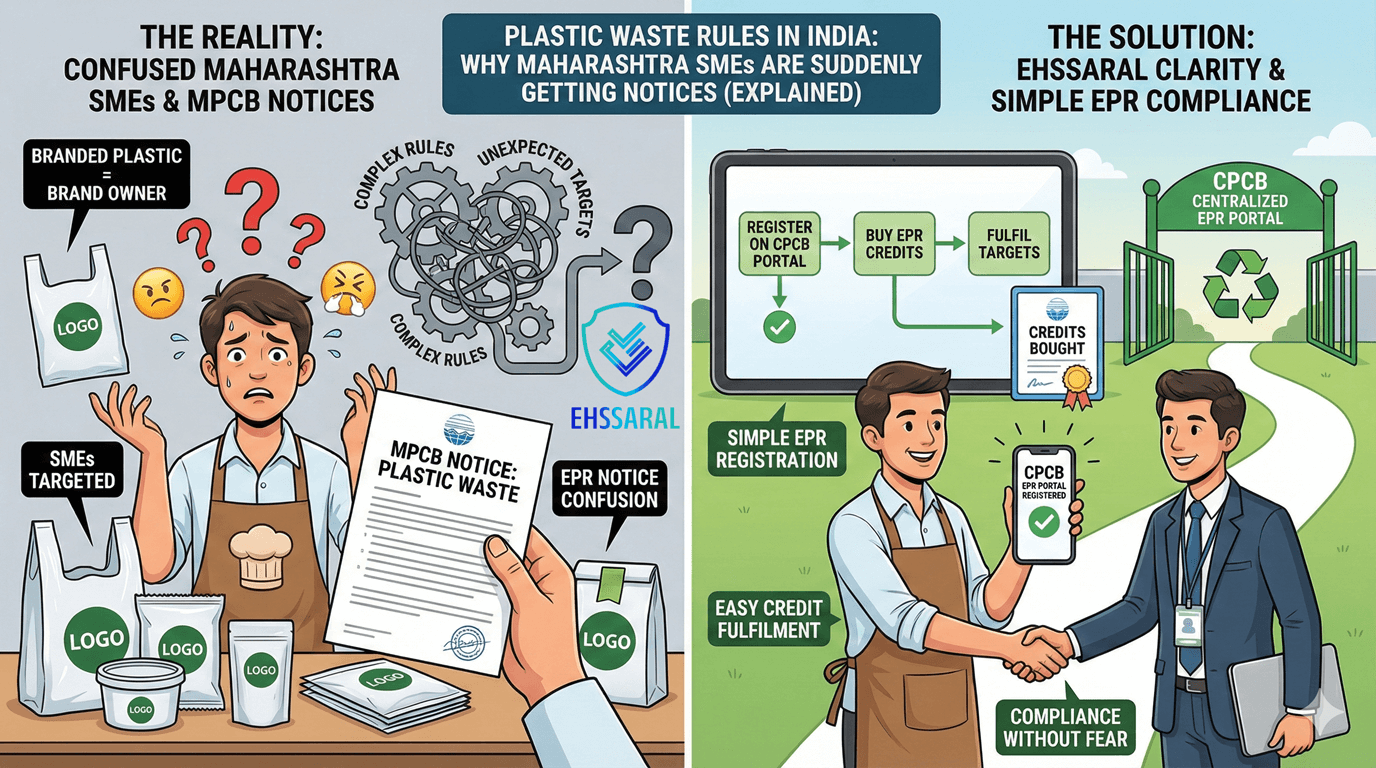
Maharashtra SME Plastic Waste EPR Guide: Are You a Brand Owner | EHSSaral
Form 3 Logbook Explained: Simple Guide for Indian Factories | EHSShala
 List, Rules & Compliance Guide ehssaral.webp)
Orange Category Industries in India (2026): List, Rules & Compliance Guide
 EHSSaral v1.png)
Blue Category MPCB 3-Year Consent Validity for Recyclers (2026) | EHSSaral
ETP & STP Troubleshooting: The Complete Indian Guide | EHSShala

Environmental Compliance vs Environmental Accounting in India
Hazardous Waste All Forms Form 1 to Form 12 Guide
ESG Data Management for Indian Factories | EHSSaral