
Blog
CTO Auto-Renewal: Capital Investment Rules 10% & 30% | EHSSaral
EHSSaral is an Environmental Compliance Intelligence Platform for Industries. Consent Intelligence • Alerts & Tasks • Incident Reporting • Form IV & V • Audit-Ready Records
See how EHSSaral works
27 Apr 2026
What it really means on the Indian factory floor
Let’s clear one thing first.
Consent to Operate (CTO) is not a certificate you keep in a file to show only when someone asks.
CTO decides one simple thing:
Can your factory legally operate today or not?
That’s it.
Most problems around CTO do not come from pollution.
They come from misunderstanding what this paper actually controls.
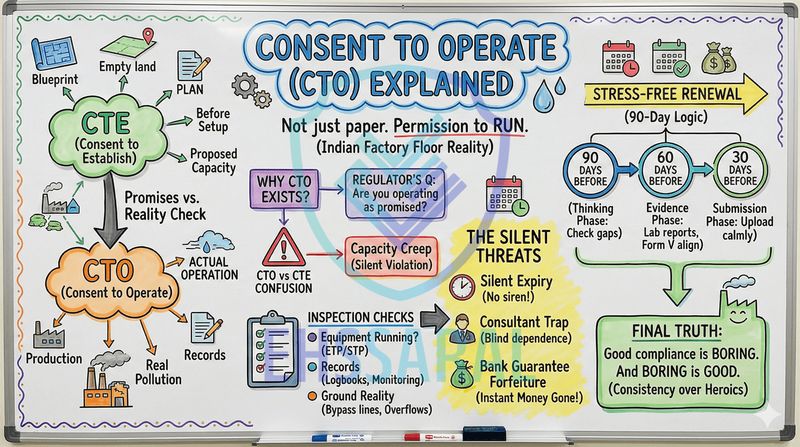
CTO exists because regulators want to check one basic thing:
Are you operating the way you said you would?
When a unit applies for Consent to Establish (CTE), it makes promises:
CTO is where the Board checks whether those promises are visible on the shop floor during actual operation.
This is not about perfection.
This is about control, consistency, and honesty.
In real inspections, officers are not expecting zero deviation.
They are checking whether things make sense on ground.
Read Ultimate guide for SPCB Consent
This confusion is extremely common, even in well-run factories.
CTE applies before anything starts:
It is based on drawings, layouts, and proposed numbers.
CTE answers one question:
What do you plan to do?
CTO applies after the plant starts running:
It is based on actual performance and records.
CTO answers one question:
What are you actually doing?
This situation comes up again and again:
On ground, everything looks fine.
During inspection, one simple question comes up:
“Is this capacity covered in your CTO?”
Silence at that moment creates the problem.
CTO is required in most operating scenarios, including:
Many units assume:
“We are small, so CTO may not be required.”
That assumption often fails during inspection.
Yes, White category units usually require intimation, not CTO.
But problems arise when:
On paper, the unit still appears White.
On ground, it may not be.
This mismatch is often noticed during inspections, not during application.
CTO expiry does not announce itself.
There is:
“CTO expiry is silent. The notice is not.”
Many EHS officers realise the expiry only when:
This usually happens not because of negligence, but because no one was tracking the date.
In many factories:
So CTO becomes:
This mindset causes more stress than compliance itself.
A healthier approach looks like this:
“An aware EHS officer is always safer than a silent one.”
Before reading further, ask yourself one simple question:
Do I know my current CTO expiry date and permitted capacity?
If the answer is “not fully sure”, you are not alone.
And this article is meant exactly for that situation.
This is where many people get nervous.
Not because something is wrong, but because they don’t know what the officer is really looking for.
On paper, inspections look technical.
On ground, they are mostly logic checks.
One of the first things officers notice is not whether equipment exists, but whether it is actually being used.
Common checks include:
A plant with a simple, visibly running system is often safer than a plant with a complex system that no one understands.
Let’s be honest.
In many units, bypass lines exist.
Overflow arrangements exist.
Temporary hoses exist.
Inspectors know this.
So the check is usually:
A visible bypass with a clear explanation is safer than a hidden one with denial.
What creates trouble is not the pipe.
It is pretending the pipe does not exist.
Officers also look for:
They are trying to understand:
“If something goes wrong, does pollution go outside the system?”
Even a simple written explanation helps more than silence.
Many factories maintain thick files.
But during CTO-related checks, a few records matter more than others.
These are checked for:
A single high value is usually discussed.
Repeated gaps or missing submissions raise questions.
Inspectors often flip through:
They are not checking handwriting quality.
They are checking:
This is where many units slip.
Equipment may be working, but:
These gaps usually come up during renewal or inspection reviews.
CTO conditions often look intimidating.
Long sentences.
Legal language.
Generic wording copied across industries.
This scares people unnecessarily.
Because:
This does not mean all conditions need daily action.
A simple approach works well:
Understanding this removes panic.
“Not every condition needs daily attention.
Some just need yearly discipline.”
This is an important but commonly ignored link.
The Environmental Statement (Form V) is an annual declaration of:
CTO, on the other hand, defines:
If Form V shows numbers that don’t align with CTO, you create a problem yourself.
For example:
The question then becomes:
“Are you under-reporting, or are you operating beyond consent?”
Neither answer is comfortable.
This is rarely said openly, but it matters.
Inspectors notice:
Saying:
“This parameter was borderline last quarter, we’ve taken steps”
is often received better than:
“Everything is perfect” followed by silence.
Honesty with control builds trust.
If something is:
It is usually manageable.
Problems escalate when:
Most CTO-related trouble does not start with pollution.
It starts with:
Knowing what inspectors actually look for allows you to prepare calmly instead of reacting emotionally.
Most CTO issues are not dramatic failures.
They are small, repeated oversights.
Seen across many sites, many years.
This happens more often than people admit.
During inspection:
At that moment, confidence drops.
Even if the CTO is valid, delay looks like absence.
This is a classic gap.
But:
On the Board’s system, it shows:
“Non-compliance”
Even though work was done.
This is why process discipline matters more than intent.
Many renewals happen like this:
But in reality:
CTO assumes current reality, not past comfort.
Capacity rarely jumps overnight.
It creeps:
From a business view, this is success.
From a consent view, this needs alignment.
Operating beyond consent scope - even without pollution increase - is still a violation.
Consultants are not the problem.
Blind dependence is.
Consultants add value when:
In these cases, experience matters.
Problems start when:
If the consultant is unavailable during inspection, the site feels exposed.
CTO ownership should never sit outside the factory.
This is where fear usually starts.
In practice, things usually move step by step.
But there is one consequence that hits early.
In many cases, especially in Maharashtra, Bank Guarantee forfeiture is one of the first actions taken if non-compliance continues.
This means:
It directly affects the owner’s pocket.
And most of the time, it is avoidable.
This is why CTO tracking is not paperwork.
It is financial protection.
Each Board has its own working style.
A few commonly observed patterns:
These are not written rules.
They are working styles.
Knowing this helps you prepare better.
During inspections, small things trigger deeper checks:
The question asked is simple:
“When was this added, and is it in your consent?”
Silence here creates stress.
Reality Check (Seen Often)
A unit had a valid CTO and regular monitoring.
During inspection, the officer noticed an additional DG set.
It was installed for backup and rarely used.
But it was not mentioned in the CTO.
The issue was not pollution.
It was operation beyond consent scope.
Lesson: Any physical change needs consent alignment, even if emissions are low.
When you step back, most issues come from:
Very rarely from deliberate pollution.
Most CTO panic is not because renewal is difficult.
It is because renewal is started too late.
When everything is rushed, even small gaps look dangerous.
A calm renewal is always a planned renewal.
You do not need complex systems.
You need timing clarity.
This is the thinking phase.
This is the best time to ask:
“Are we still operating within our consent?”
This is the evidence phase.
This is where Form V alignment also matters.
Numbers should make sense together.
This is the submission phase.
At this stage, panic should already be gone.
Across well-managed sites, one habit repeats:
One CTO folder. One owner. Multiple backups.
This folder should always contain:
And more importantly:
This avoids single-point dependency.
In stable factories, CTO management is boring.
And boring is good.
Common signs:
No drama. No surprises.
You are not expected to:
You are expected to:
Silence is not safety.
Awareness is.
“You don’t need to know everything.
You need to know what is happening.”
These ideas sound comforting, but cause trouble.
Compliance is not only about pollution levels.
It is about alignment between paper and practice.
Most CTO problems start small.
Left alone, they grow.
Handled early, they disappear.
Good CTO compliance does not need brilliance.
It needs consistency.
CTO is not meant to make you nervous.
It is meant to give structure to how your factory runs.
When you:
Inspections become conversations, not confrontations.
And compliance becomes routine, not fear.
Yes, for most operating factories, CTO is mandatory.
Only activities clearly classified under the White Category are exempt and usually require only intimation.
If capacity, process, or pollution load increases, CTO may still become applicable.
Yes.
CTO is not based only on pollution results.
It is based on whether your operation matches what is approved in your consent.
Low pollution does not automatically mean compliant operation.
CTE is permission to set up.
CTO is permission to run.
CTE is based on plans.
CTO is based on actual operation and records.
In practice, this becomes risky.
If CTO expires:
It is always safer to apply well before expiry.
Even then, consent alignment is required.
CTO covers:
Operating beyond approved scope-even with good pollution control-is still considered non-compliance.
The factory operator is always responsible.
Consultants can support:
But ownership of CTO compliance must remain with the factory and EHS team.
As specified in your CTO conditions.
Common frequencies include:
Doing monitoring but missing submission is treated as non-compliance on the Board’s system.
Because records show:
They are checking consistency, not handwriting or file thickness.
Form V declares:
CTO defines:
If Form V data does not align with CTO limits, it raises questions during inspection.
Yes, in many cases-especially where Bank Guarantee conditions exist.
BG forfeiture is often:
No.
CTO renewal becomes stressful only when:
With a simple 90-day preparation approach, renewal is usually smooth.
No.
Inspections are often routine.
Problems arise when:
Preparedness matters more than perfection.
Treating CTO as:
CTO should be treated as a working reference, not a hidden file.
By doing three simple things:
Good CTO compliance is boring. And boring is good.

Founder, EHSSaral
Founder - EHSSaral | Partner - Perfect Pollucon | ISO 14001 Lead Auditor | GHG Protocol Scope 2 | Chemist | Data Scientist | Second-generation environmental professional simplifying EHS compliance for Indian industries through practical, automated, tech-enabled, data driven compliance workflows.
CTO Auto-Renewal: Capital Investment Rules 10% & 30% | EHSSaral
Form 3 Logbook Explained: Simple Guide for Indian Factories | EHSShala

Transforming SME Compliance: Zero Surprise Failures in India | EHSSaral Research
Form 4 Hazardous Waste Annual Return: Filing Guide & Format
Rule 9 Hazardous Waste Utilization: Why Applications Fail (2023–2025) | EHSSaral Research
How MoEFCC, CPCB & SPCB Work in India: Expert Guide | EHSShala
Water & Effluent Sampling Basics for Indian Factories | EHSSHala
 ehssaral.webp)
50 mg/Nm³ Emission Limit in India: Is Your Chimney Ready? (SME Guide)
Other Waste Streams in Indian Factories | Battery, E-Waste, Plastic & More | EHSShala
TSDF Hazardous Waste Process: Manifest, Disposal & Records