
Blog
Battery Waste Registration for Equipment Importers (BWM Rules 2022 Explained) | EHSSaral
EHSSaral is an Environmental Compliance Intelligence Platform for Industries. Consent Intelligence • Alerts & Tasks • Incident Reporting • Form IV & V • Audit-Ready Records
See how EHSSaral works
3 Jan 2026
When setting up a new industrial unit or planning an expansion in India, environmental compliance is not something that comes at the end of the project-it starts at the drawing board.
Among all approvals, Consent to Establish (CTE) is the first and most critical environmental permission. Yet, it is also the most misunderstood.
Many projects get delayed, questioned, or even stopped-not because of pollution incidents, but because CTE was applied late, applied incorrectly, or misunderstood entirely.
This guide explains CTE from a practical, on-ground perspective, not just from a legal textbook point of view.
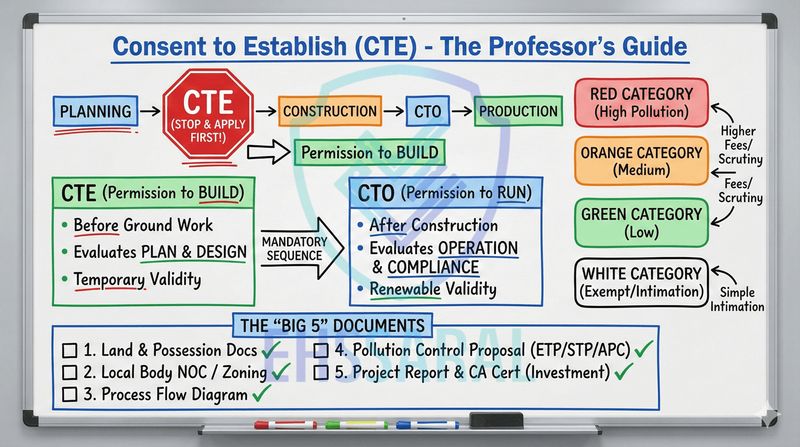
In simple terms, Consent to Establish (CTE) is the permission granted by the State Pollution Control Board (SPCB) to set up or expand a project that has the potential to cause pollution.
Think of CTE as the government saying:
“We have reviewed your plan-your location, process, and proposed pollution control measures-and we are satisfied that this project can be established without unacceptable environmental risk.”
CTE is governed primarily under:
A factory can have a legally approved building and still be illegal to construct from an environmental standpoint if CTE is missing.
CTE exists to ensure that pollution control is built into the design, not added later as damage control.
From a regulator’s perspective:
CTE forces a pause at the planning stage to evaluate:
This is why CTE is not a formality-it is preventive regulation by design.
One of the most common and costly misunderstandings in Indian projects is the belief that:
“We can start civil work while the CTE application is under process.”
Legally, this is incorrect.
Under environmental laws, establishment includes:
Basic fencing to secure land is often tolerated.
But the moment excavation, foundations, or structural work begins, CTE becomes mandatory.
On-ground reality:
Many projects are stopped not because of emissions or effluent, but because inspectors find active construction without a granted CTE.
Once this happens, the officer is legally bound to act-even if the application is “almost approved”.
If an inspection happens during construction and CTE is not granted:
From experience, this creates:
This is why experienced EHS teams insist:
CTE first. Construction later.
CTE is not limited to large chemical plants. It applies to a wide range of activities.
Any unit producing goods that generates:
Even if you rent a shed in an industrial estate:
This is where many small and mid-sized units get caught off guard.
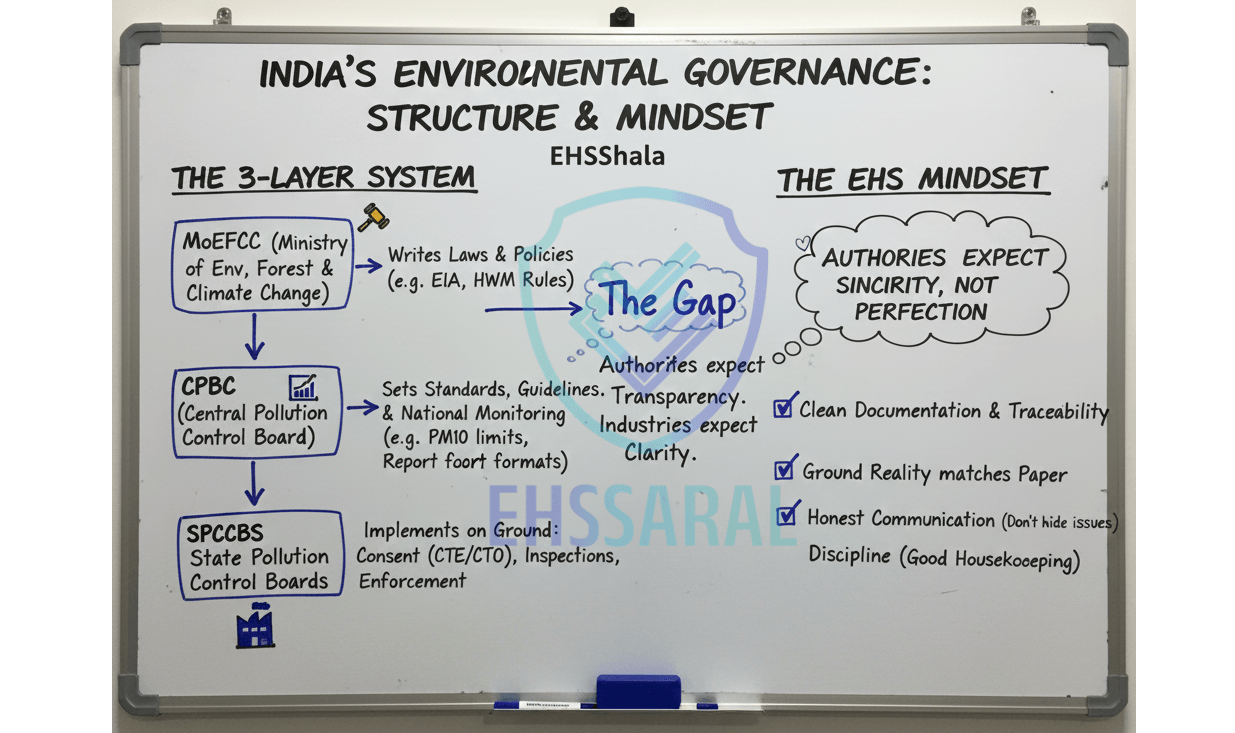
Environmental regulation in India is largely state-driven, not centralized.
CTE is issued by the State Pollution Control Board of the state where the project is located.
For example, in Maharashtra, CTE is granted by Maharashtra Pollution Control Board (MPCB).
Each SPCB:
In Union Territories (UTs), CTE is issued by Pollution Control Committees (e.g., Delhi PCC, Puducherry PCC).
The Central Pollution Control Board (CPCB):
This distinction is important because many applicants mistakenly try to “check CPCB rules” while ignoring state-specific procedures, fees, and documentation.
How MoEFCC, CPCB, SPCB, NGT Work in India?
This confusion is extremely common-especially among first-time project teams and junior EHS professionals.
| Aspect | Consent to Establish (CTE) | Consent to Operate (CTO) |
|---|---|---|
| Purpose | Approves planning and installation | Approves actual operation |
| Timing | Before construction / installation | After construction, before production |
| Focus | Design, location, pollution control proposal | Compliance with installed systems |
| Basis of review | Drawings, calculations, layouts | Physical verification, trial runs |
| Validity | Temporary (project stage) | Renewable (operational stage) |
You cannot apply for CTO unless:
Skipping or rushing the CTE stage almost always causes problems during CTO.
CTE is required whenever a new pollution potential is introduced or increased.
Even if land and building remain unchanged, process change alone can trigger CTE.
Some activities fall under the White Category, which is classified as non-polluting.
Examples include:
Key relief:
White category units usually do not require CTE or CTO.
They only need to file an intimation with the PCB.
On-ground insight:
Many MSMEs waste weeks preparing full CTE applications even though they legally only need an intimation. Knowing this saves time, fees, and frustration.
Industries are classified based on Pollution Index (PI) into four categories:
Impact:
Highest scrutiny, highest fees, longer approval timelines.
Impact:
Moderate scrutiny, but technical clarity is essential.
Impact:
Faster processing, but still formal consent required.
One of the most common rejection reasons is applying under the wrong category.
For example:
When this happens:
Experienced plants verify category carefully before filing, not after queries arrive.
While the exact document list varies slightly from state to state, most CTE applications fail or get delayed because of the same core set of documents.
From an on-ground perspective, think of documents in two buckets:
These establish your legal right to use the land:
Any mismatch in survey number, plot number, or lease validity immediately triggers queries.
This document proves that the land is approved for industrial or permissible use.
Examples:
On-ground insight:
Many projects fail at the PCB level not because of pollution issues, but because the zoning certificate shows Residential or Mixed Use. This is often discovered after machines are purchased, leading to months of deadlock.
If zoning is unclear, do not file CTE blindly. Resolve land-use clarity first.
This is a technical drawing showing:
A vague or copied PFD signals lack of process understanding and invites deeper scrutiny.
This is the heart of the CTE application.
It includes:
Common mistake:
Using a generic consultant template that does not match actual effluent characteristics or future capacity.
This establishes:
Under-reporting CI to save fees is a short-term tactic that often backfires during audits and CTO stage.
Most states now process CTE through online portals (commonly OCMMS-based systems).
A wrong activity code alone can send the application into the wrong review queue.
The SPCB officer reviews the file and may raise queries.
Typical query reasons:
You usually get 7–15 days to respond. Delayed or unclear replies reset the review cycle.
If satisfied:
If rejected:
CTE is not a permanent permission.
Typically:
You must apply for CTE extension before expiry.
Allowing CTE to lapse:
This is where many teams relax-incorrectly.
CTE comes with specific, measurable conditions, such as:
These conditions are not advisory.
They become the checklist during CTO inspection.
Practical rule:
If it’s written in the CTE, it must physically exist on-site before CTO.
Starting construction or installation without a valid CTE is treated as a serious regulatory violation, even if pollution has not yet occurred.
The Pollution Control Board issues a legal notice asking:
“Why action should not be taken for establishing the unit without consent.”
This notice is not routine paperwork. It formally records non-compliance and escalates the file internally.
A financial penalty is imposed based on:
This amount is often significantly higher than the original consent fee and is non-negotiable once levied.
In many cases-especially during expansion or repeat violations-the PCB may:
Management-level reality:
Promoters may tolerate legal notices, but financial penalties and BG forfeiture immediately attract attention and internal accountability.
In prolonged or deliberate violations:
While rare, this risk exists and should not be dismissed casually.
Despite clear rules, the same mistakes repeat across industries.
CTE is applied:
At this stage, compliance becomes corrective instead of preventive-and far more stressful.
Choosing a lower category to:
This almost always backfires during technical review or site inspection.
Generic ETP/STP designs that:
Result: unrealistic conditions that cannot be complied with during CTO.
Showing lower investment to reduce consent fees may:
When promoters or plant heads sign documents without reading:
They inherit obligations they didn’t understand-sometimes impossible to meet physically.
Experienced organizations treat CTE as a project risk document, not just a compliance step.
Best practices observed in well-run plants:
These practices don’t eliminate compliance-they make it predictable.
Consent to Establish is not “just another approval”.
It defines:
A delayed CTE delays the project.
A rejected CTE questions the project itself.
Treat CTE with the same seriousness as:
When done correctly, CTE becomes a foundation for smooth operations, not a regulatory hurdle.
This guide is based on real-world regulatory experience with Indian Pollution Control Boards and practical challenges faced by factories during project setup and expansion.
Yes-unless the activity falls under the White Category, which usually requires only intimation.
Yes. The operator of the activity is responsible, not just the landowner.
Yes. In case of ownership change or business transfer, CTE can be transferred through a formal application.
Most banks now require a valid CTE before:
Yes. Any civil work beyond basic site fencing requires a valid Consent to Establish. Starting construction without CTE can lead to stop-work orders and penalties.

Founder, EHSSaral
Founder - EHSSaral | Partner - Perfect Pollucon | ISO 14001 Lead Auditor | GHG Protocol Scope 2 | Chemist | Data Scientist | Second-generation environmental professional simplifying EHS compliance for Indian industries through practical, automated, tech-enabled, data driven compliance workflows.
Battery Waste Registration for Equipment Importers (BWM Rules 2022 Explained) | EHSSaral
Form V Late Filing Penalty: Steps After 30 September
Environmental Incident Response Guide for Indian EHS Professionals | EHSShala
How MoEFCC, CPCB & SPCB Work in India: Expert Guide | EHSShala
150 Essential EHS Terms Explained Simply | EHSShala
The Groundwater NOC Trap: Why Industrial Renewal Applications Are Rejected (2023–2025)
Stack Monitoring Basics for Indian Factories | EHSShala
Bio-Medical Waste Management for Non-Hospitals (India) | EHSShala

EHSShala Start – Begin Your EHS Learning Journey in India
Environmental Compliance vs Environmental Accounting in India