
EHSShala
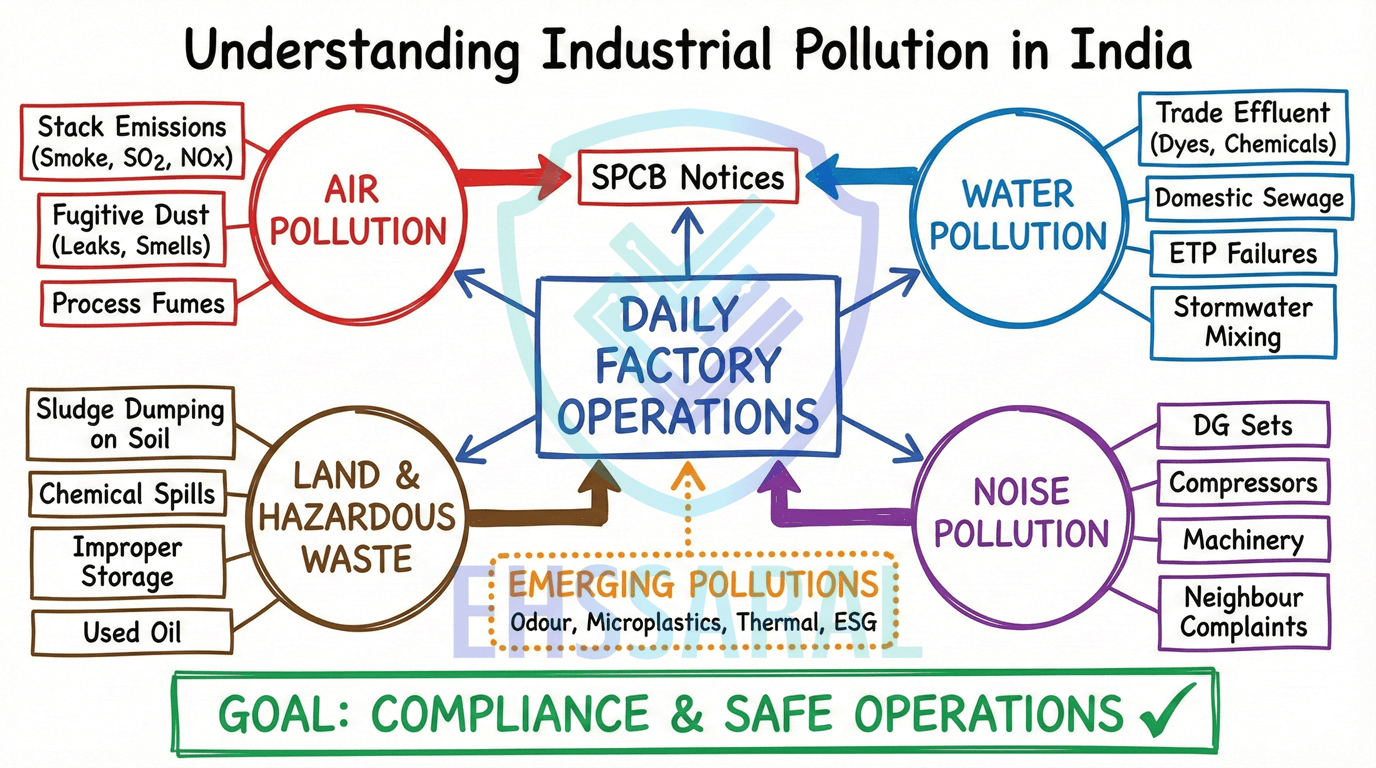
Types of Pollution in Industries Expert Guide | EHSShala
EHSSaral is an Environmental Compliance Intelligence Platform for Industries. Consent Intelligence • Alerts & Tasks • Incident Reporting • Form IV & V • Audit-Ready Records
See how EHSSaral works
22 Dec 2025
Home › EHSShala › Foundations › MoEFCC, CPCB & SPCB Explained
If this is your first article on EHSShala, we recommend reading the Start Section first to understand the basics of India’s environmental system. This Foundations article builds on those concepts in a practical, real-world way.
Environmental compliance in India has always carried one strange emotion: fear.
Not because the laws are impossible. Not because SPCB or CPCB are “strict.”
But because most industries simply don’t understand how the system actually works.
After working in the environmental field since the early 1980s - watching reports being written by hand, meeting officers in small regional offices, helping industries prepare for inspections, and later observing India’s shift toward digital compliance - one thing has stayed constant:
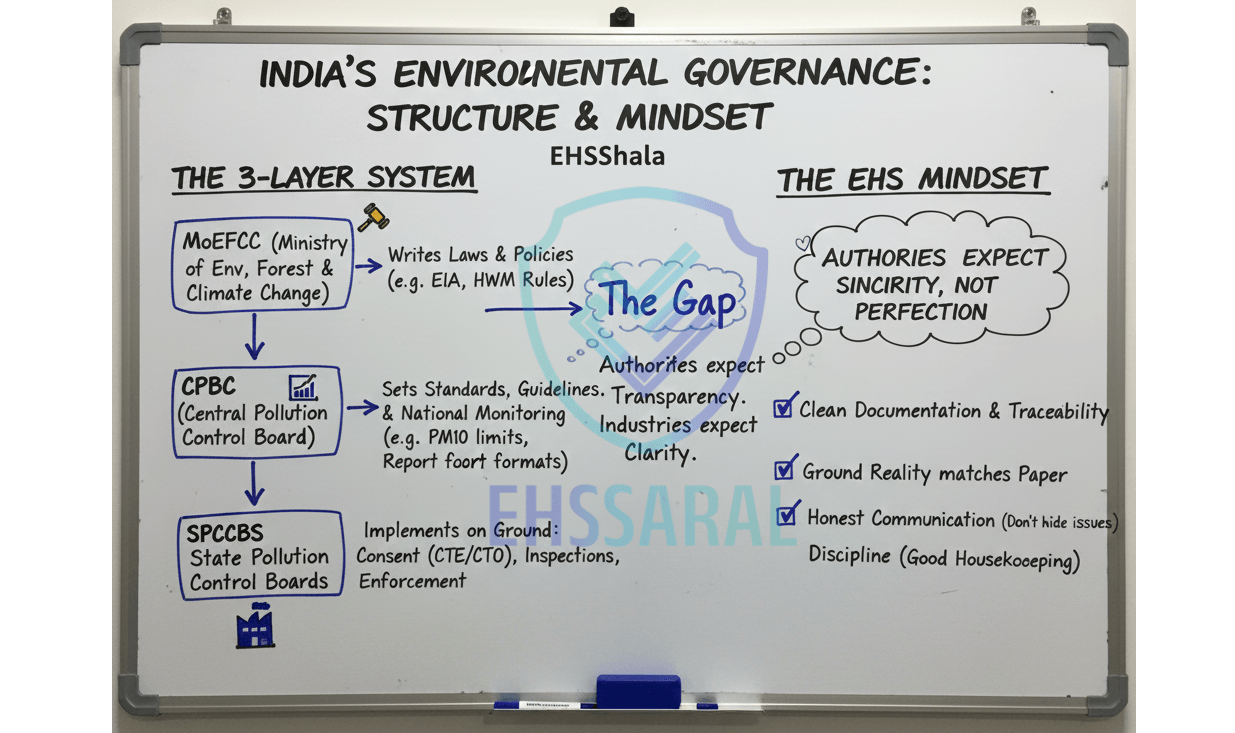
Authorities expect transparency. Industries expect clarity. EHS teams stand in between, trying to balance both.
This article tries to fill that gap.
It is written for young EHS professionals, plant heads, industry owners, consultants, and anyone who interacts with MoEFCC, CPCB, or State Pollution Control Boards (SPCBs) in day-to-day compliance.
It is not legal commentary.
It is decades of field learning, observations, conversations with officers, and practical wisdom from real cases - written respectfully, simply, and honestly.
If you haven’t gone through the Start Section of EHSShala, I strongly recommend reading that first. It sets the foundation of environmental governance in India in a simple, visual, and beginner-friendly style.
Ask any EHS officer in India about their biggest stress, and they won’t say “stack monitoring,” “water sampling,” or “manifest tracking.”
Their biggest fear is:
“What if SPCB comes for inspection?”
I have seen this pattern for decades:
But the truth is simpler:
Most officers look for discipline and honesty, not perfection.
They understand practical challenges on ground. They know industries cannot change everything overnight. They also know when misuse or negligence is happening.
What they expect is:
And in return, they are usually cooperative, clear, and supportive.
I’ve seen senior officers appreciate small things - a neat record room, organised sampling reports, proper labels on drums - even when a few parameters needed improvement.
I’ve also seen SCNs issued for minor issues like open waste storage or uncalibrated meters - not out of strictness, but because the system demands traceability and accountability.
Understanding this mindset removes half the fear.
India’s environmental protection follows a clear 3-layer structure:
In simple words:
MoEFCC writes the rules → CPCB standardises → SPCB implements.
Each plays a different role, but all aim at one thing:
Protecting environment + ensuring industries operate responsibly.
Most young EHS officers think MoEFCC is a “very high-level ministry that doesn’t affect my daily work.”
But ask anyone who has worked in compliance since the 80s, and they’ll tell you:
Every decision in environmental compliance ultimately starts at MoEFCC.
Whether it is
the origin is always the same: MoEFCC.
You may have heard names like:
Every rule either originates from OR is approved by MoEFCC.
This includes:
It is the most powerful environmental approval in India.
MoEFCC relies on data and field insights from SPCBs & CPCB.
This ensures:
For incidents like major industrial accidents or pollution spikes, MoEFCC is involved in:
After decades of watching how rules evolved, I’ve realised something young officers often miss:
MoEFCC works slowly not because it is inefficient, but because it balances three forces:
A law cannot be so strict that industries cannot operate.
But it also cannot be so relaxed that environment collapses.
This balance is not easy.
Behind every notification, there are:
This is why rules evolve step-by-step.
“MoEFCC sits far away and has no idea about ground reality.”
Reality: Most policy decisions are based on reports from SPCBs, CPCB labs, courts, scientific committees, IITs, NEERI, and district data.
“They make rules to make life difficult for industries.”
Reality: Policies are meant to reduce ambiguity, promote standardisation, and prevent future disasters.
“MoEFCC only comes into picture during big disasters.”
Reality: They continuously monitor environmental indicators through national missions.
Through the years, I’ve seen a consistent expectation:
(EIA data manipulation is taken very seriously.)
A plant claiming “Zero Liquid Discharge” but discharging during rains creates immediate distrust.
Many amendments are written assuming industries understand basics-but many don’t.
Improper documentation often signals poor management seriousness.
Their response is always better when industries report without hiding.
I once attended an MoEFCC review meeting where industries complained about strict norms.
A senior official calmly said:
“We do not make rules to harass anyone.
We make rules so disasters do not repeat.”
That sentence stayed with me.
It summarises the ministry’s intent perfectly.
If MoEFCC frames the laws, CPCB (Central Pollution Control Board) is the organisation that gives those laws shape, structure, and measurable standards.
Young EHS officers often know CPCB only as “the board that issues guidelines.”
But anyone who has worked since the 80s will tell you:
CPCB is the backbone that keeps the entire system consistent across India.
In environmental compliance, numbers matter, and the numbers come from CPCB.
Every parameter limits you see - like
They create standards for:
This standardisation ensures Tamil Nadu and Gujarat follow the same benchmark.
CPCB operates national programs like:
They collect enormous datasets, often working with SPCBs and laboratories.
This data influences:
Every few months, CPCB issues circulars or guidelines on:
These guidelines quietly change how every industry operates.
Many people think SPCBs operate independently.
Technically yes, but under CPCB supervision.
CPCB:
When CPCB issues a direction, every SPCB follows it.
Having worked with thousands of sampling reports over decades, here are ground truths:
A report that looks “homemade” immediately raises questions.
If a plant’s PM values suddenly jump from 12 to 45 without reason, it raises suspicion.
CPCB has data scientists and environmental statisticians.
Patterns don't lie.
Industries may change consultants, EHS teams, or labs.
But CPCB has the entire compliance history since the 90s.
They rarely react without data.
This is why their directions always mention references, clauses, and monitoring results.
Industries don’t speak to CPCB daily.
But CPCB interacts with them indirectly through:
Sometimes, CPCB teams visit industrial clusters for audits.
They don’t interfere with site-level operations but focus on:
After decades observing inspections, meetings, and circulars, here’s what CPCB consistently values:
Not manipulated, not cherry-picked.
Follow the format they specify.
CPCB cares deeply about measurement accuracy.
Especially in clusters like:
Misrepresentation is taken seriously, especially in treatment capacity and discharge volumes.
A few years ago, CPCB teams visited a polluted industrial cluster.
Many industries claimed:
“Sir, our stack results are always within limit.”
But CPCB compared values across 12–18 months and found the same exact numbers repeated.
They quietly noted it, didn’t scold anyone on the spot.
But later,
Not to punish industries -
but to ensure data integrity and environmental safety.
That’s CPCB’s style:
Silent observation → structured action → long-term reform.
If MoEFCC makes the rules and CPCB sets the standards,
SPCBs are the ones who actually face industries, visit sites, check systems, issue consents, and enforce compliance.
This is the authority that EHS professionals interact with the most.
And naturally, this is also the authority they fear the most.
But here’s the truth after watching this space for 40+ years:
SPCB officers are more practical, more grounded, and more understanding than most industries assume.
Their job is demanding - balancing compliance, public complaints, court orders, monitoring, and administration - all while working with limited staff and high expectations.
Understanding this reality makes compliance far smoother.
Read more about How to Read, Understand SPCB Consent
This is their most visible function.
They examine:
A consent is not a “licence to pollute.”
It is a contract that defines what you’re allowed to do and under what conditions.
SPCB has multiple types of inspections:
During inspections, officers typically check:
SPCB (sometimes with lab assistants) collects:
The reports are legally admissible.
This is why clean sampling points, safe access, and proper ports matter.
These happen mainly due to:
Most SCNs are not “punitive.”
They are “corrective.”
Officers want industries to fix issues before they become violations.
SPCB answers to:
This pressure influences their decision-making.
Every new EHS officer goes through these emotions:
But here’s what decades of experience tell us:
Officers rarely penalise first. They correct first. They educate first. They give guidance first.
Penalties happen when:
If an industry is honest and responsive, the entire compliance journey becomes smoother.
Most officers focus on:
Neat plant → neat paperwork → neat compliance.
If monthly values fluctuate without explanation, they immediately ask questions.
Industries that openly show problems earn trust.
If your SCRUBBER is perfect but your hazardous waste drums are open, you will still get an observation.
They can sense when an industry is trying to comply vs trying to hide.
A plant had perfect stack and effluent results.
But one open hazardous waste drum led to an SCN.
Why?
Because open storage signals negligence and potential ground contamination.
A young EHS engineer didn’t hide an ETP breakdown during inspection.
Officer noted the honesty, appreciated him, and gave time for correction - no penalty.
A plant had organised compliance files.
Officer finished inspection in 45 minutes instead of 3 hours.
Small things matter.
Records matter more than big speeches.
A running ETP is more valuable than 200 pages of logs.
Temporary bypasses, secret drains, modified chimneys - these are seen very seriously.
Tone and attitude matter.
Delays show low seriousness.
They handle:
In spite of this, most officers maintain professionalism and fairness.
Understanding this context helps industries build healthier compliance relationships.
If you ask 100 EHS professionals what stresses them the most, 70 will say:
“Consent renewal, sir.”
Not sampling, not waste management, not monitoring.
Consent.
Because consent is the legal foundation of your industry’s existence.
If consent lapses, your entire operation becomes vulnerable.
But consent isn’t meant to scare industries.
It is meant to ensure:
Let’s break down how it really works in practical India - based on decades of submissions, corrections, inspections, and interactions.
This is before construction/expansion.
Authorities check:
CTE is like approval of your blueprint.
If you propose responsibly now, your future becomes 50% easier.
Issued once your plant is ready.
This is where SPCB ensures that whatever you promised on paper is implemented on ground.
CTO checks:
If CTE is “planning,” CTO is “proof.”
Industries think delays are “political.”
But most delays are technical and documentation-related.
Based on real cases, these are the top reasons:
Example:
ETP design uploaded is 50 KLD but plant operates at 65 KLD.
This mismatch forces officers to seek clarification.
Common issue:
ETP automation mentioned, but the photo shows manual valve operation.
Many plants submit documents without reading.
SPCB officers immediately sense when the industry has no clarity.
If the plant had:
Different officers check different things:
Contrary to assumption, the process is systematic, not random.
A pharma plant copied the wrong by-product code from an old consent.
This small mismatch triggered a 2-month delay.
Lesson: Never copy-paste old data blindly.
The entire file was perfect but one calibration certificate was outdated.
Consent was kept pending until corrected.
Lesson: Compliance is a chain - one broken link delays everything.
A company applied for CTO when the ETP was still being welded.
Officer rejected and asked for re-application.
Lesson: On-ground readiness is mandatory.
After decades of conversations, here are their top 5 frustrations:
“Zero liquid discharge” on paper, wet soil on ground.
Officers waste 30 minutes searching for a single document.
Submitting fancy PPTs instead of standard forms.
If plant is messy, officers assume compliance is also messy.
Renewal uploaded on last day shows low seriousness.
Consent → Monitoring → Calibration → Waste → Photos → Layout → Logs.
Not just during renewal months.
Names, quantities, capacities, limits.
Officers appreciate clarity.
They show seriousness and transparency.
SPCB is not against industries.
They simply don’t want surprises, mismatches, or hidden issues.
If your documentation is clean, on-ground systems are functional, and communication is respectful,
even complex consents become smooth.
If you ask 10 EHS professionals about compliance, they will tell you 10 different experiences.
But if you ask 10 SPCB officers, their expectations are surprisingly similar.
Why the mismatch?
Because EHS teams look at compliance from a fear perspective,
and authorities look at it from a responsibility perspective.
After decades in environmental monitoring, consent work, audits, inspections, sampling, and interacting with regional and senior officers across states, we’ve learned one core truth:
Authorities don’t expect perfection. They expect sincerity.
Let’s break down what this means on ground.
You don’t need high-level English or expensive consultants to satisfy compliance.
Authorities expect very simple things:
Officers don’t like guessing.
If your documents are neatly arranged, traceable, and consistent, half the battle is won.
This includes:
Every officer appreciates a well-maintained compliance file.
A clean plant tells authorities:
“This company cares about systems.”
A messy plant tells them:
“If housekeeping is poor, compliance will also be careless.”
Housekeeping is not cosmetic -
it is environmental behaviour.
Authorities trust you more when:
What they dislike most:
Discrepancy between documents and ground reality.
Breakdown?
Bypass?
Unusual parameter rise?
Unknown sample variation?
Most industries hide it.
Most officers prefer you tell them.
Respect is built on honesty, not perfection.
Industries that respond late or avoid queries create doubt.
Simple acknowledgements like:
“Received sir, correcting immediately,”
go a long way.
After watching hundreds of inspections, the pattern is clear:
A small SME with neat files and sincere staff earns more respect than a giant company that hides information.
If a junior officer says,
“Sir, I am learning - please guide me,”
they help with patience.
The moment someone tries to argue unnecessarily, the tone of inspection changes.
If your stack results are in control for 6 months and suddenly a spike appears, they want an explanation - not excuses.
A plant kept showing “0.00” flow in all reports.
Officer immediately knew something was wrong.
When confronted, the engineer admitted:
“Sir, flow meter is not working since 2 months.”
Officer appreciated honesty, advised immediate repair, and avoided penalty.
Plant had perfect documentation but hazardous waste area was unorganised.
SCN issued within minutes.
Lesson: Ground reality > paper files.
One engineer maintained a file called “Issues to Fix” detailing:
Officer was impressed by the transparency.
Inspection completed smoothly.
A plant’s pump failed at midnight and untreated water overflowed.
Company voluntarily informed the regional office with photographs.
Officer acknowledged it positively and asked for corrective measures,
not penalties.
Transparency works.
Paper won’t save you if your ETP isn’t running.
They want discipline, not 0% deviation.
Officers immediately sense when an industry is unaware of its own data.
Calmness and honesty earn respect.
Real compliance is built daily, not during renewal month.
Don’t only prepare during renewal.
Ensure sampling points, safety, electricity, ladders, and team are ready.
Check:
This reduces last-minute panic.
This single habit builds long-term trust.
Compliance cannot be built only through fear.
It is built through:
Authorities respond far better to industries that show “intent” rather than industries that show “arguments.”
If you compare India’s environmental system of the 1980s to today, the difference is unbelievable.
Back then,
Today, India is moving toward
real-time environmental governance,
and the next 10 years will transform the sector more than the last 40.
After observing patterns for decades - from the old MPCB offices to modern CPCB portals - here’s the honest, practical, future-ready picture.
Read more about Evolution of EHS in India after Bhopal Tragedy by EHSShala
Several states already have:
Over the next decade, we will see:
Digital systems don’t eliminate compliance -
they make it easier, faster, and more accurate.
This shift has already begun:
Authorities will rely more on live data than on monthly reports.
This is the change that will redefine EHS work.
Tools will help industries:
EHS professionals will move from reactive firefighting to proactive planning.
Not colourful presentations.
Not influence.
Not brand size.
But data quality.
Years of numbers will define whether a company is:
This shift will push industries toward maintaining consistent, authentic records.
In the future, citizens will have access to:
Industries that adopt transparency early will earn trust.
Industries that resist change will face higher scrutiny.
EHS roles will become more strategic and more respected.
The job will shift from:
to:
Digital tools will replace repetitive manual work.
But judgment, experience, and integrity will always remain human.
Environmental compliance is complex -
not because the rules are difficult, but because information is scattered.
Platforms like EHSShala aim to organise knowledge, simplify regulations, and support professionals with clarity and practical understanding.
Platforms like EHSSaral (without selling) exist to reduce workload, avoid mistakes, and ensure timely compliance - especially for SMEs with limited staff.
The goal is not to replace EHS officers,
but to make them faster, more confident, and more accurate.
When I look back at 40+ years in this field, one lesson stands out:
Industries that treat compliance as culture never struggle with authorities.
Industries that treat compliance as paperwork always struggle.
A good compliance culture means:
Regulators respond positively to sincerity.
They notice discipline.
They appreciate honesty.
They support industries that show intent.
The future of compliance in India will reward companies that:
India is entering a new era where environmental governance will be:
EHS professionals must prepare not only for the present,
but for the next 10–20 years of compliance expectations.
And the good news is:
When you understand how MoEFCC, CPCB, and SPCBs work -
compliance becomes simple, structured, and stress-free.

Founder, EHSSaral
Founder - EHSSaral | Partner - Perfect Pollucon | ISO 14001 Lead Auditor | GHG Protocol Scope 2 | Chemist | Data Scientist | Second-generation environmental professional simplifying EHS compliance for Indian industries through practical, automated, tech-enabled, data driven compliance workflows.
Types of Pollution in Industries Expert Guide | EHSShala
 Practical Guide for Indian Factories EHSShala.webp)
Hazardous Waste Management Rules in India: Forms, Storage & Compliance
 EHSSaral v1.png)
EADA Random Audit Assignment: Factory Readiness Guide (2025) | EHSSaral
Form 3 Logbook Explained: Simple Guide for Indian Factories | EHSShala
Beyond the Helmet: Why Safety Compliance Alone Fails in Indian Factories | EHSSaral Research
MSIHC Rules, 1989: Practical Guide for Indian Factories
Hazardous Waste Compatibility & Segregation Guide India
Rule 9 Hazardous Waste Utilization: Why Applications Fail (2023–2025) | EHSSaral Research

New Labour Codes in India Effective Nov25: Mandatory Appointment Letters & Health Checks | EHSSaral
CTO Auto-Renewal: Capital Investment Rules 10% & 30% | EHSSaral