

EHSShala
How to Read Your Consent Copy (CTE & CTO Explained Simply) | EHSShala
EHSSaral is an Environmental Compliance Intelligence Platform for Industries. Consent Intelligence • Alerts & Tasks • Incident Reporting • Form IV & V • Audit-Ready Records
See how EHSSaral works
10 Aug 2026
Home > EHSShala > Start > Evolution of EHS in India – Part 2 (Bhopal to Today)
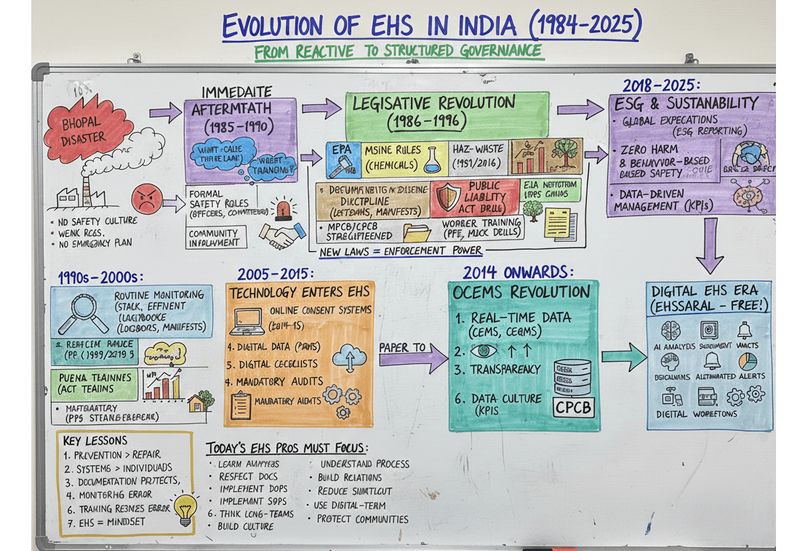
How India moved from reactive disaster-response to structured EHS governance (1984–2025)
When my father talks about the early 1980s, he always says:
Nobody understood how dangerous small safety gaps could be… until Bhopal happened.
In Part 1, we explored the pre-Bhopal era - a time when:
But 3 December 1984 changed everything.
The Bhopal gas tragedy wasn’t just an industrial disaster -
it was a national awakening.
People realized what happens when:
My father remembers the atmosphere in the months after Bhopal:
Every factory suddenly wanted to fix everything.
But the truth is - we had to change the entire way we think.
Part 2 is about that change - the long, difficult, transformative journey that built India’s modern EHS culture.
Read more about What Is EHS & Why India Needs to Know It?
For the first time, industries across India began asking:
My father shared that in 1985–1986, MPCB and CPCB officers visited many hazardous units with a seriousness India had never seen before.
Before Bhopal, incidents were seen as “accidents.”
After Bhopal, people started asking:
This shift in mindset became the foundation of modern EHS.
The role of an EHS Officer was no longer optional - it became essential.
Simple but powerful changes:
Workers who never attended formal safety sessions were now being trained regularly.
Factories were required to:
India realized that industrial safety is also public safety.
India responded quickly with new laws and frameworks.
Your juniors must understand these because they define today’s compliance culture.
EPA 1986 gave the Central Government power to regulate:
This Act is the backbone of today’s environmental governance.
My father says:
EPA 1986 changed everything.
For the first time, government had the power to enforce proactively.
Manufacture, Storage & Import of Hazardous Chemicals Rules
These rules introduced:
This is where the concept of “hazardous chemical list” came from.
Read more MSIHC Rules, 1989: Practical Guide for Indian Factories
Created the framework for:
This is the reason every industry follows:
(Super important but juniors rarely know why)
Enforced:
This law was created because in Bhopal, people had no way to claim immediate support.
This structured emergency mechanisms for:
This made “mock drills” a legal requirement, not a formality.
Introduced:
Important line for juniors:
Every environmental clearance today is a direct result of Bhopal’s lessons.
We analysed why industries struggle Post-Grant Environmental Compliance in India
My father often describes the 1990s as the decade when India finally began taking EHS seriously.
Industries started realizing that compliance is not just paperwork - it’s protection.
He told me:
In the early 90s, audits were rare.
By the late 90s, they became a standard part of every industrial calendar.
The shift was slow, but real.
This era saw the rise of:
Before that, monitoring was:
By the 2000s, it became:
This is also the period when companies like Perfect Pollucon Services began strengthening the environmental monitoring ecosystem.
Factories started maintaining:
One of the biggest lessons from Bhopal was:
If it’s not written, it never happened.
This thinking shaped modern compliance.
Throughout the 1990s:
Regulators were no longer just “inspectors” -
they became partners in prevention.
When my father spoke to early MPCB officers, he noticed something:
They were strict, but they wanted industries to succeed safely.
This respect-based relationship continues even today.
Earlier:
Now:
This professionalization of EHS roles changed the entire culture of factories.
From the late 1990s:
began happening regularly.
This directly reduced:
These ten years transformed compliance.
Industries started asking:
This is when my own understanding of digital compliance began forming, long before EHSSaral existed.
Around 2014–2015:
This was the first major shift from paper → online in Indian EHS.
Factories began storing:
digitally.
This change:
Why?
Because companies realized:
SOP culture formalized:
Especially:
Audit culture led to:
This era is very important for juniors.
OCEMS stands for:
Online Continuous Emission Monitoring System
Industries had to install:
Data started going directly to:
This forced factories to:
Earlier:
Now:
This is the biggest reform since EPA 1986.
Factories had to:
This required new skills:
EHS officers began transforming from “paper managers” to data interpreters.
The Hidden Costs of Manual Environmental Compliance in India
This is the modern wave reshaping everything.
It pushed industries to move from compliance → excellence.
Indian companies supplying to global markets had to meet:
Safety moved from:
Younger EHS officers now use Excel, dashboards, analytics -
skills unheard of 20 years ago.
Learn how EHSSaral can help ESG Data Management for Indian Factories
Between 2018–2025, industries began struggling with:
This is exactly where EHSSaral fits - but in an educational, non-salesy explanation.
Industries receive:
Young EHS officers struggle to decode them.
AI analysis changes this.
Files often get lost when:
A cloud vault protects decades of history.
The biggest compliance failures happen due to:
Automation safeguards organizations.
When:
all use one platform,
compliance becomes systematic - not accidental.
All These above Features are for free in EHSSaral. Register here
Lessons my father saw, and lessons I now understand deeply:
Junior officers reading this should internalize:
This is how modern EHS professionals grow.
Today’s EHS systems look structured, digital, and organized -
but they were shaped by decades of learnings, improvements, incidents, audits, and reforms.
If Part 1 showed where EHS came from,
Part 2 shows how it matured into the system we practice today.
Understanding this evolution makes you:
This is the EHS legacy we carry forward.
After Bhopal, India introduced stronger laws like the Environment Protection Act 1986, MSIHC Rules, Chemical Accidents Rules and hazardous waste regulations. Safety roles became formal, audits increased and emergency planning became mandatory.
Key laws include the Environment Protection Act 1986, MSIHC Rules 1989, Hazardous Waste Rules, Public Liability Insurance Act 1991, Chemical Accidents Rules 1996 and the EIA Notification 1994, along with updated CPCB/MPCB guidelines.
OCEMS (Online Continuous Emission Monitoring System) allows real-time tracking of emissions and effluent quality. Data is sent directly to Pollution Board servers, forcing better maintenance, transparency and continuous compliance.
Modern EHS officers are not just record keepers. They analyse data, manage digital systems, support ESG reporting, drive safety culture and act as a bridge between production, management and regulators.
Because industries now manage hundreds of conditions, tasks, documents and monitoring points. Digital tools help automate consent interpretation, reminders, document storage and workflows so that compliance is systematic and not dependent only on memory.

Founder, EHSSaral
Founder - EHSSaral | Partner - Perfect Pollucon | ISO 14001 Lead Auditor | GHG Protocol Scope 2 | Chemist | Data Scientist | Second-generation environmental professional simplifying EHS compliance for Indian industries through practical, automated, tech-enabled, data driven compliance workflows.
How to Read Your Consent Copy (CTE & CTO Explained Simply) | EHSShala
Environmental Compliance KPIs for Manufacturing in India

Why Good People Still Struggle With Compliance in Indian SMEs | EHSSaral Research
 ehssaral.webp)
Hazardous Waste Form 4 Portal Errors (MPCB & GPCB Fix Guide)
150 Essential EHS Terms Explained Simply | EHSShala
 Practical Guide for Indian Factories EHSShala.webp)
Hazardous Waste Management Rules in India: Forms, Storage & Compliance

Managing Safety Without Authority: Handling Protected Contractors in Indian Plants | EHSSaral

Consent Conditions Explained: What Factories Must Actually Follow After Approval | EHSShala
Environmental Monitoring Guide for Indian Factories | EHSShala

New Labour Codes in India Effective Nov25: Mandatory Appointment Letters & Health Checks | EHSSaral