

Blog
Industrial Siting Criteria in India: Factory Location Guide
EHSSaral is an Environmental Compliance Intelligence Platform for Industries. Consent Intelligence • Alerts & Tasks • Incident Reporting • Form IV & V • Audit-Ready Records
See how EHSSaral works
20 Jul 2026
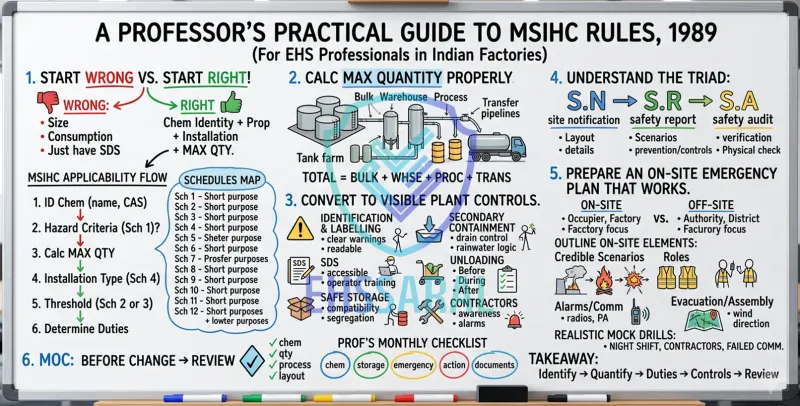
The Manufacture, Storage and Import of Hazardous Chemicals Rules, 1989: A Practical Guide for Indian Factories
The MSIHC Rules, 1989 apply to hazardous chemicals based on their properties, quantities and the type of industrial installation involved. This practical guide explains how Indian factory EHS professionals can check applicability, understand the schedules, calculate maximum chemical quantity and maintain safety reports, plant controls and emergency plans.
A factory stores solvent in a bulk tank, transfers it through pipelines and receives fresh material through road tankers.
But when someone asks the EHS officer, “Do the MSIHC Rules apply to this site?”, the answer is often based on monthly consumption or a few Safety Data Sheets.
That is the wrong starting point.
MSIHC applicability depends on:
The full name of the law is the Manufacture, Storage and Import of Hazardous Chemicals Rules, 1989, commonly called the MSIHC Rules.
These Rules focus mainly on preventing major chemical accidents and reducing their impact on workers, nearby people and the environment.
They do not apply in exactly the same way to every factory handling a dangerous chemical.
Some responsibilities are basic chemical-safety duties. Other requirements apply only when a specified chemical or quantity threshold is involved.
“Start with the chemical, its hazard and the maximum quantity that can be present.”
Depending on applicability, the MSIHC Rules may require a factory to:
The exact duties depend on the chemical, quantity, installation and applicable schedule.
This guide explains how an EHS officer can approach these requirements practically.
The MSIHC Rules were originally notified on 27 November 1989. The consolidated Rules include the corrigendum and amendments notified in 1990, 1994 and 2000. This article is based on the amended consolidated text available as of July 2026.
The Manufacture, Storage and Import of Hazardous Chemicals Rules, 1989 are Indian environmental rules for preventing major chemical accidents. They require applicable occupiers to identify chemical hazards, control accident risks, provide chemical safety information and, where specified thresholds are crossed, complete requirements such as site notification, safety reports, safety audits and On-site Emergency Plans.
MSIHC stands for Manufacture, Storage and Import of Hazardous Chemicals.
The MSIHC Rules, 1989 apply to specified hazardous chemicals, industrial activities, isolated storage and pipelines based on the applicable chemical properties and threshold quantities.
A chemical should not be assessed only by its trade name.
The purchase department may use a commercial name. Stores may use the supplier’s product name. Operators may use a local name.
But an MSIHC assessment normally requires the actual chemical identity.
The EHS officer should collect:
| Information | What to Check |
|---|---|
| Chemical name | Actual chemical identity |
| Trade name | Name used in purchase and stores |
| CAS number | Unique chemical identification number |
| Composition | Main chemical constituents |
| Concentration | Percentage of hazardous constituent |
| Physical state | Gas, liquid or solid |
| Flash point | Important for flammable liquids |
| Boiling point | May affect fire and vapour behaviour |
| Toxicity information | Possible effects of exposure |
| Maximum quantity | Highest quantity that can be present |
| Storage method | Tank, drum, cylinder, bag or vessel |
| Storage location | Exact place where it is stored or used |
| SDS revision date | Whether the safety information is current |
A chemical may come within the MSIHC Rules because:
The relevant hazardous properties can include:
The assessment should consider the actual chemical grade and concentration used at the factory.
An SDS for a similar product is not enough.
A hazardous chemical and hazardous waste may involve the same substance at different stages, but they are separate compliance subjects.
For example:
The factory may therefore need to manage:
Do not enter every hazardous chemical in the hazardous-waste register.
Similarly, do not assume that a hazardous-waste authorization covers the risks from raw materials, fuels, toxic gases or process chemicals.
Maintain separate but connected records for:
The schedules are where many EHS officers get stuck.
A copy of the Rules may be available, but the reader may not know which schedule answers which question.
The schedules serve different purposes. One schedule alone may not decide complete applicability.
Start with Schedule 1 to understand whether a substance falls within the hazardous chemical definition.
Schedule 1 covers:
The assessment may require information such as:
The SDS is an important source of information, but it should match the exact chemical and concentration used at the site.
Schedule 2 provides threshold quantities for isolated storage.
Isolated storage is not decided only by physical distance. It is also not decided only by whether a tank directly feeds a process.
Under MSIHC, isolated storage broadly means covered hazardous chemical storage that is not associated with a Schedule 4 installation on the same site and involves the applicable Schedule 2 quantity.
For example:
Where the classification is unclear, document:
Obtain a competent applicability review where required.
Do not describe a storage tank as isolated merely because it is located away from the production building.
Schedule 3 is important for factories carrying out industrial activities involving specified hazardous chemicals.
It contains chemical names and threshold quantities connected with different requirements under the Rules.
Do not check only whether the chemical appears in Schedule 3.
Also verify:
A factory may cross one threshold without crossing another.
This is why site notification, safety reporting and emergency-planning duties should not be assumed to apply at the same quantity in every case.
Schedule 4 lists types of industrial installations covered for the purpose of the relevant MSIHC provisions.
These may include specified manufacturing, processing, production or storage installations.
The EHS officer should assess both:
There is no single authority responsible for every MSIHC requirement.
Schedule 5 identifies concerned authorities and assigns duties to them.
Depending on the activity and requirement, the authority may be connected with:
Before submitting any MSIHC document, verify:
Do not rely only on what another factory submitted.
Two sites may handle different chemicals, quantities or installations. Their authority mapping may not be identical.
The later schedules provide information formats or required details for important MSIHC submissions.
| Schedule | Practical Purpose |
|---|---|
| Schedule 6 | Major accident information |
| Schedule 7 | Site-notification information |
| Schedule 8 | Safety-report information |
| Schedule 9 | Safety Data Sheet format |
| Schedule 10 | Information required for import-related compliance |
| Schedule 11 | On-site Emergency Plan details |
| Schedule 12 | Off-site Emergency Plan details |
These schedules should not be treated only as forms to fill.
The information should match:
The following decision flow can help an EHS officer approach applicability systematically.
Collect:
Do not complete the assessment using only the trade name.
Review Schedule 1 and the relevant SDS information.
For mixtures, check:
Identify the highest quantity that can be present at one time.
This may include storage, process and connected quantities.
Determine whether the chemical is associated with:
Review the correct Schedule 2 or Schedule 3 entry.
Use the correct threshold column.
Depending on applicability, the factory may need to address:
Use Schedule 5 and confirm the current local process.
Maintain evidence of:
A general chemical inventory tells the factory what chemicals are present.
An MSIHC applicability register should go further.
It should connect each chemical with:
A practical register can include:
| Field | Information to Record |
|---|---|
| Chemical name | Actual chemical name |
| Trade name | Commercial or supplier name |
| CAS number | Chemical identification number |
| Concentration | Percentage or grade used |
| Physical state | Gas, liquid or solid |
| Main hazard | Toxic, flammable, explosive or other |
| Main tank capacity | Maximum design or operating quantity |
| Day tank quantity | Maximum quantity in day tanks |
| Warehouse stock | Maximum drum, bag or cylinder stock |
| Process quantity | Maximum quantity in vessels or equipment |
| Pipeline quantity | Relevant connected quantity |
| Total maximum quantity | Combined quantity considered |
| Storage location | Tank farm, warehouse, utility or process area |
| Schedule reference | Applicable schedule and chemical entry |
| Threshold | Relevant threshold quantity |
| Triggered duties | Notification, report, plan or other duty |
| Concerned authority | Authority identified under Schedule 5 |
| SDS revision date | Date of current SDS |
| Last review date | Most recent applicability review |
| Review trigger | Chemical, quantity, process or storage change |
Suppose a factory uses one hazardous liquid.
The purchase department reports monthly consumption of 15 tonnes.
But the site also has:
Monthly consumption does not answer the applicability question.
The EHS officer should:
The purpose is not to add every small pipe volume without judgement.
The purpose is to avoid considering only one convenient number while ignoring significant storage or process quantities.
Purchase quantity, monthly consumption and maximum inventory are different numbers.
A factory may consume a large quantity every month but keep only a small stock at one time.
Another factory may use very little each month but store a large quantity in a bulk tank.
The assessment may need to consider:
“Consumption shows how much was used. Applicability may depend on how much can be present.”
A tank may have a design capacity of 50 kilolitres but normally operate below that level.
Do not select one figure without recording the basis.
Check:
Where applicability depends on maintaining stock below a certain quantity, that limit must be controlled in practice.
A note in an Excel file is not enough.
The factory may need:
Do not automatically treat every container as an independent installation.
At the same time, do not combine completely unrelated installations without understanding the Rule.
Consider:
Where the conclusion is not clear, document the basis and obtain competent technical review.
MSIHC compliance does not begin with preparing an emergency-plan file.
It begins with preventing the chemical from escaping, reacting, catching fire or exposing people.
The occupier is expected to identify major accident hazards and take steps to:
These responsibilities should be visible on the factory floor.
Tanks, containers and important pipelines should be clearly identified.
Check:
Temporary and decanted containers also need identification.
Do not allow an unknown chemical to remain in an unlabelled:
Labels should remain readable despite:
A label that cannot be read from a safe position is of little value during an emergency.
The SDS should:
Keeping one large SDS file in the EHS office is not enough.
Relevant information should be available near use and storage areas.
Operators should understand:
The SDS supports training. It does not replace training.
Chemical Accident Emergency Response Guide for Indian Factories by EHSShala
Review whether the storage arrangement is suitable for the chemical.
Check:
Incompatible chemicals should not share the same storage or containment arrangement without proper assessment.
A common dyke can create a bigger incident if leaked chemicals react with each other.
Dyke walls and containment areas should remain available for their intended purpose.
Common gaps include:
A dyke filled with rainwater has reduced containment capacity.
A drain valve kept permanently open defeats the purpose of the dyke.
Rainwater removal should follow a controlled procedure.
Before releasing water, check whether it is:
Inspection should not focus only on the main tank shell.
Review:
Leaks commonly begin at smaller points such as:
Operators should know how to stop or isolate the chemical safely.
Emergency isolation may include:
These controls should be:
Do not design emergency isolation around the assumption that one experienced person will always be available.
Chemical unloading temporarily connects the tanker, hose, pump, pipeline and factory storage system.
This creates an additional period of risk.
The unloading process should be controlled in three stages.
Verify:
Unloading should not begin until the receiving tank has enough capacity.
Do not depend only on the transporter’s statement.
The factory operator should verify the tank level.
Maintain:
The driver and operator should not leave the unloading point unattended.
Complete:
The emergency plan should consider credible unloading scenarios such as:
Contract workers may be present near hazardous chemical areas.
This includes:
They should know:
A contractor may be the first person to notice a leak.
Excluding contractors from chemical emergency awareness creates a practical gap.
Many MSIHC gaps begin with a change that never reaches the EHS department.
Production may introduce a new solvent.
Projects may increase tank capacity.
Purchase may buy a higher-concentration chemical.
Maintenance may shift a pipeline.
Stores may increase maximum inventory.
Each change may appear small to one department. But it can change:
This is why the factory needs a Management of Change process.
Management of Change means checking safety and compliance before changing a chemical, process, tank, pipeline, quantity or plant layout.
An MSIHC review should be triggered before:
The change review should check whether there is a need to update:
This need not become a complicated corporate procedure.
A controlled one-page change form is better than an undocumented modification.
Site notification, safety reports and safety audits are connected requirements.
But they are not the same.
Their applicability should be checked against the relevant rules and threshold quantities.
Site notification provides the concerned authority with information about the applicable industrial activity.
The information may include:
The notification should reflect the current plant.
Common gaps include:
Maintain:
A safety report is more than a general risk-assessment document.
It should explain:
It may include information on:
A consultant may help prepare specialised studies.
But the factory remains responsible for confirming that the report matches the actual site.
Before accepting the report, verify:
Do not keep a safety report that describes an older version of the plant.
A safety audit checks whether the chemical-safety arrangements are adequate and working.
The audit should examine both:
After the audit, maintain an action tracker.
| Audit Field | What to Record |
|---|---|
| Observation | Clear description of the gap |
| Location | Exact plant or storage area |
| Risk | Why the gap matters |
| Immediate control | Temporary action taken |
| Corrective action | Permanent action required |
| Responsibility | Department or person responsible |
| Target date | Agreed completion date |
| Evidence | Photograph, work order, test report or document |
| Verification | Confirmation that the action is effective |
| Closure date | Date of verified closure |
“An audit action closes only when the plant condition has changed and the change has been verified.”
A written reply is not closure.
A purchase order is not closure.
Material arriving at the factory gate is not closure.
The final plant condition should be checked.
An On-site Emergency Plan explains how the factory will respond to a major emergency beginning within the site.
It should not be copied from another factory.
The plan should be based on:
Group scenarios according to the site’s real risks.
For each selected scenario, define:
Do not add every possible event only to make the plan look comprehensive.
Focus on scenarios that can reasonably occur at the site.
The plan should identify key personnel and responsibilities.
Typical roles may include:
Each person should know:
Do not assign all important roles only to day-shift managers.
Every critical role should have shift-wise backup.
The emergency alarm should be:
The plan should cover:
The person calling an outside agency should be able to state:
The emergency control centre should remain usable during an emergency.
It should contain or provide access to:
Do not locate the only emergency control point inside the most likely affected area.
Identify an alternate control location where needed.
The plan should define:
Assembly points should not be selected only because open land is available.
Consider:
Chemical emergency planning should also cover pollution control.
Possible actions include:
Do not direct every spill into the ETP.
The ETP may not be designed to receive:
The impact on the ETP should be assessed before diversion.
Read more about Environmental Laws applicable to Indian factories in India
The plan should identify:
Do not assume that every nearby hospital can manage chemical exposure.
Where practical, share relevant chemical information with the selected medical facility.
| On-site Emergency Plan | Off-site Emergency Plan |
|---|---|
| Focuses on the factory premises | Covers possible effects outside the site |
| Prepared by the occupier | Prepared through the designated district authority |
| Uses factory people and resources | Coordinates external agencies |
| Controls the incident at source | Manages wider consequences |
| Covers site evacuation and rescue | Covers surrounding areas and public response |
| Maintained by the factory | Prepared using information from applicable installations |
The factory does not independently prepare the complete district Off-site Emergency Plan.
However, the occupier should provide accurate information and cooperate with the concerned authorities.
The information may include:
A mock drill should test whether the plan works.
It should not be conducted only to produce:
A useful drill should examine:
Test different operating conditions:
After the drill, record:
A major accident should be communicated and reported through the applicable process.
The factory should not wait for every fact to become clear before beginning internal escalation.
At the same time, information shared outside the site should be factual.
Avoid:
Preserve relevant records such as:
The first communication may provide:
The detailed investigation can later establish:
Do not delay immediate communication only because root-cause analysis is incomplete.
Where applicable, relevant safety information should be available to people who may be affected by a major accident.
It should explain:
Use simple language.
Emergency communication should reduce confusion, not create panic.
Factories directly importing hazardous chemicals should review the import provisions of MSIHC.
The importer may need to provide prescribed information relating to:
A factory importing through a trader should still ensure that it receives correct chemical information.
Maintain:
The EHS department should be informed before a new imported chemical is ordered.
Do not allow the first safety and applicability review to happen after the material reaches the factory gate.
The following patterns are commonly seen during chemical-safety reviews, audits and emergency-plan checks.
| Common Gap | What It Usually Reveals |
|---|---|
| Only monthly consumption is considered | Maximum inventory has not been assessed |
| Tank capacity differs from the register | Applicability review may be outdated |
| Trade name is used without composition | Chemical identity has not been confirmed |
| New solvent appears without EHS review | Management of Change is weak |
| SDS does not match the concentration | Safety information may be unreliable |
| SDS is available only in the EHS office | Operators may not have usable information |
| Containers have faded labels | Chemical identification may fail |
| Pipelines are not marked | Isolation may become difficult |
| Day tanks are missing from inventory | Total quantity may be understated |
| Warehouse stock is managed separately | Site-wide inventory may not be visible |
| Dyke drain valve remains open | Secondary containment may not work |
| Tanker unloading is absent from the plan | A transfer scenario has been missed |
| Emergency contacts are outdated | External communication may fail |
| Plan shows an old layout | Evacuation and isolation details may be wrong |
| Only day-shift managers hold emergency roles | Minimum-shift response may be weak |
| Contractors do not know the alarm | Emergency awareness is incomplete |
| Drill observations remain open | The exercise is treated only as a record |
| Audit actions close through email replies | The physical risk may still exist |
| Departments report different stock figures | Chemical inventory control is unreliable |
| Firewater runoff is not considered | Pollution control during emergencies is incomplete |
| New tank is installed before review | Compliance is reacting after the change |
| Safety-report actions are not tracked | Identified risks are not being controlled |
Different officers and auditors may focus on different areas.
Common verification points can include:
The most common weakness is not always one missing document.
It is a mismatch between:
MSIHC compliance should not be reviewed only before an inspection or annual audit.
A short monthly review can detect changes early.
Check:
Inspect:
Verify:
Review:
Confirm that the following remain current:
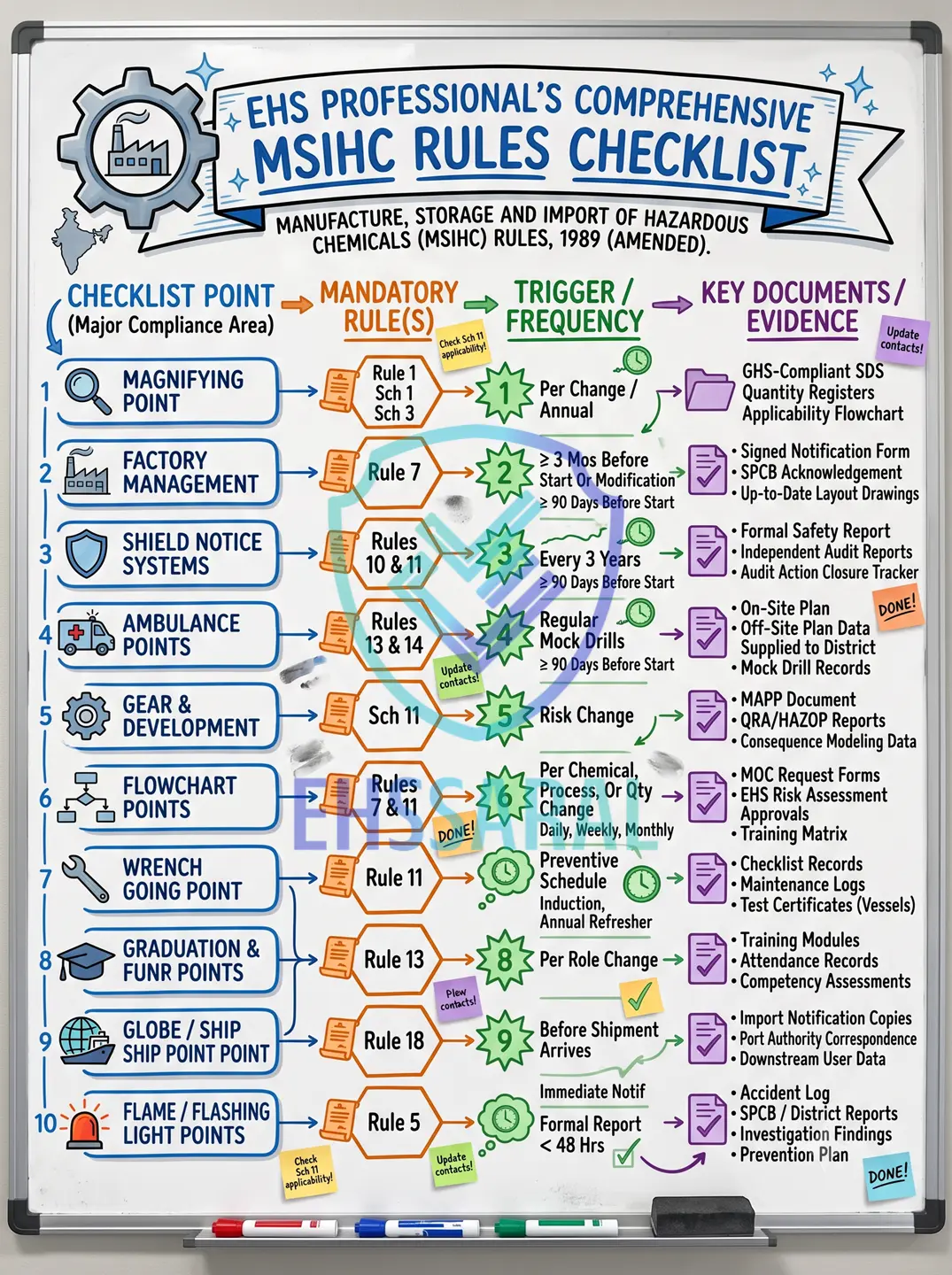
| Area | Basic Evidence to Maintain |
|---|---|
| Chemical identification | Name, CAS number, composition and concentration |
| Hazard assessment | Schedule 1 review and SDS information |
| Chemical inventory | Current location-wise inventory |
| Maximum quantity | Documented quantity calculation |
| Threshold review | Schedule 2 or Schedule 3 comparison |
| Industrial activity | Relevant installation assessment |
| Authority mapping | Applicable Schedule 5 authority |
| Applicability register | Chemical-wise compliance decision |
| Safety Data Sheets | Current and accessible SDS |
| Labels | Clear labels on tanks and containers |
| Pipelines | Identification and flow direction |
| Storage compatibility | Segregation and compatibility review |
| Secondary containment | Dyke inspection and drainage control |
| Tank integrity | Inspection, testing and maintenance records |
| Transfer systems | Hose, pump, valve and coupling checks |
| Tanker unloading | Checklist, supervision and emergency controls |
| Site notification | Submission, annexures and acknowledgement |
| Safety report | Current report matching the plant |
| Safety audit | Audit report and action tracker |
| On-site Emergency Plan | Updated controlled copy |
| Emergency roles | Current names, backups and contacts |
| Emergency control centre | Drawings, contacts, SDS and communication |
| Mock drills | Scenario, observations and action closure |
| Contractors | Training and emergency awareness |
| Medical support | First aid, ambulance and hospital arrangements |
| Off-site coordination | Information shared with concerned authorities |
| Accident reporting | Internal and regulatory procedure |
| Import requirements | Import and safety information, where applicable |
| Management of Change | EHS review before chemical or plant changes |
| Monthly review | Recorded inspection and action closure |
MSIHC is made under the Environment (Protection) Act.
Factories may also have separate duties under:
The same chemical tank or activity may be covered by different requirements for different reasons.
For example:
Compliance with one requirement does not automatically replace the others.
The EHS officer should maintain one coordinated chemical-safety system.
Documents prepared under different requirements should not contradict each other.
The same chemical quantity, tank capacity, layout and emergency contact should remain consistent across:
MSIHC compliance becomes manageable when the factory follows a clear sequence:
Do not begin with the safety-report file.
Do not begin with the mock-drill photographs.
Do not begin only by asking, “Which form do we have to submit?”
Begin with what is actually present inside the factory.
“Chemical safety does not begin with the emergency plan. It begins when the factory correctly identifies what is stored, how much is present and what can go wrong.”
Good chemical compliance does not require panic.
It requires correct information, practical controls and regular review.
MSIHC means Manufacture, Storage and Import of Hazardous Chemicals. The MSIHC Rules were notified in 1989 under the Environment (Protection) Act.
Not automatically. Applicability depends on the chemical’s hazardous properties, whether it is listed in the schedules, the maximum quantity present and the type of industrial installation or storage arrangement.
Monthly consumption alone may not be enough. The factory should check the maximum quantity that can be present in tanks, warehouses, process equipment, day tanks and other relevant locations.
A hazardous chemical can be a chemical meeting the hazard criteria in Schedule 1 or a chemical listed in Schedule 1, Schedule 2 or Schedule 3.
Schedule 2 contains threshold quantities relating to isolated storage. Schedule 3 contains threshold quantities relating to specified industrial activities and different duties under the Rules.
Isolated storage broadly refers to covered hazardous chemical storage that is not associated with a Schedule 4 installation on the same site and involves the relevant Schedule 2 quantity.
A safety report is required when the applicable chemical, industrial activity and threshold conditions specified under the Rules are met. The factory should check the relevant Schedule 2 or Schedule 3 entry.
The occupier of the applicable industrial activity prepares and keeps the On-site Emergency Plan updated.
The concerned authority prepares the Off-site Emergency Plan in consultation with the occupier and other relevant persons or agencies. The factory must provide the required site and accident information.
No. A fresh chemical used as a raw material may be a hazardous chemical. After use, the resulting spent material may separately become hazardous waste.
No. An SDS provides chemical safety information, but MSIHC compliance may also require quantity assessment, plant controls, site notification, safety reports, audits and emergency planning.
Where chemical unloading presents a credible release, fire, overflow or wrong-connection scenario, it should be considered in the site risk assessment and On-site Emergency Plan.
Review it whenever there is a change in the chemical, concentration, quantity, tank capacity, process, pipeline, unloading point, storage location or plant layout.
Important records can include the chemical inventory, applicability register, SDS, threshold calculations, site notification, safety report, audit findings, emergency plan, mock-drill reports, training records and Management of Change documents.
MAH means Major Accident Hazard. An MAH installation involves hazardous chemicals at or above the applicable threshold quantities specified under the MSIHC Rules.
Author's Note
Reviewed from a practical Indian factory EHS perspective. Readers should verify chemical-specific thresholds, applicable authorities and state submission procedures before making a compliance decision.

Founder, EHSSaral
Founder - EHSSaral | Partner - Perfect Pollucon | ISO 14001 Lead Auditor | GHG Protocol Scope 2 | Chemist | Data Scientist | Second-generation environmental professional simplifying EHS compliance for Indian industries through practical, automated, tech-enabled, data driven compliance workflows.
Industrial Siting Criteria in India: Factory Location Guide

Chemical Accident Emergency Response Guide for Indian Factories | EHSShala

Why EHS Experience Is Being Filtered Out - The Real Hiring Logic | EHSSaral

Form 4 Hazardous Waste Annual Return: Filing Guide & Format

Transforming SME Compliance: Zero Surprise Failures in India | EHSSaral Research
Environmental Compliance for Pharmaceutical Manufacturing in India | EHSSaral

Is There Truly Free Environmental Compliance Software in India? (An Honest Answer) | EHSSaral

Noise Monitoring in Factories Workplace vs Boundary (India Guide) | EHSShala

Form 4 vs Form 5: Why Hazardous Waste Numbers Don't Match

Late Filing Penalty for Form 4 SPCB: What Happens If You Miss the 30 June Deadline?