
Blog
Why Environmental Non-Compliance Happens in Indian Industries: 6 System Failures
EHSSaral is an Environmental Compliance Intelligence Platform for Industries. Consent Intelligence • Alerts & Tasks • Incident Reporting • Form IV & V • Audit-Ready Records
See how EHSSaral works
27 Apr 2026
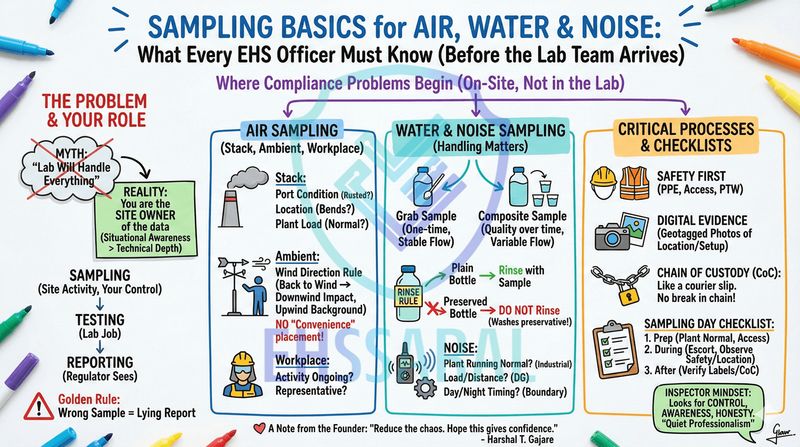
What Every EHS Officer Must Know (Before the Lab Team Arrives)
Most compliance problems do not start in the lab.
They start quietly, on site, during sampling.
A plant can have:
And still receive a notice.
Why?
Because sampling was treated as a formality, not a process.
In many factories, sampling day looks like this:
The lab team arrives.
The EHS officer escorts them.
Sampling happens.
Everyone signs.
Work resumes.
No questions asked.
No checks done.
It feels routine.
Until an inspection happens.
“Can you explain how this sample was collected?”
That is usually where panic starts.
This belief is very common.
And very risky.
Many EHS officers genuinely feel:
This is not laziness.
It is uncertainty.
But here is the reality:
The lab is responsible for testing.
You are responsible for sampling on your site.
If sampling is wrong:
And inspectors do not like defensive explanations.
Why Most Environmental Non-Compliance Is a System Failure, Not Intent
Let’s clear one confusion properly.
If sampling is incorrect, even the best testing cannot save the report.
A perfect test on a wrong sample is still wrong.
During sampling, you are not:
You are the site owner of the data.
Inspectors assume one thing very clearly:
“If sampling happened on this site, the EHS officer was aware of it.”
They don’t expect you to know lab chemistry.
They do expect you to know:
You don’t need technical depth.
You need situational awareness.
Many officers don’t distrust labs.
They distrust process shortcuts.
From inspection experience, sampling issues usually indicate:
Even honest plants get flagged because:
Inspectors read confidence silently.
A calm, clear explanation builds trust faster than any document.
CPCB – Environmental Monitoring Guidelines / Standards
This is a mindset shift.
The lab executes.
But the site controls:
If these are wrong, sampling is compromised before it starts.
This is why sampling basics matter.
These situations are commonly observed:
None of these look serious at that moment.
All of them become serious later.
Inspectors usually ask simple questions:
They are not testing your memory.
They are testing process ownership.
A confident, factual answer works better than a technical one.
This one line should stay with every EHS officer:
If the sample is wrong, the report is a lie - even if unintentionally.
This is not about fear.
This is about responsibility.
Sampling is where:
And the good news is:
You don’t need to be an expert.
You just need to be present and aware.
Air sampling is where most EHS officers feel the most uncomfortable.
Not because it is complex - but because it looks technical.
Tall stacks.
Instruments.
Climbing activity.
Wind discussions.
It creates a feeling of “lab territory”.
In reality, air sampling problems usually come from basic site issues, not instruments.
Across many sites, the same patterns repeat:
None of these are lab mistakes.
They are site-level oversights.
Stack air sampling looks intimidating.
But inspectors focus on only a few practical things.
Before any instrument is connected, check:
A very common issue is port hole jamming.
Bolts get rusted.
Paint blocks threads.
Covers are stuck.
The lab team struggles.
Time is lost.
Shortcuts begin.
If the port cannot be opened smoothly, sampling quality is already compromised.
This usually comes up later as:
Sampling point location is not just a drawing requirement.
It tells the inspector:
If sampling is done from:
Questions will follow.
You don’t need to quote rules.
You need to ensure no obvious shortcuts.
This is very important.
Inspectors assume:
If the process was:
That should be known to the EHS officer.
Silence here creates trouble later.
Ambient air sampling is often misunderstood.
Many sites treat it as:
“Place the sampler somewhere near the gate.”
That is risky.
Boundary sampling is meant to capture:
If the sampler is placed:
The reading loses meaning.
Background sampling is equally important.
It answers:
“What is already present in the surrounding environment?”
This protects the industry during:
This rule helps during site decisions.
If wind is hitting your back:
This is not theory.
This is practical positioning.
Wrong placement here often leads to:
Workplace air sampling is not required everywhere.
But when it is, it must be meaningful.
Common mistakes include:
Inspectors usually check:
Again, no deep science needed.
Only common sense supervision.
As an EHS officer, pause the activity if you notice:
Stopping politely is better than explaining later.
Inspectors don’t just read numbers.
They read intent and control.
They observe:
A calm explanation like:
“Sampling was done during normal operation, from the designated point”
Carries more weight than any technical argument.
Most air sampling problems are not technical failures.
They are preparation failures.
And preparation is fully within the EHS officer’s control.
(Where Small Handling Mistakes Create Big Compliance Issues)
Water and noise sampling look simple.
That is exactly why they cause the most trouble.
Because when something looks simple, people stop paying attention.
Most bad water reports are not because:
They are because:
And once the sample is wrong, nothing can correct it later.
This confusion exists at almost every site.
A grab sample is:
It is acceptable when:
A composite sample represents:
It is generally expected when:
The key issue is not which one is used.
The issue is why it was used.
If you can explain the reason calmly, half the problem is solved.
This is where inspectors focus closely.
Before sampling, quietly check:
Sampling during:
Creates data that does not reflect reality.
Inspectors don’t like “today special” conditions.
This one mistake alone causes many re-sampling orders.
This removes contamination from the container.
Rinsing these bottles:
Many people rinse automatically.
That one action can destroy the sample.
These are often taken lightly.
Common issues seen:
Groundwater needs:
Small lapses here raise doubts about authenticity.
Noise monitoring is often treated as:
“Just note the reading.”
That approach creates problems.
For industrial noise:
Mistakes include:
Inspectors usually ask:
“Was this measured during actual operation?”
DG noise sampling creates confusion due to distance and load.
Common mistakes:
If DG is not under normal load, the reading is meaningless.
Acoustic enclosure condition also matters.
Boundary noise often becomes an issue during complaints.
Key confusion areas:
Boundary noise should represent:
Consistency matters more than perfection.
As an EHS officer, intervene if you see:
Stopping and clarifying early is always safer.
Because these parameters are easy to manipulate unintentionally.
Inspectors check:
They trust data when:
Water and noise sampling problems usually happen because:
Slowing down by 10 minutes can prevent months of follow-up.
Sampling is not just a compliance activity.
It is also a safety activity.
During sampling, people are:
As the EHS officer, you are responsible not only for the sample, but also for the person collecting it.
Before sampling starts, quietly check:
If an accident happens during sampling, the question will be:
“Who allowed the activity?”
That answer should never be unclear.
Compliance data is useless if someone gets hurt collecting it.
Today, documents alone are not enough.
In many cases, a simple photograph has:
Photos help when:
A photo quietly answers questions without debate.
You don’t need professional photography.
Just ensure:
If possible, use:
Do not overdo it.
2–3 clear photos are enough.
Many people sign the Chain of Custody without understanding it.
Think of CoC like a courier tracking slip.
If at any point the chain breaks:
Legally, the sample is considered lost.
Even if the test result looks perfect.
That is why:
CoC is not paperwork.
It is legal continuity.
OCEMS Data Gaps Explained: Why CPCB Rejects Data & How to Fix
Most problems don’t come from bad labs.
They come from misaligned expectations.
Basic checks:
Calibration documents are often asked during inspections.
If they are missing, trust reduces instantly.
That energy is exactly what builds a community, not just a website.
When you hit that nerve-where the reader says, "Finally, someone understands what my day actually looks like"-you stop being a vendor and start being a partner. That is the EHSShaala brand you are building.
Since you are ready to push harder, here is that "5-Minute Sampling Audit" Table I mentioned. You can drop this right at the end of the article as a downloadable or a screenshot-able summary. It turns your advice into an immediate tool.
Keep this checklist on your phone. If you see a "Red Flag," pause the activity and check.
| Category | What to Check | Red Flag (Stop & Clarify) |
|---|---|---|
| Preparation | Plant Status | Plant is running on low load, shutdown, or "special adjustment" mode. |
| Air (Stack) | Port Access | Port is rusted shut; sampler is struggling to open it or using force. |
| Air (Ambient) | Location | Sampler placed behind a wall, under a tree, or "wherever the wire reaches." |
| Water | Bottle Handling | Sampler is rinsing a bottle that already contains acid/preservative. |
| Water | Source Flow | Sampling from a stagnant drain or when there is zero flow at the outlet. |
| Noise | Activity | Taking readings during lunch break or when major machines are off. |
| Safety | The Person | Sampler is climbing without a harness or handling acid without gloves. |
| Documentation | Chain of Custody | You are asked to sign blank forms or forms with wrong times. |
This is where theory becomes practice.
You don’t need to interfere.
You just need to be present.
Follow up on reports.
Never file them without review.
Pause sampling if you notice:
Stopping politely is professional.
Explaining later is painful.
Inspectors don’t expect perfection.
They look for:
They trust sites where:
They doubt sites where:
Sampling is not about:
It is about:
You don’t need brilliance.
You need attention.
“Most compliance problems start small.
Sampling is where you can stop them.”
Environmental Monitoring Jobs & Career Opportunities
Good compliance does not need heroics.
It needs systems.
If sampling is handled calmly, clearly, and consistently:
This is not extra work.
This is quiet professionalism.
A Note from the Founder: I started EHSSaral with one goal: To reduce the chaos in our industry. I know how stressful sampling days can be. I hope this guide gives you a little more confidence and a little less stress next time the lab team arrives. - Harshal T. Gajare

Founder, EHSSaral
Founder - EHSSaral | Partner - Perfect Pollucon | ISO 14001 Lead Auditor | GHG Protocol Scope 2 | Chemist | Data Scientist | Second-generation environmental professional simplifying EHS compliance for Indian industries through practical, automated, tech-enabled, data driven compliance workflows.
Why Environmental Non-Compliance Happens in Indian Industries: 6 System Failures
Best Environmental Compliance Software in India (2026): A Practical SME Comparison | EHSSaral
The ZLD Mass Balance Trap: How Auditors Calculate Effluent Using Your Water Bills | EHSSaral
E-Waste Management Rules (2022) in India - Practical Guide for Factories | EHSShala
Transforming SME Compliance: Zero Surprise Failures in India | EHSSaral Research

Consent Conditions Explained: What Factories Must Actually Follow After Approval | EHSShala
Environmental Non-Compliance Investigation: Process, RCA and Corrective Action
 Guide for Indian Factories EHSShala by EHSSaral.webp)
Ambient Air Quality Monitoring (AAQM) Guide for Indian Factories | EHSShala

Why Form IV Readiness Cannot Begin at the End of the Year
Bio-Medical Waste Management Rules, 2016 for Factories