
EHSShala
EHS Officer Career Path in India (2025–2050 Guide) | EHSShala
EHSSaral is an Environmental Compliance Intelligence Platform for Industries. Consent Intelligence • Alerts & Tasks • Incident Reporting • Form IV & V • Audit-Ready Records
See how EHSSaral works
13 Feb 2026
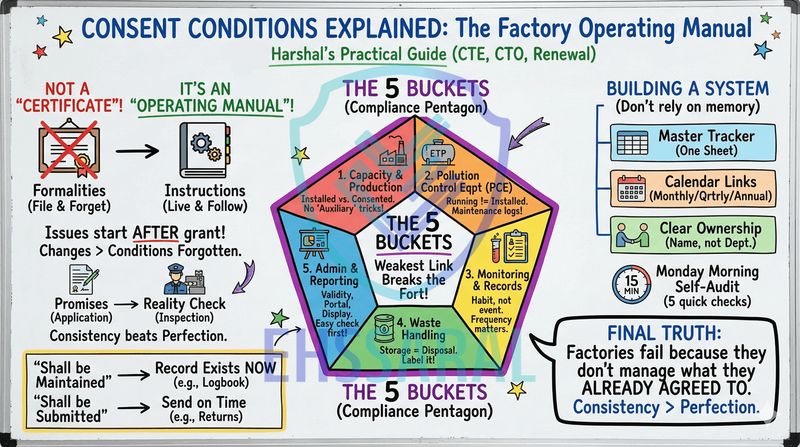
(CTE, CTO, Renewal – All Industries, All States)
Let us clear something first.
Most factories do not get into trouble because they pollute more.
They get into trouble because they do not follow what they already agreed to.
Consent conditions are not background text.
They are not “standard lines”.
They are not meant only for files.
They are operating instructions for your factory.
This is where most people panic – unnecessarily.
Not because the system is impossible.
But because nobody explained how to live with a consent after getting it.
On paper, consent conditions look boring.
Same language.
Same format.
Same wording across many industries.
So what happens in real life?
But during inspection, the same conditions suddenly become the main discussion point.
Why?
Because inspectors do not start by checking pollution numbers.
They start by checking control.
And consent conditions are the fastest way to judge control.
Think of your consent like this:
Most compliance issues start after consent is granted, not before.
Why?
Because once production starts:
And conditions get forgotten.
Consent conditions are not random.
They come from two simple places.
When you applied for consent, you told the Board:
Consent conditions are simply a written form of these promises.
Nothing more.
If you change anything later, conditions become sensitive.
During inspection, officers check one basic thing:
Does the shop floor match what was promised on paper?
They are not looking for perfection.
They are looking for consistency.
This is where “minor deviation” becomes a problem later.
One extra machine.
One additional shift.
One different fuel.
Individually small.
Together, they break the promise.
Conditions behave differently depending on the consent stage.
Many people miss this.
CTE conditions control what you can do before production.
They usually cover:
Common mistake seen later:
CTE conditions are ignored once civil work starts.
Then during CTO:
And questions start.
CTO conditions control day-to-day operations.
This includes:
This is where most inspections focus.
CTO conditions are live conditions.
They apply every day you operate.
Renewal is not a reset.
This is a dangerous assumption.
During renewal:
Many factories think renewal means:
“New consent, clean slate”
In reality:
Renewal means:
“Show us how well you managed the last one”
Consent conditions are written in a standard format.
This creates confusion.
Many conditions look copied.
Because they are standardised.
But standard does not mean optional.
A “general condition” still applies unless clearly exempted.
Because regulators want consistency.
Same industry.
Same risk.
Same wording.
But application depends on your site reality.
“This condition is not applicable to us.”
This sentence has caused more trouble than any pollution issue.
If a condition is written in your consent, it is applicable
- unless you have written clarification.
Silence is not exemption.
Stop reading consent like a certificate.
Start reading it like a control document.
Ask only three questions while reading conditions:
If you can answer these three, you are already safer than most factories.
(The Compliance Pentagon)
Most consent conditions feel scattered.
Water here.
Air there.
Some line about records.
Another about waste.
This is why inspections feel random.
They are not.
Almost every consent condition fits into five buckets.
Think of it like a fort with five walls.
If even one wall is weak, the whole system is exposed.
This is the first thing inspectors try to understand.
Not pollution.
Not records.
Capacity.
Capacity is not just a number on paper.
It includes:
Most factories break capacity conditions without realising it.
Common ground reality:
Production team sees efficiency.
Consent sees capacity expansion.
⚠️ Red Flag:
Auxiliary equipment quietly increasing capital investment or throughput.
Inspectors don’t need production figures first.
They look at:
Capacity mismatch creates doubt.
Once doubt starts, inspection goes deeper.
This bucket creates the most false confidence.
Many factories say:
“ETP is installed.”
“Scrubber is installed.”
“Bag filter is there.”
But inspectors check:
Installed but not operating is treated worse than not installed.
Because it shows intent to bypass.
Officers look for:
A silent system is a loud violation.
Temporary becomes permanent very fast.
And during inspection, “temporary” without records is treated as:
This bucket creates the most anxiety.
Not because it is complex.
Because it is continuous.
Consent conditions usually specify:
Most issues arise due to:
One missing report makes officers ask:
“What else is missing?”
⚠️ Red Flag:
“Lab didn’t come” is not accepted as a defence.
Responsibility remains with the occupier.
This bucket looks harmless.
Until it isn’t.
Inspectors check:
Even if disposal is proper, poor storage creates non-compliance.
Waste tells a story.
And inspectors read it carefully.
Learn How to read your SPCB Consent copy carefully to avoid any last-minute surprises
This bucket is underestimated.
But it creates fast observations.
These are easy to verify.
So they are checked first.
Because they signal:
A missing display board creates more questions than one borderline sample.
Before moving on: if you remember nothing else, remember the Pentagon. Every inspection question will trace back to one of those five buckets. Master those five, and you've mastered 90% of consent compliance.
(Monday Morning Safety Check)
Before inspection week, check just five things.
If these five are clean, inspection stress drops sharply.
Pollution category changes expectations, not responsibility.
Low pollution does not mean:
White units still face:
Focus usually on:
False assumption:
“Green means relaxed.”
Reality:
Green means documented simplicity.
Here documentation matters more.
This is where casual lapses become observations.
Zero tolerance zone.
Red category units must be boringly consistent.
Instead of remembering 40 conditions, remember 5 buckets.
During inspection, mentally check:
If all five are stable, inspection stress drops automatically.
Some consent conditions look so basic that they are ignored.
These are the ones that usually create first observations.
This is the most common issue seen across factories.
On ground, nothing changes.
On paper, everything breaks.
Inspectors treat this as:
And once paperwork is questioned, everything else comes under the lens.
Consent may say:
But actual work includes:
Even small process additions matter.
If it is not in the consent, it is not allowed - until amended.
Many consents carry old errors.
Wrong units.
Wrong quantities.
Copied text.
But during inspection, consent copy is treated as truth.
If your operations don’t match it, the mismatch is yours to explain.
These two phrases decide inspection outcome.
This means:
Example:
Logbooks.
If yesterday’s entry is missing, it is treated as non-compliance.
This means:
Late submission without explanation is treated as neglect.
Do not overshare.
Showing extra documents often creates new questions.
Show what is asked.
Show what is relevant.
Be precise.
Different industries trip on different issues.
Common problems:
Real example: A plastic molding unit added two injection machines "for backup." Capacity increased 30% without amendment. During inspection, machine nameplates + electrical load didn't match consent. This triggered a full capacity audit and consent violation notice.
High focus on:
Small lapses are treated seriously.
Typical issues:
Cutting, welding, surface prep often go undocumented.
Frequent gaps:
Often ignored areas:
High-visibility units.
Focus areas:
These units are inspected more often due to public impact.
This confuses many people.
Why not check samples first?
Because conditions show intent.
If conditions are weak, sample results are questioned.
If conditions are strong, minor deviations are discussed calmly.
(Without Bad Intent)
Most violations are not intentional.
Consultant handles everything.
Until they don’t.
Ownership remains with the occupier.
Monitoring.
Returns.
Renewals.
One missed date starts a chain reaction.
Knowledge leaves with people.
Systems don’t exist to absorb change.
One EHS officer.
Many units.
Something will slip. Always.
This sentence has never protected anyone.
These myths create false comfort.
Installation is the start, not the end.
Operation and records decide compliance.
No.
Lab is a service provider.
Responsibility stays with the occupier.
Silence is not approval.
Problems surface during inspection or renewal.
Renewal exposes gaps.
It does not erase them.
This catches even experienced teams.
New lines appear.
Old ones tighten.
Many people don’t re-read the full consent.
Urbanisation changes expectations.
What was acceptable earlier may not be today.
Example: A metal fabrication unit operating since 2010 was 500m from the nearest residence. By 2023, an apartment complex was built 150m away. During renewal, new noise conditions were added requiring acoustic enclosures for all machinery-conditions that didn't exist in the original consent.
Nearby habitation, schools, hospitals change inspection focus.
Compliance does not fail because people are careless.
It fails because there is no system.
This is the simplest control tool.
One sheet.
One place.
No complexity.
For each condition, track:
This alone prevents panic.
Most conditions are time-based.
If it is not on a calendar, it will be forgotten.
Use three buckets:
No heroics needed.
Just reminders.
Avoid this situation:
“Everyone thought someone else was doing it.”
Each condition must have:
This happens more often than people admit.
Ignoring it is the worst option.
Do it:
Not after an observation.
This protects you.
Use:
Written intent matters.
Even if approval is delayed, effort is visible.
Inspections are not interrogations.
They are evaluations.
Say the truth.
Explain why.
Explain corrective action.
Give timeline.
Honesty reduces escalation.
Overconfidence invites probing.
Clarity builds trust.
“Most factories don’t fail because they pollute.
They fail because they don’t manage what they already agreed to.”
This is not about fear.
This is about control.
You don’t need perfection.
You need:
Consent conditions are manageable.
Break them down.
Track them.
Own them.
That’s it.
CPCB (Central Pollution Control Board)
SPCB (State Pollution Control Board)
Consent conditions are mandatory operating requirements.
They are part of the permission to run the factory.
Ignoring them is treated as operating outside consent, even if pollution levels are normal.
No.
Installation alone is not compliance.
Consent conditions expect operation and maintenance, not just presence.
“Installed but not running” is often treated more seriously than “not installed”.
No.
If a condition is written in your consent, it applies unless clarified in writing.
Silently ignoring a condition is risky.
Clarification should be taken before inspection or renewal.
The occupier / unit is always responsible.
Consultants and vendors are service providers.
Their failure does not transfer responsibility away from the factory.
One missed report may not cause immediate action,
but it raises suspicion.
During inspection or renewal, missing reports often trigger:
No.
Renewal does not reset history.
Past gaps often:
Renewal checks how well the previous consent was managed.
No.
White category means lower pollution, not zero responsibility.
Administrative conditions, waste handling, and basic records still apply.
Because conditions show control and intent.
Pollution data can vary.
Conditions reflect whether the system is working or not.
Strong condition compliance usually leads to smoother inspections.
No.
The lab only performs testing.
Scheduling, frequency, report availability, and submission
remain the responsibility of the factory.
It means:
Incomplete or outdated records are treated as non-compliance.
It means:
Late or missing submissions are viewed negatively.
Yes.
Even “support” or “auxiliary” equipment can:
Small changes add up.
Do not ignore it.
Best practice:
Written intent protects during inspection.
Yes.
Administrative lapses are easy to verify.
They often become the first inspection observation.
They signal weak ownership, even if pollution control is good.
At least:
Conditions should be treated as live documents, not static files.
Three habits:
Consistency beats last-minute compliance.

Founder, EHSSaral
Founder - EHSSaral | Partner - Perfect Pollucon | ISO 14001 Lead Auditor | GHG Protocol Scope 2 | Chemist | Data Scientist | Second-generation environmental professional simplifying EHS compliance for Indian industries through practical, automated, tech-enabled, data driven compliance workflows.
EHS Officer Career Path in India (2025–2050 Guide) | EHSShala
Battery Waste Registration for Equipment Importers (BWM Rules 2022 Explained) | EHSSaral
Hazardous Waste All Forms Form 1 to Form 12 Guide
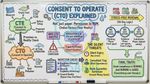
Consent to Operate (CTO) Explained for Indian Factories | EHSShala
Environmental Compliance Data for BRSR & GRI Reporting in India | EHSSaral Research
Why Running Factories Are Getting Closure Notices in 2026 | EHSSaral
Environmental Consultancy Software: Beyond Excel & WhatsApp
 EHSSaral v1.png)
EADA Random Audit Assignment: Factory Readiness Guide (2025) | EHSSaral
Form 3 Logbook Explained: Simple Guide for Indian Factories | EHSShala
Industrial Pollutants Explained: COD, BOD, TSS & PM (A Practical Guide)