
Blog
Industrial Siting Criteria in India: Factory Location Guide
EHSSaral is an Environmental Compliance Intelligence Platform for Industries. Consent Intelligence • Alerts & Tasks • Incident Reporting • Form IV & V • Audit-Ready Records
See how EHSSaral works
18 Aug 2026
Inside the factory, most EHS officers feel reasonably confident.
Waste is stored.
Labels are fixed.
Registers are updated.
Things feel under control.
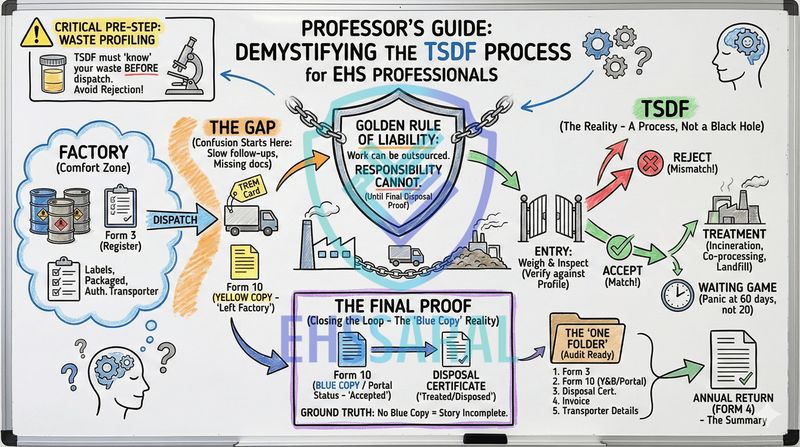
The confusion starts after the truck leaves the gate.
This article explains the TSDF hazardous waste management process step-by-step - from manifest to disposal proof.
That is where:
follow-ups slow down
documents go missing
quantities stop matching
inspectors ask uncomfortable questions
Most hazardous waste problems do not start because someone wanted to hide something.
They start because people are not fully clear about what happens after dispatch.
“Waste gaya… ab tension khatam na?”
That one assumption creates most TSDF-related trouble.
This article exists to remove that confusion calmly.
No legal sections.
No fear language.
Only how the TSDF process actually works in real factory life.
TSDF stands for Treatment, Storage and Disposal Facility.
It is an authorised facility that receives hazardous waste, verifies whether it meets the approved acceptance criteria and manages it through an authorised treatment, storage or disposal route.
For the waste-generating factory, the TSDF process does not end when the truck leaves the gate.
A complete compliance trail normally includes:
A hazardous-waste dispatch is complete only when movement, acceptance, quantity and disposal evidence form one traceable record.
TSDF means Treatment, Storage and Disposal Facility.
A TSDF is an authorised facility established for receiving and managing hazardous and other wastes through approved operations such as:
The exact treatment or disposal route depends on:
TSD is sometimes used as a shorter expression for treatment, storage and disposal.
In Indian hazardous-waste compliance, TSDF is the more commonly used term for an authorised Treatment, Storage and Disposal Facility.
The factory should focus less on the abbreviation and more on whether:
Before approaching a TSDF, verify:
Do not dispatch waste only because the TSDF or transporter is familiar with it.
The factory’s hazardous-waste authorisation should support the category, quantity and proposed disposal route.
Depending on the state and facility, the generator may need to complete:
Keep current copies of the TSDF’s authorisation and relevant approvals in the vendor file.
The TSDF may require a representative sample before accepting the waste.
The sample may be checked for characteristics such as:
Sampling should represent the actual waste proposed for dispatch.
A sample collected only from the cleanest or easiest portion of the waste does not provide reliable acceptance information.
Before dispatch, obtain clarity on:
Do not assume that an earlier approval remains valid when the manufacturing process or waste characteristics have changed.
The sender must prepare the hazardous-waste manifest in Form 10 in accordance with the applicable manifest system.
Before the vehicle leaves, verify:
Also preserve supporting documents such as:
The waste should be moved using:
The generator should not treat transportation as the transporter’s responsibility alone.
The sender remains responsible for providing correct information and ensuring that the waste is lawfully handed over for movement.
Before hazardous waste leaves the factory, take two minutes to verify the basics.
| Check | Status |
|---|---|
| Hazardous waste category verified | □ |
| Waste containers labelled properly | □ |
| Form 3 updated | □ |
| Form 10 prepared | □ |
| Authorised transporter confirmed | □ |
| TREM Card available with driver | □ |
| TSDF acceptance/profile validity confirmed | □ |
| Quantity verified before dispatch | □ |
This small checklist prevents many of the issues that later become inspection observations, document mismatches, and Form 4 reconciliation problems.
At the facility, the TSDF may:
The factory should obtain and preserve evidence showing:
After receiving the acknowledgement:
The truck leaving the factory is a movement event. Receipt, acceptance and reconciliation complete the compliance event.
Do not treat the dispatch as closed just because the vehicle has left the factory.
If the receiver acknowledgement, signed manifest copy or valid portal acceptance evidence is still pending, keep the movement open for follow-up.
First, establish what actually happened to the waste.
Verify:
Also check your gate register, outward record and factory weighbridge slip.
The first question is simple:
Did the waste physically leave exactly as recorded in Form 10?
Ask the transporter to confirm:
Ask for supporting evidence wherever available.
Do not rely only on a verbal statement such as:
“Material deliver ho gaya hai.”
You need a traceable record.
If the transporter confirms delivery but acknowledgement is still missing, contact the TSDF customer, dispatch or documentation team directly.
Share:
Ask them to confirm:
This separates a documentation delay from an actual movement problem.
If your state uses an electronic manifest or waste-tracking system, check whether:
Save the available electronic evidence with the dispatch record.
Do not assume that because the process is online, somebody else is tracking the closure.
Until acknowledgement is received, mark the dispatch as:
Acknowledgement Pending
Do not quietly treat it as a completed disposal.
Your internal exception record should contain:
This becomes especially important during Form 4 preparation.
A missing acknowledgement is easier to manage when it is an open action. It becomes difficult when it is discovered months later during annual-return preparation.
If repeated follow-ups do not establish receipt or there is a genuine doubt about where the waste reached, involve your plant management and follow the applicable SPCB/PCC process.
Keep your communication factual.
You are trying to establish:
Where did the waste go, how much was received, and what evidence supports it?
Do not create or alter records simply to close the gap.
Factory dispatch record → Transporter confirmation → TSDF confirmation → Portal status, where applicable → Receiver acknowledgement → Internal closure
If one link is missing, keep following the movement until the evidence trail is complete.
“Waste dispatched” and “waste disposal proven” are two different things.
| Stage | Document or Evidence | What the Factory Should Verify |
|---|---|---|
| Before dispatch | Hazardous-waste authorisation | Correct category, quantity and disposal route |
| Before dispatch | TSDF authorisation or facility approval | Validity and acceptance of the relevant waste |
| Before dispatch | Membership or agreement | Current relationship and approved services |
| Before dispatch | Waste-profile or sample-acceptance report | Characteristics, validity and approved route |
| Before dispatch | Packaging and labelling record | Container suitability and identification |
| During dispatch | Form 10 manifest | Correct generator, transporter, receiver, waste and quantity details |
| During dispatch | Factory weighment record | Gross, tare and net quantity basis |
| At receipt | TSDF weighment record | Quantity received and accepted |
| At receipt | Receiver acknowledgement | Date, signature and consignment reference |
| After receipt | Treatment or disposal evidence | Method and final status, where issued |
| Internal closure | Updated Form 3 | Dispatch and closing-stock adjustment |
| Annual reporting | Form 4 reconciliation | Generation, disposal and closing balance alignment |
No single document proves the entire process. Compliance is established by the complete evidence trail.
Quantity differences are common, but they should never be ignored.
For example:
The 0.4-tonne difference requires explanation.
Do not silently change the quantity merely to make the records match.
A corrected number without an explanation removes the difference from the register, but it does not remove the compliance risk.
Unexplained differences can be reduced when Form 3, Form 10, TSDF acknowledgements and physical stock are managed through a connected hazardous-waste management system.
A TSDF may reject or hold a consignment when:
Do not send rejected waste to another receiver merely because that receiver is willing to accept it.
The alternative receiver must be authorised for the relevant waste and disposal or utilisation route.
Rejection is not only a logistics issue. It may indicate a failure in classification, sampling, process control or vendor verification.
Do not select a facility only because:
Verify:
Keep a vendor-verification file containing:
Vendor confidence is not compliance evidence. Current authorisation and category-specific acceptance are.
TSDF documents are not separate from the factory’s annual return.
They support the movement and disposal quantities reported in Form 4.
The connection should be:
Form 3 generation → Physical storage → Form 10 dispatch → TSDF acknowledgement → Disposal evidence → Form 4
For every hazardous-waste category, compare:
Use the basic control:
Opening stock + generation − supported dispatch = closing stock
A properly completed Form 10 supports evidence that the waste was dispatched through the declared movement process.
The TSDF acknowledgement helps prove that it was received.
Disposal or treatment evidence completes the record further.
Form 4 should be based on this connected evidence rather than on a year-end estimate.
Managing TSDF dispatches through separate Excel files, physical manifests, emails and folders makes reconciliation difficult.
EHSSaral connects:
This helps the EHS team identify:
EHSSaral connects Form 3 records, Form 10 manifests, dispatch quantities, receiver acknowledgements, disposal evidence and Form 4 readiness.
Maintain a tracker containing at least:
| Field | What to Record |
| Waste category | Code and authorised description |
| Form 10 number | Unique manifest reference |
| Dispatch date | Date the waste left the factory |
| Factory quantity | Quantity recorded at dispatch |
| Vehicle number | Transport identification |
| Transporter | Name and authorisation details |
| Receiver | TSDF, recycler, co-processor or actual user |
| Receipt date | Date accepted by the receiver |
| Accepted quantity | Quantity recorded by the receiver |
| Difference | Dispatch quantity minus accepted quantity |
| Acknowledgement | Received, pending or disputed |
| Disposal evidence | Received or pending |
| Form 3 updated | Yes or no |
| Form 4 mapping | Relevant annual-return category |
| Open action | Follow-up or corrective action required |
Review all entries showing:
A dispatch should remain open in the tracker until the supporting records are complete.
This rule clears a lot of confusion.
“Work can be outsourced.
Responsibility cannot.”
You can hire transporters.
You can use TSDFs.
Until lawful receipt, quantity reconciliation and supporting treatment or disposal evidence are available, the factory’s traceability trail remains incomplete.
This understanding alone makes EHS officers more alert - not anxious.
Simple habits that work in real factories:
Track manifest numbers regularly
Follow up for Receiver acknowledgement or valid portal acceptance evidence every month
Match Form 3 quantities with disposal quantities
Do not wait for inspection reminders
Good compliance does not need brilliance.
It needs consistency.
Think of compliance as a chain:
Form 3 - your internal record
Form 10 - movement proof
Receiver acknowledgement or valid portal acceptance evidence - acceptance proof*
treatment, disposal or final-processing evidence, where issued or applicable - treatment proof
Annual Return (Form 4) - summary proof
If your Form 3 and Form 10 don’t match, Form 4 becomes a nightmare at year-end.
Break one link,
and the story breaks during audit.
*In the physical manifest system, the returned receiver copy-commonly remembered by EHS teams as the Receiver acknowledgement or valid portal acceptance evidence-serves as important acceptance evidence.
Many people search “List of TSDF facilities” to find the authorised TSDF for their state.
Best practice: Always refer to the latest list published by your SPCB / CPCB, because authorisations change.
Check your Consent / Authorisation conditions (approved TSDF is often mentioned)
Verify your transporter and TSDF are authorised and active
Confirm whether your waste category is accepted by that TSDF
Simple rule:
Don’t choose TSDF based only on distance or rate - choose based on authorised acceptance for your category.
This is written for:
Junior EHS officers
SME factories
Anyone who has quietly wondered: - “Waste gaya… ab tension khatam na?”
Before treating a hazardous-waste dispatch as complete, confirm:
If any answer is “no,” the dispatch record is not fully closed.
The TSDF process is not only about arranging a vehicle and sending hazardous waste outside the factory.
It is a connected compliance process:
Classification → Acceptance → Form 10 → Transportation → Receipt → Quantity reconciliation → Disposal evidence → Form 3 and Form 4 closure
A truck leaving the factory is not proof of disposal.
The strongest evidence is a complete trail showing:
Hazardous-waste movement is complete only when the physical waste, manifest, acknowledgement, disposal evidence and annual records tell the same story.
Final acceptance and disposal evidence complete the traceability trail, but they do not correct earlier non-compliance.
No.
The Yellow copy only proves that waste left your factory.
It does not prove that:
TSDF accepted it
Waste was treated or disposed
For closure, the Receiver acknowledgement or valid portal acceptance evidence or final disposal status is essential.
There is no fixed rule, but in practice:
It usually comes after acceptance and treatment
A few weeks’ delay is common
Do not panic early.
Follow up calmly if it crosses a reasonable time.
Follow up according to the agreed timeline. Do not wait until annual-return preparation or inspection week.
The logic stays the same.
In online systems:
Receiver acknowledgement or valid portal acceptance evidence appears as acceptance / final disposal status
treatment, disposal or final-processing evidence, where issued or applicables may still need manual download
Best practice:
Take monthly screenshots of acceptance status
Keep them as backup proof
Do not assume “portal updated” means records are complete.
Common reasons include:
Waste category mismatch
Mixing of different wastes
Contamination
Packaging issues
Waste not matching the approved sample / profile
Rejection is not punishment.
It is standard protocol.
If rejected, the waste usually comes back to the factory.
This situation is common and risky.
If:
Manifest is dated
Waste is still in the factory
It can raise questions during inspection.
Best practice:
Generate Form 10 as close to actual dispatch as possible
Or clearly document the delay with transporter confirmation
Yes.
If anything happens during transport:
Police or emergency teams ask for the TREM Card first
Always ensure:
Driver carries it
Transporter understands its importance
No, this is risky.
Using:
Unauthorized transporters
“Temporary” vehicles
is a common audit observation, especially during:
monsoon
festival seasons
vehicle shortages
Always use authorised transporters only.
The standard storage period under Rule 8 is 90 days. However, specified provisions and exceptions apply.
Following the 2024 amendment:
The factory should verify annual generation, authorisation conditions and applicable SPCB or PCC requirements before relying on a longer period.
Keep one clean annual set:
Form 3 (register)
Form 10 (copies or portal status)
receiver acknowledgement or valid portal acceptance evidence
treatment, disposal or final-processing evidence, where issued or applicable
TSDF invoice
Transporter details
One folder. One year. No hunting.
Directly.
Form 4 is prepared using:
Form 3 quantities
Manifest details
Disposal data
If Form 3 and Form 10 don’t match,
Form 4 becomes very difficult to file at year-end.
Good TSDF tracking today saves panic later.
Do not close the dispatch internally.
Verify the Form 10 and vehicle details, confirm physical delivery with the transporter, contact the TSDF directly and check the online portal where applicable.
Keep the movement marked as Acknowledgement Pending until receipt can be supported.
If the movement itself cannot be confirmed after reasonable follow-up, involve plant management and follow the applicable SPCB/PCC process.
Inspectors usually check:
Traceability
Quantity matching
Proof of acceptance and disposal
They are not judging paperwork beauty.
They are checking whether the story is complete and believable.
This one:
“Work can be outsourced. Responsibility cannot.”
You can outsource transport and disposal.
You can never outsource liability.
Yes. TSDF may have different meanings in unrelated technical or medical contexts. In this article, TSDF refers only to a Treatment, Storage and Disposal Facility for hazardous and other wastes.
TSDF stands for Treatment, Storage and Disposal Facility.
In hazardous-waste management, it refers to an authorised facility that receives and manages hazardous waste through approved treatment, storage and disposal operations.
Form 10 is the manifest prescribed under Rule 19 for movement of hazardous and other waste within India.
The sender prepares seven signed copies in accordance with the prescribed colour-coded manifest process.
Factories should also follow any applicable electronic portal or state-specific procedure.
No.
The factory should preserve evidence showing correct classification, lawful movement, authorised receipt, accepted quantity and internal reconciliation.
A dispatch without receiver acknowledgement and updated records remains an incomplete compliance trail.
Depending on the facility and disposal route, the record may include:
The factory should verify what evidence its SPCB, PCC, authorisation and disposal arrangement require.
Preserve both weighment records, compare the quantity basis, determine whether the full consignment was accepted and document the reason for the difference.
Update Form 3 and Form 4 only using reconciled and supportable records.
Do not change the quantity silently.
Yes.
A hazardous-waste management system can connect Form 3 records, Form 10 manifests, storage balances, TSDF acknowledgements, accepted quantities and disposal evidence.
This helps identify missing records and supports Form 4 preparation.
No.
The receiving facility should be authorised and capable of accepting the specific waste category and proposed treatment or disposal route.
A facility authorised for one waste or process should not automatically be treated as authorised for every hazardous waste.
Obtain the rejection reason and quantity in writing, maintain safe control of the consignment, update internal records and identify a lawful next step.
Do not divert the waste to an unauthorised receiver or change its description merely to obtain acceptance.

Founder, EHSSaral
Founder - EHSSaral | Partner - Perfect Pollucon | ISO 14001 Lead Auditor | GHG Protocol Scope 2 | Chemist | Data Scientist | Second-generation environmental professional simplifying EHS compliance for Indian industries through practical, automated, tech-enabled, data driven compliance workflows.
Industrial Siting Criteria in India: Factory Location Guide
The Hidden Costs of Manual Environmental Compliance in India
Hazardous Waste Packaging & Labelling in India (Inspector Guide) | EHSShala

Is Your Factory Heat-Ready? 5 New Compliance Realities for the 2026 Indian Summer
Hazardous Waste Management Software India | EHSSaral

Consent Conditions Explained: What Factories Must Actually Follow After Approval | EHSShala
Industrial Pollutants Explained: COD, BOD, TSS & PM (A Practical Guide)

Chemical Accident Emergency Response Guide for Indian Factories | EHSShala
 EHSSaral.webp)
Environmental Monitoring Mistakes in Indian Factories (Real Issues Explained)
Late Filing Penalty for Form 4 SPCB: What Happens If You Miss the 30 June Deadline?