
Blog
CSR Trends 2026: Environmental Compliance Automation in India | EHSSaral
EHSSaral is an Environmental Compliance Intelligence Platform for Industries. Consent Intelligence • Alerts & Tasks • Incident Reporting • Form IV & V • Audit-Ready Records
See how EHSSaral works
23 Jul 2026
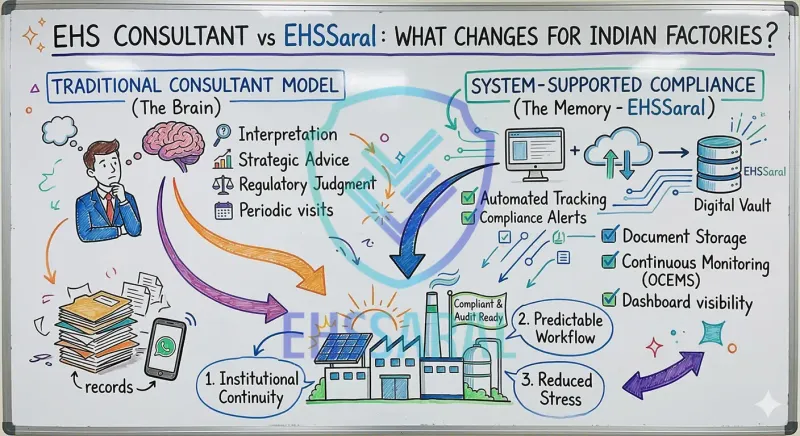
Environmental compliance in Indian factories is gradually evolving from manual tracking and consultant-driven systems to structured digital compliance platforms that improve visibility, documentation, and task management.
An environmental inspection has just started.
The Pollution Control Board officer walks into the plant and asks a straightforward question:
“Can you show the OCEMS calibration records for the last two years?”
The EHS officer knows the records exist.
The calibration reports were submitted.
The lab reports were emailed.
The documents were stored somewhere.
But retrieving them quickly becomes the challenge.
First comes the email search.
Then the shared drive folders.
Then a WhatsApp message to the consultant asking where the files were saved.
Meanwhile the inspection continues.
Scenes like this are not unusual in Indian factories. They happen even in plants where the EHS team is competent and committed.
The issue is rarely knowledge.
More often, the issue is how compliance information is organized and tracked inside the organization.
To understand why this happens, it helps to step back and look at how environmental compliance systems have evolved over time.
Environmental compliance management has gradually moved through different stages as regulations, monitoring systems, and reporting expectations have increased.
In earlier decades, compliance responsibilities were handled largely within the plant itself.
Environmental documentation was maintained in registers and physical files, and compliance tasks were remembered by experienced employees.
| Compliance Area | How It Was Typically Managed |
|---|---|
| Environmental records | Physical files and registers |
| Deadline tracking | Personal reminders |
| Monitoring schedules | Maintained in notebooks or calendars |
| Regulatory submissions | Paper-based documentation |
| Compliance knowledge | Held by a few experienced staff |
This approach worked reasonably well when the number of environmental obligations was limited.
But as regulations expanded and reporting became more structured, factories began needing deeper regulatory expertise.
Over time, environmental consultants became an integral part of the compliance ecosystem.
Consultants helped factories interpret environmental rules, coordinate monitoring activities, and prepare documentation for regulatory submissions.
Many industries across India continue to operate with strong support from experienced consultants.
| Area of Compliance | Role of Consultants |
|---|---|
| Consent management | Guidance on consent applications and renewals |
| Regulatory interpretation | Explaining environmental rules and conditions |
| Monitoring coordination | Connecting factories with laboratories |
| Documentation preparation | Preparing compliance reports and submissions |
| Inspection support | Assisting during regulatory visits |
Consultants bring an important advantage: experience built through years of field exposure and regulatory interaction.
However, the compliance landscape itself has continued evolving.
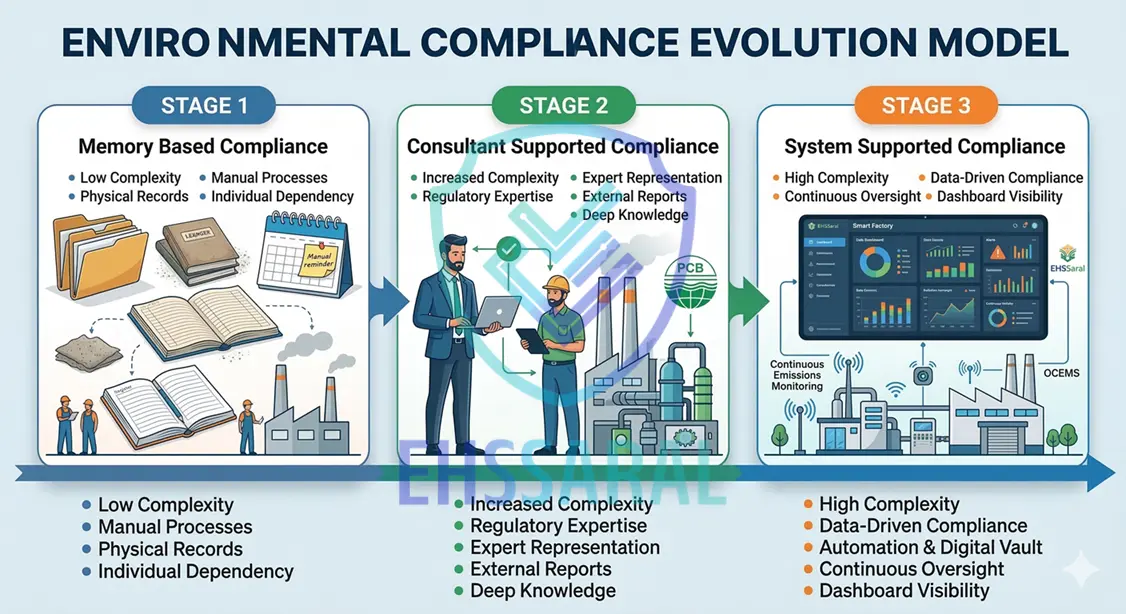
Environmental compliance today involves far more than periodic reporting.
Factories now operate in a regulatory environment that includes multiple layers of documentation and data.
Some of the major developments shaping modern compliance include:
Online consent management portals
Continuous emissions monitoring systems (OCEMS)
Digital hazardous waste reporting systems
Environmental audit submissions
ESG reporting expectations from global supply chains
Increasing transparency in regulatory oversight
Each of these developments adds operational responsibility to the EHS function.
From a practical standpoint, this means environmental compliance now involves continuous tracking rather than occasional documentation.
| Operational Challenge | What Often Happens in Practice |
|---|---|
| Monitoring schedules | Maintained in Excel trackers |
| Consent conditions | Stored as PDF documents |
| Reporting deadlines | Tracked through personal reminders |
| Compliance records | Spread across multiple folders |
| Historical documentation | Difficult to retrieve quickly |
None of these situations occur because EHS teams lack competence.
They occur because compliance tasks are often managed without structured operational systems.
To understand the pressure this creates, consider a factory managing multiple environmental programs simultaneously.
Typical activities might include:
Stack emission monitoring
Ambient air quality monitoring
Effluent discharge testing
Hazardous waste reporting
Environmental statement submissions
Each program generates its own schedule, reports, and regulatory documentation.
Without structured systems, tracking often depends on multiple independent tools.
| Compliance Activity | Typical Tracking Method |
|---|---|
| Monitoring schedules | Excel sheets or calendars |
| Laboratory coordination | Email and phone communication |
| Consent conditions | Individual PDF files |
| Document storage | Separate team folders |
| Compliance reminders | Personal notes or messages |
Initially this may appear manageable.
But over time small operational gaps begin to appear.
For example:
Duplicate versions of compliance reports
Difficulty locating historical monitoring records
Confusion about consent conditions
Last-minute preparation before audits or inspections
These challenges are rarely caused by lack of knowledge.
They are usually the result of systems that were never designed to manage the growing complexity of environmental compliance.
And this is where digital compliance platforms begin to play a role.
Read more Best Environmental Compliance Software in India (2026): A Practical SME Comparison
As environmental compliance requirements grow, many industries are beginning to introduce structured digital systems to support their compliance operations.
This transition is similar to what has already happened in other business functions.
Finance teams use ERP systems to manage accounts.
Human resource departments rely on HR platforms to track employee records.
Manufacturing operations use monitoring systems to manage production.
Environmental compliance is gradually moving in a similar direction.
Platforms like EHSSaral aim to provide a structured digital layer around daily compliance activities inside factories.
The idea is not to replace expertise.
The objective is to introduce clarity, continuity, and visibility into compliance management.
When implemented properly, a digital compliance platform functions as a central system that supports routine compliance tracking.
| Compliance Function | Traditional Approach | System-Supported Approach |
|---|---|---|
| Consent condition review | Manual reading of consent documents | Conditions converted into trackable tasks |
| Compliance deadlines | Personal reminders or Excel sheets | Automated compliance calendar |
| Monitoring documentation | Stored across folders and emails | Centralized digital document vault |
| Compliance status | Known only within EHS team | Visible through dashboards |
| Historical records | Difficult to locate quickly | Organized searchable archive |
Over time, this structured approach helps organizations maintain a clear and consistent record of compliance activities.
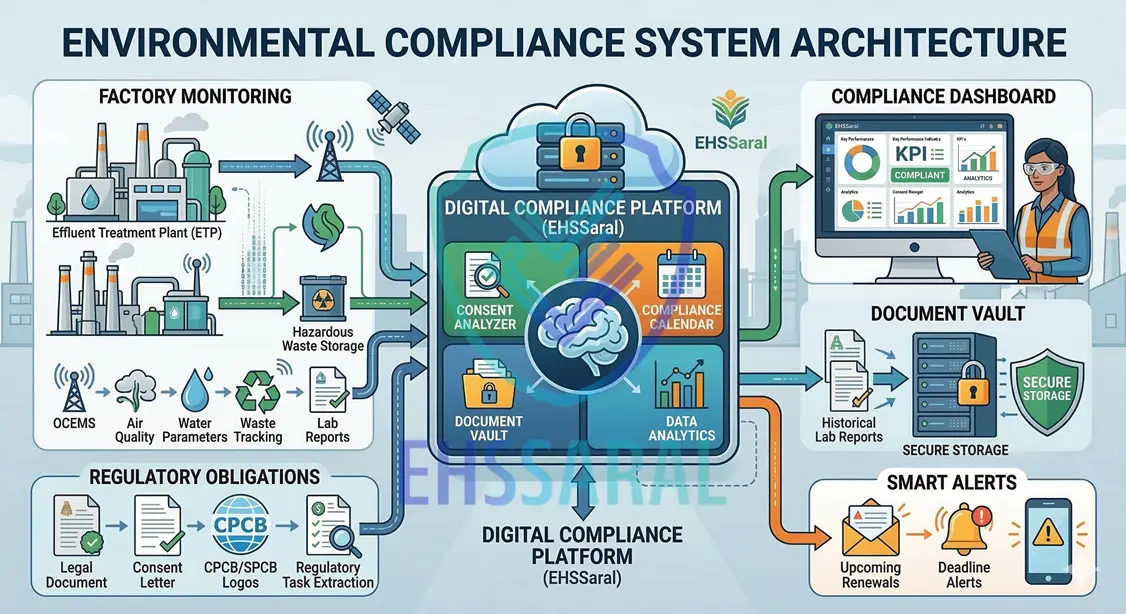
Environmental compliance systems can broadly be understood across three operational models.
Each model represents a different way in which compliance responsibilities are organized inside factories.
| Aspect | Typical Situation |
|---|---|
| Task tracking | Maintained in notebooks or personal trackers |
| Documentation | Stored in scattered folders |
| Deadline reminders | Dependent on individuals |
| Compliance visibility | Limited to specific team members |
| Risk | Knowledge loss during staff changes |
This model relies heavily on the experience and memory of specific individuals.
| Aspect | Typical Situation |
|---|---|
| Regulatory interpretation | Provided by consultants |
| Compliance documentation | Prepared externally |
| Monitoring coordination | Managed through consultant networks |
| Deadline reminders | Periodic consultant communication |
| Compliance review | Occurs during consultant visits or reporting cycles |
Consultants bring valuable regulatory knowledge and field experience, which improves the quality of compliance decisions.
However, operational tracking may still remain distributed across communication channels.
| Aspect | Typical Situation |
|---|---|
| Consent conditions | Converted into trackable digital tasks |
| Monitoring schedules | Built into compliance calendars |
| Alerts and reminders | Automatically generated |
| Document storage | Organized within a central repository |
| Compliance history | Maintained as institutional record |
The key advantage of this model is not intelligence.
It is consistency.
Systems ensure that compliance activities are tracked and documented in a predictable way.
It is important to recognize that these two approaches serve different purposes.
Consultants bring deep regulatory experience.
Systems provide structured operational support.
When viewed side by side, their roles become clearer.
| Compliance Dimension | Consultant-Supported Model | System-Supported Model |
|---|---|---|
| Regulatory interpretation | Strong expertise | Documentation and tracking support |
| Deadline monitoring | Manual reminders | Automated alerts |
| Document retrieval | Search emails and folders | Instant access through repository |
| Multi-site coordination | Managed through communication | Centralized dashboards |
| Compliance history | Dependent on record maintenance | Automatically archived |
In practice, many organizations now find value in combining these strengths.
Consultants contribute interpretation and judgment.
Systems provide continuity and structure.
Environmental compliance often sits at the intersection of plant operations and regulatory oversight.
Factories operate equipment and processes such as:
Boilers and furnaces
Effluent treatment plants
Emission control systems
Hazardous waste storage areas
Each of these operations produces environmental data and documentation requirements.
Without structured systems, operational activities and regulatory records often remain disconnected.
A digital compliance platform attempts to bridge this gap.
| Plant Activity | Regulatory Expectation | Role of System |
|---|---|---|
| Stack emission monitoring | Periodic analytical reports | Schedule tracking and document storage |
| Effluent discharge monitoring | Laboratory analysis | Organized record management |
| Hazardous waste generation | Annual reporting | Document tracking and archiving |
| Environmental audits | Evidence of compliance | Quick retrieval of historical records |
By organizing operational data and compliance records within a single structure, platforms like EHSSaral can help reduce the effort required to prepare for audits and inspections.
CSR Trends 2026: Environmental Compliance Automation in India
Environmental compliance is rarely a static responsibility.
Organizations frequently experience changes such as:
EHS staff moving to new roles
Consultants changing assignments
Expansion into new operational units
When compliance information exists only within individual knowledge or scattered files, these transitions can create uncertainty.
Structured compliance systems help maintain institutional continuity.
| Organizational Event | Impact Without System | Impact With System |
|---|---|---|
| Employee transfer | Loss of operational knowledge | Tasks remain visible within system |
| Consultant change | Gaps in documentation | Records preserved centrally |
| Management review | Limited access to compliance data | Dashboard visibility |
| Regulatory inspection | Time spent searching for files | Immediate record retrieval |
This continuity allows environmental compliance to remain stable even when people or roles change within the organization.
Rather than replacing consultants, structured compliance systems often complement their work.
A helpful way to understand this relationship is through a simple analogy.
| Element | Contribution |
|---|---|
| Consultant | Strategic thinking, regulatory interpretation, field experience |
| Compliance system | Memory, tracking, and documentation structure |
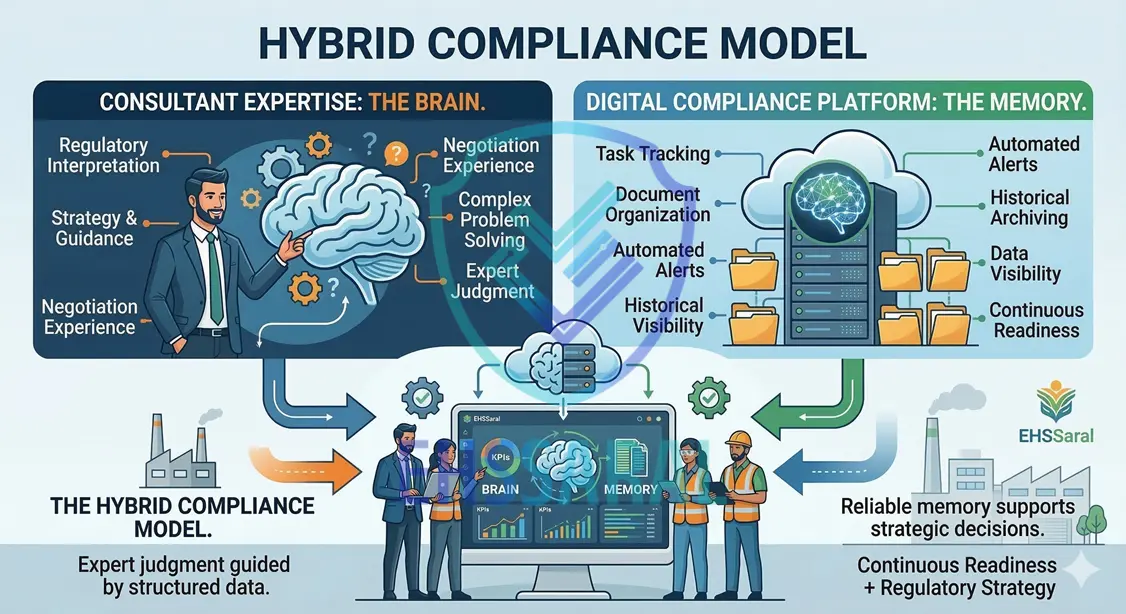
Consultants often function as the “brain” of environmental compliance.
Digital platforms act as the “memory.”
The brain interprets the situation and guides decisions.
The memory ensures that important tasks and records are never lost.
When both elements operate together, compliance becomes easier to manage and more predictable in daily operations.
Across many industries, environmental compliance is gradually moving toward a hybrid operating model.
In this model, human expertise and digital systems work together, each handling the responsibilities they are best suited for.
Consultants continue to play an important role in guiding factories through regulatory interpretation, technical decisions, and interaction with authorities. At the same time, digital platforms help organize the daily operational tasks that support compliance.
A simple way to understand this relationship is through the idea of brain and memory.
| Role in Compliance | Primary Contribution |
|---|---|
| Consultant | Interpretation, experience, regulatory judgment |
| System (such as EHSSaral) | Tracking, documentation, and institutional memory |
The brain evaluates situations and advises on the right course of action.
The memory ensures that nothing important is forgotten.
When both elements operate together, compliance becomes significantly easier to manage.
In a hybrid system, routine operational tracking is handled through structured platforms, while consultants focus on higher-level guidance.
This division of responsibilities often looks like the following.
| Compliance Activity | Consultant Role | System Role |
|---|---|---|
| Consent interpretation | Explains conditions and regulatory implications | Converts conditions into trackable tasks |
| Monitoring programs | Advises on parameters and frequency | Tracks schedules and stores reports |
| Compliance deadlines | Provides regulatory guidance | Generates automated reminders |
| Inspection preparation | Strategic support during visits | Retrieves documents instantly |
| Environmental reporting | Reviews and validates submissions | Maintains organized documentation |
This arrangement allows consultants to focus on technical expertise and strategic advice, rather than administrative tracking tasks.
Many EHS professionals are familiar with the pressure that builds around environmental reporting deadlines.
Examples include:
Environmental statement preparation
Hazardous waste annual returns
Monitoring report compilation
When compliance tasks are tracked manually, these deadlines often create sudden administrative pressure.
Structured systems help distribute this workload over time.
| Situation | Traditional Approach | System-Supported Approach |
|---|---|---|
| Upcoming deadline | Reminder through calls or messages | Automated alerts weeks in advance |
| Document compilation | Search through emails and folders | Retrieve from organized archive |
| Compliance review | Manual report compilation | Dashboard-based overview |
| Audit preparation | Last-minute document gathering | Continuous readiness |
By organizing tasks and documentation ahead of time, systems allow EHS officers to spend more effort on environmental performance and improvement, rather than administrative coordination.
As organizations expand operations, environmental compliance becomes more complex.
Companies operating multiple facilities often face challenges such as:
Separate compliance records at each plant
Different monitoring schedules
Varying documentation formats
Limited visibility at the corporate level
Without structured systems, central oversight becomes difficult.
Digital compliance platforms help create unified visibility across sites.
| Operational Area | Traditional Coordination | System-Supported Coordination |
|---|---|---|
| Compliance status across plants | Periodic reporting calls | Real-time dashboard visibility |
| Monitoring schedules | Managed independently by each plant | Standardized compliance calendar |
| Document formats | Different storage systems | Unified documentation structure |
| Historical records | Stored at individual locations | Centralized archive |
This type of centralized visibility is increasingly valuable for organizations preparing for:
ESG disclosures
sustainability reporting
supply chain environmental audits
One of the subtle benefits of structured compliance systems is the cultural shift they create inside organizations.
When compliance depends primarily on personal reminders, teams often operate in a reactive mode.
Tasks are addressed only when deadlines approach.
However, when compliance responsibilities are clearly scheduled and visible, the workflow becomes more predictable.
| Compliance Culture | Manual Model | System-Supported Model |
|---|---|---|
| Task awareness | Known only to a few individuals | Visible across teams |
| Deadline preparation | Reactive approach | Planned approach |
| Record management | Fragmented storage | Organized repository |
| Audit readiness | Periodic preparation | Continuous readiness |
Over time, this shift reduces uncertainty and helps create a more stable compliance environment.
While every factory manages environmental responsibilities differently, certain operational conditions often increase the value of structured compliance systems.
Factories that typically benefit the most share characteristics such as:
Multiple environmental monitoring programs (air, water, waste)
Several regulatory reporting obligations
Multi-site operations requiring standardized processes
Frequent staff or consultant transitions
Increasing ESG or sustainability reporting expectations
For facilities with very limited compliance obligations, consultant-only models may continue working effectively.
However, as compliance complexity grows, structured platforms like EHSSaral can help maintain clarity and continuity.
Environmental compliance has always depended on knowledgeable professionals, careful documentation, and consistent monitoring.
Consultants, laboratories, and EHS officers have played a critical role in helping industries manage these responsibilities.
What is gradually changing is the infrastructure that supports their work.
As compliance becomes more data-driven and continuous, factories are beginning to introduce structured systems that help organize tasks, documents, and monitoring records.
In many organizations, platforms such as EHSSaral are beginning to act as a form of environmental compliance infrastructure - the operational backbone that supports day-to-day compliance management.
From a practical standpoint, most compliance failures do not occur because people lack knowledge.
They occur because important tasks, records, or deadlines become difficult to track.
When experienced professionals work alongside well-structured systems, environmental compliance becomes more organized, transparent, and far less stressful for everyone involved.
And that is the direction in which environmental compliance management in India is gradually moving.
Read Environmental Non-Compliance Investigation: Process, RCA and Corrective Action
For many factories, the question is not whether consultants are useful. The real question is whether the internal compliance system supporting those consultants is strong enough.
In day-to-day operations, environmental compliance involves hundreds of small activities that must quietly work together:
Monitoring schedules
Consent conditions
Reporting deadlines
Document storage
Historical record maintenance
When these activities are handled through scattered tools and personal reminders, even experienced teams may find themselves spending unnecessary time coordinating routine tasks.
A simple way to evaluate the strength of a compliance system is to look at how these activities are managed inside the organization.
| Evaluation Area | If Managed Manually | If Managed Through Structured System |
|---|---|---|
| Consent conditions | Stored as PDF documents | Converted into trackable tasks |
| Monitoring schedules | Excel sheets or calendars | Automated compliance calendar |
| Report storage | Emails and shared folders | Organized document vault |
| Compliance reminders | Personal follow-ups | System alerts |
| Historical records | Difficult to retrieve | Searchable archive |
Factories that move toward structured systems are not replacing expertise. Instead, they are strengthening the operational framework around that expertise.
In many cases, consultants themselves find that when routine tracking becomes systematic, their time can be spent more effectively on interpretation, strategy, and improvement initiatives.
Across different sectors, a subtle shift is already visible.
EHS teams are gradually introducing systems that help them manage environmental information in a more organized way.
This does not eliminate the role of consultants. Instead, it changes the nature of their engagement.
| Traditional Consultant Engagement | Emerging Hybrid Engagement |
|---|---|
| Routine tracking handled through communication | Tracking managed through systems |
| Document exchange through emails | Centralized document access |
| Periodic compliance reviews | Dashboard-based monitoring |
| Administrative coordination | Focus on technical guidance |
When routine tasks are supported by systems, consultants can concentrate on areas where their experience creates the most value.
Another reason for this shift is the growing importance of continuous environmental data.
Many regulatory frameworks now require ongoing monitoring rather than occasional reporting.
Examples include:
Continuous emissions monitoring systems (OCEMS)
Periodic effluent analysis
Hazardous waste inventory reporting
Environmental audit documentation
These activities generate data throughout the year.
Managing this information efficiently requires more than periodic reminders. It requires a structured way of organizing environmental records and tasks over time.
Platforms like EHSSaral are designed to provide this operational structure by bringing compliance tasks, documentation, and monitoring records into a single organized environment.
One of the most noticeable benefits of structured compliance systems is the shift they create in daily workflow.
In manual systems, compliance often feels reactive.
Deadlines appear suddenly.
Documents must be assembled quickly.
Teams prepare intensively before inspections.
When compliance is supported by structured systems, the workflow changes.
| Compliance Behavior | Reactive Model | Predictable Model |
|---|---|---|
| Deadline awareness | Known close to submission date | Visible weeks in advance |
| Document organization | Prepared before inspections | Continuously maintained |
| Compliance reviews | Periodic preparation | Ongoing monitoring |
| Management visibility | Limited to reports | Dashboard overview |
This predictability reduces operational stress and allows EHS teams to focus more on improving environmental performance rather than chasing documentation.
Environmental compliance in India has steadily evolved alongside industrial growth and regulatory development.
First, compliance relied primarily on internal experience and record keeping.
Later, consultants became essential partners in interpreting regulations and guiding organizations.
Today, a third element is gradually being added: structured compliance systems.
In this emerging model:
Consultants provide expertise and judgment.
EHS officers manage day-to-day environmental responsibilities.
Systems such as EHSSaral provide structure, continuity, and visibility.
Each of these elements supports the others.
Environmental compliance has always depended on people with knowledge and commitment.
Consultants, laboratories, and EHS officers have helped industries manage environmental responsibilities for decades.
What is changing today is the infrastructure that supports their work.
As environmental regulations become more data-driven and continuous, factories are gradually introducing structured systems that help organize compliance activities more effectively.
Platforms like EHSSaral are beginning to serve as part of this infrastructure - creating a consistent operational backbone for environmental compliance.
Because in most situations, compliance failures do not occur due to lack of knowledge.
They occur when important tasks, records, or deadlines become difficult to track.
When experienced professionals work alongside well-structured systems, environmental compliance becomes clearer, more predictable, and far easier to manage.
Environmental compliance management refers to the processes factories use to meet regulatory requirements related to air emissions, wastewater discharge, hazardous waste handling, and environmental reporting.
Yes. Consultants play an important role in regulatory interpretation, environmental strategy, and inspection support. Digital compliance systems mainly assist with operational tracking and documentation.
A compliance tracking system is a structured platform that helps factories manage monitoring schedules, reporting deadlines, compliance tasks, and environmental documentation.
Digital platforms organize compliance tasks, provide deadline alerts, maintain document records, and improve visibility of environmental performance across the organization.
Modern regulations increasingly require continuous monitoring systems, digital reporting portals, and environmental data transparency, making structured compliance systems more important.

Founder, EHSSaral
Founder - EHSSaral | Partner - Perfect Pollucon | ISO 14001 Lead Auditor | GHG Protocol Scope 2 | Chemist | Data Scientist | Second-generation environmental professional simplifying EHS compliance for Indian industries through practical, automated, tech-enabled, data driven compliance workflows.
CSR Trends 2026: Environmental Compliance Automation in India | EHSSaral
 Guide for Indian Factories EHSShala by EHSSaral.webp)
Ambient Air Quality Monitoring (AAQM) Guide for Indian Factories | EHSShala

Form 4 vs Form 5: Why Hazardous Waste Numbers Don't Match
Rule 9 Hazardous Waste Utilization: Why Applications Fail (2023–2025) | EHSSaral Research
Form V Late Filing Penalty: Steps After 30 September

Consent to Operate (CTO) Explained for Indian Factories | EHSShala
EBWGR Certificate: Eligibility, Process, Cost & Records
Environmental Compliance for Pharmaceutical Manufacturing in India | EHSSaral
Hazardous Waste Stored Beyond 90 Days: What to Do

Battery Waste Registration for Equipment Importers (BWM Rules 2022 Explained) | EHSSaral