
Blog
Manual Stack Monitoring vs OCEMS: Why Results Differ in Environmental Compliance
EHSSaral is an Environmental Compliance Intelligence Platform for Industries. Consent Intelligence • Alerts & Tasks • Incident Reporting • Form IV & V • Audit-Ready Records
See how EHSSaral works
13 Aug 2026
Questions about the Form V late filing penalty usually arise immediately after an industry discovers that the 30 September Environmental Statement deadline has been missed. The EHS team may not know whether the return can still be submitted, whether a fixed penalty applies or what to do if the SPCB portal no longer shows the relevant financial year.
Missing the Form V Environmental Statement deadline can create immediate confusion inside a plant.
The EHS team may not know whether the return can still be submitted. Management may ask about the penalty. The SPCB portal may no longer show the relevant financial year. Meanwhile, the underlying production, water, waste and expenditure data may still require verification.
This is not the stage for hurried submission or assumptions about penalties.
From a practical standpoint, the plant should first establish whether Form V was actually submitted, determine the route available for delayed filing, reconcile material information and preserve a transparent record of every action taken.
This article focuses specifically on recovery after the Form V deadline has already been missed. For applicability, Parts A to I, data requirements and normal preparation, refer to the Form 5 Environmental Statement Guide.
Rule 14 of the Environment (Protection) Rules, 1986 requires applicable industries, operations and processes to submit an Environmental Statement in Form V to the concerned State Pollution Control Board.
The normal reporting cycle is:
| Reporting period | Normal Form V submission deadline |
|---|---|
| Financial year ending 31 March | On or before 30 September of the same calendar year |
For example, environmental information for the period from 1 April 2025 to 31 March 2026 is normally submitted on or before 30 September 2026.
Form V is also commonly searched for and referred to as Form 5. Both terms generally refer to the same Environmental Statement under Rule 14.
The official requirement should be checked from the current Environment (Protection) Rules, 1986 and the instructions of the applicable SPCB or Pollution Control Committee.
This is where confusion usually starts.
Rule 14 prescribes the filing requirement and the 30 September deadline. However, it does not contain a separate table imposing a fixed Form V late fee for every day or month of delay.
Therefore, neither of the following conclusions is reliable:
“There is a standard nationwide late fee that can simply be paid with the return.”
or:
“There is no Form V-specific late fee, so delayed submission has no consequence.”
The absence of a Form V-specific daily fee does not remove the obligation to submit the statement.
At the same time, it would be misleading to quote one penalty amount as the automatic outcome for every delayed Form V. The regulatory response can depend on the legal provision applied, type of entity, duration of delay, compliance history, applicable consent conditions, authority communication and facts of the case.
The enforcement provisions under the Environment (Protection) Act changed with effect from 1 April 2024 through the Jan Vishwas (Amendment of Provisions) Act, 2023.
The amended framework includes:
These are broader statutory provisions. They should not be interpreted as an automatic invoice generated immediately after the Form V deadline.
The precise provision applicable to a delayed or unsubmitted Form V, and the amount that may be determined, require consideration of the actual legal and factual position. The current Environment (Protection) Act on India Code should be referred to before quoting any figure in an internal note or management communication.
An EHS officer should not tell management that the penalty is automatically ₹10,000, ₹1 lakh, ₹15 lakh or a fixed daily amount merely because Form V was filed late.
A more accurate internal statement would be:
Rule 14 does not prescribe a separate fixed late fee for Form V. However, delayed or non-submission remains a compliance gap, and broader penalty or enforcement provisions may be considered depending on the applicable legal provision and facts of the case.
Where a notice, adjudication communication or direction has already been received, the plant should obtain appropriate legal or professional advice before responding.
Before starting a delayed-filing exercise, confirm whether the statement was submitted but the acknowledgement cannot be located.
In many Indian plants, Form V may have been handled by:
Check the following records:
A completed Form V file is not, by itself, proof of submission.
Similarly, an internal email, unsigned PDF, portal draft or screenshot of a filled form does not necessarily establish that the return was accepted.
The verification should answer four questions:
| Question | Evidence to check |
|---|---|
| Was Form V prepared? | Final statement and supporting working papers |
| Was it approved? | Signed copy or authorised approval |
| Was it submitted through an accepted route? | Portal acknowledgement, official receipt or confirmed submission reference |
| Was it submitted for the correct site and financial year? | Facility details, financial year and acknowledgement particulars |
If valid submission evidence cannot be found, keep the status as unconfirmed until the position is verified.
A controlled response is usually more effective than hurried individual action.
Prepare a short internal record containing:
This helps distinguish between:
These are different control failures and may require different corrective actions.
Inform the plant head, EHS head and authorised signatory through the company’s normal escalation process.
The communication should remain factual:
Avoid quoting an unverified penalty amount or assuring management that there will be no consequence.
Determine whether:
Portal functionality and delayed-filing procedures can differ across SPCBs and financial years.
Do not assume that sending Form V by email or courier automatically completes the statutory filing. Use an alternative route only when it is accepted or directed by the relevant authority.
Before revising the statement, confirm:
A large number of Form V differences arise because departments unknowingly submit information for different sites, production boundaries or cut-off dates.
EHS may coordinate Form V, but it should not independently certify data belonging to every department.
| Information | Likely source owner |
|---|---|
| Product-wise production | Production or planning |
| Raw-material consumption | Stores, ERP or production |
| Water withdrawal and use | Utilities |
| Effluent generation and treatment | ETP, utilities or EHS |
| Environmental monitoring | EHS, laboratory or consultant |
| Hazardous-waste information | EHS, stores or production |
| Non-hazardous waste | EHS, stores or administration |
| Environmental projects | Projects, maintenance or EHS |
| Environmental expenditure | Finance or projects |
Ask each source department to verify material figures, particularly where the delayed return is being reconstructed several months after the year-end.
The purpose is not to recreate the entire environmental-management system before filing.
The plant should identify the figures that are material, inconsistent or unsupported and resolve them before finalisation.
At minimum, review:
| Form V area | Minimum recovery check |
|---|---|
| Production | Annual total agrees with reviewed monthly or ERP records |
| Raw materials | Consumption is distinguished from purchases or stores issues |
| Water | Source-wise withdrawal is supported by meters, bills or approved estimates |
| Effluent | Generation, treatment, reuse and discharge figures are reasonably connected |
| Monitoring | Reports belong to the correct site, location, period and parameter |
| Hazardous waste | Generation, dispatch and closing stock are distinguishable |
| Non-hazardous waste | Generation, reuse, sale, transfer and closing stock are supported |
| Environmental expenditure | Budget, purchase order and actual expenditure are not mixed |
| Improvement measures | Reported projects reflect their actual status during the year |
The detailed line-by-line preparation process is already covered in EHSSaral’s Form 5 Environmental Statement Guide. The delayed-filing review should use that underlying data without duplicating the entire annual preparation exercise.
These are not the same.
For example:
Another example:
The immediate reason explains what delayed the return. The underlying cause explains why the control system allowed the delay to continue.
Once the material information is reviewed and the responsible authority has approved the return:
Retain:
Submission should not be treated as complete until the accepted evidence is independently checked.
A closed reporting period creates an operational difficulty, but it does not remove the underlying filing obligation.
If the portal does not allow submission:
Depending on the portal and reporting period, the plant may need to request reopening or unlocking through the official helpdesk or the appropriate SPCB office.
Portal reopening and alternative submission are not uniform entitlements. They should be confirmed for the relevant board, facility and financial year.
Record:
A screenshot demonstrates that an attempt was made. It does not establish that Form V was accepted.
Ask the authority whether:
Escalate internally and obtain state-specific professional guidance.
Do not invent a filing route simply to create evidence that the document was sent somewhere.
From a practical compliance standpoint, the plant should still take steps to close the filing gap after the due date.
The route may involve:
The actual submission date should remain visible.
Do not backdate:
A delayed return with transparent dates and supporting records creates a clearer compliance trail than a document carrying an artificial timeline.
This requires practical judgement.
The plant should distinguish between a pending administrative item and a material data problem.
| Situation | Practical treatment |
|---|---|
| Data is complete but approval is pending | Expedite approval through the defined authority |
| An invoice is pending but the quantity is verified elsewhere | Document the basis used and track the pending evidence |
| TSDF acknowledgement is pending | Record the actual status; do not treat acknowledgement as received |
| Two statutory records show materially different quantities | Reconcile before finalisation |
| A meter failed for part of the year | Use a documented and approved estimation method where appropriate |
| Monitoring report covers the wrong location | Obtain correction or clarification |
| A material figure is known to be unreliable | Do not present it as verified merely to complete submission |
| Activity was applicable but no quantity arose | Record nil activity where appropriate |
| A section is genuinely not applicable | Record the reason for non-applicability |
| Current-year records are missing | Do not silently copy the previous year’s figures |
The objective is not to delay indefinitely while searching for perfect information.
It is to ensure that material figures have a reasonable source, review and explanation.
Where an estimate is necessary, preserve:
An estimated figure should remain distinguishable from a measured value.
Form IV and Form V generally cover the same financial year, but they do not necessarily present hazardous-waste information from the same operational angle.
One figure may represent waste generated, while another may relate to waste dispatched, treated, recycled or remaining in storage.
Differences can arise from:
The objective is not to force identical figures. It is to explain how generation, movement, treatment and stock relate to one another.
The detailed investigation method is covered separately in:
For a delayed Form V, retain the completed reconciliation rather than making an unsupported adjustment to the final number.
Read more about Form V Data Variation & how to Explain Water, Waste & Pollution Changes year on year
A useful delayed-filing record should explain the event, present status and change being introduced.
| Field | Information to record |
|---|---|
| Facility | Name and address of the unit |
| Reporting period | Financial year covered |
| Original deadline | Applicable 30 September deadline |
| Date identified | When the omission was discovered |
| Filing status | Prepared, approved, attempted, submitted or unconfirmed |
| Immediate reason | Event directly causing the delay |
| Underlying cause | Process or control weakness |
| Information pending | Records, documents or approvals unavailable |
| Interim action | Steps taken after discovery |
| Reconciliation | Material checks completed |
| Submission route | Portal, reopened period or other accepted route |
| Actual submission date | Date of completed submission |
| Acknowledgement | Reference number or official receipt |
| Corrective action | Action closing the present gap |
| Preventive action | Process change intended to avoid recurrence |
| Responsible person | Action owner |
| Approver | Plant management or authorised signatory |
Avoid a vague explanation such as “data was not available.”
A clearer record would state:
Hazardous-waste quantities could not be finalised because receiver acknowledgements for three consignments remained pending and the category-wise closing stock had not been physically verified. The immediate records were reconciled, and monthly acknowledgement tracking and quarterly stock verification have now been assigned.
This explains both the event and the control improvement.
Use this format only after checking the procedure followed by the applicable SPCB or PCC. Adapt it to the actual facts and internal approval process.
Date: [DD/MM/YYYY]
To,
The [Designation]
[Name of State Pollution Control Board/Pollution Control Committee]
[Regional Office and address]
Subject: Submission of Form V Environmental Statement for FY [YYYY–YY]
Reference:
Dear Sir/Madam,
We are submitting the Form V Environmental Statement for the financial year [YYYY–YY] in respect of our facility located at [address].
The Environmental Statement is being submitted after completion of the pending multi-departmental reconciliation and verification of the facility’s production, water, effluent, waste and environmental-expenditure records for FY [YYYY–YY].
This verification could not be completed by the prescribed submission date due to [brief and accurate factual reason].
After identifying the delay, the facility expedited the pending review, obtained the necessary internal confirmation and completed the Environmental Statement. We have also introduced [brief preventive measure, such as monthly departmental data closure and a defined internal review calendar] to improve timely preparation in subsequent reporting periods.
The completed Form V and applicable supporting information are enclosed/submitted for your consideration.
We request you to kindly acknowledge the submission and provide any further guidance considered necessary.
Yours faithfully,
For [Company name]
[Name]
[Designation]
[Authorised signatory, where applicable]
[Contact details]
Enclosures:
The explanation should be accurate and proportionate.
Avoid:
A long-pending Form V requires a year-wise review.
First establish:
Prepare a gap register:
| Financial year | Filing status | Data status | Evidence status | Proposed route | Action owner |
|---|---|---|---|---|---|
| FY 2023–24 | Submission unconfirmed | Complete | Partial | Verify with board | EHS Head |
| FY 2024–25 | Not submitted | Inconsistent | Partial | Board guidance required | Plant Head |
| FY 2025–26 | In preparation | Complete | Complete | Current portal route | EHS Officer |
Do not combine several years into one unexplained statement.
Each financial year should retain its own:
Where the delay is significant, records are materially incomplete or a notice has already been received, obtain professional guidance before communicating a final legal position.
A delayed filing means the statement was submitted after the prescribed date.
Non-submission means the statutory obligation remains open.
A delayed return supported by:
creates a clearer compliance trail than an obligation that remains unresolved indefinitely.
However, delayed submission does not retrospectively convert the return into an on-time filing. The actual date should remain transparent.
If the delayed or pending Form V is raised during an inspection, provide one consistent factual status.
Keep the following ready:
A concise response may be:
The Form V for FY [year] was submitted after the prescribed date on [actual date]. The delay was identified on [date], following which the plant completed the pending reconciliation, obtained approval and submitted the statement through [route]. The acknowledgement and internal corrective-action record are available for review.
If the statement is still pending, state that clearly and explain the actions underway.
Do not say the return has been submitted unless accepted submission evidence is available.
Consider a plant that discovers on 12 October that Form V for the previous financial year was not submitted.
The EHS officer checks the portal and finds no acknowledgement. A completed spreadsheet exists, but it was never approved.
During the review, three material issues are identified:
The plant does not immediately upload the existing spreadsheet.
Instead, it:
The filing remains delayed. However, the plant now has a transparent and supportable record of how the gap was addressed.
Most Form V delays do not begin in September.
They begin when:
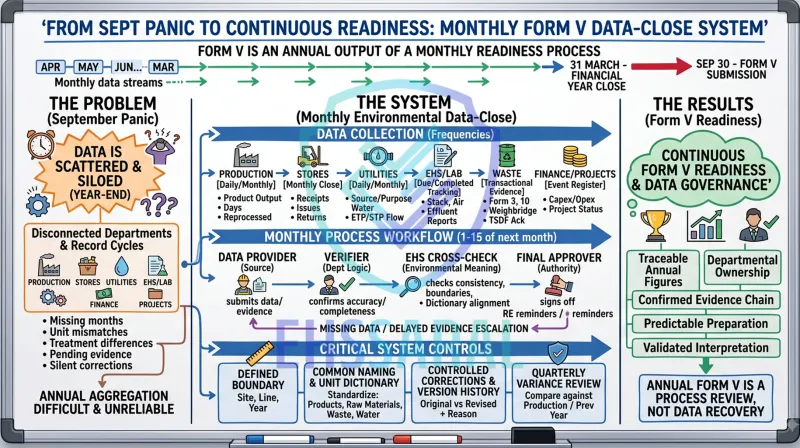
A more reliable approach is to treat Form V as a year-round data-readiness process.
That subject is covered separately in EHSSaral’s guide to a monthly Form V data-collection and readiness system.
For the delayed-filing recovery itself, the plant should implement only the controls connected with the identified cause rather than introducing a large checklist that no one owns.
EHSSaral is designed to maintain the environmental information behind Form V throughout the year instead of reconstructing it shortly before 30 September.
The system can help a plant:
For example, instead of a general reminder stating “Form V data pending,” the system can identify the actual exception:
August tanker-water quantity is entered, but Utilities verification and two inward gate records are pending.
EHSSaral can also connect hazardous-waste information across Form 3 records, Form 10 dispatch documents, receiver acknowledgements, Form IV annual-return quantities and the waste information used in Form V.
It can flag unexplained differences in generation, dispatch, receipt and closing stock before the Form V review reaches the filing stage.
The purpose is not to force every figure to match. It is to identify differences while the records and responsible people are still available.
The broader EHSSaral environmental compliance platform provides the connected structure through which responsibilities, evidence, exceptions and approvals remain visible.
EHSSaral cannot erase a missed statutory deadline. It can help prevent the same deadline from being missed again by making incomplete information, unresolved discrepancies and pending ownership visible much earlier.
The software does not replace departmental verification, professional judgement, authorised approval or the filing route prescribed by the applicable SPCB.
Missing the Form V deadline creates a compliance gap, but confusion after the deadline can make the position more difficult than necessary.
The practical response is to:
Do not ignore the return merely because the deadline has passed. At the same time, do not submit information that the plant already knows is materially unreliable simply to generate an acknowledgement.
Good recovery from a missed Form V deadline begins with factual records, transparent action and a process that prevents the same gap next year.
Form V is normally submitted on or before 30 September for the financial year ending on 31 March under Rule 14 of the Environment (Protection) Rules, 1986.
Yes. Form V is commonly written and searched for as Form 5. Both generally refer to the Environmental Statement prescribed under Rule 14.
Rule 14 does not prescribe a separate uniform automatic daily late fee specifically for Form V. Broader penalty and adjudication provisions exist under the Environment (Protection) Act, but their application should not be treated as automatic or identical in every case.
The plant should still take steps to correct the filing position. Whether the portal accepts delayed submission, requires reopening or uses another recognised route depends on the applicable SPCB or PCC and the current reporting system.
Record the portal status, raise an official helpdesk or reopening request, contact the appropriate SPCB office and obtain guidance on the accepted route. Preserve screenshots, ticket references and correspondence.
Only where that route is accepted or directed by the applicable authority. Sending an email or courier by itself does not necessarily establish valid filing.
This depends on the board and submission route. A covering letter may be useful or required where an explanation accompanies the delayed return, but it does not replace the prescribed submission process.
Material inconsistencies should be resolved before finalisation. Where exact information cannot be reconstructed, use a documented and approved basis rather than presenting an unsupported number as verified.
Previous-year figures may support comparison or a documented estimation method. They should not be silently copied and presented as current-year actuals.
A delayed or missing Form V may form part of the facility’s broader compliance record and may be examined during consent review or inspection. It does not mean one predetermined consequence automatically follows in every case.
Retain the final statement, approval, acknowledgement, actual submission date, covering letter, portal or helpdesk correspondence, reconciliation papers and internal corrective-action record.
Prepare a financial-year-wise gap register, verify the applicable reporting boundary and data for each year, check for previous authority communications and obtain state-specific professional guidance. Do not combine several years into one unexplained return.
About the author: Harshal T. Gajare works on environmental-compliance data systems for Indian industries and is the founder of EHSSaral, an environmental compliance intelligence platform focused on connected records, statutory-return readiness and practical EHS workflows.

Founder, EHSSaral
Founder - EHSSaral | Partner - Perfect Pollucon | ISO 14001 Lead Auditor | GHG Protocol Scope 2 | Chemist | Data Scientist | Second-generation environmental professional simplifying EHS compliance for Indian industries through practical, automated, tech-enabled, data driven compliance workflows.
Manual Stack Monitoring vs OCEMS: Why Results Differ in Environmental Compliance
Form 3 Logbook Explained: Simple Guide for Indian Factories | EHSShala
Hazardous Waste All Forms Form 1 to Form 12 Guide
Chemical Accidents Rules, 1996: A Practical Guide for Indian EHS Officers
Bio-Medical Waste Management for Non-Hospitals (India) | EHSShala
Why BMW Inspections Feel Stricter Today (India) | EHSSaral
Form 4 Hazardous Waste Annual Return: Filing Guide & Format
Isokinetic Sampling Basics: Simple Guide for Stack Monitoring | EHSShala

How to Read Your Consent Copy (CTE & CTO Explained Simply) | EHSShala
Used Oil & Waste Oil Management in India - Factory & EHS Guide | EHSShala