Why Form 4 & Form 5 Numbers Don’t Match - Real Industry Reasons

Why Form 4 & Form 5 Numbers Don’t Match - Real Industry Reasons

form 4 form 5 Hazardous Waste Environmental Compliance Hazardous Waste Management
Last updated:

8 May 2026

|
Read time: 20 min read

Introduction

One of the most common questions industries face during environmental audits, inspections, or annual return preparation is this:

“Why are our Form 4 and Form 5 numbers different when both are based on the same plant operations?”

In many Indian industries, this confusion usually starts very late - often during:

  • annual filing,
  • consultant review,
  • internal management verification,
  • or SPCB inspection preparation.

At first glance, both forms appear connected to the same environmental activities:

  • hazardous waste generation,
  • treatment systems,
  • disposal records,
  • and operational data.

So naturally, management expects the numbers to match perfectly.

But from a practical standpoint, real industrial operations rarely behave in such a linear manner.

And this is where most confusion begins.


Quick Summary

Form 4 and Form 5 numbers may differ because both forms look at environmental data from different angles. Form 4 focuses mainly on hazardous waste movement, while Form 5 looks at overall environmental performance.

In real industries, mismatches usually happen because of timing gaps, moisture variation, vendor lifting delays, different units, closing stock confusion, and fragmented Excel-based records.

The real issue is not always non-compliance. In many cases, it is poor traceability and weak reconciliation.


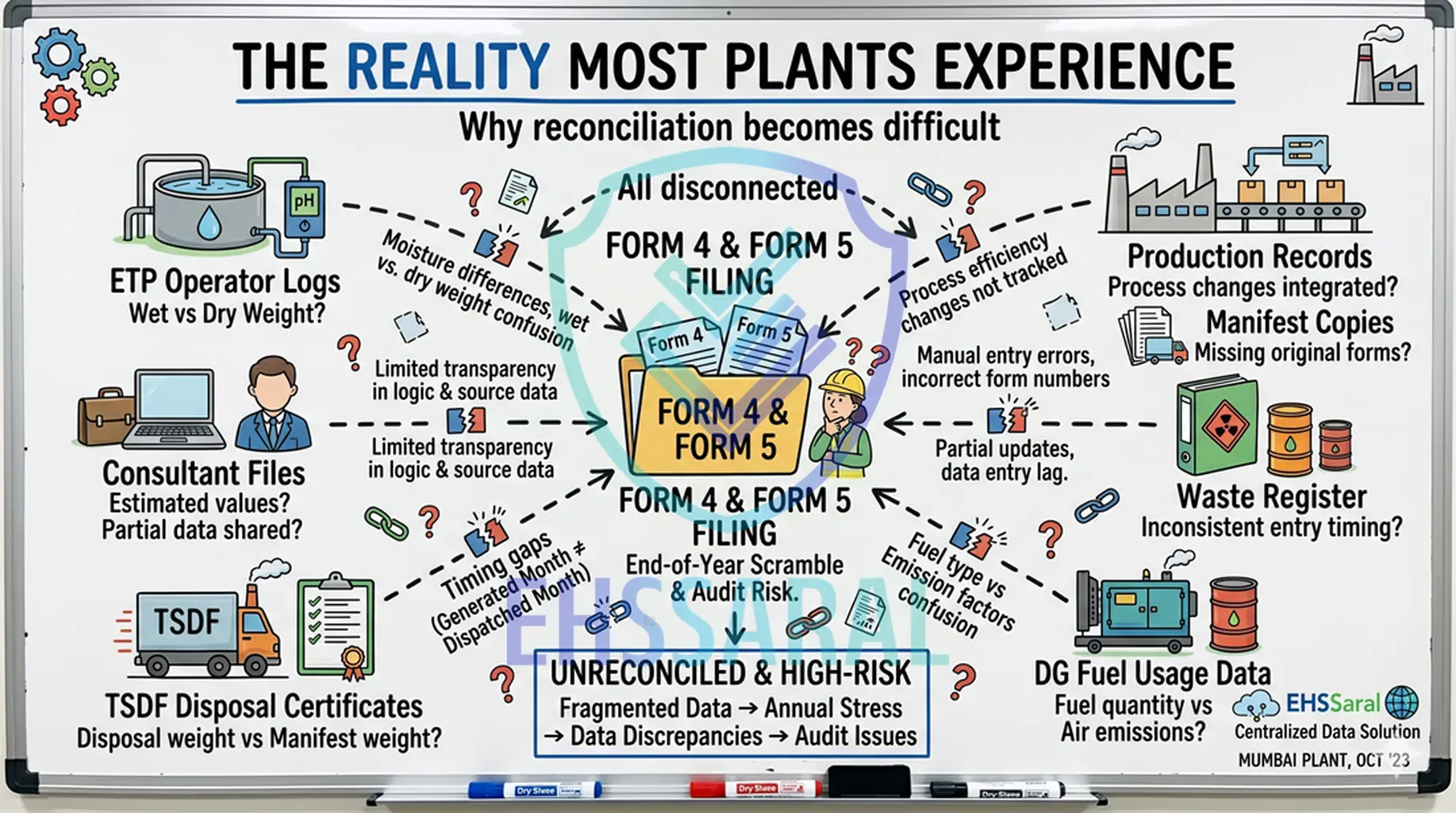
The Reality Most Plants Experience

The Reality Most Plants Experience ehssaral

In day-to-day operations, environmental data is usually spread across multiple systems and departments.

For example:

Data SourceTypically Maintained By
ETP logsUtility / ETP operator
Hazardous waste registerEHS team
ManifestsDispatch / EHS
Production dataProduction department
DG fuel recordsUtility team
Sludge disposal recordsVendor coordination team
Form 4 filing dataConsultant / EHS
Form 5 calculationsConsultant / Management

Now imagine trying to reconcile all of this together at year-end.

This is where practical gaps start appearing:

  • quantities differ,
  • units differ,
  • dates differ,
  • assumptions differ,
  • and sometimes even definitions differ.

Most mismatches are not intentional.

They are operational.


First Understand This Clearly: Form 4 and Form 5 Are Not Designed for the Same Purpose

This is probably the single biggest misunderstanding in Indian industries.

Many teams assume:

“Both forms deal with environmental compliance, so numbers should automatically match.”

But technically and operationally, both forms serve different objectives.

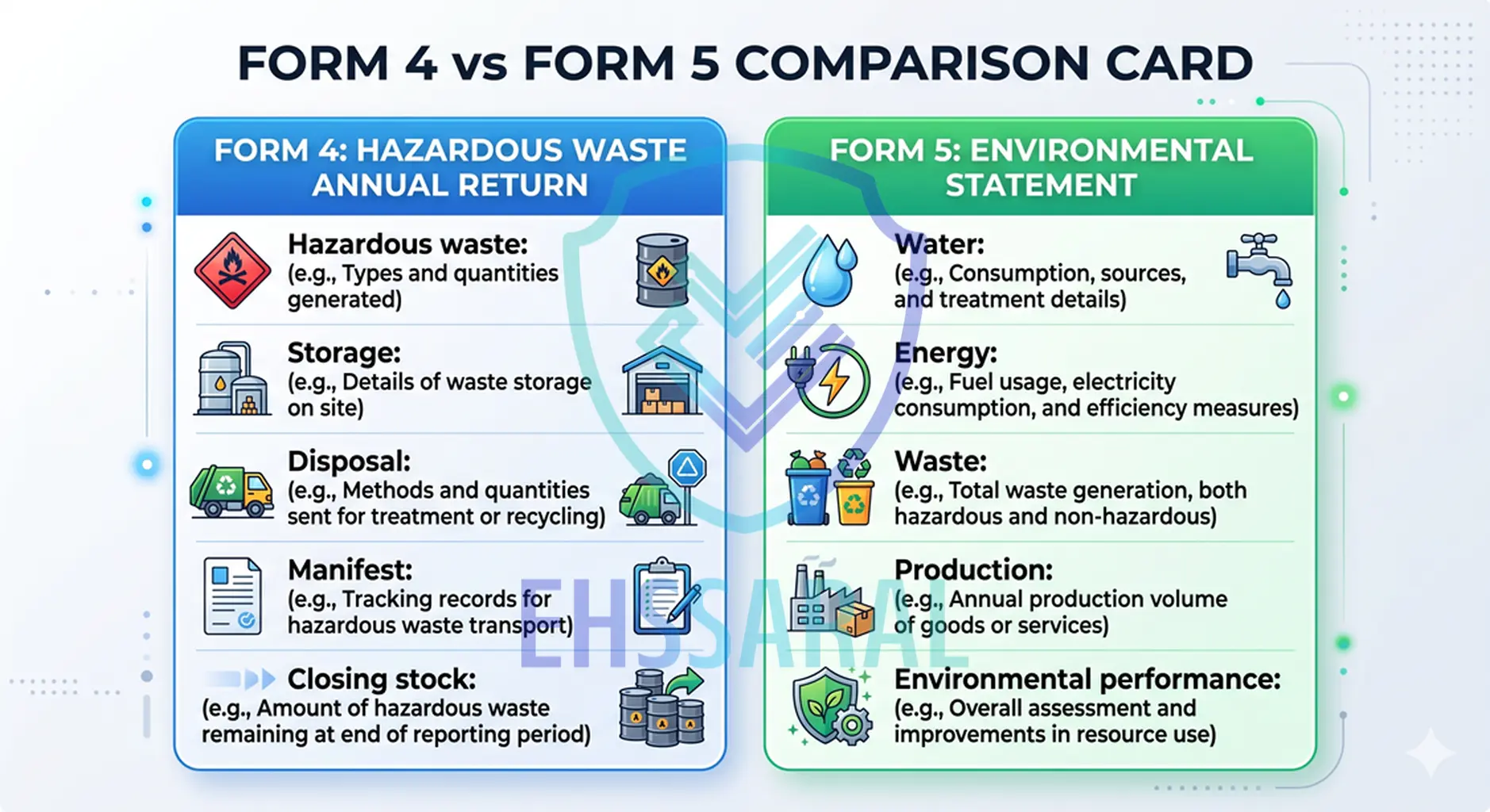
Form 4 – Hazardous Waste Annual Return

Form 4 is mainly focused on:

  • hazardous waste generation,
  • storage,
  • transportation,
  • disposal,
  • recycling,
  • co-processing,
  • and closing stock.

It is essentially a hazardous waste movement and accountability document.

The regulator wants visibility into:

  • how much hazardous waste was generated,
  • where it went,
  • who handled it,
  • and whether it remained stored at site.

Form 5 – Environmental Statement

Form 5 is much broader.

It evaluates overall environmental performance of the industry, including:

  • water consumption,
  • energy usage,
  • raw material consumption,
  • pollution generation,
  • treatment efficiency,
  • hazardous waste,
  • non-hazardous waste,
  • and resource conservation efforts.

In simple words:

PointForm 4Form 5
Main purposeHazardous waste trackingOverall environmental performance
Main focusGeneration, storage, disposal, recycling, co-processingWater, energy, raw material, pollution, waste, conservation
Data typeWaste movement dataAnnual environmental summary
Common sourceHazardous waste register, manifests, stock recordsProduction, utility, ETP, waste and resource records
Main riskManifest and stock mismatchOverall data inconsistency
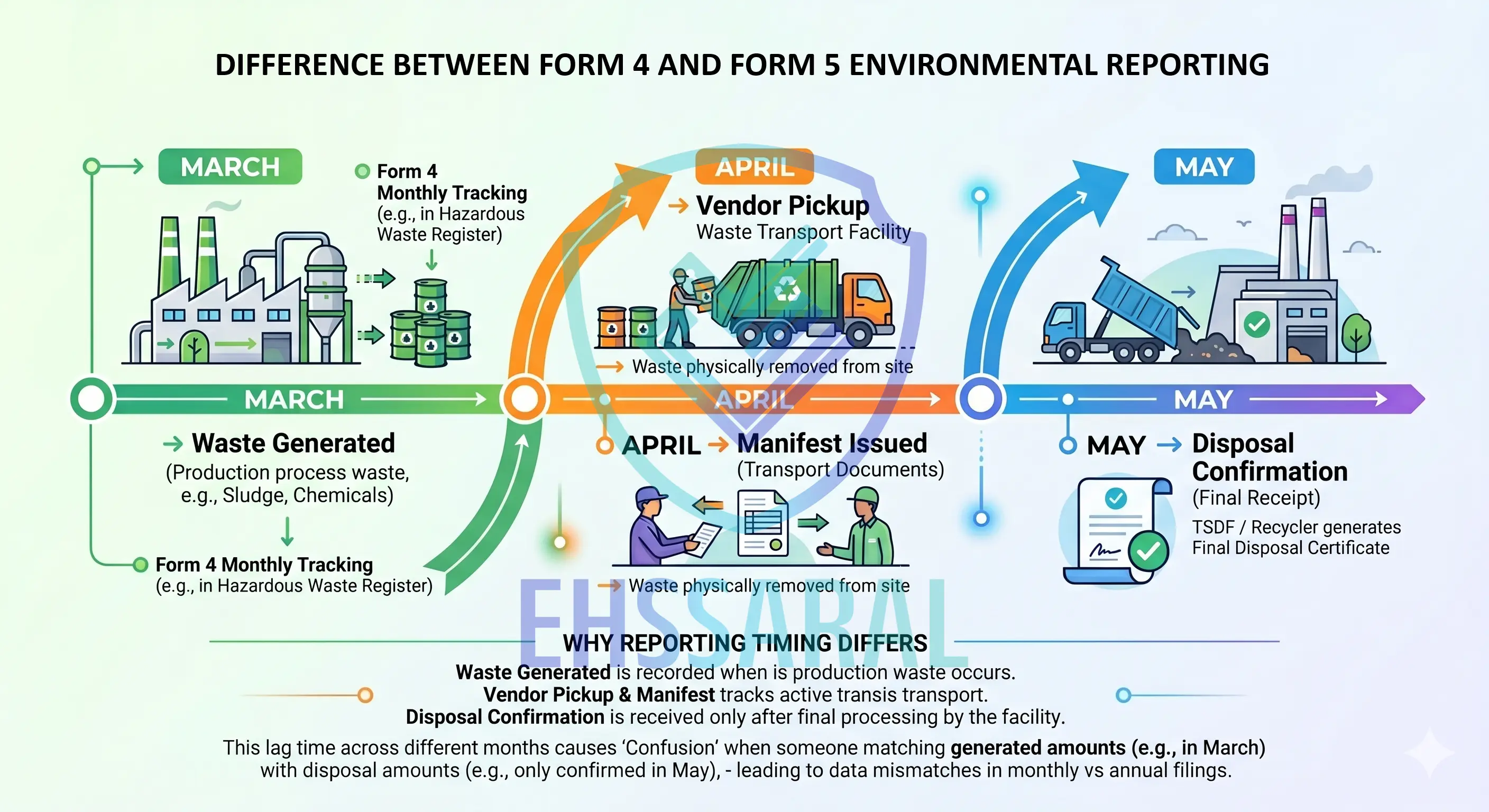
difference between form 4 and form 5 environmental reporting ehssaral

The Simple Reconciliation Logic Inspectors Often Use

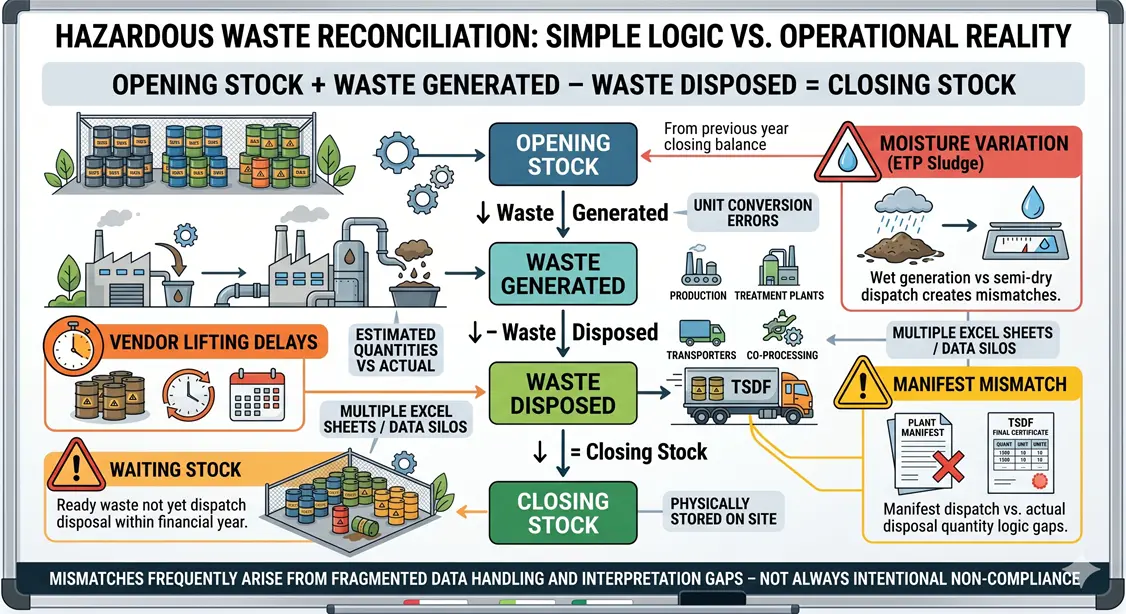
During verification, regulators and auditors usually apply one basic logic:

Opening Stock + Waste Generated − Waste Disposed = Closing Stock

This formula looks simple on paper.

But in day-to-day operations, maintaining this balance across manifests, storage areas, sludge drying, delayed vendor lifting, and multiple reporting formats becomes difficult.

This is why even plants with genuine compliance efforts sometimes struggle to explain their numbers confidently.

The issue is not only the final number. The issue is whether the number can be traced back to actual plant records.

hazardous waste reconciliation formula for form 4 and form 5 - ehssaral

Why “Perfect Matching” Rarely Happens in Real Operations

Many industries unknowingly expect environmental records to behave like accounting ledgers.

But hazardous waste generation is influenced by multiple dynamic operational factors such as:

  • moisture,
  • process efficiency,
  • production load,
  • chemical dosing,
  • machine shutdowns,
  • cleaning cycles,
  • fuel quality,
  • and treatment plant performance.

For example:

  • ETP sludge weight may increase during rainy season due to moisture.
  • Production may increase but waste may temporarily reduce due to process optimization.
  • Sludge stored for a few weeks may lose water weight before dispatch.
  • One vendor may lift material immediately while another delays for days.

These are operational realities.

This is why experienced inspectors usually look less for “perfectly matching numbers” and more for:

  • traceability,
  • consistency,
  • logic,
  • and explainability.

In many cases, explainable variation is accepted more comfortably than artificially perfect records.


Why Perfect Numbers Sometimes Create More Suspicion

This may sound surprising to newer professionals.

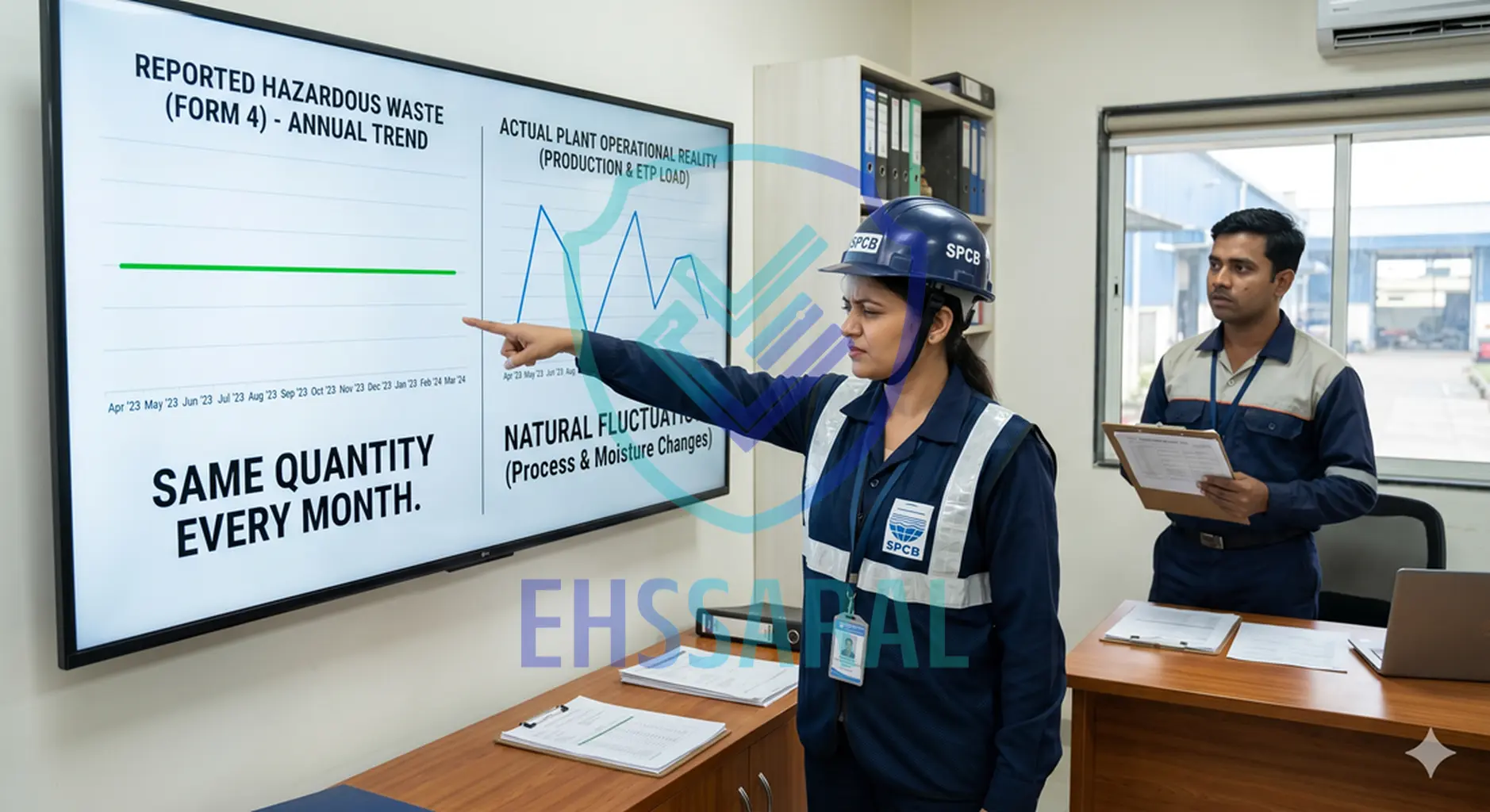
But in practice, experienced auditors and inspectors often become cautious when they see:

  • exactly identical waste quantities every month,
  • zero closing stock every year,
  • identical sludge generation despite production variation,
  • perfectly linear environmental data,
  • or copied historical trends without operational changes.

Industrial operations naturally fluctuate.

So when records appear too mathematically clean, it sometimes raises questions like:

  • Was actual reconciliation done?
  • Were estimates copied forward?
  • Was data rounded excessively?
  • Were storage variations ignored?

Over the years, many regulators have developed an operational sense of what “real plant variability” looks like.

This is why realistic, explainable records usually build more confidence than artificially perfect reporting.

why perfectly matching environmental data may look suspicious ehssaral

Common Red Flags Inspectors May Notice

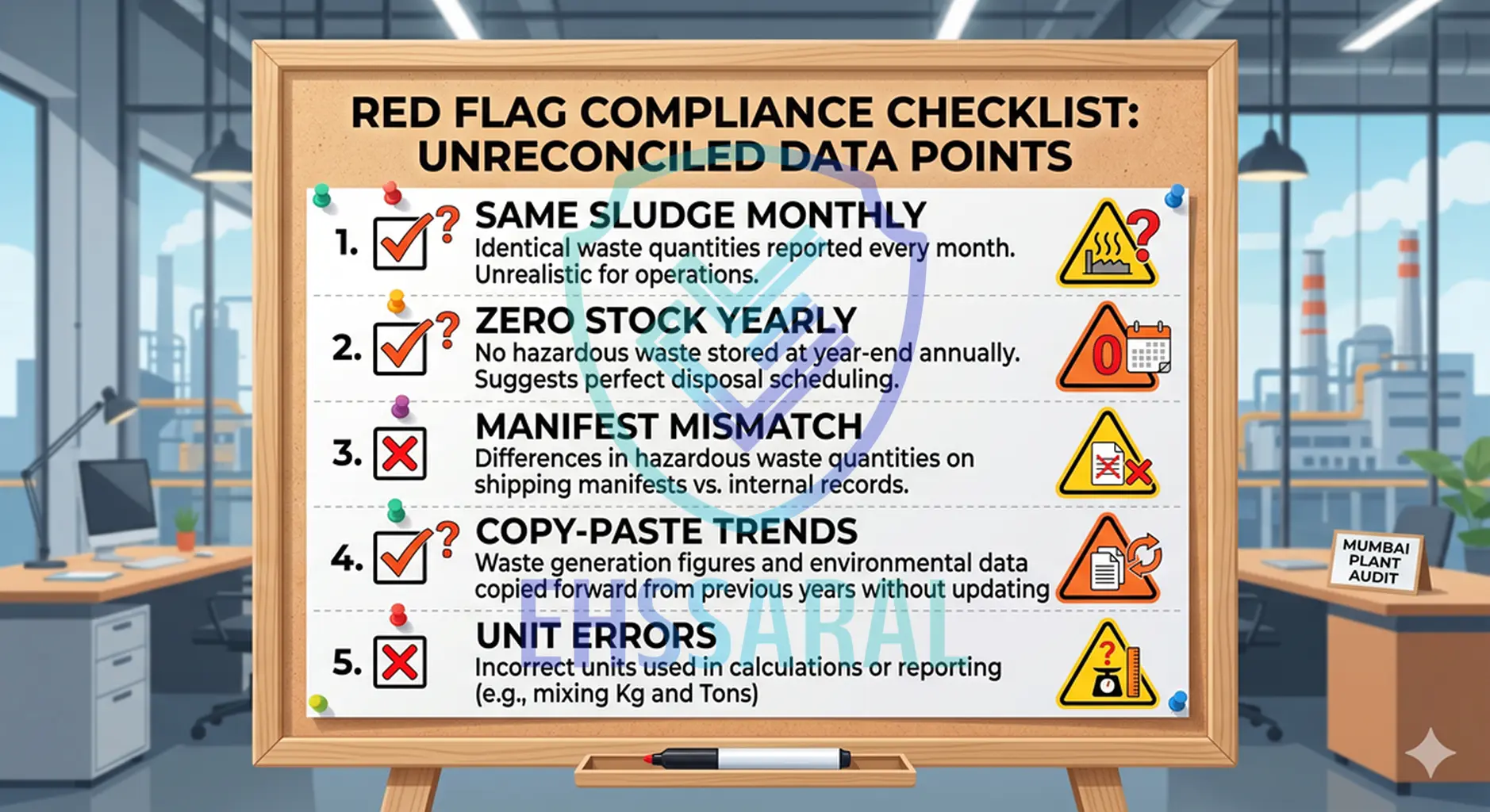
During inspections or document reviews, certain patterns may attract more questions.

Red FlagWhy It Raises Questions
Same sludge quantity every monthReal plant operations usually fluctuate
Zero closing stock every yearContinuous perfect disposal may look unrealistic
Production increased but waste stayed sameNeeds operational explanation
Manifest quantity differs from Form 4Indicates traceability gap
Disposal shown without supporting manifestWeak document linkage
Old values repeated from previous yearSuggests copy-paste reporting
Unit conversion errorsCreates major quantity mismatch

These red flags do not automatically mean non-compliance. But they do increase the need for clear explanation and supporting records.

common environmental compliance red flags during inspections ehssaral

The Most Common Reason Form 4 & Form 5 Numbers Differ

The biggest practical reason is simple:

Different teams often prepare both forms using different source data.

For example:

Now if:

  • one dataset was updated,
  • another was estimated,
  • one included stored waste,
  • and another included only disposed waste,

the final numbers naturally begin drifting apart.

And because these differences usually accumulate slowly across the year, they become visible only during final filing or inspection review.


This Is Where Confusion Usually Starts

In many Indian plants:

  • hazardous waste tracking is monthly,
  • production reporting is daily,
  • manifests are event-based,
  • and Form 5 preparation happens annually.

These timelines themselves are different.

As a result:

  • waste generated in March may be disposed in April,
  • manifests may arrive later,
  • revised quantities may be updated after dispatch,
  • or consultant calculations may use a different cutoff date.

Eventually, everyone is working from “technically correct” data -
but from different operational moments.

And this is exactly why reconciliation becomes difficult without a structured tracking system.

Everyone is working from technically correct data - but from different operational moments.


Real Industry Reasons Why Form 4 & Form 5 Numbers Don’t Match

Once the basic difference between both forms is understood, the next step is understanding something even more important:

Most mismatches are created gradually throughout the year - not during final filing.

In many plants, the final forms only expose operational gaps that already existed in:

  • data collection,
  • coordination,
  • storage tracking,
  • or reporting logic.

Let us look at the most common real-world reasons.


1. Waste Generated vs Waste Disposed Confusion

difference between hazardous waste generated and disposed EHSSaral

This is probably the most common mismatch seen during reconciliation.

In practice, industries often confuse:

  • waste generated,
    with
  • waste dispatched or disposed.

But both are different operational events.

Example

A plant generates:

  • 15 MT of ETP sludge in March.

But:

  • the TSDF vehicle arrives in April,
  • and only 10 MT gets lifted initially.

Now different records may show different realities:

RecordQuantity Reflected
Internal sludge generation log15 MT
Manifest dispatch record10 MT
Closing stock at site5 MT

Now if:

  • Form 4 captures generated quantity,
  • but Form 5 references disposed quantity,

the mismatch immediately appears.

This becomes even more common near financial year-end.


2. Closing Stock Not Considered Properly

Many industries focus heavily on:

  • waste generated,
  • and waste sent out.

But they forget the importance of:

waste physically remaining inside the plant.

This remaining quantity becomes closing stock.

In many inspections, this is where reconciliation starts breaking.

Common Practical Situations

  • Sludge drying inside bags before dispatch
  • Drums waiting for transporter approval
  • Waste stored temporarily before co-processing
  • Vendor pickup delays
  • Labelling or manifest documentation pending

Operationally, the waste still exists at site.

But if reports assume:

“everything generated was disposed,”

then the numbers stop matching.


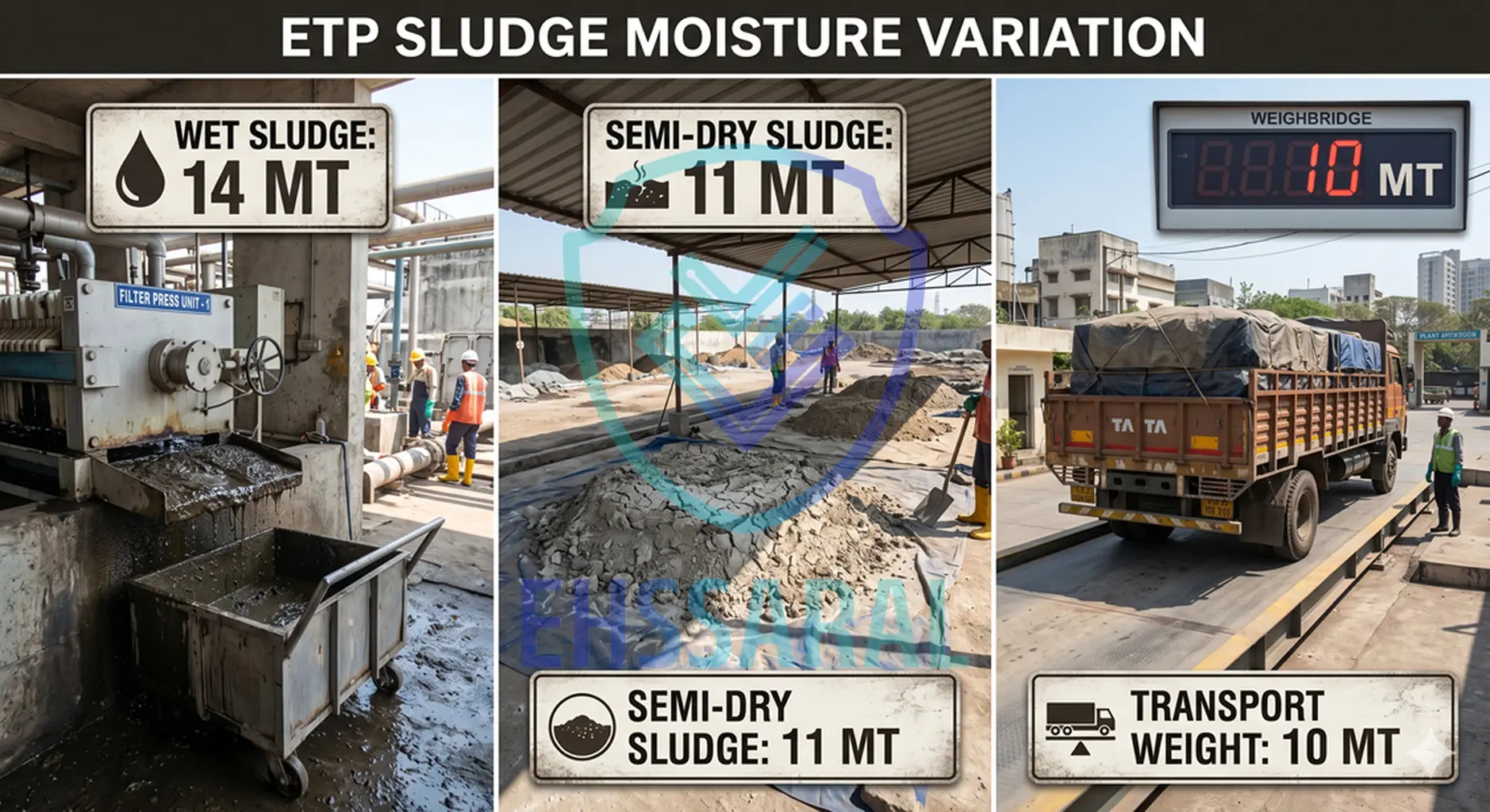
3. Moisture Variation in ETP Sludge

etp sludge weight variation due to moisture content EHSSaral

This is one of the most practical and least discussed reasons.

ETP sludge is rarely stable in moisture content.

Its weight changes due to:

  • weather,
  • drying time,
  • storage conditions,
  • filter press efficiency,
  • and chemical dosing.

Example

The same sludge may weigh:

  • 12 MT immediately after filter press,
  • but only 9 MT after partial drying before dispatch.

Now imagine:

  • generation records taken at wet stage,
  • manifest recorded at dry stage.

Suddenly:

  • Form 4,
  • manifests,
  • and Form 5

all begin showing different numbers.

From a practical standpoint, this is very normal in many industries.

But without explanation, it appears suspicious during audits.


4. Different Units Used by Different Departments

This sounds small.

But in reality, unit conversion mistakes create major reconciliation problems.

Different teams may record:

  • litres,
  • KL,
  • Kg,
  • MT,
  • drums,
  • bags,
  • or even tanker counts.

And during annual filing, someone manually converts everything into a single format.

This is where:

  • decimal shifts,
  • rounding errors,
  • and estimation mistakes

start entering the system.

Common Examples

Original RecordFinal Filing Interpretation
850 Kg0.85 MT
850 Kgincorrectly entered as 8.5 MT
12 drumsestimated without actual weighing
4 tankersconverted using assumed density

In many cases, the operational team understands the data internally -
but the filing format creates confusion later.


5. Vendor Lifting Delays

This is extremely common across India.

Waste may be:

  • generated,
  • packed,
  • labelled,
  • and ready for disposal,

but transporter or TSDF scheduling gets delayed.

Reasons may include:

  • vehicle availability,
  • manifest approval delays,
  • holiday periods,
  • TSDF load capacity,
  • co-processing schedules,
  • or commercial disputes.

Now operationally:

  • the plant has generated waste,
  • but disposal has not happened yet.

If one report reflects generation while another reflects actual dispatch, mismatch becomes unavoidable.

Read more about TSDF Process for Hazardous Waste: What Happens After Dispatch


6. Co-Processing vs Disposal Classification Confusion

This has become more common with:

  • cement kiln co-processing,
  • AFR systems,
  • solvent recovery,
  • and recycler-based utilization.

Many plants struggle with this question:

“Should this quantity be shown as disposed, recycled, utilized, or co-processed?”

Different vendors also use different terminology.

Some reports mention:

  • disposal,
    while others mention:
  • utilization or recovery.

This becomes a reporting issue because:

  • Form 4,
  • manifests,
  • recycler certificates,
  • and Form 5

may all describe the same waste movement differently.

Without consistent classification logic, reconciliation becomes difficult.

Read more about Hazardous Waste Classification in India


7. Production Increase but Waste Pattern Not Updated

Inspectors often compare:

  • production trend,
    with
  • waste generation trend.

For example:

YearProductionSludge Generated
20241000 MT12 MT
20251600 MT12 MT

Now operationally, this may still be explainable:

  • process improved,
  • raw material changed,
  • chemical optimization happened.

But if there is:

  • no explanation,
  • no supporting logic,
  • and no documented process improvement,

the mismatch starts attracting questions.

This is why environmental reporting should never be viewed in isolation from operations.


8. Copy-Pasting Previous Year Data

This happens more often than industries openly admit.

Especially when:

  • records are incomplete,
  • filing deadlines are near,
  • or data collection is fragmented.

Teams sometimes:

  • use previous year templates,
  • retain old calculations,
  • or estimate based on historical trends.

Eventually:

  • identical waste quantities,
  • identical percentages,
  • identical water consumption ratios

start appearing year after year.

Experienced auditors notice these patterns very quickly.

Because real industrial operations rarely remain perfectly static over long periods.


9. Multiple Excel Sheets Maintained by Different People

This is the silent root cause behind many reconciliation problems.

In many plants:

  • one person maintains manifests,
  • another tracks sludge,
  • another prepares monthly MIS,
  • consultant prepares final forms,
  • and production team maintains separate records.

Now imagine:

  • one file updated,
  • another not updated,
  • one version emailed,
  • another saved locally,
  • and one number manually corrected later.

By year-end:
everyone has “their own correct sheet.”

This is exactly why many industries struggle during inspections when regulators ask:

“Which is the final source of truth?”


The Hidden Problem Is Usually Not the Form

In many cases, the real issue is not Form 4 or Form 5.

The real issue is disconnected environmental data management.

The forms only expose gaps that already exist in the system - separate Excel sheets, delayed updates, unclear ownership, missing manifests, and different assumptions used by different teams.

This is why industries often feel their records are correct, but still struggle during reconciliation.

The forms only expose operational gaps already existing inside the system.


Why Timing Differences Create Major Reconciliation Problems

One of the most overlooked reasons for mismatch is timing.

In environmental compliance, different activities happen on different dates:

  • waste generation,
  • storage,
  • manifest preparation,
  • transporter pickup,
  • recycler acknowledgement,
  • disposal confirmation,
  • and annual filing.

But many industries unknowingly expect all records to align perfectly within the same reporting window.

Operationally, that rarely happens.


A Simple Example That Creates Confusion

Let us take a very common situation.

March Activity

A plant generates:

  • 18 MT of hazardous sludge in March.

The sludge is:

  • packed,
  • labelled,
  • and stored inside the hazardous waste area.

But:

  • transporter arrives only in April,
  • and final disposal certificate comes later.

Now different records may reflect different realities depending on timing.

Record TypeWhat It Shows
March internal generation log18 MT generated
March closing stock18 MT stored
April manifest dispatch18 MT lifted
Recycler/TSDF acknowledgementApril disposal confirmation

Now imagine:

  • Form 4 prepared based on generation period,
  • while Form 5 prepared later using disposal records.

The same waste quantity may appear in different operational stages.

This is one of the biggest reasons industries struggle during annual reconciliation.


Quarterly vs Annual Reporting Logic

Another practical challenge is reporting frequency.

Form 4

Hazardous waste reporting is usually tracked more frequently and operationally.

Industries maintain:


Form 5

Form 5 is annual in nature.

It is usually prepared by combining:

  • production data,
  • water data,
  • waste summaries,
  • energy records,
  • and treatment system performance.

Now naturally:

  • annual summaries smooth out fluctuations,
  • while operational waste records capture event-level activities.

This creates differences in:

  • rounding,
  • stock consideration,
  • averaging,
  • and timing assumptions.

Why ETP Sludge Creates the Maximum Confusion

Among all waste streams, ETP sludge is probably the biggest source of reconciliation difficulty.

Because sludge is influenced by:

  • water content,
  • treatment efficiency,
  • production chemistry,
  • and storage conditions.

And unlike packaged solid waste, sludge is operationally dynamic.


Example of Sludge Weight Variation

A plant may observe:

StageApproximate Weight
Immediately after filter press14 MT
After partial drying11 MT
At transporter weighing bridge10 MT

Now if:

  • internal logs record wet sludge,
  • transporter records semi-dry sludge,
  • and Form 5 uses annual estimated sludge generation,

three different values begin circulating inside the same compliance system.

Without proper explanation, this appears inconsistent.

But operationally, it may be completely genuine.


Why Auditors Compare Production With Waste

Experienced environmental auditors rarely evaluate waste numbers in isolation.

They usually cross-check:

  • production,
  • raw material usage,
  • water consumption,
  • fuel usage,
  • and pollution generation together.

Because environmental systems generally move in patterns.

For example:

  • higher production often increases ETP load,
  • higher fuel usage may increase ash generation,
  • higher chemical usage may influence sludge quantity.

This does not mean:

“waste must increase proportionally every time.”

But if operational trends change significantly without explanation, it attracts scrutiny.


A Very Common Audit Observation

Consider this situation:

ParameterPrevious YearCurrent Year
Production1000 MT1700 MT
Water ConsumptionIncreased 
Fuel ConsumptionIncreased 
Hazardous SludgeExactly same quantity 

Immediately, auditors begin asking:

  • Was sludge estimation reused?
  • Was disposal fully recorded?
  • Did treatment chemistry change?
  • Was waste classification modified?

Again:
the issue is usually not the number itself.

The issue is:

lack of operational explainability.


Why “Zero Closing Stock” Often Looks Unrealistic

Many industries try to maintain “clean-looking” reports by showing:

  • complete disposal,
  • zero pending stock,
  • and perfectly balanced numbers.

But in real operations:

  • vehicles get delayed,
  • waste accumulates,
  • drums remain in storage,
  • and dispatch schedules fluctuate.

So when every year shows:

Opening Stock = 0
Closing Stock = 0

it sometimes raises operational doubts.

Not because zero stock is impossible -
but because continuous perfect clearance is uncommon in many industries.

Inspectors usually understand that temporary storage is operationally normal.

What they expect is:

  • proper storage,
  • labelling,
  • traceability,
  • and disposal planning.

Why Different Departments Create Different “Truths”

One of the biggest operational realities in Indian industries is this:

Every department sees environmental data differently.

Production Team Thinks:

“How much process waste was generated?”

EHS Team Thinks:

“How much hazardous waste must be reported?”

Dispatch Team Thinks:

“How much material physically left the gate?”

Finance Team Thinks:

“How much disposal cost was paid?”

Consultant Thinks:

“What numbers are available before filing deadline?”

Now all of these perspectives may technically be correct.

But they are measuring different operational moments.

This is why reconciliation becomes difficult unless one unified system connects:

  • generation,
  • storage,
  • dispatch,
  • manifests,
  • disposal,
  • and reporting together.

The Real Risk Is Not Small Variation

From a practical standpoint, regulators usually understand:

  • operational fluctuations,
  • moisture differences,
  • and dispatch timing delays.

What creates concern is:

  • unexplained variation,
  • inconsistent logic,
  • missing supporting records,
  • or inability to trace numbers back to source data.

For example:

  • a 5–10% explainable variation may be acceptable,
  • but completely unsupported numbers create compliance discomfort.

This is why documentation quality matters as much as final values.


This Is Where Most Plants Start Feeling Pressure

Everything appears manageable throughout the year.

Then suddenly:

  • annual filing starts,
  • consultant asks for reconciliation,
  • management wants consistency,
  • or inspection notice arrives.

Now teams begin manually searching through:

  • old manifests,
  • Excel sheets,
  • weighbridge slips,
  • vendor certificates,
  • sludge records,
  • and previous filings.

This is usually the moment industries realize:

environmental compliance is not just form submission.

It is actually a data management and traceability challenge.


Common Mistakes Industries Make During Reconciliation

In many industries, the actual mismatch does not happen because of one major error.

It usually happens because of:

  • small assumptions,
  • delayed updates,
  • manual adjustments,
  • and disconnected records

accumulating throughout the year.

By the time annual filing starts, the gap has already formed.

Let us look at some of the most common practical mistakes seen during reconciliation.


1. Treating Annual Filing as a “Last Week Activity”

This is probably the root cause behind many reconciliation problems.

In practice, some plants maintain:

  • manifests,
  • waste logs,
  • and disposal records

throughout the year.

But actual reconciliation starts only near:

  • filing deadlines,
  • consultant follow-up,
  • or inspection preparation.

At that stage:

  • missing manifests appear,
  • quantities remain unverified,
  • stock calculations are incomplete,
  • and different Excel sheets show different values.

Now teams start estimating instead of reconciling.

This creates stress very quickly.


2. Depending Entirely on Consultants Without Internal Validation

Consultants play an important role.

But operational data still belongs to the industry.

In many cases:

  • consultants receive partial records,
  • incomplete summaries,
  • or manually prepared estimates.

Naturally, they prepare filings based on available inputs.

Later during inspection, management asks:

“Why are these numbers different?”

But the actual issue started much earlier during internal data collection.

Good compliance systems work best when:

  • operations,
  • EHS,
  • utility,
  • dispatch,
  • and consultants

all work from synchronized records.


3. Ignoring Monthly Reconciliation

Many industries only review waste quantities annually.

But by then, tracing old operational differences becomes difficult.

For example:

  • missing manifest from July,
  • revised disposal quantity from October,
  • stock correction in December

may all remain unnoticed until final filing.

This is why experienced plants usually maintain:

  • monthly reconciliation,
  • running stock balance,
  • and periodic verification.

Small corrections monthly prevent major confusion later.


4. Not Maintaining One Master Waste Tracker

This is extremely common.

Different teams maintain:

  • different Excel files,
  • different units,
  • different versions,
  • and different assumptions.

Eventually:

  • the manifest total differs from stock register,
  • sludge quantity differs from ETP log,
  • disposal quantity differs from invoice quantity.

Without one centralized tracker, reconciliation becomes dependent on memory and manual cross-checking.

And manual systems become fragile as plant complexity increases.


5. Confusing Estimated Quantities With Actual Quantities

In some operations, quantities are estimated operationally.

Examples include:

  • tanker volume estimation,
  • drum count conversion,
  • sludge bag approximation,
  • or average density assumptions.

Operationally, estimation is sometimes unavoidable.

But problems begin when:

  • estimated values are later treated as exact values,
  • or different teams use different assumptions.

Example

DepartmentAssumption
EHS team1 drum = 50 Kg
Vendor invoice1 drum = 62 Kg
Manifest entryActual weighbridge value

Now all records begin drifting slowly.


6. Forgetting Pending Storage Material

Sometimes waste is:

  • generated,
  • packed,
  • and moved to storage area,

but not yet officially dispatched.

Operational teams may assume:

“It is ready, so consider it disposed.”

But regulators usually evaluate:

  • actual storage,
  • actual manifest movement,
  • and actual disposal confirmation.

This creates a gap between:

  • operational assumption,
    and
  • compliance traceability.

7. Poor Manifest Traceability

Manifests are one of the most important reconciliation documents.

But in many industries:

  • manifests remain scattered,
  • scanned copies are missing,
  • or acknowledgement copies arrive late.

Then during annual filing:

  • teams estimate quantities from memory,
  • vendor invoices,
  • or partial records.

This becomes risky because inspectors often directly compare:

  • Form 4,
  • manifest totals,
  • and disposal certificates together.

If one link breaks, confidence in the entire dataset reduces.


8. No Supporting Logic for Process Changes

Sometimes operational changes genuinely reduce waste generation.

For example:

  • improved filter press efficiency,
  • better chemical dosing,
  • raw material quality improvement,
  • process optimization,
  • or partial recycling.

But if:

  • waste suddenly reduces,
  • and no operational explanation exists,

auditors may struggle to understand the change.

This is why maintaining simple operational notes becomes very valuable.

Even small documentation helps explain:

“Why this year was different.”


9. Mixing Hazardous and Non-Hazardous Waste Logic

This creates confusion in many plants.

Especially where:

  • sludge classification changes,
  • packaging waste exists,
  • or multiple waste streams mix operationally.

Sometimes:

  • one report includes mixed waste,
  • another includes only hazardous fraction,
  • and another uses disposal vendor category.

Eventually:

  • all numbers appear different,
    even though everyone believes they are reporting correctly.

This is why waste categorization consistency is extremely important.


10. No Clear Ownership of Environmental Data

One of the most overlooked problems is ownership.

In many plants:

  • waste data belongs partially to EHS,
  • partially to utility,
  • partially to stores,
  • partially to dispatch,
  • and partially to consultants.

But nobody owns:

end-to-end reconciliation.

As a result:

  • everyone manages their own part,
  • but nobody validates the final connected picture.

This creates hidden gaps throughout the system.


What Experienced Inspectors Usually Check

In practical inspections, regulators often verify whether the environmental story makes operational sense.

They may compare:

  • production vs sludge generation,
  • water usage vs effluent generation,
  • manifests vs disposal quantities,
  • fuel consumption vs ash generation,
  • storage area condition vs reported stock.

They also observe:

  • whether records look operationally genuine,
  • whether trends are explainable,
  • and whether supporting documents exist.

In many cases, inspectors become more comfortable with:

  • slightly variable but explainable data

than:

  • perfectly clean but unsupported records.

Why Many Industries Feel Stressed During Inspection

Because environmental data is often maintained reactively.

Everything remains manageable until:

  • inspection notice arrives,
  • annual return deadline approaches,
  • or management requests reconciliation.

Then suddenly teams begin:

  • searching old emails,
  • collecting manifests,
  • checking weighbridge slips,
  • correcting Excel formulas,
  • and recalculating annual totals.

This creates unnecessary pressure.

Especially when multiple years of historical data must be verified quickly.


The Real Problem Is Usually Fragmentation

Most industries already have:

  • data,
  • manifests,
  • records,
  • invoices,
  • and operational logs.

But the information exists in disconnected formats.

That fragmentation creates:

  • duplication,
  • missed updates,
  • inconsistent assumptions,
  • and reconciliation gaps.

Eventually, Form 4 and Form 5 simply expose those disconnected workflows.


How Industries Can Reduce Form 4 & Form 5 Mismatch Problems

In many plants, reconciliation problems do not require complicated solutions.

Most issues reduce significantly when industries improve:

  • consistency,
  • traceability,
  • and operational coordination.

The goal should not be:

“perfect numbers at any cost.”

The real goal should be:

“numbers that are operationally explainable and traceable.”

That difference is very important.


1. Start Monthly Reconciliation Instead of Annual Reconciliation

This is probably the single biggest improvement industries can make.

Instead of waiting until:

  • June,
  • September,
  • or inspection season,

plants should reconcile:

  • generation,
  • disposal,
  • and closing stock

every month.

Even a simple monthly review helps identify:

  • missing manifests,
  • stock mismatches,
  • unit conversion issues,
  • or pending vendor acknowledgements

before they become large annual problems.


A Practical Monthly Reconciliation Format

A simple tracker like this already improves visibility significantly:

MonthOpening StockGeneratedDisposedClosing Stock
April2 MT5 MT4 MT3 MT
May3 MT6 MT5 MT4 MT

This basic structure alone helps industries:

  • track movement logically,
  • identify unexplained variation,
  • and prepare for annual filing much more confidently.

2. Maintain One Master Source of Truth

Many reconciliation problems occur because multiple Excel sheets exist simultaneously.

A much better approach is:

  • one centralized waste tracker,
  • updated regularly,
  • accessible to all relevant departments.

This tracker should ideally connect:

  • hazardous waste generation,
  • manifests,
  • disposal records,
  • stock balance,
  • and vendor details together.

When everyone works from the same operational dataset:

  • mismatches reduce automatically,
  • and audit preparation becomes easier.

3. Link Manifest Records With Stock Records

In many plants:

  • manifests exist separately,
  • while storage records exist elsewhere.

This creates traceability gaps.

A stronger system connects:

  • manifest number,
  • dispatch date,
  • quantity dispatched,
  • transporter,
  • disposal facility,
  • and remaining stock together.

Then during inspection:

  • each quantity can be traced operationally.

This creates much more confidence than isolated documents.


4. Document Operational Reasons for Variation

Not every variation is a problem.

But unexplained variation creates concern.

For example:

  • sludge reduction due to improved chemical dosing,
  • lower waste due to process optimization,
  • moisture reduction during summer,
  • or temporary production shutdowns

should be documented internally.

Even small operational notes become extremely useful later.

Because during audits, industries often remember:

“something changed that year…”

But without records, explaining becomes difficult.


5. Standardize Units Across Departments

This sounds simple, but it has major impact.

Industries should define:

  • one reporting unit,
  • one conversion logic,
  • and one standard calculation method.

For example:

  • all sludge in MT,
  • all water in KL,
  • all manifests verified against weighbridge values.

This reduces:

  • manual assumptions,
  • duplicate conversion,
  • and rounding inconsistencies.

6. Do Not Ignore Closing Stock

Many industries focus heavily on disposal.

But environmental compliance also evaluates:

what still remains stored at site.

This is why:

  • temporary storage,
  • pending dispatch,
  • drying sludge,
  • rejected material,
  • or delayed pickup

must be tracked properly.

Closing stock is not automatically a negative indicator.

Unexplained closing stock is the actual issue.


7. Keep Supporting Records Organized

During inspections, industries often spend more time:

  • searching documents,
    than
  • explaining operations.

Simple organization improves confidence significantly.

Important records usually include:

  • manifests,
  • disposal certificates,
  • stock registers,
  • weighbridge slips,
  • recycler acknowledgements,
  • sludge analysis reports,
  • and monthly summaries.

Even good compliance work appears weak if supporting evidence is difficult to retrieve.


8. Involve Operations Along With EHS

Environmental reporting should not remain isolated inside the EHS department.

Because waste generation is directly influenced by:

  • production,
  • utilities,
  • process chemistry,
  • and maintenance activities.

Plants that involve:

  • production,
  • utility,
  • dispatch,
  • and EHS together

usually achieve much better reconciliation quality.

Environmental data becomes stronger when operational understanding improves.


9. Understand That Inspectors Evaluate Trends

Most experienced regulators do not evaluate only one number.

They evaluate:

  • operational consistency,
  • year-to-year trends,
  • and explainability.

For example:

  • increasing production with stable waste may be acceptable,
    if operational optimization exists.

Similarly:

  • temporary stock increase may also be acceptable,
    if dispatch delay records exist.

The key factor is usually:

whether the environmental story makes operational sense.


10. Build Traceability Instead of Dependence on Memory

One hidden problem in many industries is dependence on individual people.

For example:

  • one person knows sludge estimation logic,
  • another remembers vendor delays,
  • another tracks manifests manually.

But when:

  • staff changes,
  • consultant changes,
  • or inspection happens suddenly,

the operational explanation disappears.

This is why traceable systems become important.

Good compliance should remain understandable even if:

  • one employee leaves,
  • or records are reviewed years later.

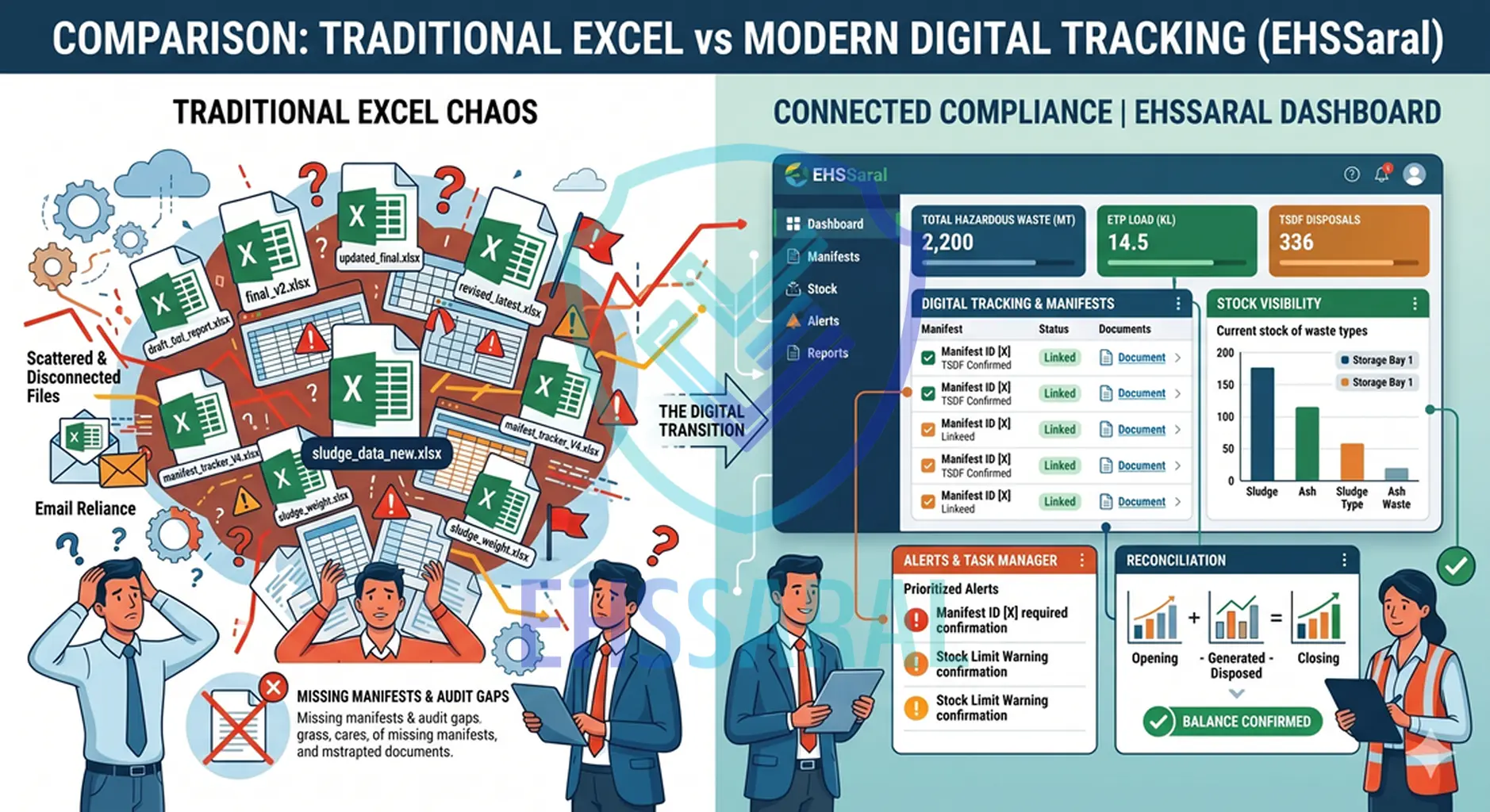
Why Industries Are Moving Toward Digital Environmental Tracking

digital environmental compliance tracking system EHSSaral

As environmental reporting becomes more detailed, industries are realizing something important:

The challenge is no longer just:

“submitting forms.”

The bigger challenge is:

maintaining connected environmental data throughout the year.

This is where traditional fragmented Excel-based systems start becoming difficult to scale.

Because modern environmental compliance increasingly depends on:


How Digital Systems Reduce Reconciliation Stress

Modern environmental tracking systems help by connecting:

  • waste generation,
  • manifests,
  • storage records,
  • disposal status,
  • annual returns,
  • and supporting documents

inside one structured workflow.

Instead of manually collecting:

  • multiple Excel sheets,
  • emails,
  • invoices,
  • and manifest copies

during filing season, industries can maintain running visibility throughout the year.

This reduces:

  • last-minute panic,
  • manual reconciliation,
  • and dependency on memory-based reporting.

The Bigger Shift Happening in Environmental Compliance

Earlier, environmental compliance was often treated as:

  • periodic documentation activity.

But gradually, industries are realizing that:

  • environmental data behaves more like operational intelligence.

Because:

  • production,
  • water,
  • fuel,
  • emissions,
  • sludge,
  • disposal,
  • and resource efficiency

are all interconnected.

And once industries begin viewing compliance as connected operational data rather than isolated forms, reconciliation becomes much easier and more meaningful.


Before Filing Form 4 and Form 5, Check These Points

Before final submission, industries should ideally verify:

  • Does opening stock match the previous year’s closing stock?
  • Are all manifest quantities entered correctly?
  • Is pending disposal shown as closing stock?
  • Are units converted properly into Kg, MT, KL or litres?
  • Are ETP sludge moisture variations understood?
  • Does waste generation broadly align with production trends?
  • Are recycler, TSDF or co-processing records available?
  • Are there notes for unusual increases or reductions?
  • Is one final master tracker used for both forms?
  • Can each number be traced back to a document?

This simple check can reduce most last-minute confusion during filing or inspection.


Final Thought

Most Form 4 and Form 5 mismatches do not happen because industries intentionally report incorrectly.

In many cases, the mismatch is simply a reflection of:

  • fragmented records,
  • disconnected workflows,
  • operational timing differences,
  • and manual reconciliation limitations.

The important thing is not achieving artificially perfect numbers.

The important thing is maintaining:

  • consistency,
  • traceability,
  • operational logic,
  • and explainable records.

Because in practical environmental compliance:

believable and traceable data usually builds more trust than mathematically perfect reporting.

A Practical Closing Note

As environmental compliance becomes more data-driven, industries will need better systems to connect waste generation, manifests, storage, disposal, and annual reporting.

The future of compliance is not just form filling. It is maintaining clean, traceable, and explainable environmental data throughout the year.


Frequently Asked Questions

Can Form 4 and Form 5 numbers be different?

Yes. Form 4 and Form 5 numbers can differ because both forms use different reporting logic. The difference should be explainable through records, stock balance, manifests, and operational data.

Why does ETP sludge quantity change?

ETP sludge quantity changes due to moisture content, chemical dosing, filter press efficiency, production load, and storage time before disposal.

What is the difference between waste generated and waste disposed?

Waste generated means waste produced during plant operations. Waste disposed means waste actually lifted, transported, recycled, co-processed, or sent to an authorized facility.

Why does closing stock matter?

Closing stock shows waste that remains stored at the plant. If generated waste is not yet lifted or disposed, it should be traceable as closing stock.

How do inspectors check Form 4 and Form 5 data?

Inspectors may compare manifests, hazardous waste registers, production data, ETP logs, stock records, disposal certificates, and previous year filings.

How can industries reduce Form 4 and Form 5 mismatch?

Industries can reduce mismatch by maintaining monthly reconciliation, linking manifests with stock records, standardizing units, documenting variations, and using one master tracker.

Harshal T Gajare

Harshal T Gajare

Founder, EHSSaral

ISO 14001 Lead Auditor | Second-generation environmental professional simplifying EHS compliance for Indian manufacturers through practical, tech-enabled guidance.

Related Blogs

SPCB Consent Conditions: Common Compliance Mistakes Explained | EHSSaral

SPCB Consent Conditions: Common Compliance Mistakes Explained | EHSSaral

Can You Transfer Hazardous Waste Responsibility in India? (What the Law Says)

Can You Transfer Hazardous Waste Responsibility in India? (What the Law Says)

Why We Wrote The Indispensable EHS Officer Book (A Realist Guide for India) | EHSSaral

Why We Wrote The Indispensable EHS Officer Book (A Realist Guide for India) | EHSSaral

Sampling Basics for Air, Water & Noise EHS Officer Guide | EHSShala

Sampling Basics for Air, Water & Noise EHS Officer Guide | EHSShala

Common Hazardous Waste Mistakes in Indian Factories | EHSShala

Common Hazardous Waste Mistakes in Indian Factories | EHSShala

The Paper Shield: PF & ESIC Challans vs Real Compliance Risk | EHSSaral

The Paper Shield: PF & ESIC Challans vs Real Compliance Risk | EHSSaral

MPCB CTO Refusal Patterns in Maharashtra (2023–2025) Analysis | EHSSaral Research

MPCB CTO Refusal Patterns in Maharashtra (2023–2025) Analysis | EHSSaral Research

Why Most Environmental Non-Compliance Is a System Failure, Not Intent | EHSSaral

Why Most Environmental Non-Compliance Is a System Failure, Not Intent | EHSSaral

EHSShala Consent - SPCB Consent System Explained| EHSShala

EHSShala Consent - SPCB Consent System Explained| EHSShala

Environmental Inspection India: What Inspectors Check | EHSSaral

Environmental Inspection India: What Inspectors Check | EHSSaral