

Research
Why Form IV Readiness Cannot Begin at the End of the Year
EHSSaral is an Environmental Compliance Intelligence Platform for Industries. Consent Intelligence • Alerts & Tasks • Incident Reporting • Form IV & V • Audit-Ready Records
See how EHSSaral works
13 Aug 2026
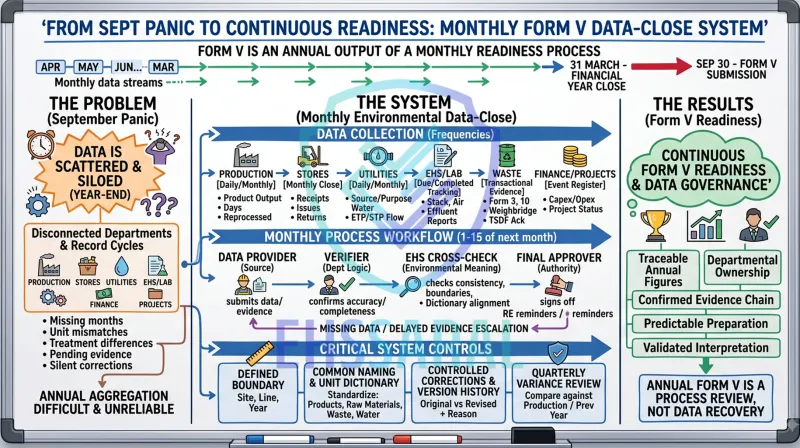
Form V may be submitted once a year, but almost every number reported in it is generated throughout the year.
Production is recorded by the production team. Raw-material movement sits with stores or ERP. Water readings come from utilities. Monitoring reports remain with EHS, the laboratory or the consultant. Waste quantities are distributed across registers, manifests, weighbridge slips and disposal acknowledgements. Environmental expenditure is maintained by finance and projects.
By the time EHS begins preparing the annual environmental statement, the information may be spread across several departments, files and definitions.
This is where Form V data collection becomes difficult.
The main challenge is usually not filling the final format. It is collecting 12 months of complete, consistently defined, supported and approved information from different parts of the factory.
A practical Form V system therefore does not begin shortly before submission. It operates as a monthly environmental data-close process.
Form V is an annual output of a monthly data-readiness system.
This article focuses specifically on that monthly operating system: responsibilities, evidence, review status, reconciliation, escalation and correction control.
For applicability, due date, Parts A–I, calculations and the Form V format, refer to EHSSaral’s separate Form 5 Environmental Statement Guide. Keeping these two subjects separate helps EHS teams understand both the final statement and the operating process behind it.
Under Rule 14 of the Environment (Protection) Rules, Form V is the environmental statement for the financial year ending 31 March. The reporting date was changed to 30 September through the 1993 amendment. India Code records the applicable amendment and Form V format.
In many Indian plants, however, serious Form V data preparation starts only after the financial year has closed.
EHS then sends requests to several departments:
Each department may maintain its information for a different purpose.
Production may report in pieces while Form V requires tonnes. Stores may provide material issued instead of material consumed. Utilities may have total water-purchase figures but no source-wise or use-wise allocation. Finance may identify every pollution-control expense under a general maintenance ledger.
None of these records is necessarily wrong. They were simply created for different operational purposes.
The annual difficulty arises when EHS has to convert them into one consistent environmental statement.
Common situations include:
These are data-governance problems. They cannot be resolved reliably by asking EHS to work faster during the filing period.
Not every Form V input should be collected in the same way.
Some information is generated every day and closed monthly. Some becomes available only when monitoring is conducted. Some changes only when a project is implemented or the consent is amended.
A useful Form V data collection system separates information by its natural record cycle.
| Information type | Examples | Appropriate control |
|---|---|---|
| Monthly operating data | Production, raw materials, water, effluent and waste | Monthly close |
| Frequency-based records | Stack, ambient air, effluent, water and noise reports | Due-versus-completed tracking |
| Transaction-based evidence | Waste manifests, weighbridge slips, invoices and acknowledgements | Update when the transaction occurs |
| Event-based information | Pollution-control projects, process improvements and conservation measures | Event register with monthly review |
| Master information | Plant details, consented products, capacity, water sources and waste categories | Update when an approved change occurs |
| Annual information | Previous-year comparison and final management approval | Consolidate after monthly records are closed |
This distinction is important.
For example, asking a department to upload the same consent details every month creates unnecessary work. At the same time, waiting until year-end to identify missing water readings creates avoidable uncertainty.
A good system applies the right frequency to each dataset.
Form V data can appear complete and still be inconsistent if departments are reporting against different boundaries.
Before starting monthly collection, define:
Consider a plant with two production blocks and a common ETP.
The production team may submit figures for only one block, while utilities report total water supplied to both. The two datasets may be individually accurate but cannot be used together without explaining the boundary difference.
From a practical standpoint, the first monthly control should be:
Are all departments reporting for the same site, period and operational boundary?
This becomes especially important when a plant expands, introduces a new product, adds a borewell, changes its waste route or commissions new pollution-control equipment during the financial year.
One of the most common Form V department responsibility problems is the assumption that EHS owns every number because EHS prepares the final statement.
EHS usually coordinates Form V, but the source information belongs to several departments.
A practical responsibility structure should distinguish three roles.
The data provider is the person or department maintaining the original operational record.
Examples include:
The verifier checks whether the information is complete, correctly defined and supported by the underlying records.
For example, a stores manager may verify that reported raw-material consumption has considered opening stock, receipts, issues, returns and closing stock.
The final approver accepts the reviewed dataset for use in the plant’s annual environmental reporting.
This may be the production head, utilities head, finance head, EHS head, plant head or authorised signatory, depending on the dataset and the factory’s internal authority structure.
A useful operating principle is:
The department closest to the source should confirm the number. EHS should confirm its environmental meaning, reporting relevance and consistency with connected records.
EHS should not be expected to silently certify a production or financial figure that the responsible department has not reviewed.
The responsibility matrix should identify who provides each dataset, what EHS checks and what evidence supports it.
| Dataset | Primary data provider | EHS cross-check | Supporting evidence | Suggested approver |
|---|---|---|---|---|
| Product-wise production | Production or planning | Product names, units, reporting boundary and capacity alignment | Monthly production report or ERP extract | Production Head |
| Raw-material consumption | Stores, ERP or production | Inventory adjustment and consistent material names | Opening stock, receipts, issues, returns and closing stock | Stores or Operations Head |
| Source-wise water withdrawal | Utilities | Source classification, meter balance and consent conditions | Meter logs, bills and tanker records | Utilities Head |
| Purpose-wise water use | Utilities or production | Process, cooling, boiler, domestic and other uses | Distribution-meter logs and operating records | Utilities Head |
| Effluent generation and treatment | ETP or utilities | Water-effluent relationship, operating days, treatment and reuse | Flowmeter records, ETP logbooks and reuse records | Utilities or EHS Head |
| Environmental monitoring | EHS, laboratory or consultant | Location, parameter, frequency, reporting period and completeness | Signed monitoring reports | EHS Head |
| Hazardous waste | EHS, stores or production | Generation, dispatch, stock and Form IV relationship | Form 3, Form 10, weighbridge records and acknowledgements | EHS Head |
| Non-hazardous waste | EHS, stores or administration | Classification, quantity, movement and destination | Registers, gate records, invoices and receiver evidence | EHS or Administration Head |
| Environmental projects | Projects, maintenance or EHS | Environmental purpose, implementation status and claimed result | Approval, purchase order, completion record and photographs | Plant Head |
| Environmental expenditure | Finance or projects | Capex/Opex classification and proposed-versus-completed status | Ledger, PO, invoice and approval | Finance Head |
| Pollution-control improvements | Engineering, maintenance or EHS | Measure implemented and environmental relevance | Commissioning and performance records | Plant Head |
| Plant master information | EHS, legal or operations | Consent and authorisation alignment | Consent, authorisation and previous statement | Authorised Signatory |
The exact titles can be adapted to the factory. The important point is that each dataset has a named source owner and does not remain addressed simply to “concerned department.”
A Form V monthly checklist is incomplete without a controlled naming and unit dictionary.
Over a year, the same item may appear under several names:
Similarly, a product may appear under its commercial name in production reports, its internal code in ERP and its consented name in regulatory documents.
If these variations are not mapped early, annual consolidation becomes dependent on one person’s memory.
The dictionary should standardise:
The dictionary should also distinguish between concepts that are often mixed:
| Terms that may be confused | Required distinction |
|---|---|
| Quantity issued and quantity consumed | Material issued from stores may remain unused or in work-in-progress |
| Quantity generated and quantity dispatched | Waste can remain in closing stock |
| Freshwater and recycled water | Recycled water should not be added to freshwater withdrawal without explanation |
| Concentration and pollutant load | A laboratory concentration is not the same as total mass discharged |
| Budget and expenditure | Approved expenditure is not necessarily incurred expenditure |
| Zero and missing | Zero is a confirmed value; missing means the value is not available |
| Nil activity and not applicable | An applicable process may have no activity during a particular month |
| Estimated and measured | Estimated information should remain visibly identified |
A blank cell should not be allowed to represent zero, pending, not applicable and unknown at the same time.
Production and raw materials form the operational base for several Form V comparisons.
A monthly close should capture:
A practical raw-material relationship is:
Opening stock + receipts − closing stock ± approved adjustments = material consumed
However, this equation should be applied with an understanding of the plant’s process.
ERP issues do not necessarily equal actual consumption. Materials may remain on the shop floor, be returned to stores, become part of work-in-progress or be transferred between units.
EHS does not need to repeat the production department’s accounting process. It should check whether:
Where commercial confidentiality applies to a raw material, the reporting treatment should be agreed and documented rather than decided during final preparation.
Water information often becomes difficult because it comes from several records covering different periods.
The monthly dataset should identify water received from:
Water use should be classified, as relevant, into:
The effluent record should separately capture:
A monthly reconciliation should identify:
The purpose is not to force every water balance to become mathematically perfect.
Real plants have evaporation, moisture in products, floor washing, domestic consumption, gardening, sludge moisture and other legitimate differences. The objective is to make the basis and significant differences understandable.
For a detailed discussion of water-balance scrutiny, readers can refer to EHSSaral’s separate guide on how water bills and effluent records are examined in ZLD audits.
The monthly Form V system should not duplicate the plant’s environmental monitoring programme. Instead, it should verify whether the evidence expected during the period is complete.
For every applicable monitoring activity, check:
For example, “monitoring completed” is not sufficient if the report covers the wrong stack or omits a consent-specified parameter.
The detailed explanation of monitoring types, parameters and operational interpretation already exists in EHSSaral’s Environmental Monitoring Guide for Indian Factories. The Form V data-readiness process should refer to that framework and focus only on completeness and traceability.
Waste information should be closed stream by stream.
For each applicable waste, record:
The basic stock relationship is:
Opening stock + generation − authorised movement or treatment = closing stock, subject to documented adjustments
For hazardous waste, the monthly Form V close should use the same source records that support Form 3, Form 10 and the annual Form IV return.
This does not mean every number will look identical without interpretation. Timing, stock, moisture and document cut-offs can create legitimate differences.
The detailed reasons and reconciliation method are covered separately in Why Form IV and Form V Numbers Do Not Match. This article is concerned with preventing those differences from remaining undiscovered until annual preparation.
In many plants, non-hazardous waste records are less structured than hazardous-waste records.
The monthly close should still confirm:
Non-hazardous waste should not become a balancing quantity used to absorb unexplained differences in other records.
Environmental projects and expenditure are often reconstructed from emails, purchase orders and personal memory.
A monthly project register can include:
Each project should carry a clear status:
| Project status | Meaning |
|---|---|
| Proposed | Identified but not yet approved |
| Approved | Management approval received |
| Ordered | Purchase order or work order issued |
| Under implementation | Work has started |
| Commissioned | System has been placed into service |
| Completed | Work and acceptance are complete |
| On hold | Work has been formally paused |
| Cancelled | Proposal will not proceed |
The register should separately identify:
An approved budget should not automatically be reported as completed environmental expenditure.
Similarly, a completed physical project may not appear in the same month’s finance ledger if the invoice is pending. The difference should be visible and explained.
A spreadsheet can show a value in every row and still not be Form V ready.
For each dataset, the monthly system should ask five separate questions:
Consider two examples.
Production reports 850 MT for the month. The number is available, but the ERP extract includes two products under internal codes that have not been mapped to the reporting dictionary.
The data exists, but it is not yet fully ready.
A disposal quantity is entered in the waste tracker. Form 10 and the weighbridge slip are available, but the receiver acknowledgement remains pending.
The transaction has a number and partial evidence, but its evidence chain is incomplete.
This distinction prevents “cell filled” from being treated as “review complete.”
Every monthly dataset should carry a visible readiness status.
| Status | Meaning |
|---|---|
| Complete | Data, evidence, verification and applicable cross-checks are complete |
| Pending | Data, evidence or approval has not yet been received |
| Inconsistent | Information exists but does not reconcile with a related record |
| Not applicable | The dataset does not apply to the facility or reporting boundary |
| Nil activity | The dataset applies, but no activity occurred during the period |
“Not applicable” and “nil activity” should remain separate.
A waste category may apply to the facility but have nil generation during a shutdown month. A particular water source may be completely inapplicable because the plant has no connection or permission for it.
The difference matters when annual records are reviewed.
Monthly Form V data collection depends on several departments, so some delays are inevitable.
The response should be structured rather than personal.
A practical escalation sequence can be:
The system should show exactly what is pending:
A general reminder such as “Form V data pending” is less useful than:
April tanker-water invoices are available, but the source-wise quantity has not been confirmed by Utilities.
This is where EHSSaral helps reduce routine follow-up work. Instead of EHS manually checking different spreadsheets and sending general reminders, the system can identify the exact value, document, verification or approval that remains pending and alert the responsible stakeholder.
EHS can then focus on unresolved exceptions rather than repeatedly chasing information that has already been submitted.
There may be situations where exact information is temporarily unavailable because of meter failure, damaged records or delayed external evidence.
If an estimate is used, preserve:
An estimate should remain visibly different from a measured or source-confirmed value.
A monthly freeze creates an approved reference point.
It does not mean that a record can never be corrected. It means later changes follow a controlled process instead of silently replacing the earlier value.
A correction record should preserve:
For example, if March hazardous-waste generation is corrected, the change may also affect:
A connected correction should therefore be reflected across the relevant records, with the history preserved.
In EHSSaral, a correction can remain connected to the records it affects. For example, a revised hazardous-waste generation quantity can update the relevant monthly balance and Form V preview while preserving the original value, reason, evidence and approval trail.
This helps prevent one corrected number from leaving inconsistent figures elsewhere.
This is one of the most important differences between a controlled monthly system and an annually rebuilt spreadsheet.
Documents used during Form V preparation may pass through several versions.
A monitoring report may be corrected. Finance may issue a revised expenditure statement. Production may update output after the monthly accounting close.
The document-control process should identify:
Old versions should not remain mixed with final versions in one folder without any indication of which document is current.
At the same time, an earlier document should not be deleted if it formed the basis of a previously approved record. Preserving the trail makes later corrections understandable.
A plant can adapt the following calendar to its accounting and operational close.
| Timeline | Activity | Primary responsibility |
|---|---|---|
| Day 1–3 | Close source operational records | Production, stores, utilities, ETP and EHS |
| Day 4–6 | Submit monthly values and supporting evidence | Data providers |
| Day 7–9 | Verify departmental information | Department verifiers |
| Day 10–12 | Perform environmental and cross-dataset checks | EHS |
| Day 13–14 | Resolve or document exceptions | Data provider, verifier and EHS |
| Day 15 | Approve and freeze the monthly dataset | Designated approvers |
| After Day 15 | Process changes through controlled correction | Relevant owner and approver |
The dates are illustrative.
Some factories may close production and finance at different times. The system should accommodate that reality while retaining a clear cut-off and ownership structure.
Before freezing the month, review the following.
A monthly close checks completeness. A quarterly review checks whether the information makes operational sense.
Useful comparisons include:
A variance should create a review, not an automatic conclusion that the data is wrong.
Production mix, weather, shutdowns, maintenance, cleaning cycles and project commissioning can all affect environmental performance.
The objective is to identify unexplained variation early enough for the responsible department to review it.
A plant is not continuously ready merely because it has created a Form V template.
It is continuously ready when:
By the end of March, the plant should already know which datasets are complete and which exceptions remain open.
Annual preparation then becomes a process of review, consolidation and management approval rather than information recovery.
EHSSaral is designed to function as the coordination and exception layer between source departments and the annual environmental statement.
It helps plants:
EHSSaral does not wait until September to create Form V. It helps the plant keep the underlying information ready throughout the year.
This distinction is important.
A one-time Form V generator can help populate the final format. A Form V data-readiness system helps determine whether the numbers entering that format are complete, consistent, approved and traceable.
EHSSaral does not replace the source department’s judgement or the EHS professional’s interpretation. It provides a common structure through which responsibilities, evidence, reviews and exceptions can remain visible.
Consider the water dataset for June.
Utilities submits:
The municipal bill and ETP logbook are attached. Tanker invoices are available, but two trips do not have inward gate records. The recycled-water figure is based on a meter that was replaced during the month.
The monthly status should not simply be “complete” because all four numbers have been entered.
A more useful status would show:
The exception is then assigned to the appropriate person.
Once the gate entries and meter-replacement calculation are verified, the dataset can be approved and frozen.
This small monthly discipline prevents the same issue from becoming an unexplained annual difference several months later.
An annual number without monthly traceability makes it difficult to identify missing periods, unit changes and abnormal variations.
EHS can coordinate and cross-check, but source departments should verify production, inventory, utility and financial information.
A document may cover the wrong site, period, parameter or version.
Pending information, inconsistent information, nil activity and not-applicable information require different treatment.
Silent changes weaken confidence in the dataset and can create continuity problems in connected records.
A difference should be understood and explained. Unsupported adjustments made only to create a perfect balance can hide the actual operational reason.
A complete number without confirmation from the source department may still create uncertainty during final sign-off.
If the monthly system adds duplicate entry without clarifying the source of truth, departments may continue maintaining several conflicting versions.
The implementation should identify which operational source remains authoritative and how verified information moves into the Form V readiness layer.
Factories do not need to redesign every environmental process at once.
A phased approach can work better.
Begin with:
These datasets create most of the reconciliation work.
Connect:
Track:
Once the monthly system is stable, review the accumulated Form V preview quarterly.
This allows EHS and management to identify structural gaps before the financial year closes.
Form V data collection is not a single annual request sent by EHS.
It is a coordinated process through which production, stores, utilities, treatment operations, laboratories, waste stakeholders, projects and finance provide information in a consistent and reviewable form.
The strongest monthly system has:
When these controls operate throughout the year, Form V preparation becomes more predictable.
By September, the plant should be reviewing an already-developed environmental statement-not searching across departments for the information needed to create one.
Good Form V preparation begins with monthly ownership, not annual paperwork.
Form V uses plant details and information related to production, water, raw materials, pollution discharged, hazardous waste, solid waste, pollution-control measures, conservation initiatives and other environmental improvements.
For the complete part-by-part structure, refer to the Form 5 Environmental Statement Guide.
Most quantitative operational information is best closed monthly because production, raw materials, water, effluent and waste are generated throughout the year.
Monitoring should be tracked according to its applicable frequency, while project and improvement information can be updated when an event occurs and reviewed monthly.
EHS generally coordinates the final environmental statement, but responsibility for source data is distributed across production, stores, utilities, ETP operations, laboratories, projects, maintenance and finance.
Each dataset should have a provider, verifier and approver.
EHS should check environmental relevance and cross-dataset consistency. The responsible production or finance authority should confirm the source figure.
EHS should not be expected to independently certify information controlled by another department.
Data completeness means the required value is available.
Evidence completeness means the source documents, departmental confirmation and relevant review records are also available. A number can exist while its supporting trail remains incomplete.
Assign the missing item to the source owner, record what is pending and set a review date.
If an estimate is temporarily necessary, document the estimation method, source, reason and approval. Replace it with actual information when available.
Nil activity means the dataset applies, but no activity occurred during that month.
Not applicable means the dataset does not apply to the facility, process or reporting boundary.
Yes. A freeze creates an approved version; it does not prohibit correction.
Later corrections should preserve the original value, revised value, reason, evidence, reviewer, approver and effect on connected datasets.
They should be reconcilable, but the figures may require interpretation because of opening stock, closing stock, generation, dispatch timing, moisture differences and reporting boundaries.
See the detailed guide on Form IV and Form V quantity mismatches.
A well-designed Form V system can assign responsibilities, send reminders, standardise units, connect evidence, identify missing months, preserve correction history and show the current readiness position.
The software should support departmental accountability rather than transferring every responsibility to EHS.
Some reviewed environmental information-such as water, energy, waste and environmental projects-may support sustainability reporting.
However, regulatory and sustainability disclosures can use different boundaries, definitions and calculation methods. The information should be mapped carefully rather than copied without review.
EHSSaral explains this relationship in its separate article on ESG data management for Indian factories.
A plant can begin at any point in the financial year.
If earlier months are incomplete, first create a gap register showing what is available, missing, inconsistent or not applicable. The current month should then follow the new closing process while historical gaps are resolved separately.

Founder, EHSSaral
Founder - EHSSaral | Partner - Perfect Pollucon | ISO 14001 Lead Auditor | GHG Protocol Scope 2 | Chemist | Data Scientist | Second-generation environmental professional simplifying EHS compliance for Indian industries through practical, automated, tech-enabled, data driven compliance workflows.
Why Form IV Readiness Cannot Begin at the End of the Year
Hazardous Waste Storage Rules in Indian Factories | EHSShala

Evolution of EHS in India - (Part 1) Pre-Bhopal Era | EHSShala
Chemical Accidents Rules, 1996: A Practical Guide for Indian EHS Officers
Noise Monitoring in Factories Workplace vs Boundary (India Guide) | EHSShala

Why EHS Experience Is Being Filtered Out - The Real Hiring Logic | EHSSaral
MPCB CTO Refusal Patterns in Maharashtra (2023–2025) Analysis | EHSSaral Research
The ZLD Mass Balance Trap: How Auditors Calculate Effluent Using Your Water Bills | EHSSaral
Isokinetic Sampling Basics: Simple Guide for Stack Monitoring | EHSShala

Factories Act 1948: Download Compliance Checklist & Rules PDF | EHSSaral