
EHSShala
MSIHC Rules, 1989: Practical Guide for Indian Factories
EHSSaral is an Environmental Compliance Intelligence Platform for Industries. Consent Intelligence • Alerts & Tasks • Incident Reporting • Form IV & V • Audit-Ready Records
See how EHSSaral works
13 Aug 2026
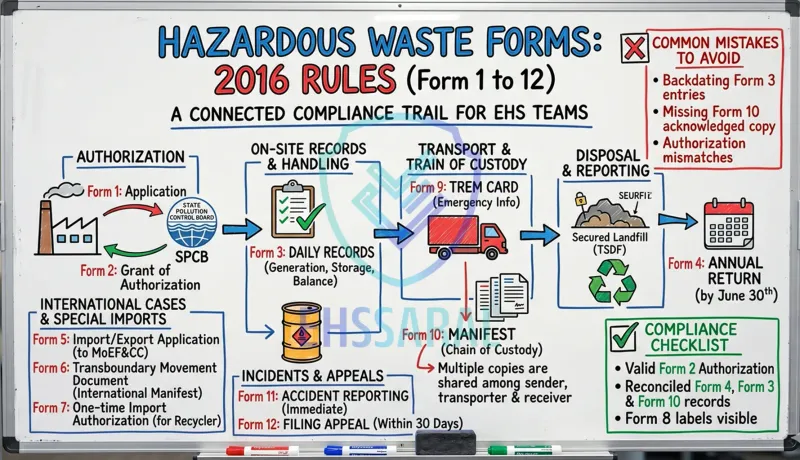
During a State Pollution Control Board inspection, the question is rarely only, “Do you have Form 4?”
The real question is usually deeper:
Does your Form 4 annual return match your Form 3 daily records?
Do your Form 10 manifests support the waste dispatched?
Does your authorization actually cover the waste being generated?
Do you have proof that the waste reached the authorized recycler, co-processor, pre-processor or TSDF?
This is where hazardous waste forms under the Hazardous and Other Wastes (Management and Transboundary Movement) Rules, 2016 become important.
These forms are not separate pieces of paperwork. They create a connected compliance trail - from authorization and daily recordkeeping to labelling, transport, annual return, accident reporting and appeal.
hazardous waste compliance in Indian factories
This guide explains all major forms from Form 1 to Form 12 in simple, practical language for Indian EHS officers, plant managers and compliance teams.
EHSSaral’s Hazardous Waste Management System connects Form 3 records, Form 10 manifests, storage balances, TSDF/recycler evidence and Form IV preparation in one traceable workflow.
Hazardous waste forms under the 2016 Rules are not different state-wise forms created independently by each Pollution Control Board.
The base forms come from the central rules. State Pollution Control Boards and Pollution Control Committees implement them through their own portals, document requirements and scrutiny practices.
So, whether a plant is dealing with MPCB, GPCB, KSPCB, TNPCB, DPCC or any other State Pollution Control Board, the form logic remains linked to the 2016 Rules.
| Area | Practical Meaning |
|---|---|
| Form format and purpose | Comes from the central 2016 Rules |
| Portal process | May differ depending on the SPCB or PCC |
| Supporting documents | Upload requirements may differ by state, industry and case |
| Query handling | Board officers may raise queries based on local scrutiny practice |
| Core compliance logic | Remains linked to the 2016 Rules, as amended from time to time |
From a practical standpoint, EHS teams should understand both sides:
First, what the form means under the 2016 Rules.
Second, how that form is submitted, maintained or checked through their state portal or during inspection.
Many users search for hazardous waste forms in PDF or Word format because they need the actual format for internal records, audit preparation, annual return work or training.
Before using any downloaded format, check whether your State Pollution Control Board portal requires online filing, portal-generated forms, specific attachments or digital acknowledgement.
Downloaded formats are useful for understanding, internal preparation and recordkeeping. But final submission should follow the current state portal process wherever online filing is required.
| Form | Common Use |
|---|---|
| Form 1 | Authorization application preparation |
| Form 2 | Granted authorization reference |
| Form 3 | Daily hazardous waste record |
| Form 4 | Annual return preparation |
| Form 8 | Hazardous waste container label |
| Form 9 | Transport Emergency Card / TREM Card |
| Form 10 | Manifest reference for hazardous waste movement |
| Form 11 | Accident reporting format |
| Form 12 | Appeal filing format |
Form 3 hazardous waste record format
In day-to-day operations, hazardous waste compliance is not proved only by saying, “We have authorization.”
Authorization is only the starting point.
A plant also needs to show that hazardous waste generated on site is recorded, labelled, stored, transported and disposed of through proper channels.
This is where the forms connect with each other.
Form 1 tells the Board what hazardous waste the facility wants authorization for.
Form 2 shows what the Board has approved.
Form 3 records the daily or regular movement and balance of waste.
Form 4 summarizes the financial year.
Form 10 Manifest System proves chain of custody when waste moves from the generator to the receiver.
If these records do not speak the same language, confusion starts.
For example, if Form 2 authorizes one waste category, Form 3 shows another, Form 10 has different quantities, and Form 4 shows rounded annual figures, the plant may struggle to explain the mismatch during scrutiny.
In many Indian plants, the issue is not intentional non-compliance.
The issue is that records are maintained by different people, at different times, in different files or Excel sheets.
One person updates the hazardous waste register.
Another coordinates with the transporter.
A third person files the annual return.
Someone else stores the TSDF or recycler acknowledgement.
Over time, these small gaps become large reconciliation problems.
That is why understanding the forms as a connected system is more useful than simply downloading blank formats.
This is one of the most common doubts among EHS teams.
Many professionals search for terms like:
“MPCB Form 4”
“GPCB hazardous waste annual return”
“TNPCB Form 10 manifest”
“KSPCB hazardous waste authorization”
“DPCC hazardous waste Form 4”
These searches are natural because actual compliance work happens through state-level portals.
But from the rule point of view, hazardous waste forms are based on the Hazardous and Other Wastes Rules, 2016, as amended from time to time.
The form number, basic purpose and compliance logic are nationally aligned.
What differs is the practical submission experience.
| Aspect | Practical Meaning |
|---|---|
| Form format and purpose | Comes from the central 2016 Rules |
| Portal process | May differ depending on the SPCB or PCC |
| Login and filing flow | State portals may ask for information in different steps |
| Supporting documents | Requirements may differ based on state, category and case |
| Query handling | Scrutiny practice may differ from one Board to another |
| Final recordkeeping | Site should maintain copies, acknowledgements and supporting records |
The safer way to think is simple:
The form is national.
The portal experience is state-specific.
The inspection expectation is practical and evidence-based.
This is why a national forms hub is useful. It gives the base understanding. Then each individual form guide can explain state-specific portal points where required.
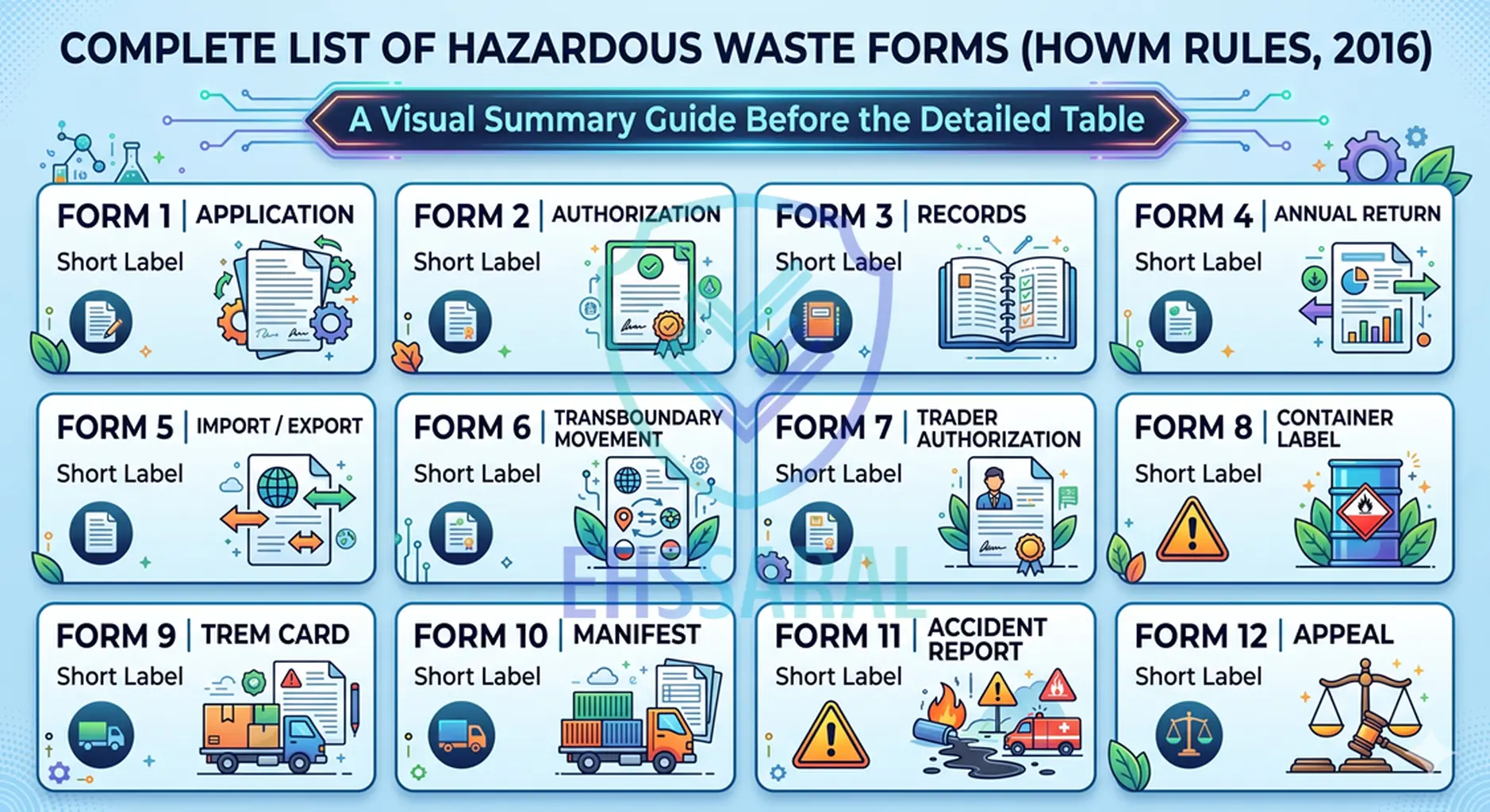
The 2016 Rules use different forms for different stages of hazardous waste compliance.
Some forms are used for applying to the Board.
Some are maintained at the site.
Some travel with the waste during transportation.
Some are used only when there is import, export, accident or appeal.
| Form No. & Title | Purpose | Who Uses It | Submitted To / Maintained At | When Required | Core Data Tracked | Common Practical Pitfall |
|---|---|---|---|---|---|---|
| Form 1: Application for Authorization | To apply for grant or renewal of hazardous waste authorization | Generator / occupier / operator | SPCB / PCC | New authorization, renewal, expansion or change in waste handling | Waste streams, process details, storage, treatment, recycling, disposal and requested quantity limits | Minor or secondary waste streams are missed during application. Later, when those wastes appear in records, authorization and actual generation do not match. |
| Form 2: Grant of Authorization | Authorization granted by the Board against Form 1 | Issued by SPCB / PCC; used by occupier / operator | Maintained at site | After approval of authorization application | Approved waste category, quantity, disposal route, validity and specific compliance conditions | EHS teams check only the validity date and miss quantity limits, category conditions or disposal restrictions. |
| Form 3: Records of Hazardous and Other Wastes | To maintain records of generation, storage, treatment, recycling, disposal or dispatch | Occupier / operator / facility handling hazardous waste | Maintained at site | Regular recordkeeping | Daily or periodic generation, storage balance, dispatch, receipt, treatment and disposal details | Backdating entries at month-end instead of recording actual movement in real time. |
| Form 4: Annual Return | To submit yearly return of hazardous and other wastes handled during the financial year | Occupier / operator / TSDF / recycler / facility as applicable | Submitted to SPCB / PCC | Every year by 30 June for the preceding April–March period | Annual quantity generated, stored, recycled, co-processed, disposed, imported, exported and closing balance | Form 4 totals not matching Form 3 records and Form 10 manifests. Nil Return may also be relevant where authorization exists but no hazardous waste was generated. |
| Form 5: Application for Import or Export | To seek permission for import or export of hazardous and other wastes | Importer / exporter | MoEF&CC / concerned authority as applicable | Before import or export shipment | Waste description, quantity, source, destination, reason, insurance and supporting documents | Incomplete documentation can delay permission, NOC or shipment-level clearance. |
| Form 6: Transboundary Movement Document | To track cross-border movement of hazardous and other waste consignments | Importer / exporter / concerned parties in shipment | Customs / concerned authorities as applicable | Per international consignment | Port details, routing, sender and receiver details, waste identity and quantity | Mismatch between document details and actual cargo can create port-level hold-ups or additional scrutiny. |
| Form 7: One-Time Authorization for Traders | To authorize traders for one-time import of specified waste categories | Trader | SPCB / MoEF&CC as applicable | Before first import of specified waste, especially Schedule III Part D cases | Trader details, waste category, quantity, source and actual-user details | Failing to verify whether the final actual user has valid authorization and facility capability. |
| Form 8: Label for Hazardous and Other Waste Containers | To identify hazardous waste containers clearly during storage and handling | Generator / occupier / operator | Affixed on container | Whenever hazardous waste is stored, packed or moved in containers | Waste description, generator details, quantity, hazard symbol, handling precautions and emergency contact | Labels washing off, missing hazard symbols, or unclear information for shop-floor workers and transport handlers. |
| Form 9: Transport Emergency Card / TREM Card | To provide emergency response information during transportation | Generator prepares; transporter carries | With transporter / driver during movement | During off-site transportation | Waste properties, risk information, first-aid, spill control, fire response and emergency contact details | Card is kept only as paperwork, without ensuring the driver can understand the instructions during an emergency. |
| Form 10: Manifest for Hazardous and Other Waste | To track chain of custody during off-site movement | Sender initiates; transporter and receiver complete | Sender, transporter, receiver and SPCB/PCC as per manifest copy flow | Every off-site dispatch of hazardous or other waste | Sender details, transporter details, receiver details, waste description, quantity, vehicle details and acknowledgement | Final acknowledged copy is not collected or archived, leaving the disposal trail weak. |
| Form 11: Accident Reporting | To report an accident involving hazardous and other waste | Occupier / transporter / facility / concerned person | SPCB / PCC | Immediately after accident, spill, fire, leakage or related incident | Incident details, waste involved, sequence of events, exposure, immediate action and corrective measures | Treating a spill or incident as an internal matter without checking whether reporting is required. |
| Form 12: Filing Appeal | To appeal against an order or decision | Aggrieved party | Appellate Authority | Within prescribed appeal timeline, commonly 30 days from communication of order | Order details, grounds of appeal, relief sought and supporting documents | Missing the appeal timeline because order date, communication date and internal escalation are not tracked properly. |
One common mistake is assuming that every form is submitted online to the Board.
That is not how hazardous waste compliance works in practice.
Some forms are submitted to the authority.
Some are granted by the authority and kept at site.
Some are maintained internally. (Hazardous waste storage and site records)
Some physically travel with the waste.
Some are used only in special cases.
| Type of Use | Forms Usually Involved | Practical Meaning |
|---|---|---|
| Application / permission | Form 1, Form 5, Form 7 | Used when a facility, importer, exporter or trader is seeking permission or authorization |
| Approval / authorization | Form 2 | Issued by the Board and maintained as the facility’s approved authorization |
| Site records | Form 3 | Maintained at site and produced during inspection or record review |
| Annual reporting | Form 4 | Submitted every year to report hazardous and other waste handled during the financial year |
| Import / export movement | Form 5 and Form 6 | Used for transboundary movement cases |
| Storage and handling identification | Form 8 | Used on hazardous waste containers |
| Transport safety | Form 9 | Carried during transportation for emergency response |
| Chain of custody | Form 10 | Used for movement from generator to receiver through transporter |
| Accident reporting | Form 11 | Used when accident, spill, leakage, fire or similar incident occurs |
| Appeal | Form 12 | Used when an aggrieved party files appeal against an order |
From a practical standpoint, EHS teams should not only ask, “Which form is applicable?”
They should ask:
Where should this form be kept?
Who updates it?
Who signs it?
Who checks it before submission?
What supporting records prove that the data is correct?
This approach avoids many last-minute problems during annual return filing, inspection or internal audit.
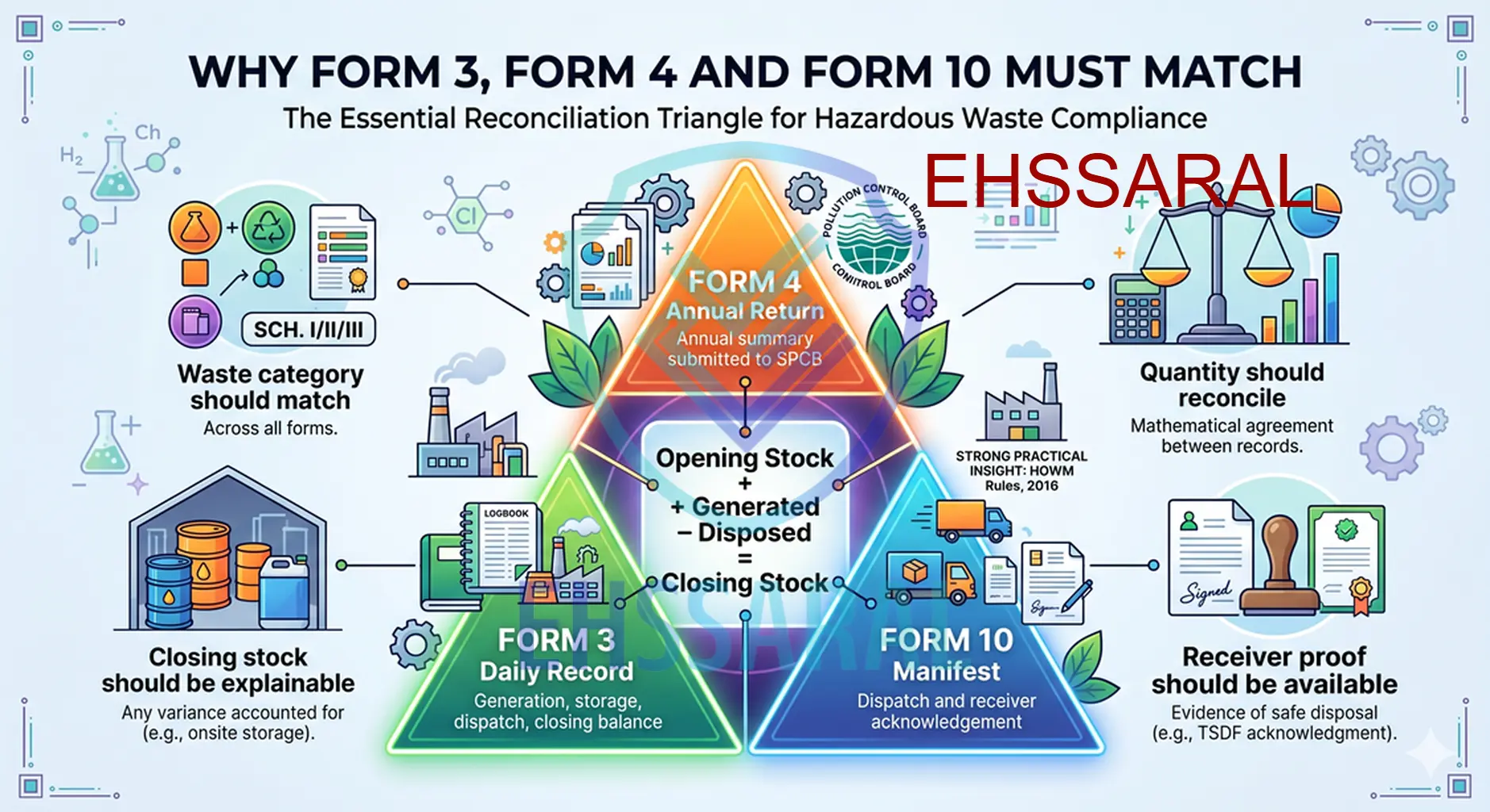
For many factories, the most important operational connection is between Form 3, Form 4 and Form 10.
Form 3 is the running record.
Form 10 is the movement proof.
Form 4 is the annual summary.
If these three do not match, the annual return becomes difficult to defend.
A simple practical check is:
Opening stock + waste generated during the year − waste dispatched / treated / disposed = closing stock
This logic should broadly reflect across Form 3, Form 10 and Form 4.
For example, if Form 3 shows that 10 MT of used oil was generated and Form 10 shows only 6 MT sent to an authorized recycler, the remaining 4 MT should be explainable as closing stock, reuse, internal storage or another valid route.
If Form 4 simply reports 10 MT disposed without supporting manifests, the number may look complete on paper but weak during scrutiny.
This is why many EHS teams face problems not because the waste was mishandled, but because the documents were not reconciled before filing.
Before submitting Form 4, it is useful to check:
| Record | What to Check |
|---|---|
| Form 2 authorization | Is the waste category authorized? Is the quantity within approved limits? |
| Form 3 record | Are generation, dispatch and closing stock updated properly? |
| Form 10 manifest | Are all dispatches supported by manifest records and acknowledgements? |
| Weighment slips | Do quantities match dispatch records? |
| Recycler / TSDF acknowledgements | Is final receipt proof available? |
| Storage area records | Does physical stock match closing balance? |
| Previous year closing balance | Does it match the current year opening balance? |
This reconciliation should ideally be done before the annual return is prepared, not after a query is raised.
One practical confusion we often see is that the same form number can mean different things under different environmental rules.
For example, Form 4 under the Hazardous and Other Wastes Rules is used for filing the annual return of hazardous and other wastes.
But Form 4 or Form IV under another waste rule may have a completely different purpose.
This is where confusion usually starts.
An EHS officer may search for “Form 4 annual return” and land on a biomedical waste, plastic waste, construction and demolition waste, or hazardous waste format.
The form number alone is not enough.
The rule family must also be checked.
| Search Term | What Should Be Checked |
|---|---|
| Form 4 | Which rule? Hazardous waste, biomedical waste, construction and demolition waste, plastic waste or another rule? |
| Annual return | Which waste stream is being reported? |
| Manifest | Is it hazardous waste movement under Form 10? |
| Authorization | Is it hazardous waste authorization, EPR registration, biomedical authorization or another permission? |
| Accident report | Which rule applies, and what type of incident is being reported? |
A safer way to search, save or label files is to use the full name.
For example:
Form 4 Annual Return under Hazardous and Other Wastes Rules, 2016
This is much safer than saving the file only as:
Form 4
In day-to-day plant work, this small naming habit can avoid major confusion later.
In some cases, a facility may hold valid hazardous waste authorization, but no hazardous waste may be generated or dispatched during a particular financial year.
This can happen due to shutdown, low production, process change, job-work changes, trial operations or simply because that waste stream was not generated during the year.
In such cases, the EHS team should not casually ignore annual return compliance.
From a practical standpoint, it is better to check the state portal requirement and submit a Nil Return or suitable declaration wherever applicable.
This avoids a common record gap.
The Board record may show that the unit has authorization.
But the annual return history may show no submission.
Later, during inspection or renewal, this can create an avoidable question:
“If authorization was active, why was the annual return not filed?”
A Nil Return helps maintain continuity.
| Situation | Practical Approach |
|---|---|
| Authorization exists, but no waste generated | Check whether Nil Return or declaration is required |
| Waste generated but not dispatched | Record generation and closing stock properly |
| Waste generated and stored | Ensure storage quantity and storage period remain within authorization and rule expectations |
| Waste dispatched after year-end | Do not wrongly include next-year dispatch as previous-year disposal |
| Portal does not clearly show Nil option | Keep internal note, supporting declaration and screenshot / acknowledgement wherever possible |
For EHS teams, continuity of records is often as important as the numbers themselves.
Most hazardous waste compliance issues do not start with major violations.
They start with small record gaps.
Many plants obtain authorization and then keep the document in a file.
But authorization is not only a certificate. It defines the waste categories, quantities, disposal routes and compliance conditions approved for the facility.
Before filing returns or dispatching waste, the EHS team should check whether the actual waste stream is covered in the authorization.
The expiry date is important, but it is not enough.
EHS teams should also check:
| What to Check in Authorization | Why It Matters |
|---|---|
| Waste category | The generated waste should match the authorized category |
| Quantity limit | Actual generation should be reviewed against approved quantity |
| Disposal mode | Waste should go to the approved recycler, co-processor, pre-processor or TSDF route |
| Specific conditions | Boards may mention storage, display, recordkeeping or reporting conditions |
| Renewal timeline | Renewal planning should start before expiry |
A common confusion is mixing up the renewal application timeline with the Board’s processing timeline.
The practical correction is simple:
Renewal may be applied for three months before expiry.
The 120-day period relates to the Board’s timeline for granting authorization after receiving a complete application.
These are two different things.
Form 3 should work like a running record.
But in many plants, it is updated only at the end of the month or just before an audit.
This creates problems because actual waste movement has already happened.
The weighment slip has one number.
The transporter record has another.
The manifest has a third.
The internal Excel sheet has a rounded number.
When the annual return is prepared, these mismatches become visible.
A better approach is to update Form 3 whenever waste is generated, moved, stored, sent, received or disposed.
Form 4 is an annual summary, but it should not be prepared by guesswork.
Before filing Form 4, the EHS team should reconcile opening balance, generation, dispatch, receiver acknowledgements, physical stock and previous year closing balance.
When this reconciliation is not done, Form 4 becomes weak.
The return may be submitted, but it may not be defensible.
Form 10 is not complete when the waste leaves the factory gate.
From the generator’s point of view, the important question is:
Did the waste reach the authorized receiver?
That is why the final acknowledged copy matters.
If the final copy from the receiver, recycler or TSDF is not collected and archived, the chain of custody remains incomplete from a recordkeeping point of view.
Container labels are not only for inspection.
They are also for safe handling.
A label should help a worker, supervisor, transporter or emergency responder understand what is inside the container.
Common issues include:
| Label Issue | Practical Risk |
|---|---|
| Label washes off | Waste identity becomes unclear |
| Hazard symbol missing | Handler may not understand risk |
| Waste category not mentioned | Record matching becomes difficult |
| Emergency contact missing | Delay during spill or leakage |
| Language not understood by workers | Label exists, but does not communicate |
Form 8 should be treated as a communication tool, not only a compliance sticker.
Form 9, or the Transport Emergency Card, becomes important during transport emergencies.
But simply handing over the card is not enough.
The driver or transport team should understand what to do in case of leakage, fire, spill, exposure or accident.
In some cases, regional-language support may be more useful than an English-only card.
Form 11 is usually not used in normal routine.
Because of that, many teams do not think about it until an incident happens.
But accidents, leakage, fire, spillage or exposure involving hazardous waste should not be handled casually.
The facility should check whether reporting is required and document the sequence, immediate action and corrective steps properly.
A small incident handled transparently and documented well is easier to explain than an incident that appears hidden later.
Before an inspection, renewal, annual return filing or internal review, the EHS team can use a simple checklist.
The purpose is not to create more paperwork.
The purpose is to check whether the hazardous waste trail is complete.
| Area | Practical Check |
|---|---|
| Authorization | Is the latest Form 2 authorization available at site? |
| Waste category | Are all generated hazardous wastes covered in the authorization? |
| Quantity | Are actual quantities within approved limits or properly explained? |
| Form 3 | Is the hazardous waste record updated regularly? |
| Form 4 | Was the annual return filed by the due date? |
| Nil Return | If no waste was generated, was Nil Return or declaration checked? |
| Form 8 | Are containers properly labelled? |
| Form 9 | Is the TREM Card available and understandable to transporter / driver? |
| Form 10 | Are all dispatches supported by manifests? |
| Final acknowledgement | Has the final receiver / TSDF / recycler acknowledgement been collected? |
| Storage area | Does physical stock match record balance? |
| Accident readiness | Does the team know what to do if spill, leakage or fire occurs? |
| Appeal tracking | Are adverse orders and timelines tracked properly? |
This checklist is useful because hazardous waste compliance is often tested through records.
A plant may have done the right thing operationally, but if the proof is scattered, incomplete or inconsistent, the explanation becomes difficult.
Consider a factory generating hazardous sludge from its process.
The authorization mentions the waste category and permitted annual quantity.
During the year, the EHS team maintains Form 3, but entries are updated irregularly.
A few dispatches happen through an authorized transporter.
Form 10 is prepared at the time of dispatch, but the final acknowledged copy from the receiver is not collected for two consignments.
At the end of the year, Form 4 is prepared quickly.
The annual quantity is taken from internal estimates instead of reconciled records.
On paper, the return is filed.
But during scrutiny, questions may arise:
Why does Form 3 show one quantity and Form 4 another?
Where is the final acknowledgement for two dispatches?
Does the closing stock match the physical storage area?
Was the disposal route the same as the authorization condition?
None of these questions necessarily mean the plant had bad intent.
But they show weak record control.
This is why hazardous waste forms should not be handled as separate files.
They should be handled as one connected trail.
In many plants, the problem is not lack of intention.
The problem is fragmentation.
Authorization is in one file.
Daily records are in Excel.
Manifests are in physical files.
Annual return data is prepared manually.
Reminders are managed through calendar alerts, WhatsApp messages or memory.
When the system depends only on people remembering everything, errors are natural.
A digital compliance workflow can help by connecting the records. (environmental compliance management system)
| Manual Problem | Digital Workflow Support |
|---|---|
| Renewal date missed | Authorization validity alert |
| Waste category mismatch | Mapping waste records with authorization |
| Form 3 not updated | Periodic task and record reminder |
| Form 10 final copy missing | Dispatch-wise closure tracking |
| Form 4 mismatch | Reconciliation dashboard before filing |
| Nil Return forgotten | Annual return task even when quantity is zero |
| Records scattered | Central document vault |
| Plant manager unaware | Dashboard summary and escalation |
Technology does not remove the need for EHS judgment.
But it can reduce avoidable gaps.
Good compliance starts with understanding, but it becomes sustainable when the process is tracked properly.
Hazardous waste forms under the 2016 Rules are not just formats to download.
They are a system of control.
Form 1 and Form 2 define permission.
Form 3 captures daily reality.
Form 4 summarizes the year.
Form 8 and Form 9 support safe handling and transport.
Form 10 proves movement and chain of custody.
Form 11 deals with accidents.
Form 12 protects appeal rights when an order needs to be challenged.
When these forms are understood together, hazardous waste compliance becomes calmer and more defensible.
Most issues arise from interpretation gaps, scattered records and last-minute reconciliation.
Good compliance starts with understanding, but it becomes stronger when the process is maintained throughout the year.
No. The base forms come from the Hazardous and Other Wastes Rules, 2016, as amended from time to time.
However, the portal process, supporting documents, scrutiny style and local instructions may differ from state to state.
So an EHS team should understand the national form requirement as well as the state portal process.
Form 1 is the application for authorization.
It is used by an occupier, generator or operator to apply for hazardous waste authorization or renewal.
It contains details such as waste category, quantity, process, storage, treatment, recycling, disposal and other handling details.
Form 2 is the authorization granted by the State Pollution Control Board or Pollution Control Committee.
It should be maintained at site and reviewed carefully.
The EHS team should check not only the validity period, but also waste categories, quantity limits, disposal routes and specific conditions mentioned in the authorization.
A renewal application may be made three months before expiry.
The 120-day timeline is different. It relates to the Board’s timeline for granting authorization after receiving a complete application.
These two timelines should not be confused.
Form 3 is used for maintaining records of hazardous and other wastes handled by the facility.
It works as a running record of generation, storage, treatment, recycling, disposal, dispatch or receipt, depending on the activity.
For practical compliance, Form 3 should be updated regularly and should support Form 4 annual return data.
Form 4 is the annual return for hazardous and other wastes.
It is submitted to the State Pollution Control Board by 30 June every year for the preceding April to March period.
It summarizes hazardous waste generation, storage, recycling, utilization, disposal and closing balance.
If a facility has authorization but no hazardous waste was generated during the year, the EHS team should check the state portal requirement.
Where applicable, submitting a Nil Return or suitable declaration helps maintain continuity of compliance records.
Form 8 is the label used on hazardous and other waste containers.
It helps identify the waste, hazard nature, handling precautions, generator details and emergency information.
A good label should be readable, durable and useful for workers, supervisors, transporters and emergency responders.
Form 9 is the Transport Emergency Card.
It is carried during transportation of hazardous waste and gives emergency instructions for incidents such as spill, leakage, fire or exposure.
The card should be understandable to the driver or transport team, not only kept as a formality.
Form 10 is the manifest used for hazardous and other waste movement.
It tracks the chain of custody from sender to transporter to receiver.
The sender prepares multiple copies as part of the manifest system. In practice, this is commonly understood as the seven-copy manifest system.
For the generator, collecting and archiving the final acknowledged copy is important because it helps prove that the waste reached the authorized destination.
Form 11 is used for reporting accidents involving hazardous and other waste.
This may include incidents such as spill, leakage, fire, exposure or transport-related accidents.
Reporting should not be delayed or treated casually, because incident documentation becomes important later.
Form 12 is used for filing an appeal against an adverse order or decision.
The timeline for appeal is short, so the order date, communication date and internal escalation should be tracked carefully.
For many hazardous waste generators, the most commonly relevant forms are:
Form 1 for authorization application.
Form 2 for granted authorization.
Form 3 for daily or regular records.
Form 4 for annual return.
Form 8 for container labelling.
Form 9 for transport emergency card.
Form 10 for manifest and chain of custody.
Other forms become relevant depending on import, export, accident or appeal situations.
Because they represent different stages of the same waste trail.
Form 3 records daily or regular waste movement.
Form 10 supports off-site dispatch and receipt.
Form 4 summarizes the full financial year.
If these three do not broadly reconcile, the annual return may become difficult to defend during scrutiny.
Avoid saving documents only as “Form 4” or “Form 10.”
Use full names such as:
Form 4 Annual Return under Hazardous and Other Wastes Rules, 2016
Form 10 Manifest under Hazardous and Other Wastes Rules, 2016
This avoids confusion with forms under other waste rules.

Founder, EHSSaral
Founder - EHSSaral | Partner - Perfect Pollucon | ISO 14001 Lead Auditor | GHG Protocol Scope 2 | Chemist | Data Scientist | Second-generation environmental professional simplifying EHS compliance for Indian industries through practical, automated, tech-enabled, data driven compliance workflows.
MSIHC Rules, 1989: Practical Guide for Indian Factories
Why Running Factories Are Getting Closure Notices in 2026 | EHSSaral
Form V Data Collection: Monthly System for Factories
Noise Monitoring in Factories Workplace vs Boundary (India Guide) | EHSShala
Sampling Basics for Air, Water & Noise EHS Officer Guide | EHSShala

Why Good People Still Struggle With Compliance in Indian SMEs | EHSSaral Research
Why Safety Culture Fails in Indian SMEs: People & Compliance Challenges | EHSSaral Research
ESG Data Management for Indian Factories | EHSSaral
EHSShala Foundations - Core Environmental Basics for EHS Officers
Form V Environmental Statement: Due Date, Format, Example & Guide