Quick Summary for Busy Officers If you remember only 5 things:
Daily QC matters more than annual calibration.
OOT is not disaster. Ignoring it is.
OCEMS flat lines trigger questions.
Documentation changes inspection tone.
Calibration discipline = credibility.
Why Monitoring Problems Usually Start With Calibration For three years, the stack reports were within limits.
Every six months, the laboratory came.
During renewal scrutiny, one simple question came:
Show me the calibration record of your stack gas analyzer.
Silence.
The instrument was working.
That day the EHS officer understood something important.
Environmental Monitoring does not fail in the lab. It fails in maintenance.
This article exists to remove confusion.
Not to quote rules.
Just to explain how calibration and QA/QC actually work in Indian factories.
If you understand this properly, inspections become predictable.
What Is Calibration? Calibration means checking whether your instrument is showing the correct value.
You compare your instrument with a known standard.
Examples:
A pH meter is checked using buffer solutions (pH 4, 7, 9).
A sound level meter is checked using an acoustic calibrator.
A gas analyzer is checked using zero gas and span gas.
A flow meter is compared with a reference device.
Calibration does not mean repair.
Calibration does not mean servicing.
Calibration means verification and documentation .
If your pH meter shows 7.2, you should be confident it is actually 7.2 - not 6.5 or 8.0.
That confidence comes from calibration discipline.
Memory Trick: The 3C Rule of Calibration Every environmental instrument must satisfy 3C:
C Meaning What to Check Correct Is the reading accurate? Zero/span or buffer check Current Is calibration valid? Expiry date Certified Is traceability available? NABL certificate & scope
If one C fails, credibility weakens.
Calibration vs Adjustment - A Small but Important Difference Many operators assume calibration automatically corrects the instrument.
Not always.
Calibration is verification.
Adjustment is correction.
During formal calibration:
Lab checks instrument accuracy (“as found” condition).
If deviation exists, adjustment may be done.
After adjustment, accuracy is recorded again (“as left” condition).
Your calibration certificate should clearly show:
If the certificate only shows final value without “as found,” you lose drift history.
Drift history helps you understand whether error was sudden or gradual.
That matters during internal review.
Read more about NABL accreditation
One Word Most People Ignore: Traceability When your instrument is calibrated by a third-party lab, the certificate should mention traceability.
Traceability means:
The standard used to check your instrument is itself linked to a national or international reference standard.
Simple example:
Your pH meter → calibrated by ABC Lab
That chain is traceability.
If this chain is missing, the certificate becomes weak.
You do not need to become a metrology expert.
Just remember:
A calibration certificate must show that your readings are linked to recognized standards - not just someone’s internal comparison.
What Inspectors Usually Check First Many officers assume inspectors start with emission values.
In reality, they often start with credibility.
They check:
Calibration certificates
Expiry dates
Instrument serial number matching certificate
Parameter within lab accreditation scope
Logbooks and internal QC records
If calibration discipline is weak, even good results look suspicious.
If calibration discipline is strong, even borderline results look controlled.
Most inspections do not question your numbers first.
They question your system.
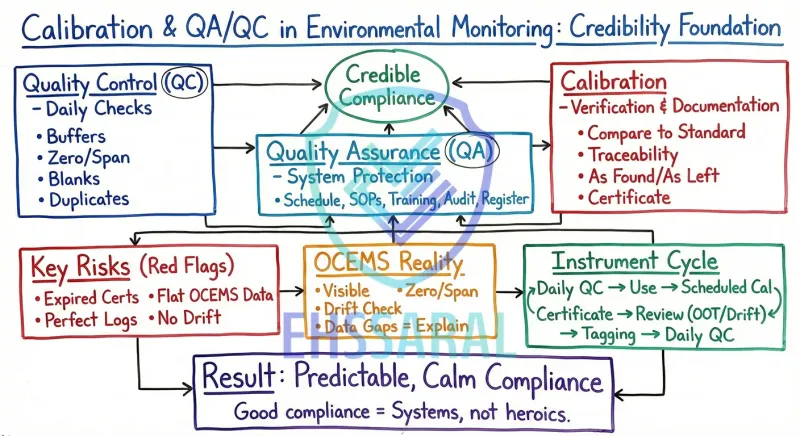
What Is QA and What Is QC? Many people mix these two terms.
Let us simplify.
Quality Control (QC) QC is day-to-day checking.
Examples:
Checking pH meter with buffer before sampling
Performing zero/span check before stack monitoring
Running blank samples in laboratory
Taking duplicate samples
Checking drift in online sensors
QC protects today’s result.
Quality Assurance (QA) QA is system-level protection.
Examples:
Maintaining calibration schedule
Keeping SOPs for sampling
Training operators
Annual third-party calibration
Internal audits
Maintaining calibration register
QC checks today’s sample.
Both are required.
If QC is strong but QA is weak, discipline slowly collapses.
If QA is strong but QC is ignored, daily errors creep in.
QA vs. QC: A Comparison in Environmental Monitoring Feature
QUALITY ASSURANCE (QA)
QUALITY CONTROL (QC)
Focus
The entire monitoring system and process.
Individual measurements and data points.
Scope
System-level protection to ensure reliability.
Day-to-day checking of specific tasks.
Goal
To protect the entire system and ensure it remains reliable.
To protect today’s result and check today’s sample.
Examples
• Maintaining a calibration schedule
• Keeping SOPs for sampling
• Training operators
• Annual third-party calibration
• Internal audits
• Maintaining a calibration register
• Checking pH meter with buffer before sampling
• Performing zero/span check before monitoring
• Running blank samples in the lab
• Taking duplicate samples
• Checking drift in online sensors
5-Minute Check Before Any Monitoring Check Why It Matters Calibration date valid Avoid inspection query Zero/span done Ensure accuracy Battery/Power OK Prevent incomplete data Serial number matches certificate Avoid documentation mismatch Logbook updated Show system discipline
Five minutes before sampling can save five hours of explanation later.
Why Calibration Gets Ignored in Real Factories Calibration is rarely ignored intentionally.
It gets ignored because:
The instrument is “working fine.”
No visible complaint.
Production pressure is high.
AMC exists, so everyone assumes it is handled.
Calibration sticker is unnoticed.
Operator does not understand importance.
Sometimes instruments do not break down.
But silent drift happens.
Especially in:
Gas sensors exposed to moisture
Flow meters with dust deposition
Aging pH electrodes
Noise meters stored without protection
The instrument still shows numbers.
But slowly, those numbers move away from reality.
Risk builds quietly.
Common Instruments That Require Calibration Air & Stack Monitoring Stack gas analyzer (SO₂, NOx, CO, O₂)
Flow measurement devices
Temperature probes
Manometers
Isokinetic sampling equipment
OCEMS sensors
These are often consent-critical parameters.
Small deviation can mean large compliance impact.
Read about SPCB Consent Guide
Effluent & Water Monitoring pH meters require frequent checking.
Electrodes degrade gradually.
Noise Monitoring Sound level meter
Acoustic calibrator
Before boundary noise monitoring, acoustic check confirms reliability.
It takes a few minutes.
Skipping it creates doubt later.
OCEMS & CEMS - Special Attention Area Online Continuous Emission or Effluent Monitoring Systems have changed the way regulators see factories.
Earlier, monitoring was periodic.
And continuous visibility creates pressure.
OCEMS requires regular:
Common ground realities seen across many units:
Zero calibration not recorded properly
Span gas cylinder empty but not replaced
Sensor probe coated with dust or moisture
Moisture trap not drained
Data gaps during power fluctuation
Flat emission lines despite production changes
Mismatch between plant dashboard and regulator server
Online systems increase visibility.
If OCEMS value is perfectly flat month after month, it may not look natural.
Real processes fluctuate slightly.
Perfect stability often triggers more questions than minor variation.
Remember D.R.E.A.M. for OCEMS Letter Meaning Action D Drift Check weekly trend R Records Maintain zero/span log E Errors Investigate abnormal spikes A Alerts Respond immediately M Maintenance Clean probe & check moisture
If OCEMS does not “dream,” it creates nightmares.
CPCB OCEMS Complete Guide
When OCEMS Value Looks Suspicious - A Simple 3-Step Check If you notice abnormal reading or unexpected pattern:
Check last zero/span calibration record.
Inspect sensor physically and review cleaning log.
Verify data transmission and server synchronization.
Most OCEMS issues are mechanical or maintenance-related.
Not compliance-related.
But weak documentation converts technical issue into compliance doubt.
Data Gaps - Handle Them Professionally Online systems sometimes fail.
Power failure.
Data gaps happen.
The mistake is not the gap.
The mistake is no explanation.
If data gap occurs:
Record reason internally.
Inform vendor immediately.
Document corrective action.
Preserve email or service communication.
Transparency reduces suspicion.
Silence increases it.
Out of Tolerance (OOT) - The Situation That Creates Panic Suppose you send your stack analyzer for annual calibration.
Certificate returns with note:
“Instrument found out of tolerance.”
This means at time of calibration, error was beyond acceptable range.
It does not automatically mean every past result was wrong.
But it does mean you must evaluate impact.
Calm response includes:
Recording OOT status in calibration register.
Reviewing daily QC logs.
Checking if drift trend was visible earlier.
Increasing internal QC frequency temporarily.
Re-establishing baseline after adjustment.
If internal daily QC was done properly, you usually detect drift early.
If no internal QC was maintained, OOT becomes more serious.
Annual calibration tells you once a year.
Daily QC protects you every day.
When OOT Happens – Do Not Panic Step Action Purpose 1 Record deviation Documentation 2 Review past QC logs Assess impact 3 Increase checking frequency Prevent repeat 4 Re-establish baseline Reset confidence 5 Inform management Transparency
OOT is data. Silence is risk.
Calibration Frequency - What Is Practical? Frequency depends on:
But practically, many factories follow this pattern:
Instrument Type Routine QC Check Formal Calibration Who Does It Approx. Cost (Indicative) Handheld pH Meter Daily using buffer Annual Operator / Accredited Lab ₹3,000-₹5,000 Stack Gas Analyzer Zero/Span before use Annual or post-repair Third-party accredited agency ₹15,000-₹25,000 OCEMS Sensor Auto-zero daily / Drift monthly Quarterly or Bi-Annual Vendor / AMC ₹40,000-₹60,000 per year Sound Level Meter Acoustic check before use Annual Accredited Lab ₹4,000-₹8,000 Effluent Flow Meter Trend & physical check weekly Annual Vendor / Specialist agency Varies widely
Costs vary by region and vendor.
Routine QC is usually low cost.
Formal calibration requires external validation.
Do not skip daily QC to save money.
Daily discipline reduces annual surprises.
If Budget Is Limited - Calibrate What Matters First Not every factory can calibrate everything quarterly.
So prioritize.
Priority 1: Consent-critical parameters
Priority 2: Online monitoring systems
Priority 3: Supporting internal instruments
Better to calibrate critical instruments properly
Consistency builds credibility.
Calibration Priority Pyramid Priority Instrument Type Why 1 Consent-critical parameters Direct regulatory impact 2 Online monitoring systems Continuous visibility 3 Supporting instruments Internal control
Protect what regulators see first.
When Calibration Gets Delayed - Interim Protocol Real-world scenario:
Calibration due on 15th January.
Production cannot stop.
In such case:
Increase daily QC checks.
Document vendor communication and delay reason.
Inform management about delay.
Avoid fresh compliance-critical sampling if risk is high.
Fix a hard internal cutoff (for example, do not extend beyond 30 days).
Documentation shows control.
Unrecorded delay looks like negligence.
QA/QC in Laboratory Monitoring - Do Not Ignore Sample Integrity Many EHS officers focus only on final numbers in lab report.
But sample handling matters equally.
For certain parameters:
BOD must be preserved and analyzed within defined time.
DO changes quickly if not fixed immediately.
COD requires proper preservation.
Heavy metal samples need correct acidification.
If sample travels in a hot vehicle for long duration, result reliability reduces.
Before accepting report, check:
Date and time of sampling
Date and time of receipt at lab
Preservation method mentioned
Sample condition on receipt
You do not need to challenge every report.
But you must understand the chain.
Monitoring is not only about testing.
It is about maintaining sample integrity.
Red Flags That Indicate Calibration Risk Experienced inspectors often notice patterns quickly.
These patterns do not automatically mean wrongdoing.
But they indicate weak control.
Red Flags in Your Own Data Exactly the same value month after month
pH always 7.00 without fluctuation
Stack emissions flat despite load variation
OCEMS always just below limit
Sudden spike without process change
Flow data not matching production capacity
Real processes breathe.
If data looks too perfect, deeper questions arise.
Red Flags in Vendor or Lab Reports Before accepting monitoring report, check:
Test method clearly mentioned
Instrument model referenced
Calibration date mentioned
LOD/LOQ included
Accreditation scope matching parameter
Analyst signature present
Weak report example:
“pH tested. Result: 7.2”
Strong report example:
“pH analyzed as per IS method using calibrated pH meter (Model XYZ), calibration date 12-Jan-2026.”
Small details build credibility.
When Instrument Fails Mid-Consent Period - What To Do If instrument fails calibration during active consent period:
Record failure immediately.
Assess approximate impact period.
Review recent monitoring data.
Inform management.
Correct instrument and revalidate.
The goal is not to hide error.
The goal is to strengthen system.
One failed calibration is a data point.
Ignoring it creates pattern.
Build a Simple Calibration Control System You do not need expensive software.
Simple discipline works.
Step 1: Maintain Calibration Register Include:
Instrument name
Serial number
Location
Parameter
Last calibration date
Next due date
Responsible person
Maintain master Excel sheet.
Use color coding for due dates.
Step 2: Apply the 30-Day Rule Set reminder 30 days before due date.
This prevents last-minute rush.
Early planning creates calm control.
Step 3: Physical Tagging System Attach visible sticker:
Operators understand color faster than emails.
Step 4: Quarantine Expired Instruments If calibration expires:
Tag instrument clearly
Restrict usage
Record in logbook
Using expired instrument knowingly weakens your position during inspection.
Documentation shows intent to control.
Step 5: Internal Audit Cross-Check During internal audit:
Randomly select one instrument.
Verify:
This keeps system active.
Internal Culture Matters Calibration discipline should not sit only with EHS officer.
Operators must understand:
Red tag means no reading.
Old habit:
New culture:
When operators understand consequence, compliance becomes shared responsibility.
Not individual burden.
Remember C.A.L.M. Compliance Letter Meaning C Calibration disciplined A Audit-ready documentation L Logbooks maintained M Monitoring credible
Calm compliance is not accidental. It is structured.
The Boring Truth About Good Compliance Monitoring equipment is like weighing scale at a grocery shop.
If scale is wrong, every transaction is wrong.
Even if shopkeeper is honest.
Calibration verifies that your measurement is trustworthy.
It does not make your process clean.
It proves your data is credible.
And in environmental compliance, credibility matters.
Because once credibility is lost, every number is questioned.
Years ago, that EHS officer sat silently when asked for calibration records.
Today, his Excel tracker gives reminder 30 days in advance.
His operators respect red tags.
His OCEMS logbook shows weekly drift checks.
The emissions did not change.
But the inspection conversation did.
Good compliance does not need heroics.
It needs systems.
Calibration is quiet.
Unseen.
But powerful.
When calibration discipline becomes routine,
And predictable compliance is calm compliance.
Frequently Asked Questions (FAQs) - Calibration & QA/QC in Monitoring 1. Is calibration mandatory for all environmental monitoring instruments? Not every instrument has the same frequency requirement.
But any instrument used for consent-critical monitoring - like stack emissions, effluent pH, flow meters, or OCEMS - must be calibrated regularly.
If your monitoring data is used in regulatory reporting, calibration is not optional.
2. What happens if calibration certificate expires during the year? Expired calibration does not automatically mean your data is invalid.
But it weakens your credibility during inspection.
If calibration is delayed:
Unrecorded delay creates more risk than short, documented delay.
3. What is the difference between calibration and validation? Calibration checks instrument accuracy against a known standard.
Validation confirms that the overall method or system works correctly under real conditions.
In simple words:
Calibration checks the instrument.
4. How often should a pH meter be calibrated? For handheld pH meters:
If pH meter is used daily for effluent discharge control, internal buffer checking becomes very important.
Electrodes drift over time.
5. What does “Out of Tolerance (OOT)” mean in calibration? OOT means the instrument was outside acceptable accuracy limits at the time of calibration.
It does not automatically mean past data is wrong.
But you must:
Ignoring OOT is more serious than OOT itself.
6. Is daily QC really necessary if annual calibration is done? Yes.
Annual calibration checks once a year.
Daily QC protects you every day.
Without daily QC, you may discover drift only after 12 months.
That is risky.
7. What should I check in a laboratory monitoring report? Before filing the report, verify:
Also check sample holding time for sensitive parameters like BOD.
8. What if OCEMS data shows flat values for many days? Real industrial processes rarely produce perfectly flat emission trends.
If values are too stable:
Flat data without variation can trigger inspection queries.
9. How can I manage calibration when budget is limited? Prioritize:
Consent-critical instruments
Online monitoring systems
Supporting instruments
Maintain strong daily QC even if formal calibration frequency is limited.
Discipline matters more than volume.
10. Do regulators immediately penalize if calibration is missing? In most cases, regulators first evaluate system control.
If they see:
Organized register
Honest documentation
Clear corrective action
Discussion remains technical.
If they see:
Then seriousness increases.
Clarity reduces tension.
Avoidance increases it.
11. Can I continue monitoring if calibration is slightly overdue? Short delay with documentation and strengthened QC may be manageable.
But long unrecorded delay weakens compliance position.
Set internal rule:
Do not extend beyond reasonable buffer (for example, 30 days).
Plan ahead using reminders.
12. Why is calibration considered part of QA/QC and not just maintenance? Maintenance keeps instrument running.
Calibration proves instrument accuracy.
QA/QC protects data credibility.
Environmental compliance depends on data credibility.
That is why calibration sits inside QA/QC, not just maintenance.



 EHSSaral v1.png)
 List, Rules & Compliance Guide ehssaral.webp)