
Blog
Hazardous Waste All Forms Form 1 to Form 12 Guide
EHSSaral is an Environmental Compliance Intelligence Platform for Industries. Consent Intelligence • Alerts & Tasks • Incident Reporting • Form IV & V • Audit-Ready Records
See how EHSSaral works
8 Jun 2026
 List, Rules & Compliance Guide ehssaral.webp)
In many Indian plants, environmental compliance does not become difficult when limits are crossed.
It starts becoming difficult much earlier - at the stage of classification.
A unit starts operations assuming it is small, controlled, or not heavily polluting, and therefore should fall under Green category. A consultant may suggest Orange. During inspection, the Pollution Control Board may interpret the same process differently.
This is where confusion usually starts.
Two factories doing similar-looking work may still fall under different categories. A unit handling only mixing may be treated differently from one involving chemical reactions. A recycling unit using a dry process may remain in Orange, while a slightly modified process may move into Red.
From the plant’s perspective, this feels inconsistent.
From a regulatory perspective, it depends on how pollution potential is interpreted through actual process details.
Over the years, we have seen that most Orange category issues do not arise because industries are polluting heavily. They arise because:
Before looking at lists or rules, one point needs to be understood clearly:
Orange category is not a safe middle zone. It is often the category where interpretation mistakes happen the most.
Industries in India are categorized based on their Pollution Index (PI), which reflects overall pollution potential by considering factors such as:
Under the updated CPCB direction (Classification of Sectors into Red, Orange, Green, White and Blue Categories), the classification broadly follows:
| Category | Pollution Index (PI) | Meaning | Approx. No. of Sectors (CPCB ~2026) | Typical Industry Examples | Compliance Expectation |
|---|---|---|---|---|---|
| Red | ≥ 80 | High pollution potential | ~60 | Cement plants, bulk drugs & pharmaceuticals, large chemical manufacturing, thermal power plants, integrated steel plants | Strict control systems, continuous monitoring (OCEMS), high scrutiny, frequent inspections |
| Orange | 55 to < 80 | Moderate pollution potential | ~130+ | Dairy processing, paint blending, plastic recycling, textile dyeing, engineering units, food processing | Defined pollution control systems (ETP/APCD), regular monitoring, consistent operation expected |
| Green | 25 to < 55 | Lower pollution potential | ~150+ | Assembly units, small fabrication, packaging units, electronics assembly | Basic controls, limited monitoring, lower compliance burden |
| White | < 25 | Minimal pollution potential | ~60 | Solar panel assembly, LED assembly, biscuit making (dry process), small service units | No major pollution control systems required, minimal regulatory burden |
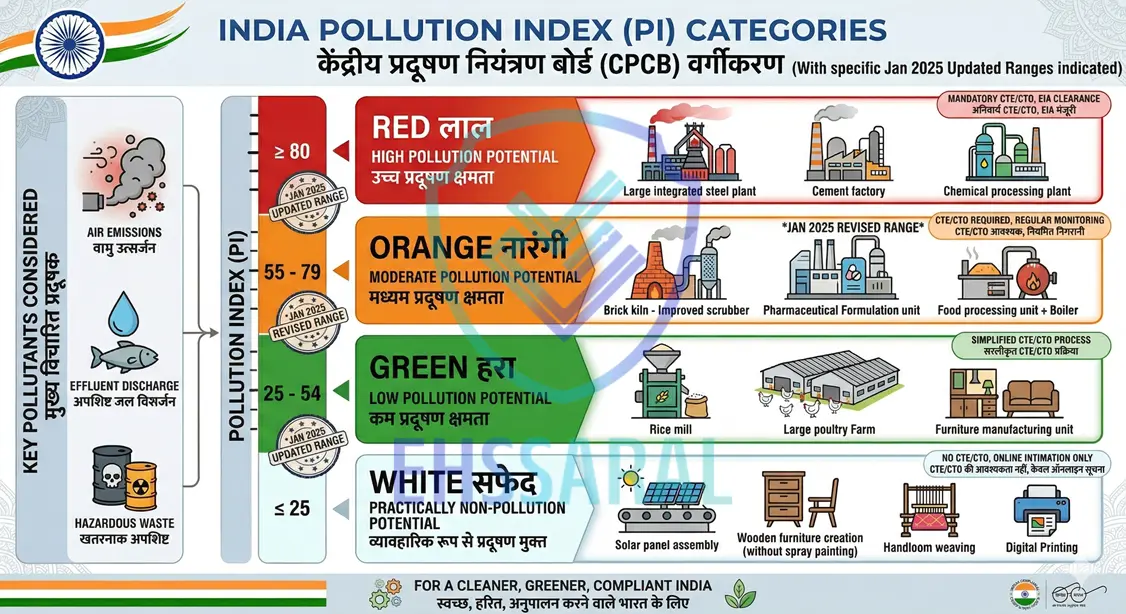
This classification is indicative and based on CPCB sector categorization. The exact category applicable to a unit depends on actual process details, raw materials, fuel type, and pollution control requirements, not just the industry name.
From a practical standpoint, factories do not calculate this index themselves. The category is assigned based on the industry type and process characteristics, not declared by the unit.
This is important.
A plant may feel that its emissions are low or operations are controlled. But if the process inherently carries a certain pollution potential, it will still fall under that category.
This is also why older content online often creates confusion. Many websites still show previous PI ranges, even though the classification approach has evolved.
In day-to-day operations, what matters is not the number alone. What matters is whether your actual process aligns with the category applied by CPCB and your respective SPCB such as MPCB or GPCB.
On paper, Orange category represents moderate pollution potential.
In practice, it means something more specific.
An Orange category industry is expected to:
Typically, an Orange category unit will require:
What differentiates Orange from Green is not just pollution level, but expectation of control.
Orange category assumes that pollution exists-but is manageable with systems.
However, this is where ground reality often differs.
In many Indian factories, pollution control systems are:
This creates a gap between:
And this gap is where most observations, notices, and delays originate.
While the exact classification should always be checked against the latest CPCB and respective SPCB list, the following types of industries commonly fall under Orange category in India:
This is not a substitute for the official sector list. It is an indicative understanding layer.
In practice, the exact category depends less on the industry name and more on:
Instead of going through a long, unreadable list, it is easier to understand Orange category through typical industry groups seen in Indian industrial areas.
These industries generate:
Even though they may appear “non-chemical,” the pollution load-especially in water-places them in Orange.
Here, the classification depends heavily on what exactly is happening.
Simple mixing without reaction may fall under Orange. But the presence of:
can shift interpretation.
These typically generate:
Individually, these may appear manageable-but combined impact leads to Orange classification.
This is one of the most misunderstood segments.
Two units both calling themselves “recycling” may fall into completely different categories depending on:
These generate:
Even at smaller scales, the variability and load often push them into Orange.
One important observation from field experience:
Classification is rarely about the industry name.
It is about how the process actually runs on the shop floor.
This is the area where most confusion, delays, and compliance issues originate.
Not because the rules are always unclear - but because process boundaries are often misunderstood, simplified, or described too loosely during consent and compliance discussions.
This is one of the most common examples.
From the plant’s perspective, both may be casually described as “paint manufacturing.”
From a regulatory perspective, they are not the same.
The difference may depend on:
This is where many classification mistakes begin.
If the process description is loose, the category becomes vulnerable to reinterpretation later.
Especially relevant in recycling and metal operations.
For example:
The classification changes-not because the industry name changed-but because process nature changed.
Fuel plays a significant role in classification interpretation.
Two identical units with the same process but different fuels may be evaluated differently.
However, one practical point:
Changing fuel does not automatically change category.
It needs to be reflected in consent and evaluated formally.
A cleaner fuel may improve your compliance position, but it does not automatically rewrite your category on paper.
A very common misunderstanding.
Many plants assume:
In reality, classification is often:
This leads to situations where:
This happens more often than expected.
A unit assumes:
But differences may exist in:
Even small differences can change classification.
In many Orange category discussions, the biggest confusion comes from broad labels such as “food unit,” “recycling unit,” or “chemical unit.”
But classification usually depends on narrower boundary conditions such as:
This is why two units under the same broad industry label may still fall into different categories.
Most misclassification does not come from incorrect intention.
It comes from:
And this usually becomes visible only when:
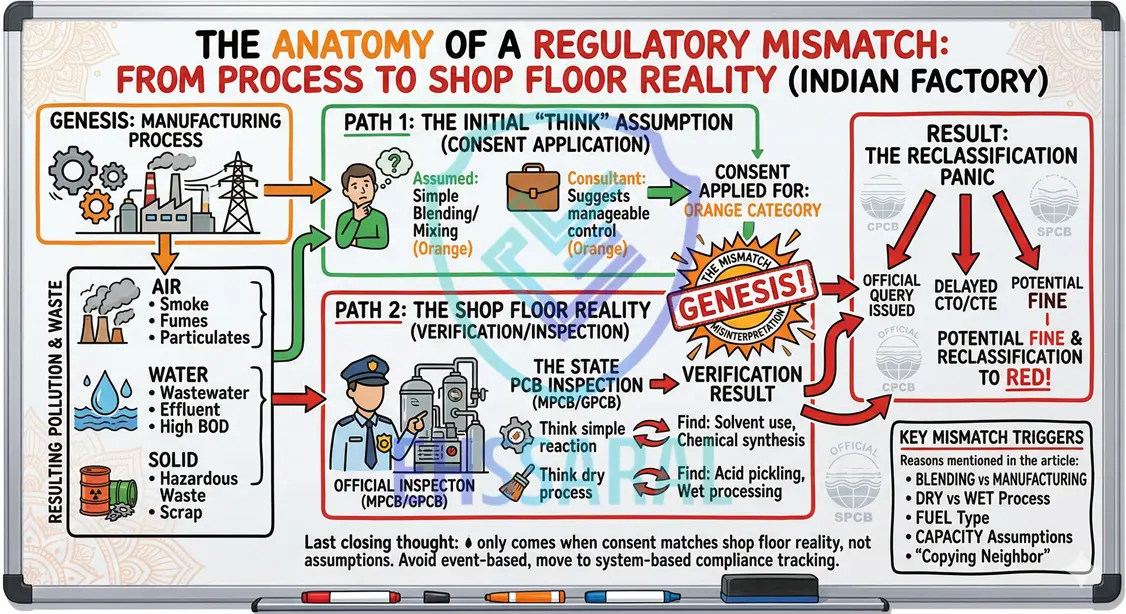
When a Pollution Control Board officer visits an Orange category unit, they are not just checking whether limits are within range.
They are trying to answer a deeper question:
Is this unit operating with a reliable compliance system, or is compliance being adjusted around inspections and sampling?
This is a critical shift in understanding.
Before looking at ETP or APCD, inspectors try to understand:
If the process explanation is unclear or inconsistent with consent conditions, it raises immediate concern.
Many plants proudly show:
But inspectors go one step further:
For example:
If a system runs properly only when someone is coming to check it, that is not compliance. That is preparation.
With growing digital monitoring:
Inspectors are now correlating:
Mismatch between these is one of the biggest triggers for observations.
This is subtle but important.
Inspectors can usually tell the difference by:
From a document perspective, compliance looks straightforward:
But on the ground, compliance is more layered.
Most plants underestimate this.
They focus on:
But ignore:
In reality:
Consent conditions define compliance more than limits alone.
If consent mentions:
Any mismatch between:
creates compliance gaps-even if limits are met occasionally.
Records are often treated as paperwork.
But for inspectors, records are:
Typical records expected:
Gaps in records are often interpreted as:
Many Orange category units still operate with this mindset:
This approach is increasingly risky.
Because:
This is one of the most critical sections-and where most practical issues exist.
An Orange category unit with effluent should have:
Across multiple industries, common patterns include:
Result:
This creates:
Many processes generate variable load:
But ETP operation remains constant, leading to:
ETP is not just treatment.
It also generates:
Improper handling of this can itself become a compliance issue.
Common issue:
Common issue:
Common issue:
Common issue:
| Industry type | Typical pollution concern | Common control gap |
|---|---|---|
| Food processing | High BOD/COD, odour, wash water | Underestimating peak load in ETP |
| Paint / blending | VOC emissions, sludge, hazardous waste | Focusing only on effluent and ignoring air emissions |
| Engineering | Oil and grease, metal scrap, contaminated waste | Poor segregation and storage |
| Recycling | Variable emissions, fuel impact, process inconsistency | Process changes without consent update |
| Textile / washing | Colored effluent, fluctuating chemical load | Treating variable effluent like constant load |
The shift in 2026 is not just about updated classification tables. It reflects a broader move toward clearer categorization, higher data visibility, and stronger logic-based evaluation of whether a plant’s systems actually match its declared category and compliance position.
Now, the landscape is changing.
This reduces dependency on:
Regulators are increasingly looking at:
Not just:
Another reason for confusion is that many search results still reflect older categorization references. This is why EHS professionals often see different PI ranges online. In practice, the safer approach is to rely on the latest CPCB direction and then cross-check state-level application through the respective SPCB.
Earlier:
Now:
Instead of thinking:
“We are not heavily polluting, so we are safe”
Think:
“We have pollution potential that must be continuously managed and demonstrated”
Forget long CPCB lists for a moment.
If you want clarity, ask these 5 questions about your plant:
Not what you call it.
Not what your consultant wrote.
What is actually happening on the shop floor?
Even a small overlooked step can change classification.
Break it into three:
If all three exist-even at moderate levels-Orange is often justified.
If your process needs:
Then you are already in a category where active control is expected.
This is rarely Green.
This is where many gaps exist.
Check:
Mismatch example:
Even if operations are controlled, this mismatch creates compliance risk.
This is the most honest test.
Ask yourself:
If the answer depends on preparation, not routine-there is a gap.
Process → Pollution generation → Control system required → Monitoring need → Record expectation → Category sensitivity
The more your process depends on active pollution control and regular monitoring, the less likely it is to sit in a low-risk category.
Instead of overthinking categories, use this practical lens:
If your plant needs continuous pollution control systems to remain compliant,
you are not in a “low-risk” category.
And if those systems are not consistently operated:
You are exposed-regardless of what your last report says.
Let’s take a typical situation.
A mid-sized unit:
They assume:
“We are small, so Orange is enough-or maybe even Green”
Consent obtained: Orange
Everything seems fine.
But:
During inspection:
Now the issue is not just compliance.
It becomes:
“Is this unit correctly classified and operating as per consent?”
This is how a simple gap turns into:
These are not theoretical. These are patterns seen repeatedly.
Many units:
But forget:
Plants often track:
But ignore:
This is one of the biggest risks.
This creates:
Even minor changes matter:
If not reflected in consent:
It becomes a compliance gap.
Common issues:
For inspectors, this signals:
Lack of system discipline
If you want to stay in control, focus on these:
If these five are in place, most Orange category units stay stable.
Earlier, a plant could operate with:
Now, the environment is shifting.
Instead of:
“Report is within limit, so okay”
The thinking is shifting to:
“Does the system behave logically over time?”
Earlier:
Now:
This is the most important takeaway.
Compliance is moving from event-based to system-based.
Earlier:
Now:
By the time a notice, query, or inspection observation reaches management, the actual system gap usually started much earlier.
It may have started when:
This is why Orange category compliance should not be seen only at the point of inspection. It should be seen as a system that is either stable every day, or slowly becoming unreliable.
At this stage, the goal is not to add more documents or complexity.
The goal is to create clarity inside your own system.
Most consents are:
But every consent actually contains:
Instead of treating it as a document, convert it into:
A simple internal checklist of:
For each major activity in your plant, map:
Example:
This mapping creates clarity.
Without this, compliance becomes guesswork.
Ask one simple question:
“Is this system running because it should, or because someone is watching?”
When systems become routine:
You don’t need complex dashboards.
Even simple tracking helps:
Most factories struggle not because they don’t do compliance-but because they lose track of it.
Once a month, step back and ask:
This single habit can prevent most surprises.
After years of working with different types of units, one pattern is clear.
Factories don’t want:
They want:
Peace of mind that nothing will suddenly go wrong
And that comes only when:
Instead, you have:
A system that shows you where you stand-at any point of time
As compliance becomes more structured:
This creates two types of factories:
Operate in:
Operate with:
The gap between these two is not technology.
It is:
Visibility + discipline
Even if everything looks fine today, watch for these signals:
These are early indicators-not failures yet, but risks building up.
If we simplify everything discussed:
Orange category is not about:
It is about:
Managing moderate pollution with consistent systems
Factories that struggle usually:
Factories that stay stable:
Maintain clarity in records
As environmental compliance becomes more structured, many factories are moving away from memory-based and event-based tracking.
They are trying to create visibility around:
This shift is important because most Orange category units do not fail due to lack of effort. They fail because obligations are scattered across documents, people, and dates.
When compliance becomes visible, it becomes manageable.
Most compliance problems do not start when limits are crossed.
They start when:
If these three remain unclear, even a technically decent plant can start appearing unreliable during inspection or review.
That is why Orange category should not be seen as just a moderate pollution category.
It should be seen as a category that demands:
Factories that struggle usually underestimate this.
Factories that remain stable usually understand one thing early:
occasional compliance is not the same as controlled compliance.
If you look at your plant today and feel,
“We are managing, but not fully confident,”
that is not a bad place to start.
That is usually the point where real improvement begins.
Because clarity does not come from more paperwork.
It comes from seeing your own system clearly - before someone else has to point out where it is failing.
In some cases, yes-but only if:
Changing category is not just an application-it is a process validation exercise.
Not always.
Category depends on:
A small unit can still be Orange or even Red.
Not completely.
Reports show:
Compliance requires:
Only if:
Otherwise, absence of a required system becomes a compliance issue.
At minimum:
This helps catch:
before they become external observations.

Founder, EHSSaral
Founder - EHSSaral | Partner - Perfect Pollucon | ISO 14001 Lead Auditor | GHG Protocol Scope 2 | Chemist | Data Scientist | Second-generation environmental professional simplifying EHS compliance for Indian industries through practical, automated, tech-enabled, data driven compliance workflows.
Hazardous Waste All Forms Form 1 to Form 12 Guide
Environmental Inspection India: What Inspectors Check | EHSSaral
Ozone-Depleting Substances Rules, 2000 - A Practical Guide for Indian Industries
How MoEFCC, CPCB & SPCB Work in India: Expert Guide | EHSShala
Post-Grant Environmental Compliance Failures in India | EHSSaral Research
Environmental Compliance to Sustainability Framework India | EHSSaral

150 Essential EHS Terms Explained Simply | EHSShala
Why Form IV Filing Becomes Difficult for Indian EHS Teams: A Field-Level Analysis
SWM Rules 2026: Is Your Factory a Bulk Waste Generator? | EHSSaral
 EHSSaral v1.png)
Blue Category MPCB 3-Year Consent Validity for Recyclers (2026) | EHSSaral