Bio-Medical Waste Management Rules, 2016 for Factories

Bio-Medical Waste Management Rules, 2016 for Factories

Bio-Medical Waste BMW Rules 2016 Factory OHC Environmental Compliance EHS CBWTF Waste Segregation
Last updated:

19 Jul 2026

|
Read time: 28 min read

The Bio-Medical Waste Management Rules can apply to factories that generate medical waste through an Occupational Health Centre, dispensary, first-aid room, ambulance, laboratory, vaccination drive or health camp. This guide explains authorization, colour coding, CBWTF handover, daily records, annual returns and practical factory responsibilities.


Bio-medical waste is normally associated with hospitals.

That is why it is easily missed inside factories.

A factory may generate only a small quantity of bio-medical waste. But this waste may come from many locations:

  • Occupational Health Centre
  • Factory dispensary
  • First-aid room
  • Ambulance
  • Shop-floor first-aid boxes
  • Vaccination drive
  • Medical examination camp
  • Blood collection activity
  • Pathology laboratory
  • Microbiology or research laboratory
  • Expired medicines stored in the OHC

The quantity may be small. The handling responsibility is still real.

“A small quantity does not remove the need for a clear disposal route.”

This guide explains how the Bio-Medical Waste Management Rules, 2016 apply to factories and manufacturing units in India.

It is written for EHS officers who need to connect medical-room activities with authorization, records, waste vendors, internal inspections and factory wastewater systems.

Read more Environmental Laws Applicable to Industries in India

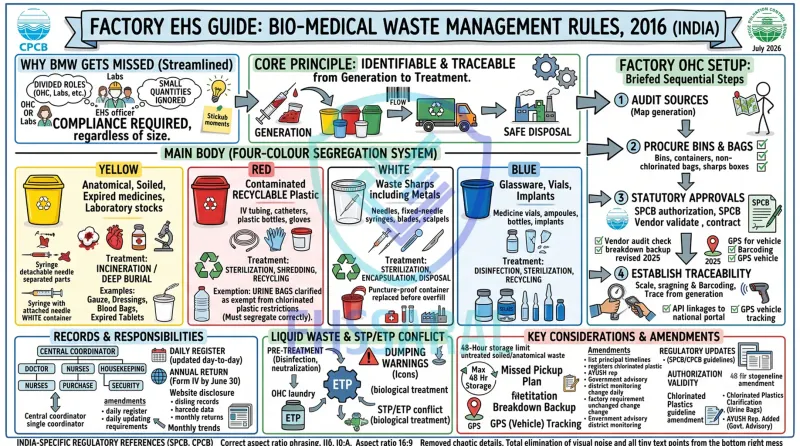
Why Bio-Medical Waste Gets Missed in Factories

Bio-medical waste is usually a small waste stream inside a factory.

That is exactly why it gets missed.

The doctor treats the worker.

HR arranges the health camp.

Housekeeping moves the waste.

Security receives the collection vehicle.

Purchase buys the bags and containers.

EHS manages the authorization and annual return.

When responsibility is divided across departments, nobody sees the complete route.

Common gaps include:

  • The OHC has coloured bins, but no one checks their contents.
  • The CBWTF collects waste, but the factory’s authorization position is unclear.
  • Health-camp waste is left outside the normal OHC records.
  • Used first-aid cotton enters the shop-floor general waste bin.
  • Expired medicines remain in storage without a disposal plan.
  • The EHS officer prepares the annual return from vendor invoices instead of daily records.
  • OHC liquid waste enters the STP without any assessment.

The EHS officer does not need to perform every activity.

But the EHS officer should be able to explain the complete system.

“The doctor manages treatment. The EHS officer helps ensure that the waste has a complete compliance route.”

Do the Bio-Medical Waste Management Rules Apply to Your Factory?

The Rules apply to persons and facilities that generate, collect, receive, store, transport, treat, dispose of or otherwise handle bio-medical waste.

For a factory, applicability may arise through:

  • Medical treatment
  • First aid
  • Diagnosis
  • Immunisation
  • Pathology testing
  • Biological research
  • Microbiological testing
  • Medical examination
  • Blood collection
  • Health camps

The factory does not need to operate a large hospital.

Do not decide applicability only from:

  • Number of workers
  • Number of OHC beds
  • Size of the medical room
  • Frequency of injuries
  • Monthly waste quantity
  • Whether the doctor is permanent or visiting
  • Whether an outside agency collects the waste

The Rules require occupiers handling bio-medical waste to apply for the applicable authorization irrespective of the quantity generated.

A factory OHC generating only a few needles and dressings still needs:

  • Correct segregation
  • Suitable containers
  • Safe storage
  • An authorized disposal route
  • Daily records
  • Periodic reporting
  • Trained people

Start by Mapping Where Waste Is Generated

Do not begin with the colour chart.

Begin with the factory.

Walk through every location where medical treatment or testing may happen.

Occupational Health Centre

Check:

  • Treatment table
  • Dressing area
  • Injection area
  • Medicine cupboard
  • Sample collection desk
  • Refrigerator
  • Emergency tray
  • Doctor’s room
  • Nursing station
  • Store room
  • Expired-medicine shelf

Ambulance

Check for:

  • Used cotton
  • Dressings
  • Gloves
  • IV tubing
  • Syringes
  • Needles
  • Vomit- or blood-contaminated material
  • Emergency medicine waste

The ambulance should not become an unrecorded temporary storage point.

Shop-Floor First-Aid Points

Check:

  • Production areas
  • Warehouse
  • Utility section
  • Maintenance workshop
  • Laboratory
  • Security gate
  • Canteen
  • Construction areas

Ask a simple question:

“After a worker receives first aid here, where does the used cotton or dressing go?”

Temporary Medical Activities

Include:

  • Annual medical examinations
  • Vaccination drives
  • Blood donation camps
  • Eye check-ups
  • Dental camps
  • Pathology sample collection
  • Occupational-health screening
  • Visiting doctor camps

Factory Laboratories

Some factories may operate:

  • Microbiology laboratories
  • Quality-control laboratories
  • Biological testing facilities
  • Pharmaceutical laboratories
  • Food-testing laboratories
  • Research and development laboratories

These activities may generate waste that requires on-site pre-treatment before handover.

Read Bio-medical Waste Management Rules 2016 on IndiaCode

What Is Bio-Medical Waste in a Factory?

Common factory examples include:

  • Blood-contaminated cotton
  • Used gauze
  • Dressings
  • Bandages
  • Used needles
  • Lancets
  • Syringes
  • IV tubing
  • IV bottles
  • Catheters
  • Urine bags
  • Contaminated gloves
  • Medicine vials
  • Ampoules
  • Blood samples
  • Blood bags
  • Laboratory cultures
  • Test kits
  • Expired medicines
  • Broken contaminated glass
  • Waste from vaccination activities

Not everything inside an OHC is bio-medical waste.

General waste may include:

  • Uncontaminated paper
  • Outer cardboard boxes
  • Food waste
  • Uncontaminated packaging
  • Office waste
  • Sweepings

Other waste may require a separate compliance route:

  • E-waste
  • Batteries
  • Hazardous chemical waste
  • Used oil
  • Municipal solid waste
  • Radioactive waste

This distinction matters.

When normal waste enters a bio-medical waste bag, treatment cost increases.

When bio-medical waste enters a general waste bin, safety and traceability are lost.

Read more about Used Oil & Waste Oil Management in India - Factory & EHS Guide by EHSShala
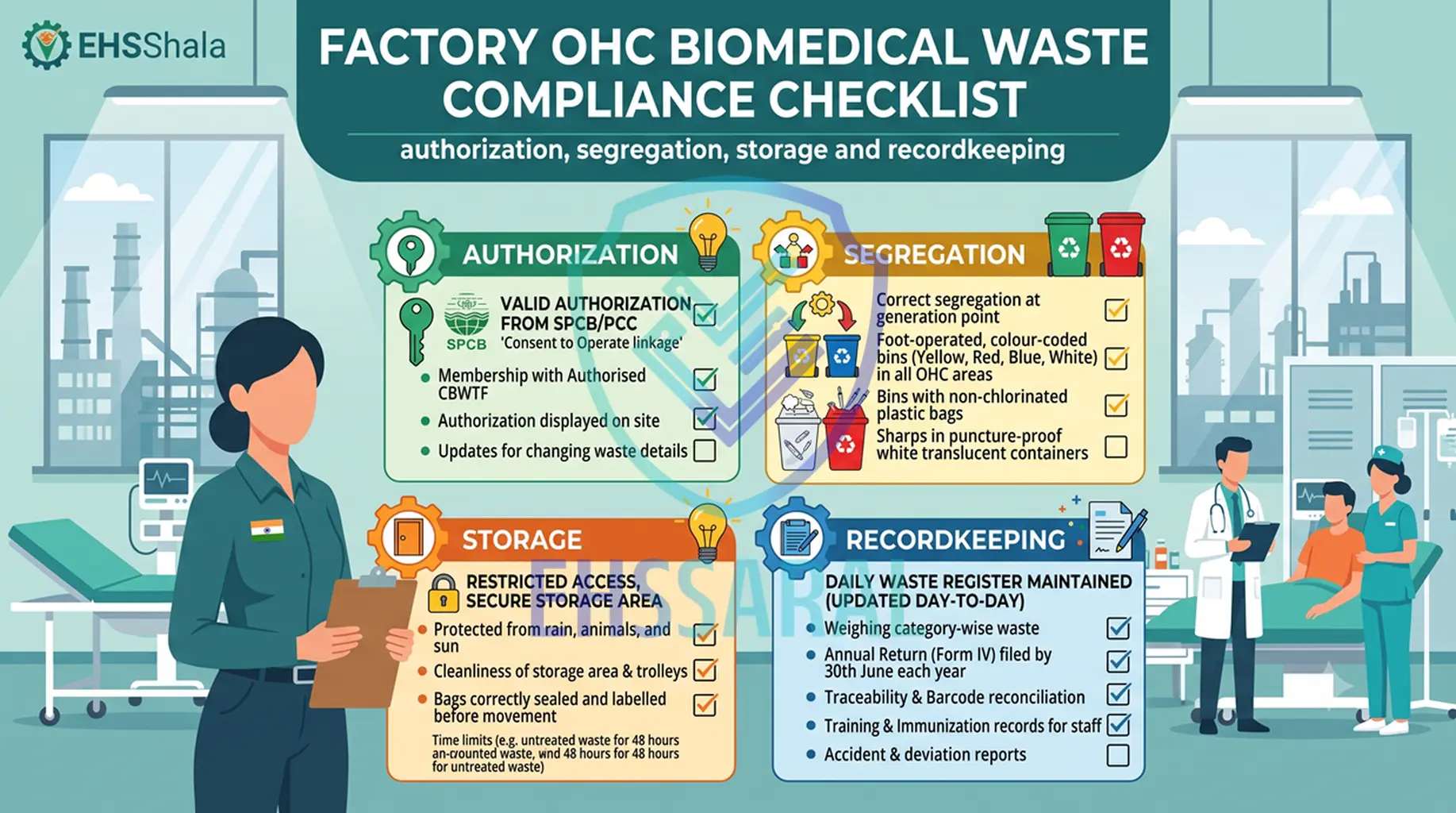
Factory OHC Setup: A Practical Sequence

Factory OHC biomedical waste authorization, segregation, storage and recordkeeping checklist EHSShala

Step 1: List Every Waste Item

Walk through the OHC with the doctor or nurse.

Check actual cupboards, drawers, trays, bins and treatment activities.

Do not prepare the list only from memory.

Include occasional activities such as vaccination and emergency treatment.

Step 2: Decide the Correct Waste Route

Place each item under:

  • Yellow
  • Red
  • White translucent
  • Blue
  • General waste
  • Another applicable waste stream

Do not write only “medical waste.”

An item-level list is easier for staff to understand.

Step 3: Install Suitable Containers

Provide:

  • Yellow-category arrangement
  • Red-category arrangement
  • White translucent sharps container
  • Blue-marked container for glass
  • General waste bin
  • Spare compliant bags
  • Labels and barcodes
  • Spill-control materials

Use foot-operated bins where appropriate.

Place the containers where treatment happens.

Do not keep all bins outside the room only to make the OHC look clean.

Step 4: Verify Authorization

Check:

  • Factory name
  • Factory address
  • OHC or dispensary details
  • Medical and laboratory activities
  • Waste categories
  • Quantity, where mentioned
  • Conditions
  • Authorization status

Do not assume the factory’s Consent to Operate automatically covers bio-medical waste authorization.

Step 5: Verify the CBWTF Agreement

Confirm:

  • Correct factory location
  • Waste categories covered
  • Collection frequency
  • Holiday collection
  • Emergency collection
  • Barcoding
  • Weighing
  • Rejected-bag process
  • Breakdown arrangement
  • Contact persons

Step 6: Start Daily Records

Record waste on the day it is generated or handed over.

Do not wait for the monthly invoice.

Step 7: Train Everyone Involved

Include:

  • Doctor
  • Nurse
  • OHC assistant
  • Laboratory staff
  • Housekeeping
  • EHS team
  • Security
  • Ambulance staff
  • Shop-floor first-aiders
  • HR and administration

Step 8: Include the OHC in EHS Inspections

Check the OHC during routine environmental inspections.

Do not review it only before an SPCB inspection or annual-return filing.
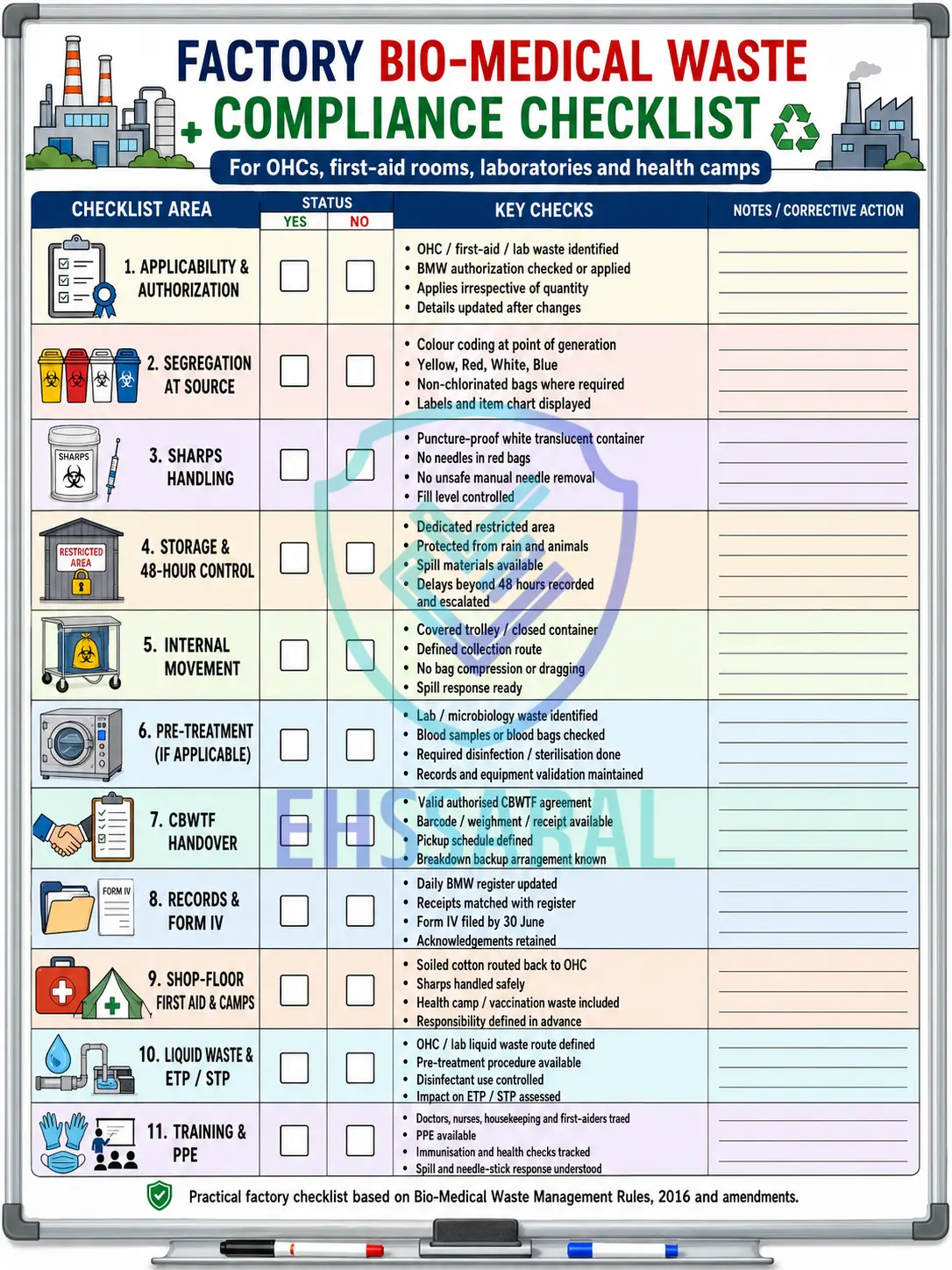
Bio medical Waste compliance Checklist for factories EHSSaral EHSShala

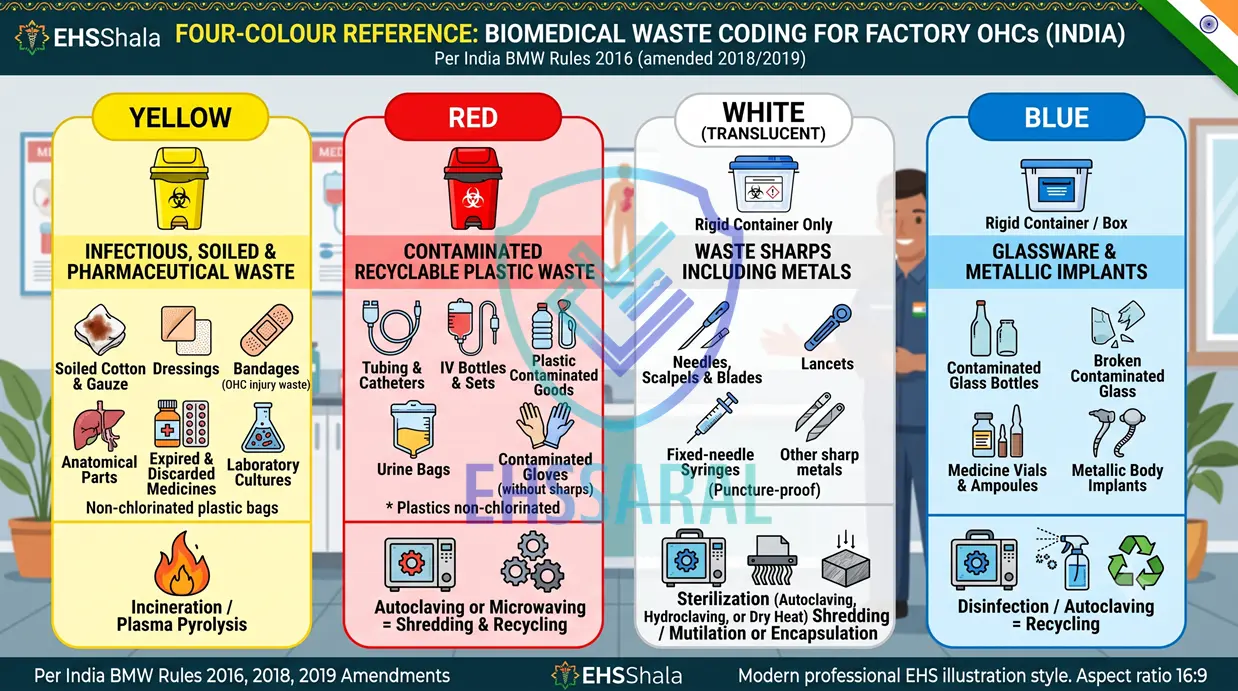
The Four-Colour Segregation System

Yellow, Red, White and Blue biomedical waste colour coding for factory Occupational Health Centres EHSSaral EHSShala

The Rules use four main colour categories:

  • Yellow
  • Red
  • White translucent
  • Blue

The correct colour depends on the waste item and its prescribed treatment route.

It does not depend on the department generating the waste.

Yellow Category

Yellow broadly covers waste such as:

  • Anatomical waste
  • Soiled waste
  • Blood-contaminated cotton
  • Used dressings
  • Bandages
  • Blood bags
  • Expired or discarded medicines
  • Certain pharmaceutical waste
  • Certain chemical waste
  • Microbiology and laboratory waste after required pre-treatment

In a normal factory OHC, the most common yellow waste is:

  • Blood-stained cotton
  • Contaminated gauze
  • Used dressings
  • Bandages
  • Certain discarded medicines

Red Category

Red broadly covers contaminated recyclable plastic.

Factory examples include:

  • IV tubing
  • Catheters
  • Urine bags
  • Syringes without needles
  • Contaminated gloves
  • Plastic medical tubing
  • Certain plastic bottles
  • Vacutainers, where applicable

Red-category waste normally requires prescribed treatment followed by shredding, mutilation or authorized recycling.

It should not be sold directly to a normal scrap dealer.

White Translucent Category

White translucent is used for sharps, including metal sharps.

Examples include:

  • Needles
  • Fixed-needle syringes
  • Lancets
  • Blades
  • Scalpels
  • Other contaminated sharps

The container should be:

  • Puncture-proof
  • Leak-proof
  • Tamper-proof
  • Clearly marked

A normal plastic bag is not suitable for sharps.

Blue Category

Blue broadly covers:

  • Contaminated glass bottles
  • Medicine vials
  • Ampoules
  • Broken contaminated glass
  • Metallic body implants, where applicable

In a factory OHC, blue-category waste commonly includes medicine vials, ampoules and contaminated glass.

Read more about Environmental Compliance Calendar Software

Quick Factory Reference Table

ColourCommon factory wasteBroad route
YellowBlood-stained cotton, dressings, gauze, bandages and certain expired medicinesIncineration or another prescribed treatment route
RedIV tubing, urine bags, contaminated gloves and syringes without needlesSterilisation followed by shredding, mutilation or authorized recycling
White translucentNeedles, lancets, blades and fixed-needle syringesSharps treatment followed by permitted disposal or recovery
BlueVials, ampoules and contaminated glassDisinfection or sterilisation followed by authorized recycling

The detailed colour coding and treatment routes originate from the Bio-Medical Waste Management Rules and their schedules.

Use the Correct Bags and Containers

Colour coding is not only about the colour of the outer bin.

Factories should verify:

  • Non-chlorinated bags where prescribed
  • Puncture-proof sharps containers
  • Leak-proof containers
  • Suitable blue-marked containers
  • Clear labels
  • Barcode requirements
  • Bag strength
  • Availability of replacement bags

Do not use an ordinary garbage bag only because its colour appears correct.

The bag or container should suit:

  • The waste
  • The handling risk
  • The treatment route

What About a Syringe With the Needle Attached?

This creates confusion in many OHCs.

Where a syringe has a detachable needle, the needle should be removed using an approved needle-removal or cutting arrangement without unsafe hand contact.

The parts should then follow their respective routes:

  • Needle or sharp portion: white translucent container
  • Contaminated plastic syringe without needle: red category

A syringe with a fixed needle should be treated as sharps waste and placed in the white translucent puncture-proof container.

Do not ask housekeeping workers to pull needles from used syringes manually.

Do not place a syringe with an attached needle in a red bag.

Segregation Must Happen at the Point of Generation

Segregation should happen immediately after treatment or testing.

The correct container should be within practical reach.

A bin kept outside the OHC may look neat during an inspection. But it encourages staff to:

  • Carry contaminated material by hand
  • Keep it temporarily on a tray
  • Use the nearest general waste bin
  • Mix waste during emergency treatment

The actual test is simple: open the lid and check whether the contents match the label outside.

Do not expect housekeeping workers to open mixed bags later and separate the contents.

“Once waste is mixed, the safest segregation opportunity has already been lost.”

Read more about Ozone-Depleting Substances Rules

Shop-Floor First-Aid Waste

This is one of the most commonly missed areas in factories.

A worker receives a minor cut near a machine.

The supervisor uses cotton and gauze from the first-aid box.

The contaminated waste is then thrown into the nearest dustbin.

This breaks the bio-medical waste route.

A practical factory system may include:

  1. A small marked collection arrangement at important first-aid points.
  2. Training for supervisors and certified first-aiders.
  3. Safe transfer of soiled waste back to the OHC.
  4. A puncture-proof container where sharps may be generated.
  5. Inclusion of the waste in the OHC record.
  6. Inspection of first-aid points during EHS rounds.

A full four-colour collection station may not be required beside every first-aid box.

The arrangement should match the waste likely to be generated.

But every first-aid point should have a clear answer to this question:

“Where will the waste go after treatment?”

Waste From Health Camps and Vaccination Drives

Factories regularly organize:

  • Annual medical examinations
  • Blood tests
  • Eye check-ups
  • Dental camps
  • Vaccination drives
  • Blood donation camps
  • Occupational-health screening

A visiting hospital or laboratory may bring its own staff and equipment.

Do not assume it will automatically remove the generated waste.

Before the activity, decide:

  • Who will provide the colour-coded bins?
  • Who will provide the sharps container?
  • Who will barcode the waste?
  • Who will weigh it?
  • Where will it be stored?
  • Who will arrange collection?
  • Whose CBWTF agreement will be used?
  • Who will maintain the record?
  • How will the quantity be included in annual reporting?

Record these responsibilities in the work order, email or camp plan.

“Waste responsibility should be decided before the camp starts, not after the medical team leaves.”

Authorization Is Required Irrespective of Quantity

Every occupier or operator handling bio-medical waste must apply for the applicable authorization from the concerned State Pollution Control Board or Pollution Control Committee.

The requirement is not removed because:

  • Waste generation is low
  • The OHC has no beds
  • The doctor visits only on selected days
  • Waste is collected by an outside vendor
  • The factory already has Consent to Operate
  • The CBWTF has given a membership certificate

For non-bedded healthcare facilities, including many factory OHC arrangements, the Rules provide a one-time authorization structure. The factory must still check the State-specific application process and inform the authority when relevant details change.

Changes may include:

Consent to Operate, BMW Authorization and CBWTF Agreement

These three documents are connected, but they are not the same.

Consent to Operate

The Consent to Operate covers the factory’s approved industrial operations, emissions, effluent and other consent conditions.

It should not be assumed to replace bio-medical waste authorization.

Bio-Medical Waste Authorization

This is the applicable regulatory authorization for the occupier handling bio-medical waste.

It may show:

  • Facility name
  • Address
  • Medical activity
  • Waste categories
  • Quantities
  • Treatment arrangement
  • Conditions

CBWTF Agreement

This is the service agreement with the Common Bio-Medical Waste Treatment Facility.

It normally covers:

  • Collection
  • Transport
  • Treatment
  • Disposal
  • Pickup frequency
  • Barcoding
  • Weighing
  • Documentation
  • Charges

A factory may have a CBWTF agreement but still have a gap in its own authorization.

Similarly, authorization alone is not enough when the collection arrangement is not working.

Where a CBWTF Is Available

Where an authorized CBWTF service is available, the factory should normally hand over its segregated waste to that facility.

A factory should not install its own incinerator or full treatment facility only for convenience.

In-house treatment creates additional responsibilities relating to:

  • Equipment validation
  • Monitoring
  • Emissions
  • Maintenance
  • Operator training
  • Records
  • Authorization conditions

For most factory OHCs, the practical focus should be:

  • Correct segregation
  • Safe temporary storage
  • Barcoding
  • Timely pickup
  • Authorized CBWTF handover
  • Record reconciliation

Which Waste Requires On-Site Pre-Treatment?

This requirement is often misunderstood.

It does not mean every factory must disinfect every bio-medical waste bag before handover.

On-site pre-treatment is specifically important for waste such as:

  • Laboratory waste
  • Microbiological waste
  • Blood samples
  • Blood bags
  • Cultures
  • Stocks or specimens of microorganisms
  • Other highly infectious clinical laboratory waste

The applicable waste should be pre-treated through the prescribed disinfection or sterilisation method before it is sent to the CBWTF.

The method may include:

  • Autoclaving
  • Microwaving
  • Hydroclaving
  • Chemical disinfection where permitted

The correct method depends on the waste and the prescribed treatment standard.

Normal Factory OHC

A normal OHC commonly generates:

  • Cotton
  • Dressings
  • Needles
  • Syringes
  • Medical plastic
  • Medicine vials

Such an OHC may not need to install an autoclave merely because it generates bio-medical waste.

Factory With Laboratory Activity

A factory operating a microbiology, pharmaceutical, food-testing, biological or research laboratory may generate waste requiring pre-treatment.

The EHS officer should check:

  • Is microbiological waste generated?
  • Are cultures handled?
  • Are blood samples handled?
  • Does the authorization require pre-treatment?
  • Is treatment equipment available?
  • Has the equipment been validated?
  • Are cycle records maintained?
  • Does the CBWTF accept the waste only after pre-treatment?

How Long Can Bio-Medical Waste Be Stored?

The Rules specifically restrict storage beyond 48 hours for untreated:

  • Human anatomical waste
  • Animal anatomical waste
  • Soiled waste
  • Biotechnology waste

Where exceptional storage becomes necessary, the occupier must take protective measures and inform the prescribed authority with reasons.

As a practical factory control, all bio-medical waste should be planned for timely pickup.

Prepare for:

  • Public holidays
  • Missed pickups
  • Vehicle breakdown
  • CBWTF equipment failure
  • Heavy rainfall
  • Road closure
  • Plant shutdown
  • Unexpected health-camp waste
  • Temporary increase in injuries

Maintain:

  • Bag closure date and time
  • Scheduled pickup
  • Actual pickup
  • Reason for delay
  • Person informed
  • Temporary measures taken

The 48-hour requirement should be managed through planning, not explained after waste has accumulated.

Temporary Storage Area

The bio-medical waste storage area should be:

  • Restricted
  • Clearly identified
  • Protected from rain
  • Protected from animals
  • Easy to clean
  • Away from food
  • Away from general waste
  • Separated from hazardous-waste drums
  • Accessible for collection
  • Provided with spill-control materials
  • Arranged to prevent bag damage

Do not automatically use the hazardous-waste storage shed.

Industrial hazardous waste and bio-medical waste have different:

  • Risks
  • Labels
  • Registers
  • Vendors
  • Transport documents
  • Disposal routes

Where the same broader utility area is used, maintain clear physical separation.

The storage area should not become a sorting area.

Waste should reach it already segregated, closed and labelled.
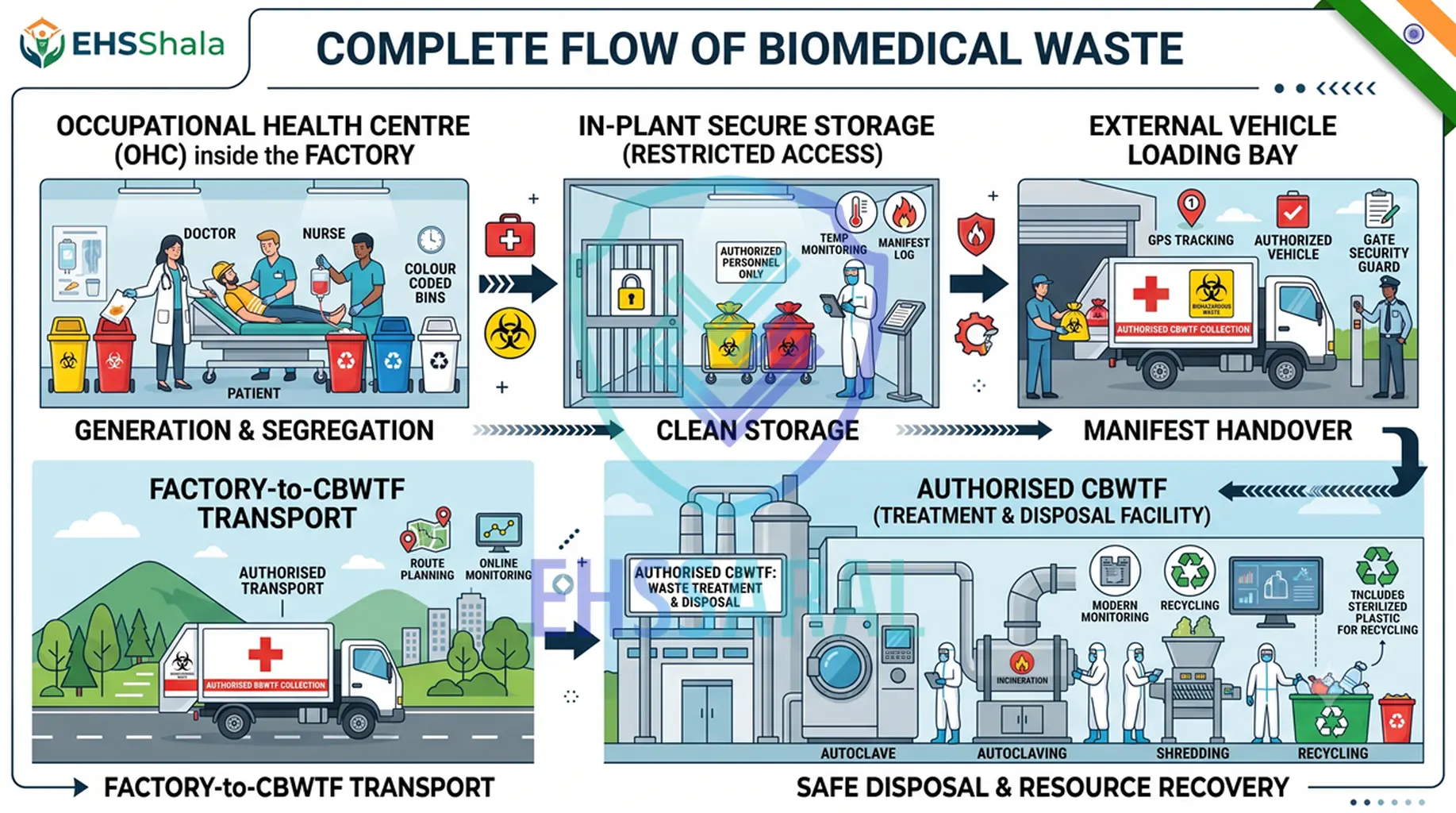
Internal Movement From OHC to Storage

Biomedical waste flow from factory OHC generation point to authorized CBWTF treatment facility EHSShala

Waste may be segregated correctly inside the OHC and still become mixed during movement.

Use:

  • Covered trolley
  • Defined collection time
  • Defined route
  • Trained handler
  • Suitable PPE
  • Trolley-cleaning procedure
  • Spill-response arrangement

Avoid:

  • Dragging bags
  • Carrying bags against the body
  • Compressing bags manually
  • Moving waste through the canteen
  • Keeping bags in common corridors
  • Transferring sharps between containers
  • Leaving bags unattended at the security gate

Barcoding, Weighing and Traceability

A good traceability chain should look like this:

Waste generated

Placed immediately in the correct container

Bag or container closed at the generation point

Moved through the defined internal route

Stored in the designated area

Weighed and barcoded

Handed over to the authorized CBWTF vehicle

Pickup receipt matched with the daily register

Records retained for reporting and inspection

“The chain should not break between the bin and the final record.”

Compare:

  • Bag count
  • Waste category
  • Weight
  • Barcode
  • Daily register
  • Pickup receipt
  • CBWTF statement
  • Invoice
  • Annual return

A barcode added after several days of estimated entries does not create proper traceability.

Daily Bio-Medical Waste Register

The bio-medical waste register should be updated on a day-to-day basis.

A practical factory register may include:

FieldWhat to record
DateDate of generation or handover
Generation pointOHC, ambulance, laboratory, camp or first-aid point
Yellow wasteQuantity or weight
Red wasteQuantity or weight
White wasteQuantity or weight
Blue wasteQuantity or weight
BarcodeBag or container identification
Pickup detailsDate, time and vehicle
ReceiptCBWTF acknowledgement
RemarksDelay, rejection, spill or correction

The Rules require daily updating of the bio-medical waste register. The 2019 amendment strengthened the day-to-day register and disclosure framework.

A separate general monthly register is not the main requirement.

However, a monthly category-wise summary is useful for:

  • Trend review
  • Invoice checking
  • Annual-return preparation
  • Management review
  • Inspection readiness
  • Applicable portal or disclosure requirements

Do not wait for the monthly invoice to reconstruct daily waste generation.

Annual Return

Every occupier should submit the prescribed annual report in Form IV on or before 30 June each year for the previous calendar year.

For example, the annual report for calendar year 2026 would ordinarily be due by 30 June 2027.

Prepare the annual return from daily records.

Do not rely only on:

  • Vendor invoices
  • Last year’s return
  • Estimated averages
  • Number of workers
  • Number of OHC beds
  • Purchase records

Before filing, reconcile:

  • Daily register
  • Monthly summaries
  • CBWTF receipts
  • Barcode data
  • Category-wise weights
  • Authorization details
  • Accident records
  • Health-camp waste
  • Laboratory waste
  • Expired-medicine disposal

Retain:

  • Submitted return
  • Acknowledgement
  • Supporting calculations
  • Source records
  • Correction explanation, where needed

Expired Medicines in the OHC

Expired medicines are often found during audits because nobody owns the disposal process.

The OHC may remove the stock from the active shelf but keep it in a carton for several years.

A practical system should include:

  • Monthly or quarterly expiry review
  • Separate expired-medicine area
  • “Not for use” marking
  • Stock record
  • Identification of cytotoxic medicines
  • Approved disposal route
  • Handover evidence
  • Reconciliation with the medical stock register

Do not place expired medicines in:

  • General waste
  • Drains
  • Normal scrap
  • Red bags without checking the category
  • Industrial hazardous-waste drums without verifying the route

The correct route depends on the medicine type.

Factory OHC Liquid Waste and the ETP or STP

Bio-medical waste is not limited to coloured bags.

Liquid waste may arise from:

  • Wound cleaning
  • Blood spills
  • Sample collection
  • Laboratory washing
  • Cleaning of contaminated surfaces
  • Chemical disinfection
  • Dental procedures
  • Medical camps

Factories commonly connect the OHC drain to the main STP or ETP.

This arrangement should be reviewed.

Disinfectants, residual chlorine, medicines and laboratory chemicals may affect biological treatment.

The OHC should not pour every liquid into the drain only because the quantity is small.

The EHS, medical, laboratory and wastewater teams should jointly confirm:

  • What liquid waste is generated?
  • Does it require separate collection?
  • Is pre-treatment required?
  • Which disinfectant is used?
  • What concentration is used?
  • What contact time is required?
  • Is neutralisation needed?
  • Where does the drain lead?
  • Can the ETP or STP accept the stream?
  • Is the route covered by the approved wastewater arrangement?
  • What liquids must never enter the drain?

Chemical treatment should not be done by guesswork.

Too little treatment may not provide proper disinfection.

Too much chemical may disturb the ETP or STP.

“A small OHC drain can still create a large treatment problem when nobody knows what enters it.”

Read more about Groundwater NOC for Factories in India: CGWA Guidelines, State Rules and Borewell Compliance

What Should Be Checked During a CBWTF Vendor Audit?

Do not check only the invoice and membership certificate.

Verify:

  • Valid authorization
  • Waste categories permitted
  • Treatment capacity
  • Service area
  • Collection schedule
  • Barcode arrangement
  • Weighing arrangement
  • Vehicle condition
  • GPS tracking
  • Holiday collection
  • Missed-pickup response
  • Rejected-bag process
  • Emergency contact
  • Breakdown plan
  • Alternate treatment arrangement
  • Pickup acknowledgements
  • Complaint-handling process

CPCB continues to issue operational guidance for CBWTFs in addition to the formal Rules and amendments. The Ministry’s recent reporting continues to identify the 2016 Rules as the main national framework.

The EHS officer should ask:

“If your treatment equipment stops tomorrow, where will our waste go?”

The factory does not operate the CBWTF.

But it should understand whether the disposal route will continue during a breakdown.
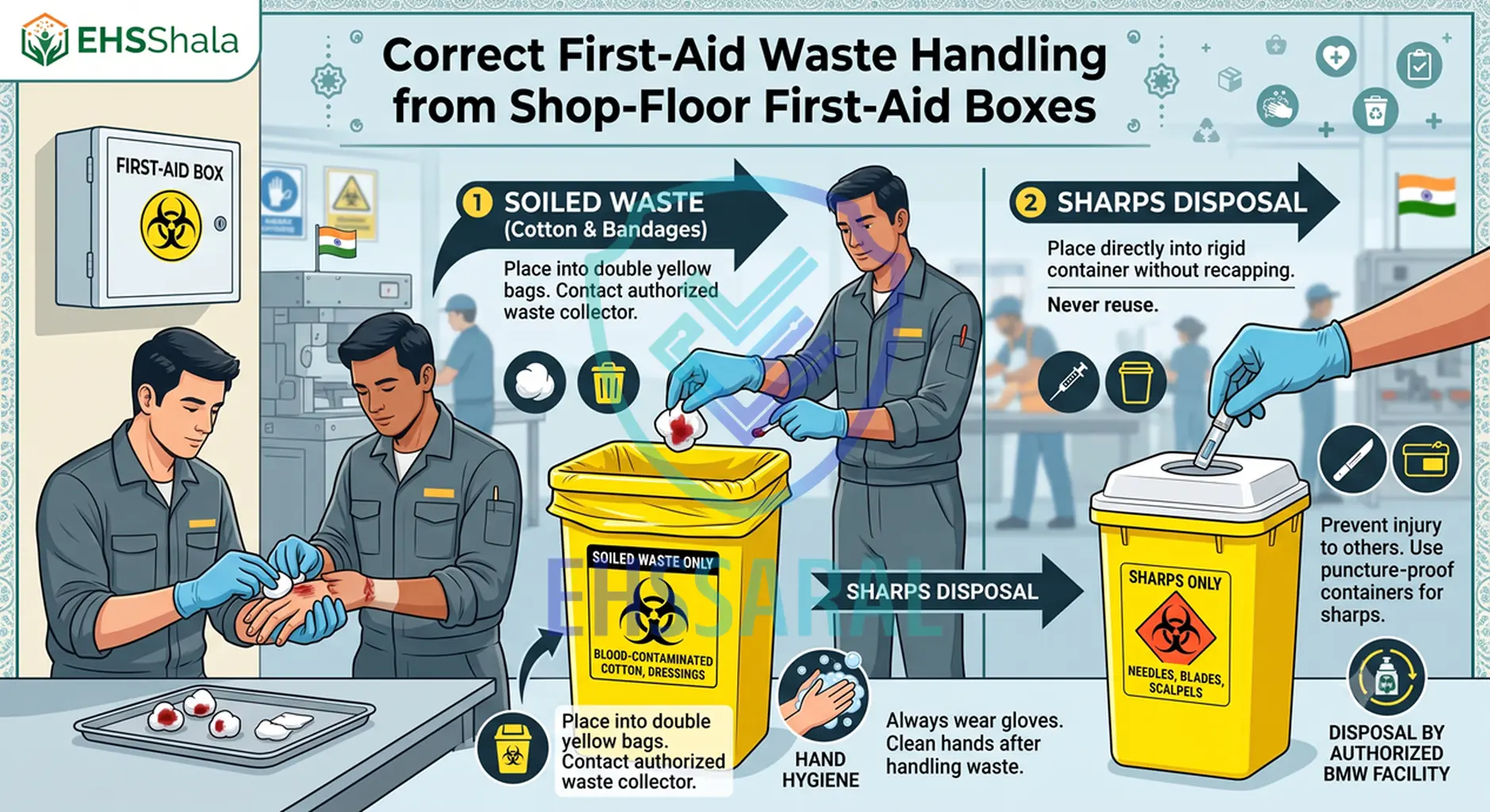
Training and Competency

Correct handling of blood-contaminated cotton and sharps from shop-floor first-aid boxes EHSShala EHSSaral

Do not limit training to housekeeping workers.

Include:

  • Doctor
  • Nurse
  • OHC assistant
  • Laboratory staff
  • Ambulance staff
  • Housekeeping
  • First-aiders
  • Security
  • EHS team
  • HR and administration
  • Contract workers handling waste

Training should cover:

  • Waste identification
  • Colour coding
  • Sharps handling
  • Closing bags
  • Labelling and barcoding
  • Internal movement
  • Spill response
  • Needle-stick response
  • Missed pickup
  • Shop-floor first-aid waste
  • Laboratory pre-treatment
  • Reporting incorrect segregation

The best test of training is not the attendance sheet. Observe how staff discard an item during normal work.

Maintain applicable records relating to:

  • Initial training
  • Refresher training
  • Immunisation
  • Health checks
  • Needle-stick injuries
  • Exposure incidents

What Should Be Checked During an Internal EHS Inspection?

OHC

  • Are the correct containers available?
  • Are they near the treatment activity?
  • Do the contents match the labels?
  • Is the sharps container below the safe fill level?
  • Are expired medicines controlled?
  • Are compliant bags available?
  • Is the daily register current?

Shop-Floor First-Aid Points

  • Do first-aiders know where contaminated cotton goes?
  • Is there a safe route back to the OHC?
  • Can sharps be handled safely?
  • Is first-aid waste mixed with general waste?

Laboratory

  • Is microbiological waste identified?
  • Are blood samples and blood bags controlled?
  • Is required pre-treatment carried out?
  • Is the equipment validated?
  • Are cycle and treatment records maintained?

Storage Area

  • Is access controlled?
  • Is waste protected from rain and animals?
  • Is there any leakage?
  • Is general waste stored separately?
  • Is hazardous waste stored separately?
  • Are spill materials available?
  • Is waste pending beyond the collection period?

Records

  • Is the authorization current?
  • Is the CBWTF agreement current?
  • Do receipts match the register?
  • Are barcode records available?
  • Are camp records included?
  • Are accident records maintained?
  • Is the annual-return acknowledgement available?

What Inspecting Officers May Commonly Verify

Inspection practices can vary.

However, officers commonly compare records with actual conditions.

They may check:

  • Bio-medical waste authorization
  • CBWTF agreement
  • Waste categories
  • Actual bin contents
  • Compliant bags and containers
  • Sharps management
  • Laboratory pre-treatment
  • Temporary storage
  • Barcoding
  • Daily register
  • Pickup records
  • Annual return
  • Training
  • Immunisation and health records
  • Accident records
  • Liquid-waste arrangement
  • Expired medicines
  • Shop-floor first-aid waste
  • Authorization conditions

“An inspection rarely becomes difficult because one poster is missing. It becomes difficult when the register, bins, authorization and actual waste do not match.”

If a gap is found, explain it clearly.

Do not provide unsupported figures.

Show:

  • What was found
  • Why it happened
  • What immediate action was taken
  • Who is responsible
  • When it will be corrected
  • How recurrence will be prevented

Most officers respond better to clarity than avoidance.

Roles Inside the Factory

FunctionPractical responsibility
Doctor or nurseCorrect segregation immediately after treatment
OHC assistantDaily records, bin checks and handover coordination
Laboratory teamIdentification and pre-treatment of applicable laboratory waste
First-aidersSafe handling of waste from shop-floor treatment
HousekeepingInternal movement without opening or mixing bags
EHS teamAuthorization, vendor audit, reconciliation and inspection readiness
HR or administrationOHC support, training and medical-camp coordination
MaintenanceStorage area, drainage and trolley condition
PurchaseCompliant bags, containers and sharps boxes
SecurityControlled entry and CBWTF vehicle coordination
ManagementResources and review of repeated gaps

One person should coordinate the complete system.

This does not mean one person should perform every activity.

It means one person should be able to explain the full route.

Monthly Factory Compliance Routine

Once every month:

  1. Check the authorization status.
  2. Check the CBWTF agreement.
  3. Compare daily records with pickup receipts.
  4. Review category-wise generation.
  5. Inspect actual bin contents.
  6. Check sharps-container levels.
  7. Inspect the storage area.
  8. Review barcode records.
  9. Verify bag and container stock.
  10. Review expired medicines.
  11. Inspect shop-floor first-aid points.
  12. Check missed pickups and rejected bags.
  13. Review spills and needle-stick incidents.
  14. Confirm training of new staff.
  15. Include health-camp and vaccination waste.
  16. Verify laboratory pre-treatment, where applicable.
  17. Check the OHC drain and wastewater route.
  18. Close repeated gaps.
  19. Keep records ready for annual reporting.

Good compliance does not require daily panic.

It requires a small routine followed consistently.

Latest Amendment Position

The principal framework remains the Bio-Medical Waste Management Rules, 2016.

Formal amendments were issued in:

  • March 2018
  • February 2019
  • May 2019
  • April 2026

India Code lists the 2016 Rules and the 2018 and 2019 amendment notifications under the Environment (Protection) Act.

The Bio-Medical Waste Management (Amendment) Rules, 2026, notified through G.S.R. 293(E), added AYUSH representation to the State or Union Territory advisory committee under Rule 11 and the district-level monitoring arrangement under Rule 12. It did not change the day-to-day factory requirements on segregation, authorization, storage, CBWTF handover, pre-treatment or records.

Factories should therefore continue to focus on:

  • The 2016 Rules
  • Formal amendments
  • SPCB or PCC directions
  • Authorization conditions
  • Applicable CPCB guidelines
  • State portal requirements

A guideline should not automatically be described as an amendment to the Rules.

What Can Happen When Gaps Are Not Corrected?

The Bio-Medical Waste Management Rules are issued under the Environment (Protection) Act, 1986.

Bio-medical waste is therefore not only a medical-housekeeping issue.

It is also an environmental compliance responsibility.

Depending on the facts, regulatory action may include:

  • Inspection observations
  • Corrective directions
  • Monetary penalties
  • Action relating to authorization
  • Further proceedings in continued cases

Regulatory action depends on the facts of the case, the applicable directions and the response of the factory.

The purpose of mentioning this is not to create fear.

It is to help management understand why even a small OHC needs a working system.

Frequently Asked Questions

Do the Bio-Medical Waste Management Rules apply to a factory OHC?

They may apply where the OHC generates waste during diagnosis, treatment, first aid, immunisation, medical examination or a related healthcare activity.

Is there a minimum quantity below which authorization is not required?

The Rules require occupiers handling bio-medical waste to apply for the applicable authorization irrespective of quantity.

Is a CBWTF agreement enough?

No.

The factory should separately verify:

  • Consent conditions
  • Bio-medical waste authorization
  • CBWTF service agreement

Does every factory OHC need an autoclave?

No.

The need depends on the waste generated.

Specific laboratory, microbiological, blood-sample and highly infectious waste may require on-site pre-treatment.

Where should blood-contaminated cotton from the shop floor go?

It should enter the factory’s bio-medical waste route, normally through the yellow-category arrangement for soiled waste.

Where should a needle be placed?

In a puncture-proof white translucent sharps container.

Where should a syringe without a needle be placed?

A contaminated plastic syringe without a needle generally follows the red-category route.

Where should a fixed-needle syringe be placed?

It should be treated as sharps waste and placed in the white translucent container.

Where should a used urine bag be placed?

A contaminated urine bag generally follows the red-category route as contaminated recyclable plastic.

The chlorinated-plastic clarification does not mean it can be placed in general waste.

Can contaminated medical plastic be sold directly to a scrap dealer?

No.

It should first undergo the prescribed treatment and shredding or mutilation before authorized recycling.

Can bio-medical waste be stored beyond 48 hours?

Untreated anatomical, soiled and biotechnology waste should not be stored beyond 48 hours.

Exceptional delays require protective measures and applicable intimation with reasons.

Is a separate monthly register required?

The Rules require a day-to-day bio-medical waste register.

A monthly summary is useful for reconciliation, reporting and inspection readiness.

When is the annual return due?

The annual report in Form IV should be submitted on or before 30 June each year for the previous calendar year.

Should bio-medical waste be entered in the hazardous-waste register?

Not automatically.

Bio-medical waste and industrial hazardous waste have separate regulatory systems.

Who should manage waste from a factory health camp?

The factory and the visiting medical agency should decide responsibility before the camp.

Can OHC wastewater go directly to the factory STP?

Not without assessment.

Disinfectants, medicines, blood residues and laboratory chemicals may affect biological treatment.

Final Self-Audit Checklist

Authorization and Vendor

  • Is the authorization position clear?
  • Has the factory applied irrespective of quantity?
  • Does the authorization show the correct address?
  • Are the correct activities and categories covered?
  • Is the CBWTF agreement current?
  • Is the vendor authorized?
  • Is the breakdown arrangement understood?

Segregation

  • Are yellow, red, white and blue arrangements available?
  • Are compliant bags and containers used?
  • Are they placed near generation points?
  • Do the contents match the labels?
  • Are sharps controlled?
  • Is shop-floor first-aid waste included?

Pre-Treatment

  • Is laboratory or microbiological waste generated?
  • Are blood samples or blood bags handled?
  • Is pre-treatment required?
  • Is the method defined?
  • Are equipment and treatment records available?

Storage and Movement

  • Are bags closed properly?
  • Is a covered trolley used?
  • Is the storage area restricted?
  • Is waste protected from rain and animals?
  • Is it separated from general and hazardous waste?
  • Is the 48-hour control working?

Records

  • Is the daily register current?
  • Do records match pickup receipts?
  • Are barcode records available?
  • Are health-camp quantities included?
  • Is the Form IV annual return filed by 30 June?
  • Is the acknowledgement retained?
  • Are accident records maintained?

People

  • Are doctors and nurses trained?
  • Are laboratory staff trained?
  • Are first-aiders trained?
  • Is housekeeping trained?
  • Does security understand the vehicle process?
  • Are new staff covered?
  • Is one person coordinating the full system?

Liquid Waste

  • Are OHC and laboratory liquid streams identified?
  • Is the drain route known?
  • Is pre-treatment defined?
  • Has the ETP or STP impact been assessed?
  • Are disinfectants used through a defined procedure?

Final Practical View

Bio-medical waste may be a small waste stream inside a factory.

But it crosses many departments:

  • Medical
  • Laboratory
  • EHS
  • Housekeeping
  • HR
  • Security
  • Maintenance
  • Purchase
  • Waste vendor

That is why small gaps can continue for years.

A good system makes the route clear:

  • The doctor knows the category.
  • The laboratory knows what requires pre-treatment.
  • The first-aider knows where contaminated cotton goes.
  • Housekeeping does not open the bag.
  • Security knows which vehicle may collect it.
  • The EHS officer can match the register with the receipt.
  • Management knows that the OHC is under control.

“The colour of the bin matters. But the discipline around the bin matters more.”

Good bio-medical waste compliance does not need brilliance.

It needs ownership, traceability and consistent daily practice.

Harshal T Gajare

Harshal T Gajare

Founder, EHSSaral

Founder - EHSSaral| Partner - Perfect Pollucon | ISO 14001 Lead Auditor | Second-generation environmental professional simplifying EHS compliance for Indian manufacturers through practical, tech-enabled guidance.

Related Blogs

CTO Auto-Renewal: Capital Investment Rules 10% & 30% | EHSSaral

CTO Auto-Renewal: Capital Investment Rules 10% & 30% | EHSSaral

Is There Truly Free Environmental Compliance Software in India? (An Honest Answer) | EHSSaral

Is There Truly Free Environmental Compliance Software in India? (An Honest Answer) | EHSSaral

Why Form 4 & Form 5 Numbers Don’t Match - Real Industry Reasons

Why Form 4 & Form 5 Numbers Don’t Match - Real Industry Reasons

How to Read Your Consent Copy (CTE & CTO Explained Simply) | EHSShala

How to Read Your Consent Copy (CTE & CTO Explained Simply) | EHSShala

OCEMS Data Gaps Explained: Why CPCB Rejects Data & How to Fix | EHSSaral

OCEMS Data Gaps Explained: Why CPCB Rejects Data & How to Fix | EHSSaral

The Groundwater NOC Trap: Why Industrial Renewal Applications Are Rejected (2023–2025)

The Groundwater NOC Trap: Why Industrial Renewal Applications Are Rejected (2023–2025)

TSDF Process for Hazardous Waste: What Happens After Dispatch | EHSShala

TSDF Process for Hazardous Waste: What Happens After Dispatch | EHSShala

Environmental Compliance Management in India: Systems vs Consultants Explained

Environmental Compliance Management in India: Systems vs Consultants Explained

Beyond the Helmet: Why Safety Compliance Alone Fails in Indian Factories | EHSSaral Research

Beyond the Helmet: Why Safety Compliance Alone Fails in Indian Factories | EHSSaral Research

CPCB OCEMS Flatline Notice: How Industries Should Respond (Safely) | EHSSaral

CPCB OCEMS Flatline Notice: How Industries Should Respond (Safely) | EHSSaral