

EHSShala
EHS Officer Career Path in India (2025–2050 Guide) | EHSShala
EHSSaral is an Environmental Compliance Intelligence Platform for Industries. Consent Intelligence • Alerts & Tasks • Incident Reporting • Form IV & V • Audit-Ready Records
See how EHSSaral works
27 Apr 2026
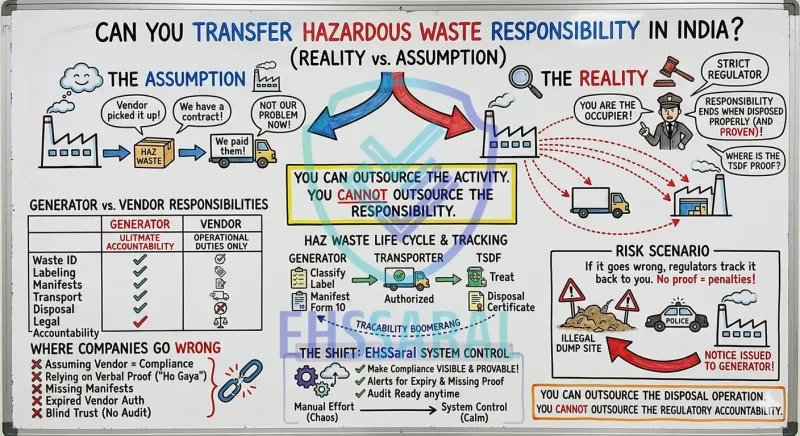
Yesterday, I got a call from a company.
They were looking for a vendor to handle hazardous waste disposal. That part was normal.
What wasn’t normal was this line:
“We want a vendor who takes full responsibility after pickup.”
On the surface, it sounds reasonable.
You generate waste → you hire a vendor → they take it away → problem solved.
But the real question is:
Once hazardous waste leaves your factory gate, are you still responsible for it?
Most people answer this incorrectly.
And this one misunderstanding has led to notices, penalties, and serious compliance issues for many factories across India.
If you talk to plant teams or even some consultants, you’ll hear variations of the same thinking:
“Sir, vendor ne le liya hai… ab unki responsibility hai.”
“We have an agreement. It clearly says vendor is responsible.”
“We are paying for disposal. Why should liability stay with us?”
From an operational perspective, this logic feels correct.
After all:
So naturally, the assumption becomes:
“Responsibility is transferred.”
But this is where compliance reality and operational thinking diverge.
If you are trying to understand how compliance actually works in Indian factories, this guide on Environmental Compliance Management in India: Systems vs Consultants Explained will give you the bigger picture.
In India, hazardous waste management is governed by the
Hazardous and Other Wastes (Management and Transboundary Movement) Rules, 2016 (and subsequent amendments).
Under these rules, one concept is very clear:
The responsibility of hazardous waste lies with the “Occupier” - the one who generates it.
In simple terms:
The term “occupier” is used because responsibility does not depend only on who owns the land or building. It applies to the person or organization that is actually operating and controlling the premises where the hazardous waste is generated.
So if your plant is generating hazardous waste, you are the occupier.
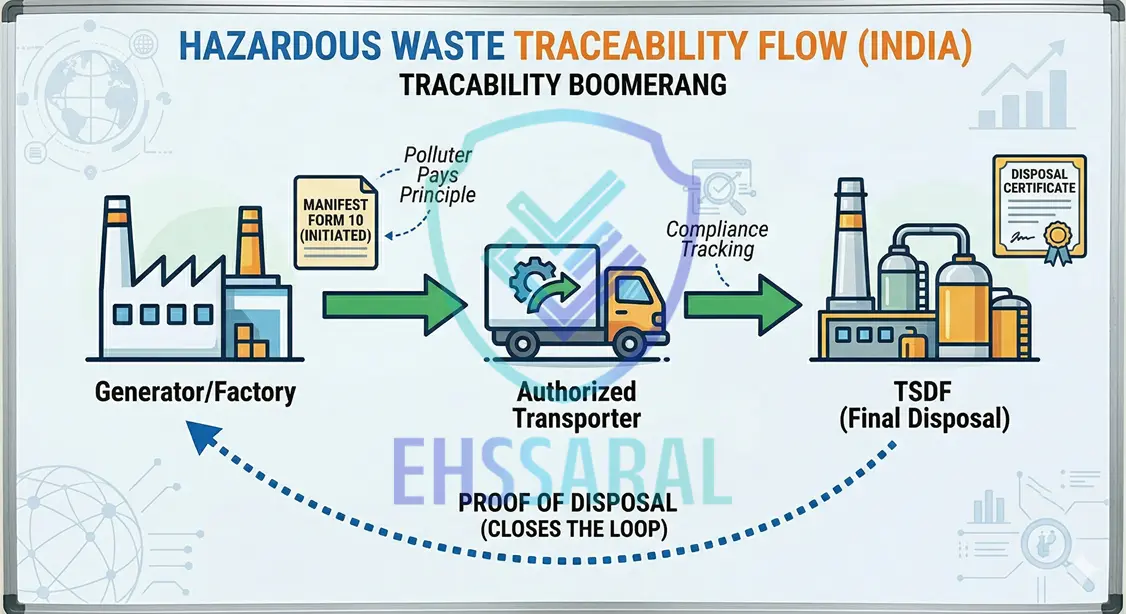
Before we go further, let’s simplify some commonly used terms:
To understand the full legal framework behind this, refer to Hazardous Waste Management Rules (2016) – Practical Guide for Indian Factories.
You can outsource the activity. You cannot outsource the responsibility.
Even if:
The regulatory system still traces the waste back to the generator.
Because from the regulator’s perspective:
“You generated it. You must ensure it is safely disposed of.”
At first glance, this may feel unfair to factories.
But there is a very practical reason behind it.
Imagine a system where:
What happens next?
And no one would be accountable.
There would be no traceability.
That’s exactly what environmental laws are designed to prevent.
The system ensures:
That’s why the responsibility doesn’t “end at the gate.”
It continues until:
Final disposal is completed at an authorized facility - and documented properly.
The confusion doesn’t come from the law.
It comes from how things are handled on the ground.
Factories often:
And slowly, the mindset shifts to:
“Once it leaves our premises, it’s no longer our problem.”
This is where the gap begins.
Not in regulation - but in interpretation.
MOEF Hazardous Waste Management Rules
Let’s break this down clearly.
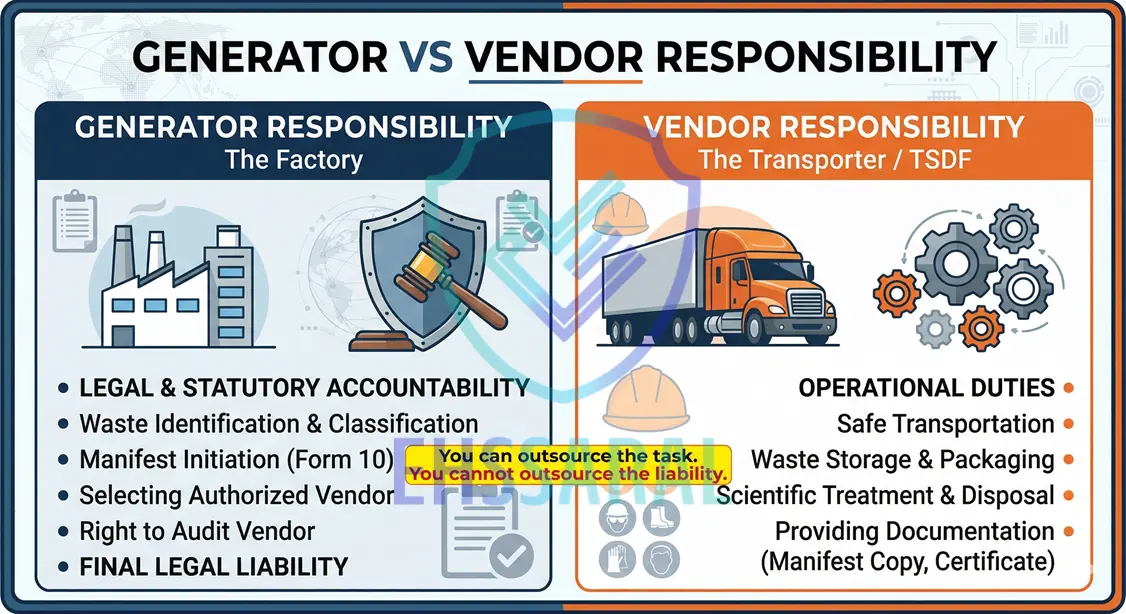
If something goes wrong, the notice usually comes to the generator first.
Not because the vendor is irrelevant.
But because the law sees the generator as the starting point of responsibility.
Most factories don’t fail because they ignore compliance.
They fail because they assume:
“Handled = compliant”
But in hazardous waste:
Only one thing matters:
Can you prove where your waste went - and how it was disposed of?
An inspector will not accept:
“Vendor confirmed disposal.”
They are more likely to ask:
“Show me the TSDF certificate with the waste category, quantity, and disposal date.”
On paper, most factories follow the process:
But in reality, the breakdown happens in the invisible layer - verification and documentation.
Here are the most common mistakes seen across industries:
Many teams think:
“Vendor is authorized, so we are safe.”
But they don’t verify:
Authorization is not binary. It’s specific and conditional.
Once waste is handed over:
The assumption becomes:
“Vendor will take care of it.”
But from a compliance perspective:
If you cannot track it, you cannot defend it.
The manifest system is designed to ensure:
But in practice:
During inspection, this becomes the first red flag.
This is extremely common.
“Sir, ho gaya disposal.”
And teams accept it.
No:
In compliance, verbal confirmation = zero value
This is the biggest gap.
Factories often:
But not:
And that’s exactly what regulators care about.
You should also understand what actually happens after dispatch. This guide on TSDF Process for Hazardous Waste: What Happens After Dispatch explains it clearly.
Another silent risk:
And no one noticed.
From regulator’s view:
Waste given to unauthorized party = violation
Very few factories:
Most rely purely on:
Look closely.
These are not technical failures.
They are system failures.
No tracking
No alerts
No verification loop
And that leads to one dangerous belief:
“Everything is fine… until inspection happens.”
This is where theory ends and reality begins.
Inspectors don’t come to confirm what you did right.
They come to find:
Where your system breaks
Here’s what they typically look for:
They will check:
Any gap = immediate question
If you are not fully clear on how tracking works, read Form 10 Manifest System Explained: 7 Copies, Flow & SPCB Inspectors Checklist.
This is critical.
They may ask:
If this is missing, your position becomes weak instantly.
They compare:
Mismatch raises suspicion:
“Where did the rest go?”
They verify:
Even before transport:
This reflects your compliance maturity.
This is where many teams struggle.
Inspectors do not only check documents.
They try to understand whether you actually control the hazardous waste process as a system.
In practice, this can come out through questions like:
If the answers are vague, person-dependent, or undocumented, it signals weak compliance control.
If you want to understand inspector mindset deeper, read Environmental Inspection India: What Inspectors Check.
Inspectors don’t just see numbers. They see patterns.
These indicate:
System weakness, not isolated issues
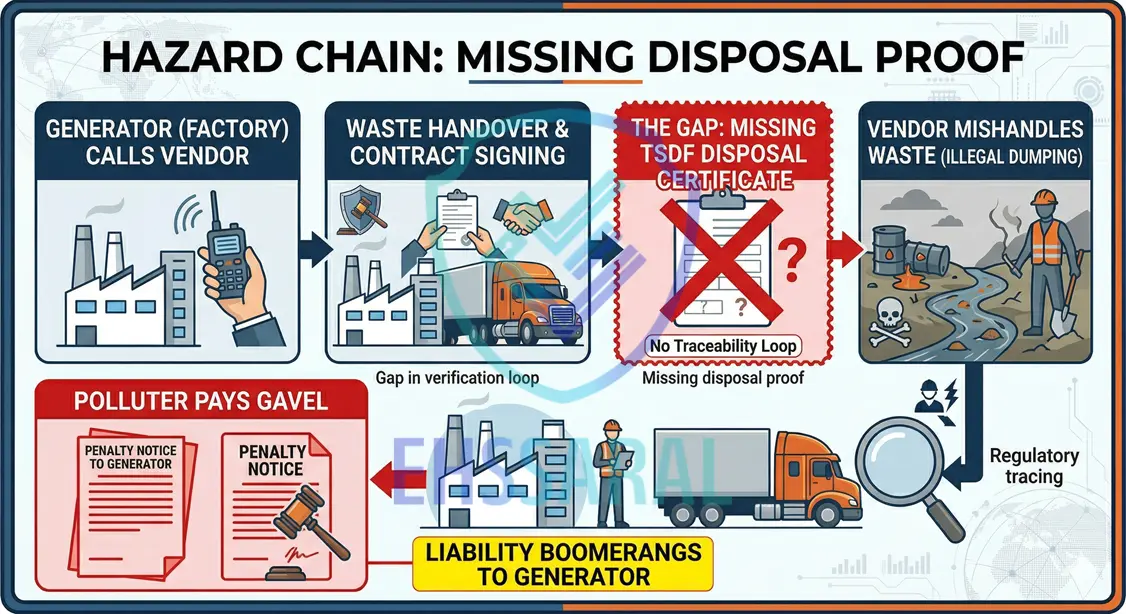
Let’s walk through a situation.
A mid-sized manufacturing unit generates hazardous sludge.
They:
From their perspective:
“Work done.”
Six months later:
Waste is found dumped near a local area.
Authorities investigate.
They trace the source using:
It leads back to the factory.
The factory says:
“We gave it to an authorized vendor.”
Inspector asks:
“Show disposal proof from TSDF.”
Factory response:
“Vendor handled it.”
No certificate.
No final documentation.
No trace of actual disposal.
This assumption is one of the most common mistakes. You can explore more such issues in Common Hazardous Waste Mistakes in Indian Factories.
Notice is issued.
To the vendor?
No.
To the factory.
Because from regulatory perspective:
That is enough to trigger action
This is the gap most teams don’t prepare for:
Pickup is visible. Disposal is invisible.
And compliance depends on what happens in that invisible part.
Let’s address the core question directly.
No. Not completely.
You can:
But you cannot:
Contracts protect you commercially.
Regulations hold you accountable legally.
Even if your agreement says:
“Vendor is fully responsible”
If something goes wrong:
They can:
They cannot:
Instead of trying to “transfer responsibility,” a strong agreement should focus on control and verification.
Define:
Ensure:
Define:
Protect against:
This is powerful.
Include:
Right to audit the vendor / TSDF facility, especially if documentation is delayed, quantities do not reconcile, or disposal timelines are missed.
This allows you to:
Define:
At this point, most EHS professionals understand the problem.
But they struggle with execution.
Because reality looks like this:
All tracked across:
And the complexity adds up fast.
If you are managing 3 hazardous waste streams across 5 vendors with regular pickups, you may end up handling well over 150 documents in a year - before you even count authorization renewals, consent updates, exception cases, or delayed disposal certificates.
An inspector walks in and asks:
“Show me disposal proof for last 6 months.”
That’s when panic starts.
Not because work wasn’t done.
But because:
System wasn’t strong enough to prove it.
Before we go into systems and solutions, let’s simplify this.
If you strip everything down, hazardous waste compliance comes down to one question:
Can you prove - at any point in time - that your waste was handled and disposed of correctly?
Use this as a quick self-check.
This is a basic version.
In reality, compliance requires:
This is exactly why most teams struggle over time.
If you want a broader compliance view, you can also refer to this Environmental Monitoring Checklist for Factories (India Guide).
If you want a complete, practical checklist used by EHS professionals (with detailed points, verification steps, and audit-ready structure):
Download Hazardous Waste Compliance Checklist:
Let’s be honest.
The challenge is not understanding the rules.
The challenge is managing:
All while handling:
It’s not daily work.
It’s unexpected inspection.
“Show records.”
“Show disposal proof.”
“Show last 6 months data.”
That’s when everything is tested.
Compliance doesn’t fail in execution.
It fails in retrieval.
You may have:
But if you cannot:
It still becomes a problem.
Most teams try to solve this with effort:
It works - for some time.
But as complexity increases:
From “managing compliance”
to
“controlling compliance”
That shift changes everything.
EHSSaral is built around one simple idea:
Make compliance visible, trackable, and provable - without dependency on memory or manual follow-up
EHSSaral helps teams move from manual follow-up to system-driven control by making it easier to:
Instead of:
You move to:
Because in environmental compliance:
What you can prove matters more than what you have done.
In hazardous waste compliance, the real risk is not always illegal intent.
Very often, it is weak traceability, delayed proof, and overdependence on vendors.
Let’s come back to the original question:
“Can you transfer hazardous waste responsibility to a vendor?”
You can outsource the disposal operation.
You cannot outsource the regulatory accountability.
The generator (occupier) of the hazardous waste is primarily responsible under Indian regulations, even if disposal is outsourced.
No. Operational tasks can be outsourced, but legal responsibility remains with the generator.
It is a tracking mechanism (Form 10) that follows hazardous waste from generation to final disposal, ensuring traceability.
Regulators typically trace the waste back to the generator.
If disposal proof is missing, the factory may face notices or penalties.
By:
In practice, yes - the generator can still face regulatory questions if the waste is not properly tracked, documented, or disposed of through authorized channels. This is why vendor verification, TSDF validation, and periodic audits matter. The fact that a third party mishandled the waste does not automatically remove scrutiny from the generator.
If you’ve ever felt unsure about whether your hazardous waste process is truly compliant, you’re not alone.
The difference is simple:
Some teams assume compliance.
Others build systems to prove it.

Founder, EHSSaral
Founder - EHSSaral | Partner - Perfect Pollucon | ISO 14001 Lead Auditor | GHG Protocol Scope 2 | Chemist | Data Scientist | Second-generation environmental professional simplifying EHS compliance for Indian industries through practical, automated, tech-enabled, data driven compliance workflows.
EHS Officer Career Path in India (2025–2050 Guide) | EHSShala
Beyond the Helmet: Why Safety Compliance Alone Fails in Indian Factories | EHSSaral Research
Plastic Waste Management Rules in India: A Practical Guide for Factories, Warehouses and Offices
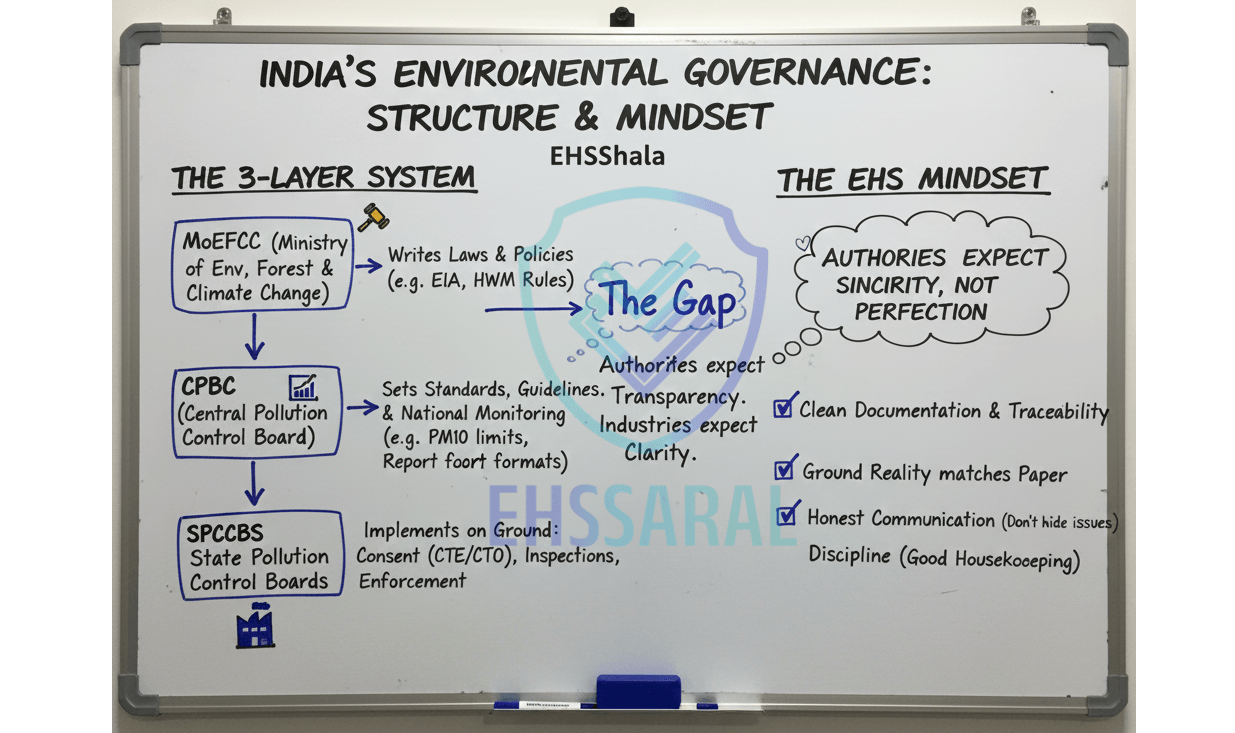
How MoEFCC, CPCB & SPCB Work in India: Expert Guide | EHSShala
Hazardous Waste Compatibility & Segregation Guide India
Hazardous Waste Management Software India | EHSSaral

Bio-Medical Waste Management for Non-Hospitals (India) | EHSShala
Maharashtra SME Plastic Waste EPR Guide: Are You a Brand Owner | EHSSaral
The Paper Shield: PF & ESIC Challans vs Real Compliance Risk | EHSSaral
OCEMS Data Gaps Explained: Why CPCB Rejects Data & How to Fix | EHSSaral