
EHSShala
Environmental Calendar from Consent Conditions (Practical Guide) | EHSShala
EHSSaral is an Environmental Compliance Intelligence Platform for Industries. Consent Intelligence • Alerts & Tasks • Incident Reporting • Form IV & V • Audit-Ready Records
See how EHSSaral works
15 Jul 2026
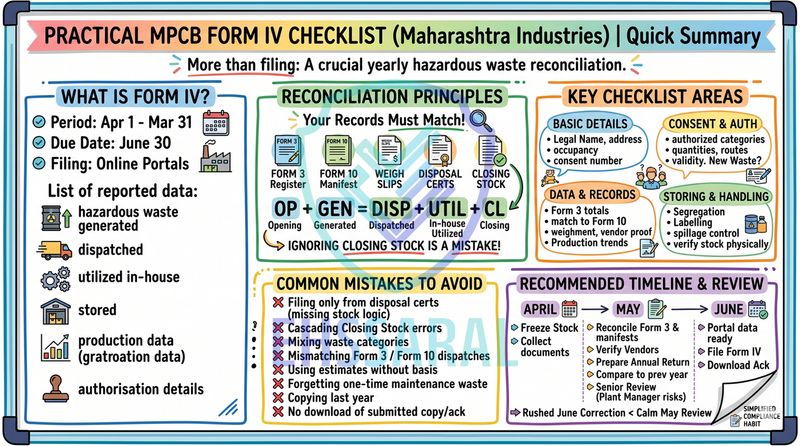
MPCB Form IV is not just an annual online filing task.
For Maharashtra industries, it is a yearly reconciliation of hazardous waste generation, storage, dispatch, utilisation and disposal.
A good Form IV filing depends on one simple discipline:
Your Form 3 register, Form 10 manifest, weighment records, disposal certificates and closing stock should speak the same language.
This checklist helps plant teams prepare Form IV with fewer errors, fewer last-minute corrections and better confidence during MPCB review or inspection.
Before filing MPCB Form IV, Maharashtra industries should verify consent and hazardous waste authorisation, Form 3 register, Form 10 manifests, TSDF or recycler certificates, weighbridge slips, production data, opening stock, waste generation, waste dispatch and closing stock. The return should be submitted by 30 June for the previous financial year.
Read more about Why Form IV Filing Becomes Difficult for Indian EHS Teams: A Field-Level Analysis
In many Maharashtra plants, Form IV work starts only near the June deadline.
At that stage, the EHS team starts asking production, stores, maintenance, accounts, transporters and disposal vendors for data.
This is where confusion usually starts.
The hazardous waste register may show one number. The manifest may show another. The TSDF certificate may mention a different quantity. The opening stock may not match last year’s closing stock. Some waste may be stored but not dispatched. Some categories may appear in consent but not in the annual return.
From a practical standpoint, Form IV is not difficult because the form is complex.
It becomes difficult because the data is spread across departments, vendors and months.
This article gives a practical MPCB Form IV checklist for Maharashtra industries so that EHS teams can prepare before the deadline instead of correcting errors after submission.
MPCB Form IV, commonly called Form 4 annual return, is the annual return for hazardous and other waste handled by an industry, facility, recycler, co-processor or disposal facility.
For most manufacturing industries, Form IV reports:
In Maharashtra, the filing is done through the MPCB / MAITRI-linked online system, depending on the portal flow available to the unit.
The reporting period is normally the financial year:
1 April to 31 March
The annual return is generally submitted by:
30 June every year
For example, Form IV for FY 2025–26 covers the period from 1 April 2025 to 31 March 2026 and is due by 30 June 2026.
This checklist is useful for:
It is especially useful for Maharashtra industries operating under MPCB consent and hazardous waste authorisation.
Form IV should be understood as part of the broader hazardous waste rules in India, not as a standalone portal task.
Many teams see Form IV as a portal entry requirement.
In practice, it is more than that.
Form IV becomes a yearly summary of how the plant handled hazardous waste. During review or inspection, it can be compared with:
This is why Form IV should not be treated as an isolated filing.
It should be treated as an annual reconciliation exercise.
Before entering waste data, verify basic details carefully.
Small mistakes in facility details may not look serious, but they create avoidable confusion in records.
| Item | What to Verify |
|---|---|
| Legal name of unit | Same as Consent to Operate and MPCB records |
| Factory address | Complete address with plot number, MIDC area, village, taluka and district |
| Contact details | Correct phone number and email ID |
| Authorised person | Name and designation of occupier / authorised signatory |
| Consent number | Latest valid consent reference |
| Hazardous waste authorisation number | Correct authorisation number and date |
| Validity period | Ensure authorisation was valid during the reporting year |
| Industry category | Check if it matches MPCB records |
| Portal login | Correct user ID and access credentials |
In many plants, the person filing Form IV is not the same person who applied for consent or authorisation.
So the first step should be to download and review the latest consent and hazardous waste authorisation before filling the return.
Do not rely only on old Excel sheets.
Automate hazardous waste records and Form IV preparation using EHSSaral
Form IV should be aligned with the hazardous waste categories authorised by MPCB.
This is one of the most important checks.
| Question | Why It Matters |
|---|---|
| Which hazardous waste categories are authorised? | Form IV should not randomly add categories without basis |
| What quantity is authorised? | Large variation may need explanation |
| Which disposal route is approved? | TSDF, recycler, co-processing, reuse or other route |
| Is the authorised vendor mentioned? | Some permissions mention specific route or facility |
| Was authorisation valid for the full year? | Expired authorisation can create review questions |
| Was any new waste generated during the year? | It may need authorisation amendment |
If a waste category is generated but not mentioned in authorisation, do not simply hide it from Form IV.
First understand why the category is missing.
It may be due to a process change, maintenance activity, raw material change, old authorisation, or incorrect classification.
From a compliance standpoint, clarity is better than forced matching.
The next step is to list all hazardous waste categories generated during the year.
For Maharashtra industries, this is where many errors begin.
The waste category should be checked from authorisation and actual plant operations.
| Industry Activity | Possible Waste Stream |
|---|---|
| ETP operation | ETP sludge |
| Paint booth | Paint sludge, used filters |
| DG / machinery maintenance | Used oil, waste oil |
| Solvent use | Spent solvent |
| Chemical handling | Discarded containers, liners |
| Surface treatment | Chemical sludge |
| Process filtration | Spent carbon, filter media |
| Laboratory activity | Chemical residue |
| Incinerable waste | Contaminated rags, gloves, absorbents |
Do not prepare Form IV only from the authorisation list.
Prepare it from both sides:
Authorisation list + actual plant waste walk-through
Sometimes a plant has an authorised category that was not generated during the year. Sometimes a waste is generated during maintenance but not captured in routine monthly records.
Both situations need proper treatment.
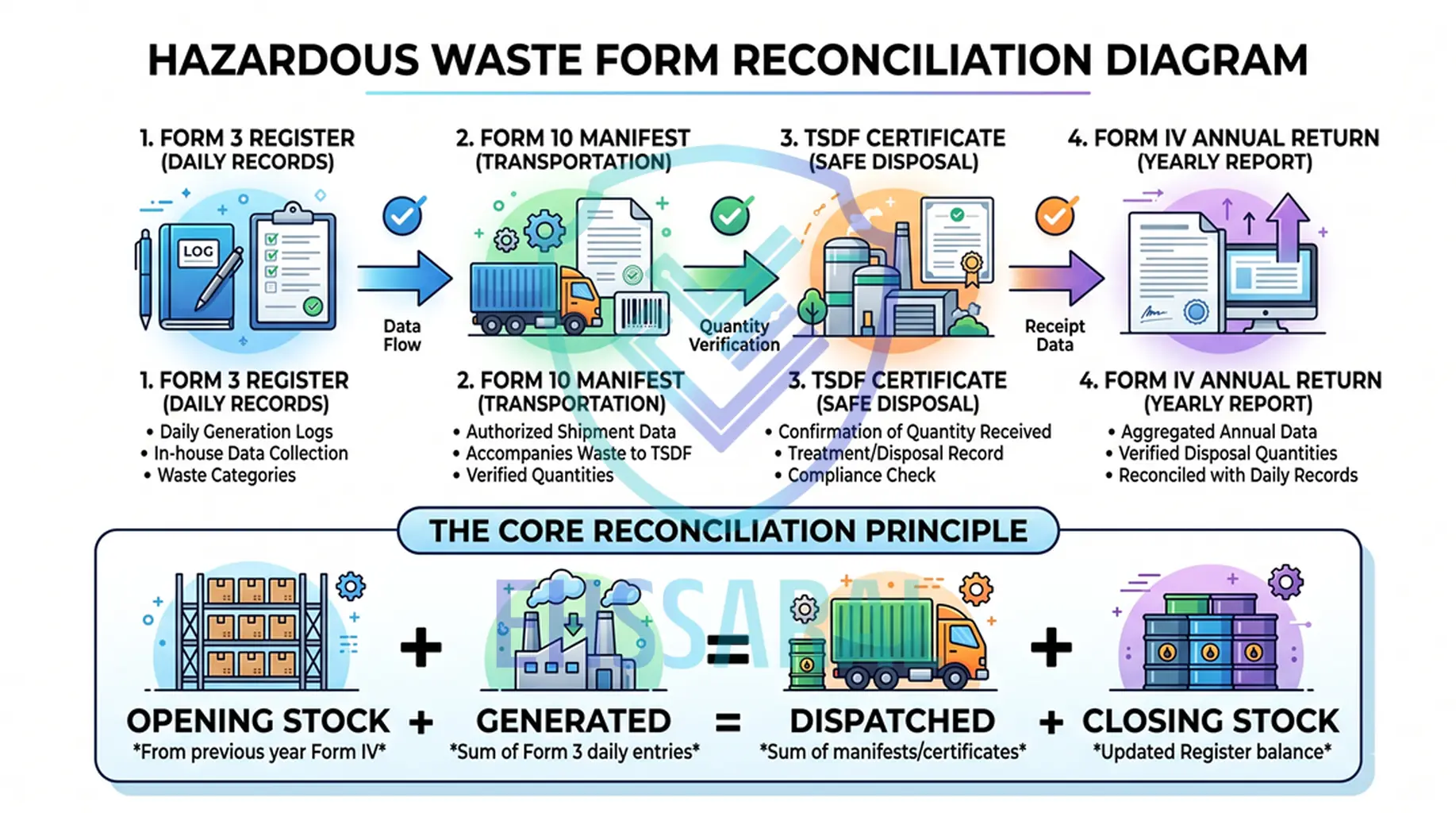
Form 3 is one of the strongest supporting records for Form IV.
In day-to-day operations, Form 3 should capture hazardous waste generation, storage and disposal details.
Before filing Form IV, reconcile the annual totals from Form 3.
| Form 3 Item | What to Review |
|---|---|
| Opening stock | Should match previous year closing stock |
| Monthly generation | Check month-wise entries |
| Waste category | Should match authorisation and Form IV |
| Quantity stored | Check physical stock and register balance |
| Quantity dispatched | Should match Form 10 and disposal proof |
| Disposal facility | Name should match authorised vendor |
| Date of dispatch | Should match manifest and gate records |
| Closing stock | Should match year-end balance |
A common mistake is preparing Form IV directly from dispatch certificates.
That is incomplete.
Form IV needs generated, dispatched and closing stock logic. If only dispatched quantity is used, closing stock may get ignored.
The basic mass balance should be checked:
Opening Stock + Waste Generated = Waste Dispatched + Waste Utilised In-House + Closing Stock
This one equation catches many Form IV errors.
Form 10 is the movement document for hazardous and other waste.
For Form IV, it helps prove dispatch quantity, date, transporter and destination.
| Manifest Detail | What to Match |
|---|---|
| Manifest number | Should be traceable |
| Date of dispatch | Should match gate pass and weighment |
| Waste category | Should match Form 3 and Form IV |
| Quantity | Should match weighbridge / vendor receipt |
| Transporter | Should be authorised, wherever applicable |
| Disposal facility | Should match TSDF / recycler certificate |
| Vehicle number | Should match logistics record |
| Acknowledgement | Confirm receipt at destination |
If the manifest quantity and actual received quantity differ slightly due to weighment difference, keep the explanation and supporting weighbridge slips.
Do not silently adjust numbers without a trail.
During review, a clear explanation is better than unexplained mismatch.
Form IV asks where the waste was sent.
So disposal or recycling proof is important.
| Disposal Route | Supporting Proof |
|---|---|
| TSDF landfill | Disposal certificate / receipt |
| Incineration | Incineration certificate / TSDF receipt |
| Recycler | Recycler receipt / recycling certificate |
| Co-processing | Co-processing acceptance certificate |
| Pre-processing | Authorised facility receipt |
| In-house utilisation | Permission and internal utilisation record |
Do not assume that vendor invoice is enough.
Invoice proves commercial transaction.
Form IV needs environmental handling evidence.
The stronger record is the acknowledged manifest, disposal certificate, recycling certificate or authorised facility receipt.
For more clarity on disposal documentation, read our guide on the TSDF process for hazardous waste.
Quantity mismatch is one of the most common Form IV problems.
This happens because different teams use different numbers.
Production may use estimated generation. Stores may use drum count. Vendor may use weighbridge quantity. Accounts may use invoice quantity.
Before filing Form IV, decide the quantity basis and document it.
| Source | Strength |
|---|---|
| Form 3 register | Primary internal record |
| Weighbridge slip | Strong dispatch evidence |
| TSDF / recycler receipt | Strong final receipt evidence |
| Vendor invoice | Useful but not sufficient alone |
| Drum count estimate | Useful only if conversion is documented |
| Physical stock check | Required for closing stock |
Use this order:
If quantity is stored in drums, bags or containers, define a reasonable conversion method.
For example:
The method should be consistent and explainable.
Opening and closing stock are often ignored until the last day.
But they are central to Form IV accuracy.
| Stock Item | What to Verify |
|---|---|
| Opening stock as on 1 April | Should match previous year Form IV closing stock |
| Waste generated during year | Should match Form 3 |
| Waste dispatched during year | Should match manifest and certificates |
| In-house utilisation | Should be supported by permission and records |
| Closing stock as on 31 March | Should match physical stock and register |
| Particular | Quantity |
|---|---|
| Opening stock | 2.000 MT |
| Generated during year | 18.500 MT |
| Dispatched to TSDF | 16.000 MT |
| Closing stock | 4.500 MT |
Check:
2.000 + 18.500 = 16.000 + 4.500
20.500 = 20.500
This is a clean reconciliation.
Closing stock should not be entered casually.
If closing stock is shown as zero every year but the plant has visible hazardous waste storage, that creates a practical contradiction.
Similarly, if closing stock keeps increasing year after year, the plant should review storage period, vendor pickup frequency and authorisation conditions.
Form IV asks for production during the year, wherever applicable.
Many teams treat this as a minor field, but it helps regulators understand whether waste generation is reasonable compared to production.
| Question | Why It Matters |
|---|---|
| Was production higher or lower than last year? | Waste generation should be explainable |
| Did product mix change? | Waste category or quantity may change |
| Was plant shut for some months? | Low waste generation may be justified |
| Was there trial production? | New waste streams may appear |
| Was any line added or closed? | Consent and authorisation may need review |
Waste generation should broadly make operational sense.
If production increased but waste generation became zero, or production reduced but waste increased sharply, keep a practical explanation ready.
Not every variation is a problem.
Unexplained variation creates confusion.
Form IV is not only about online numbers.
The physical hazardous waste storage area should support the return.
| Storage Point | What to Check |
|---|---|
| Segregation | Different waste categories stored separately |
| Labeling | Waste name, category, date and hazard indication |
| Flooring | Impervious floor, wherever required |
| Spillage control | Spill kit / absorbent / containment |
| Rain protection | Covered storage where required |
| Compatibility | Incompatible waste not mixed |
| Access control | Restricted access and housekeeping |
| Stock count | Physical stock matches closing stock |
Before filing Form IV, take a simple internal stock verification.
This is not only for filing.
It helps the plant identify old stock, damaged containers, unlabelled drums and pending disposal.
Many Form IV errors are discovered by just walking through the waste storage area with the Form 3 register.
Waste sent to an unauthorised or unsuitable facility can create serious compliance confusion.
Before finalising Form IV, verify vendor authorisation.
| Question | Why It Matters |
|---|---|
| Was the vendor authorised during the dispatch date? | Validity should cover actual movement date |
| Is the waste category permitted? | Vendor may not be authorised for every category |
| Is the destination facility correct? | Branch or depot confusion can occur |
| Is the transporter valid? | Transport chain should be traceable |
| Are certificates received? | Filing should be evidence-backed |
Do not check vendor authorisation only once at onboarding.
For Form IV, check validity for the financial year being reported.
A vendor valid today may not have been valid on the actual dispatch date.
Sometimes a hazardous waste category is authorised but not generated during the year.
This can happen due to:
| Situation | Practical Treatment |
|---|---|
| Category authorised but not generated | Mention zero generation if portal allows |
| Waste generated but not dispatched | Show generation and closing stock |
| Waste generated once during maintenance | Capture it with date and supporting record |
| Category no longer relevant | Consider authorisation amendment during next update |
Zero generation is acceptable when it is true and explainable.
But forced zero entry only to avoid data work creates future risk, especially if Form 3, storage area, purchase records or maintenance records show otherwise.
Some industries utilise hazardous waste in-house.
This should be handled carefully.
In-house utilisation should not be treated as a casual adjustment field.
If waste is shown as utilised in-house, the plant should have a clear technical and regulatory basis.
Otherwise, it may be better to review the classification with a qualified environmental professional before filing.
Sometimes waste is rejected by TSDF, recycler or co-processor.
This can happen due to:
Rejected waste should not disappear from records.
If waste is dispatched and returned, the Form 3 register and Form IV logic should still explain where the waste finally went or whether it remained in closing stock.
If any hazardous waste-related accident, leakage, spillage or incident occurred during the year, check whether it was recorded and reported as required.
Cleanup waste is often forgotten.
For example, contaminated sand, absorbents, PPE or damaged containers generated during spill response may also need to be captured as hazardous waste, depending on the material and classification.
Before final submission, compare this year’s Form IV with last year’s return.
This is a very useful senior-level review.
| Item | What to Look For |
|---|---|
| Opening stock | Should match last year closing stock |
| Waste categories | Any new or missing category? |
| Generation quantity | Major increase or decrease? |
| Dispatch route | Any vendor or route change? |
| Closing stock | Is stock building up? |
| Production | Does waste quantity match production trend? |
Large variation is not automatically wrong.
But unexplained variation creates questions.
A short internal note explaining major changes can save time later.
For example:
“ETP sludge increased due to higher production and desludging of old collection tank in Q3.”
This kind of explanation is practical and useful.
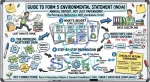
Form IV and Form V are separate filings, but their data should not contradict each other.
Form IV focuses on hazardous waste annual return.
Form V Environmental Statement covers a wider environmental performance summary, including resource consumption, pollution control, waste and cost-related information.
| Data Point | Form IV | Form V |
|---|---|---|
| Hazardous waste generated | Yes | Usually reflected in waste section |
| Disposal route | Yes | Should align conceptually |
| Production | Yes, wherever applicable | Yes |
| Raw material / resource use | No detailed focus | Yes |
| Pollution control measures | Limited | Yes |
| Waste reduction | Indirect | Yes |
If Form IV says 25 MT ETP sludge generated, but Form V says 5 MT hazardous waste generated, the mismatch may attract attention.
The two forms do not need to be identical in structure, but they should be consistent in logic.
Before logging into the portal, keep data ready in one reviewed sheet.
Portal filing should be the last step, not the first step.
Most portal errors are not technical errors.
They are data preparation errors.
If the backend records are clean, portal filing becomes much easier.
In Maharashtra, Form IV filing is generally handled through the MPCB online services or MAITRI-linked portal flow available to the unit.
Use this as a quick review before submission.
| Sr. No. | Checklist Item | Completed? |
|---|---|---|
| 1 | Latest Consent to Operate reviewed | ☐ |
| 2 | Hazardous waste authorisation reviewed | ☐ |
| 3 | Authorised waste categories listed | ☐ |
| 4 | Form 3 register updated up to 31 March | ☐ |
| 5 | Previous year closing stock verified | ☐ |
| 6 | Current year opening stock matched | ☐ |
| 7 | Monthly generation data compiled | ☐ |
| 8 | Form 10 manifests collected | ☐ |
| 9 | TSDF / recycler certificates collected | ☐ |
| 10 | Weighbridge slips checked | ☐ |
| 11 | Vendor authorisation validity checked | ☐ |
| 12 | Transporter details verified | ☐ |
| 13 | Closing stock physically verified | ☐ |
| 14 | Mass balance checked | ☐ |
| 15 | Production data compiled | ☐ |
| 16 | Zero generation categories reviewed | ☐ |
| 17 | In-house utilisation checked, if applicable | ☐ |
| 18 | Rejected / returned waste records checked | ☐ |
| 19 | Accident / spillage records reviewed | ☐ |
| 20 | Form IV compared with previous year | ☐ |
| 21 | Form IV aligned with Form V logic | ☐ |
| 22 | Portal acknowledgement downloaded | ☐ |
| 23 | Final submitted copy stored | ☐ |
| 24 | Internal management copy shared | ☐ |
Vendor certificates are important, but they are not the full picture.
They only show what was received or disposed.
They may not show opening stock, generated quantity or closing stock.
Closing stock is one of the most important numbers in Form IV.
If closing stock is wrong, next year’s opening stock also becomes wrong.
This creates a chain of errors.
ETP sludge, paint sludge, used oil, discarded containers and contaminated waste should not be casually clubbed together.
Category-wise reporting matters.
Form 3 and Form 10 should support each other.
If the register says waste was dispatched but there is no manifest, the record is incomplete.
Estimation may be needed in some practical situations, especially for sludge or containerised waste.
But estimation should have a documented method.
Maintenance shutdowns, tank cleaning, filter replacement and spill cleanup can generate one-time hazardous waste.
These are often missed in annual returns.
This is risky.
Production, waste generation, vendors, consent conditions and storage quantities may change every year.
Form IV should be prepared fresh from records.
After filing, download the submitted copy and acknowledgement.
Keep them in the compliance folder.
This is useful during inspection, audit, renewal and internal review.
Let us take a simple example of ETP sludge.
| Particular | Quantity |
|---|---|
| Opening stock as on 1 April | 1.200 MT |
| Generated during the year | 14.800 MT |
| Sent to TSDF | 13.500 MT |
| Closing stock as on 31 March | 2.500 MT |
Check:
Opening Stock + Generated = Dispatched + Closing Stock
1.200 + 14.800 = 13.500 + 2.500
16.000 = 16.000
This category is reconciled.
Now check supporting documents:
| Record | What to Check |
|---|---|
| Form 3 | Monthly sludge generation and stock |
| Form 10 | Dispatch date and quantity |
| TSDF certificate | Final receipt quantity |
| Weighbridge slip | Dispatch weight |
| Storage area | Closing stock physically available |
| Previous year Form IV | Opening stock matches last year closing |
This is the practical way to prepare Form IV.
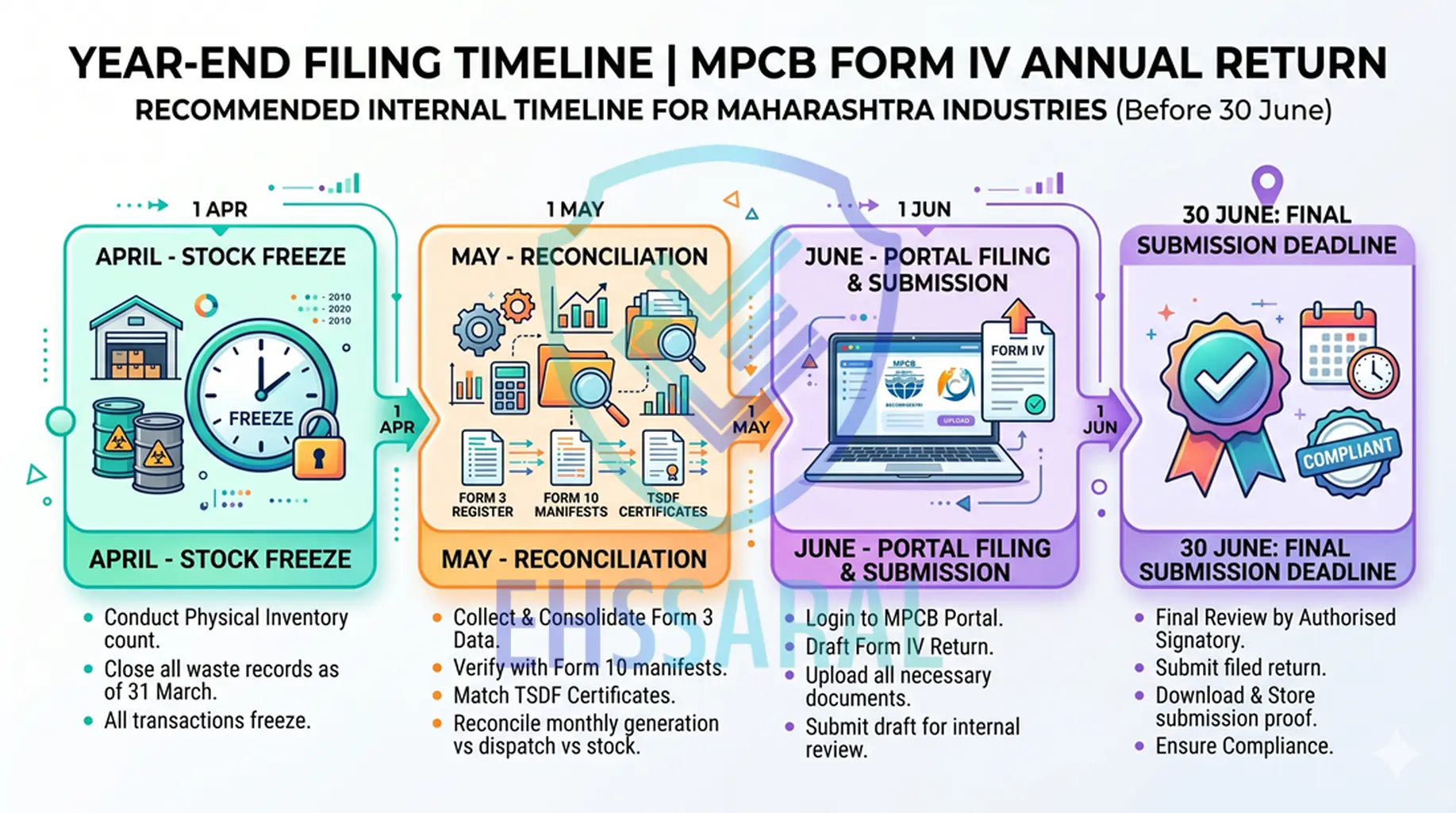
Waiting until the last week of June creates pressure.
A better approach is to close records step-by-step.
| Period | Action |
|---|---|
| April first week | Freeze 31 March closing stock |
| April second week | Collect Form 10 and disposal certificates |
| April third week | Reconcile Form 3 with manifests |
| May first week | Verify vendor authorisations |
| May second week | Prepare category-wise annual summary |
| May third week | Compare with previous year Form IV |
| May fourth week | Review with plant head / authorised signatory |
| June first week | Keep portal-ready data sheet |
| Before 30 June | File Form IV and store acknowledgement |
A calm May review is better than a rushed June correction.
Most issues arise from interpretation gaps, not intent.
Plant managers do not need to check every manifest line.
But they should review key risk points before final submission.
A 20-minute senior review before filing can prevent many future clarifications.
Form IV should not remain only with the EHS officer.
It is a plant-level compliance record.
In day-to-day operations, Form IV becomes difficult when records are maintained in separate files, Excel sheets, emails and vendor WhatsApp messages.
The better approach is to connect the records throughout the year.
A practical Form IV system should track:
Clarity at the process level avoids confusion later.
Good compliance starts with understanding, not paperwork.
MPCB Form IV is the annual return for hazardous and other waste. It reports how much hazardous waste was generated, stored, dispatched, utilised or disposed during the financial year.
Form IV is generally submitted by 30 June every year for the previous financial year ending 31 March.
Form IV covers the financial year from 1 April to 31 March.
It applies to facilities handling hazardous and other waste under the relevant rules and authorisation. If a unit has hazardous waste authorisation or generates hazardous waste, it should review Form IV applicability carefully.
Key records include consent, hazardous waste authorisation, Form 3 register, Form 10 manifest, disposal certificates, recycler receipts, weighbridge slips, production data and closing stock details.
Yes. Form IV is an annual summary, while Form 3 is the running hazardous waste record. The annual totals should be logically aligned.
Yes. Dispatch quantities in Form IV should be supported by Form 10 manifest and final receipt / disposal records.
It should normally appear as generated quantity and closing stock, based on actual records.
If the waste was genuinely not generated during the year, it may be reported as zero generation where the portal allows. The reason should be explainable from operations.
Vendor invoice is useful for commercial records, but it should not be the only proof. Manifest acknowledgement, TSDF receipt, recycler certificate or disposal certificate are stronger compliance records.
The biggest mistake is filing only from dispatch records without reconciling opening stock, generation and closing stock.
The occupier, authorised signatory or responsible person as per the facility’s records should review and sign / submit as applicable through the portal process.
MPCB Form IV is not just a deadline-driven return.
It is a yearly mirror of hazardous waste management at the plant.
If the Form 3 register, Form 10 manifests, vendor certificates, weighment records and closing stock are properly connected, Form IV becomes straightforward.
In many Maharashtra industries, the real improvement starts when Form IV preparation moves from a June activity to a monthly reconciliation habit.
That is where compliance becomes simpler, clearer and easier to defend.

Founder, EHSSaral
Founder - EHSSaral | Partner - Perfect Pollucon | ISO 14001 Lead Auditor | GHG Protocol Scope 2 | Chemist | Data Scientist | Second-generation environmental professional simplifying EHS compliance for Indian industries through practical, automated, tech-enabled, data driven compliance workflows.
Environmental Calendar from Consent Conditions (Practical Guide) | EHSShala
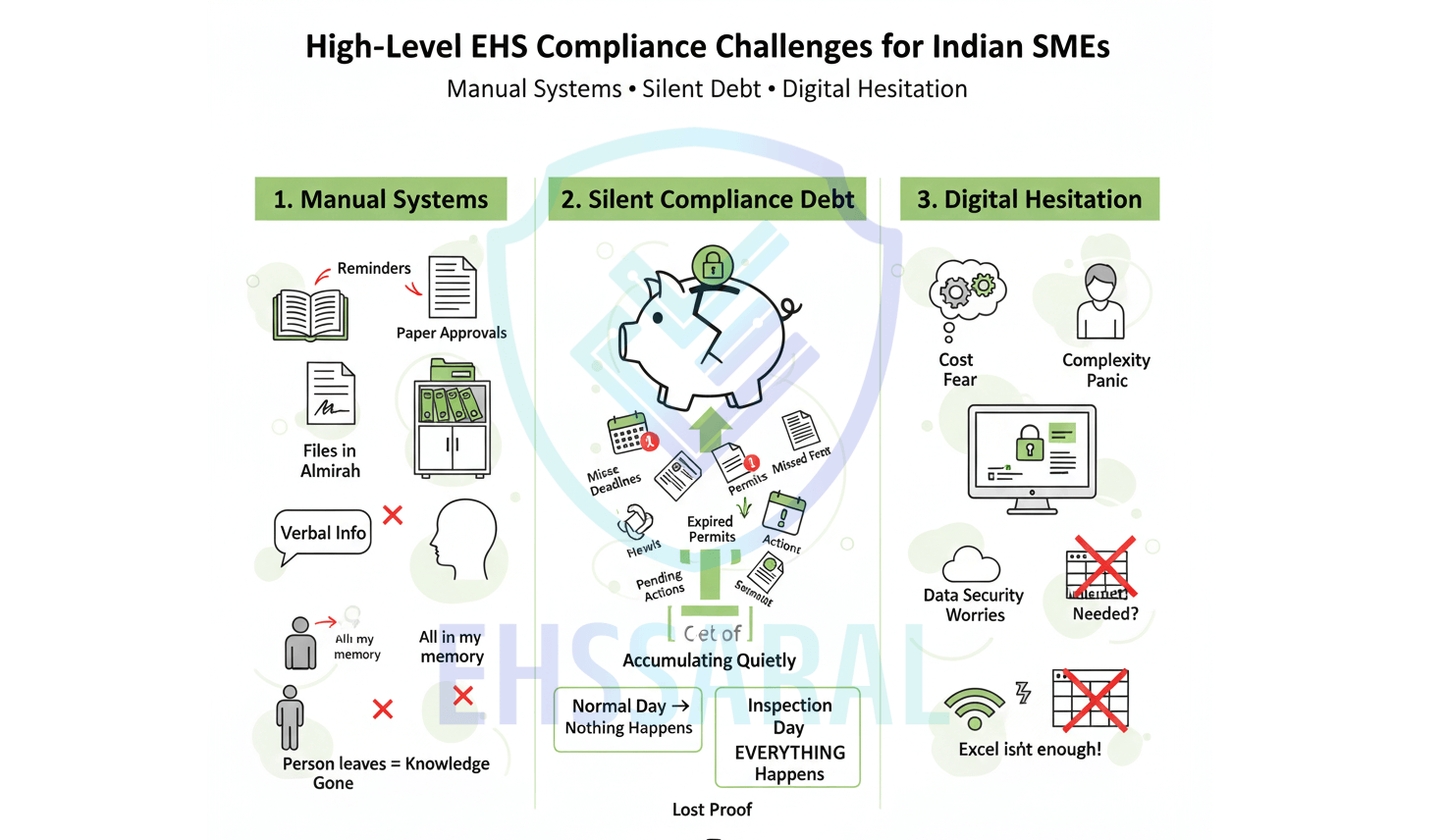
Systems & Technology Barriers in Indian SME Compliance | EHSSaral Research
Evolution of EHS in India - (Part 2) Post-Bhopal | EHSShala
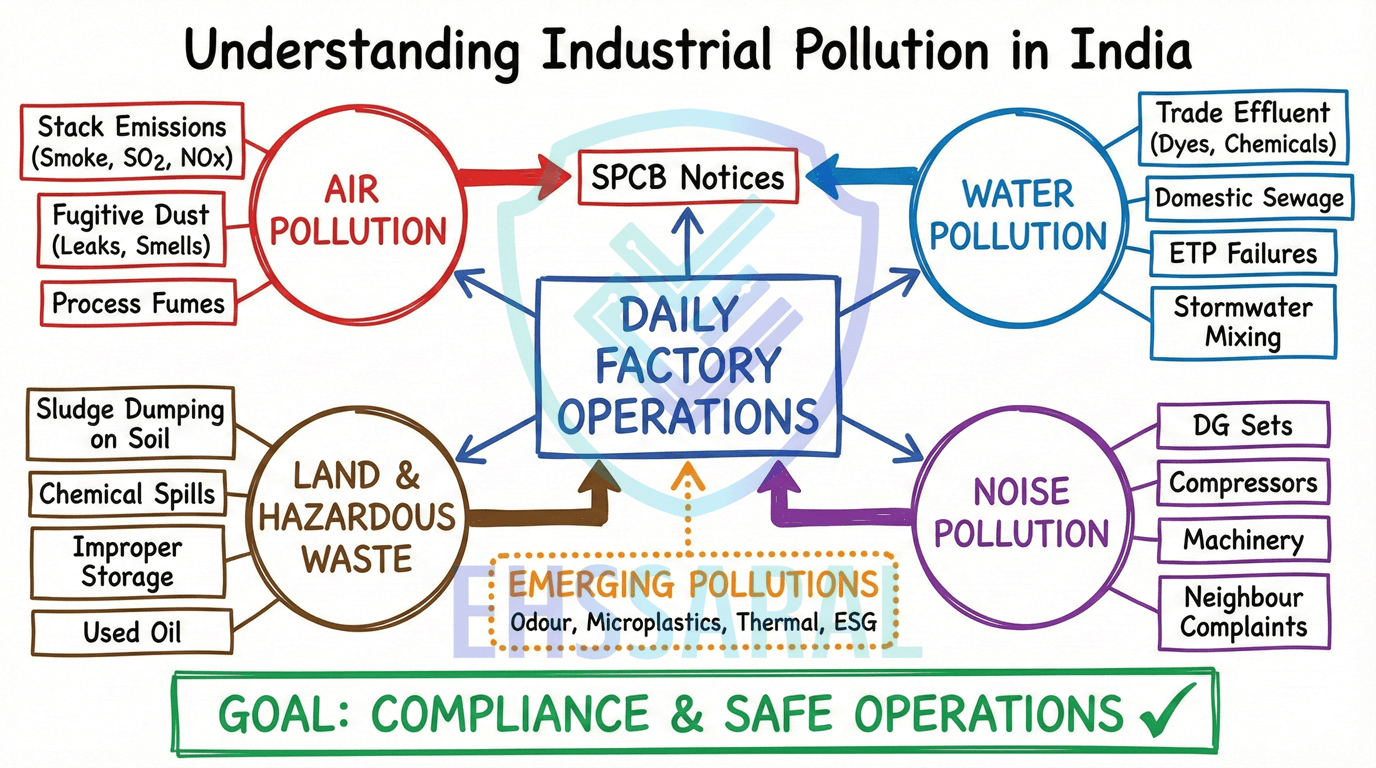
Types of Pollution in Industries Expert Guide | EHSShala
The Hidden Costs of Manual Environmental Compliance in India

Form 4 vs Form 5: Why Hazardous Waste Numbers Don't Match
Form V Environmental Statement: Due Date, Format, Example & Guide
Other Waste Streams in Indian Factories | Battery, E-Waste, Plastic & More | EHSShala
Bio-Medical Waste Management Rules, 2016 for Factories
 ehssaral.webp)
50 mg/Nm³ Emission Limit in India: Is Your Chimney Ready? (SME Guide)