

Blog
Environmental Compliance Management in India: Systems vs Consultants Explained
EHSSaral is an Environmental Compliance Intelligence Platform for Industries. Consent Intelligence • Alerts & Tasks • Incident Reporting • Form IV & V • Audit-Ready Records
See how EHSSaral works
10 Jul 2026
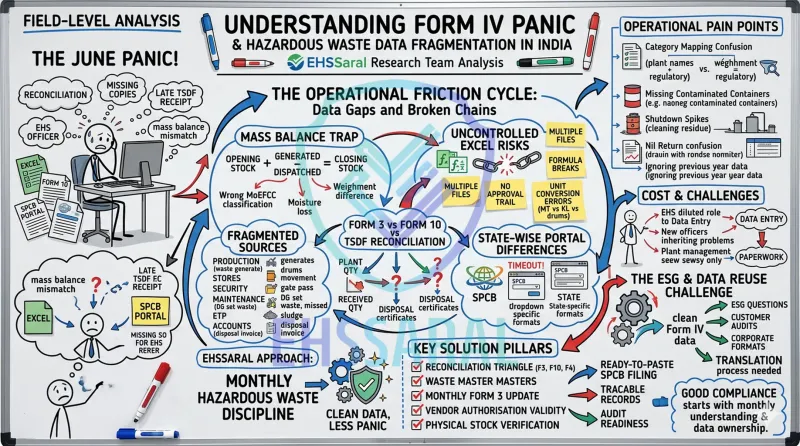
EHSSaral Research Note
This field-level analysis looks at the practical challenges faced by Indian EHS teams while preparing Form IV hazardous waste annual returns for SPCB submission. The purpose is to understand the operational friction behind the form - including data fragmentation, Form 3 gaps, Form 10 reconciliation, TSDF delays, Excel dependency, portal pressure, and ESG data reuse.
In many Indian plants, the real pressure of Form IV is felt in the last week of June.
The EHS officer is usually sitting with three things open at the same time - one Excel sheet with hazardous waste data, one folder full of Form 10 manifests, and one SPCB portal login screen waiting for final entry.
On paper, Form IV looks like an annual hazardous waste return.
In practice, it becomes a full-year reconciliation exercise.
The difficulty is not only in filling the form. The difficulty is in proving that the numbers in the form are supported by Form 3 records, Form 10 manifests, TSDF or recycler receipts, opening stock, closing stock, and actual waste stored at site.
This is why Form IV becomes stressful even for sincere EHS teams.
Most problems do not arise because people want to hide data. They arise because hazardous waste data is fragmented throughout the year.
By the time June comes, the EHS team is not only preparing a return. They are trying to rebuild the complete hazardous waste story of the previous financial year.
Form IV filing becomes difficult because it depends on year-round hazardous waste discipline.
The form itself may look simple, but the data behind it comes from many sources.
| Area | Common Pain Point |
|---|---|
| Form 3 | Monthly hazardous waste record is incomplete or updated late |
| Form 10 | Manifest copies are missing, delayed, or not reconciled |
| Excel files | Multiple versions create confusion |
| Waste categories | CTO / authorisation category and actual plant description do not match clearly |
| Mass balance | Opening, generation, dispatch, and closing stock do not tally |
| TSDF / recycler | Acknowledgements and receipts come late |
| Portal | Login, timeout, dropdown, attachment, and draft-saving issues |
| Departments | EHS depends on production, stores, maintenance, accounts, and security |
| Deadline | Serious reconciliation starts too late, usually in May or June |
| Form V linkage | Hazardous waste numbers may not match later in Environmental Statement |
| ESG / customer audits | Same waste data is required again in different formats |
| Corporate formats | Factory records need translation into rigid reporting language |
The real problem is not Form IV.
The real problem is weak hazardous waste data control throughout the year.
Read more about hazardous waste management rules 2016
Form IV, also commonly referred to as Form 4 hazardous waste annual return, is submitted by industries handling hazardous and other wastes to their respective State Pollution Control Board or Pollution Control Committee.
It generally covers the previous financial year, from 1 April to 31 March, and is submitted by 30 June.
For example, for FY 2025–26, the return covers hazardous waste handled from 1 April 2025 to 31 March 2026.
From a practical standpoint, Form IV tells the regulator:
So, Form IV is not only a compliance form.
It is a yearly hazardous waste movement summary.
Many plant managers assume Form IV is a routine annual filing.
But EHS officers know that it is more than that.
To fill Form IV correctly, the EHS team has to connect many records:
This is where confusion usually starts.
The person responsible for submitting Form IV may not be the person controlling all these records.
Production may know process waste generation.
Stores may know drum movement.
Security may have gate-out entries.
Accounts may have disposal invoices.
The TSDF may have final weighment.
The consultant may have last year’s working file.
And the EHS officer is expected to bring everything together into one clean annual return.
This is why Form IV becomes difficult even when the plant is genuinely trying to comply.
Read more about MoEFCC Hazardous and Other Wastes Rules, 2016 PDF
In many Indian industries, June becomes Form IV season.
The EHS officer starts asking:
This is not a theoretical problem.
This is the actual ground-level pressure many EHS professionals face every year.
The issue is not that Form IV suddenly becomes important in June.
The issue is that the supporting data was not controlled month by month from April onwards.
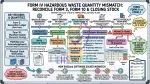
Form IV is built around a simple hazardous waste mass-balance logic:
Opening Stock + Waste Generated - Waste Dispatched / Disposed / Utilised = Closing Stock
This equation looks simple.
But in real plants, each number comes from a different source.
| Quantity | Usual Source |
|---|---|
| Opening stock | Previous year Form IV closing balance |
| Generated quantity | Form 3, production records, ETP sludge records, maintenance records |
| Dispatched quantity | Form 10 manifest, gate pass, weighbridge slip |
| Received quantity | TSDF or recycler acknowledgement |
| Closing stock | Physical hazardous waste storage inventory |
The problem starts when these records do not speak the same language.
For example:
| Record | Quantity |
|---|---|
| Form 3 generation | 12.5 MT |
| Form 10 dispatch total | 10.8 MT |
| TSDF acknowledged receipt | 10.6 MT |
| Physical closing stock | 1.2 MT |
Mathematically, something is missing.
That missing quantity may be due to:
From a practical standpoint, this is where Form IV filing becomes stressful.
The portal asks for final numbers.
But the plant records may not be ready to support those numbers.
Form 3 is supposed to be the base record for hazardous waste handled by the occupier or operator.
In day-to-day operations, Form 3 should capture generation, collection, storage, dispatch, and disposal details.
In reality, many plants update Form 3 irregularly.
Some common situations are:
This creates a problem during Form IV preparation.
If Form 3 is weak, Form IV becomes a reconstruction exercise.
The EHS team then has to collect data from manifests, gate passes, storage records, invoices, and vendor receipts to rebuild the annual picture.
This is where time is lost.
This is also where mistakes enter.
Form 10 manifest is one of the most important records for hazardous waste movement.
It connects the generator, transporter, and receiver.
For Form IV, dispatch and disposal quantities should be traceable to manifest records.
But in many plants, Form 10 reconciliation is not done regularly.
Common issues include:
| Manifest Issue | Practical Impact on Form IV |
|---|---|
| Manifest copy missing | Dispatch cannot be confidently supported |
| TSDF acknowledgement delayed | Disposal quantity remains uncertain |
| Plant quantity and TSDF quantity differ | Mass balance does not match |
| Manifest number not entered in Form 3 | Traceability gap |
| Multiple wastes sent in one vehicle | Category-wise split becomes unclear |
| Vehicle reaches after year-end | Financial year cut-off confusion |
| Rejected waste returned | Dispatch and closing stock need correction |
| Handwritten manifest unclear | Data entry mistakes increase |
Many EHS teams have dispatch records but not complete acknowledgement records.
This is especially painful near year-end.
A vehicle may leave the factory on 30 March, but the TSDF acknowledgement may come in April.
Now the EHS officer has to decide how to treat that quantity in the annual return.
This is why Form 10 should not be treated as only a transport document.
It is the backbone of Form IV traceability.
Excel is still widely used in Indian industries because it is flexible, familiar, and easy to start with.
There is nothing wrong with using Excel.
The problem starts when hazardous waste data is maintained in multiple uncontrolled Excel files across departments.
One file may be with EHS.
One file may be with stores.
One file may be with accounts.
One file may be with the consultant.
One file may be used only for portal filing.
By June, nobody is fully sure which file is final.
| Excel Issue | Form IV Impact |
|---|---|
| Formula breakage | Annual generation or dispatch total becomes wrong |
| Hidden rows | Some dispatches are missed |
| Text instead of number format | Totals do not calculate correctly |
| Multiple file versions | Wrong working file gets used |
| Manual copy-paste | Category or quantity errors enter the return |
| Unit conversion outside the sheet | kg, MT, KL, drums, and bags get mixed |
| No document link | Quantity cannot be traced to manifest or receipt |
| No monthly locking | Past data keeps changing |
| No approval trail | Nobody knows who finalised the number |
Excel can support compliance when it is controlled.
But when Excel becomes the only system of record without validation, document linking, and monthly reconciliation, Form IV filing becomes unnecessarily risky.
The issue is not Excel.
The issue is fragmented and uncontrolled data.
Read Why Form IV Readiness Cannot Begin at the End of the Year
Hazardous waste category mapping is one of the most common pain points in Form IV preparation.
The waste category entered in Form IV should align with the hazardous waste authorisation or Consent to Operate conditions.
But plant-level waste descriptions are often different from regulatory category descriptions.
For example:
| Plant Language | Possible Compliance Confusion |
|---|---|
| Used oil | Used oil or waste oil? |
| ETP sludge | Chemical sludge, process sludge, or effluent treatment sludge? |
| Empty drums | Contaminated containers or scrap? |
| Solvent waste | Spent solvent, distillation residue, or process residue? |
| Filter cloth | Contaminated filter media or general waste? |
| Oily cotton | Oily waste or housekeeping waste? |
| Chemical residue | Process residue or off-spec material? |
This is where the process starts feeling like a guessing game for many junior EHS officers.
One month, the record may say “used oil.”
Next month, it may say “waste oil.”
Another file may mention only “5.1.”
When the annual return is prepared, the EHS officer has to map all these variations into one correct category.
The problem becomes bigger when the portal dropdown does not exactly match the internal wording used by the plant.
Good practice is to create a hazardous waste category master and use the same description throughout the year.
Hazardous waste authorisation usually specifies the category and permitted quantity of hazardous waste.
During Form IV preparation, some industries discover that actual generation does not match authorised quantity.
This can happen due to practical reasons:
The EHS team then faces a difficult question.
Should the actual quantity be reported as generated?
Should the authorisation be reviewed?
Is an amendment required?
Can the variation be explained?
Form IV often reveals whether the hazardous waste authorisation still reflects the actual plant operation.
This is why Form IV should not be seen only as an annual return.
It is also a useful check on whether the plant’s authorisation is still current and practical.
Opening and closing stock are small fields, but they create large problems.
Opening stock should ideally come from the previous year’s Form IV closing balance.
Closing stock should represent the hazardous waste physically available at the end of the financial year.
But in many plants:
Once the opening stock is wrong, the full year’s mass balance becomes weak.
Once the closing stock is wrong, next year’s Form IV also starts with an error.
This is how one year’s mistake continues into the next year.
Unit conversion looks simple until actual plant records are checked.
Hazardous waste may be recorded in different forms:
Form IV or the SPCB portal may require reporting in a specific unit, often MT.
Now the EHS team has to convert everything consistently.
| Plant Record | Form IV Challenge |
|---|---|
| 25 drums | Need weight per drum or actual weighment |
| 40 bags | Need kg or MT conversion |
| 2 tankers | Need KL or MT, depending on waste type |
| 500 litres | Need density if converting to weight |
| 1 lot | Not useful unless quantified |
| 3 pallets | Need actual hazardous waste quantity |
The issue is not only calculation.
The issue is proof.
If Form IV shows 3.25 MT, the EHS officer should know how that number was arrived at.
Was it from weighbridge?
Was it from standard container weight?
Was it from vendor receipt?
Was it from density?
Was it an estimate?
This basis should be documented internally.
EHS teams depend heavily on authorised TSDFs, recyclers, co-processors, pre-processors, and actual users.
The plant may dispatch waste correctly, but Form IV preparation still depends on documents received from these external parties.
Common vendor-related pain points include:
This creates a difficult situation for the EHS officer.
The waste has left the plant.
But the proof needed for Form IV is still pending.
This is why vendor follow-up should happen after every dispatch, not only in June.
Online SPCB portals have made submission more traceable.
But the actual filing experience can still be stressful, especially near deadline periods.
EHS officers often face practical issues such as:
This becomes more difficult when the EHS officer is copying data manually from Excel into the portal.
By the time category code, annual quantity, disposal route, and vendor details are checked, the portal session may expire.
The practical solution is to prepare the full Form IV working summary offline before opening the portal.
Portal filing should be the final entry step.
It should not be the place where reconciliation begins.
One reason EHS teams feel pressure during Form IV filing is that correction is not always simple after final submission.
Many SPCB portals allow draft preparation, but once the form is finally submitted, correction may require communication with the regional office, a formal request, or resubmission support depending on the state process.
This creates hesitation before pressing the final submit button.
The EHS officer usually rechecks:
The pressure is understandable.
A small typo in quantity, category, or unit can create unnecessary explanation later.
From a practical standpoint, this is why Form IV data should be reviewed internally before portal entry.
The portal should receive finalised data.
It should not become the place where the EHS team discovers mismatches.
The core hazardous waste return logic is similar across India.
But the portal experience differs from state to state.
An EHS officer filing under MPCB Maharashtra may face a different flow from someone using GPCB Gujarat, TNPCB Tamil Nadu, KSPCB Karnataka, HSPCB Haryana, or other SPCB portals.
Differences may appear in:
For companies operating in multiple states, this becomes a major coordination issue.
The corporate EHS team may want one standard Form IV review process.
But each unit may be dealing with a different portal experience.
This is why a common internal hazardous waste data structure is important.
Even if portals differ, the plant’s internal Form IV logic should remain consistent.
Form IV is usually filed by EHS.
But the data comes from many departments.
| Department | Data Needed for Form IV |
|---|---|
| Production | Process waste generation |
| Maintenance | Used oil, oily waste, filters, cleaning waste |
| Stores | Chemical drums, containers, packaging waste |
| ETP team | Sludge generation and treatment records |
| Security | Gate pass and vehicle outward movement |
| Accounts | Vendor invoices and disposal bills |
| Purchase | Vendor authorisation and contracts |
| Admin / housekeeping | Miscellaneous contaminated waste |
| Management | Authorised signatory approval |
This is one of the most practical pain points.
EHS owns the submission, but not every data source.
If other departments do not understand the importance of timely data, Form IV becomes a chasing exercise.
A good plant-level system should make hazardous waste data ownership clear across departments.
Hazardous waste does not come only from production.
Maintenance activities generate several waste streams.
Examples include:
In many plants, this waste is generated in small quantities and stored in the maintenance area before being moved to the hazardous waste storage area.
If EHS is not informed at the right time, these quantities may not enter Form 3 properly.
Later, during Form IV preparation, the waste may either be missed or added without proper monthly history.
This is a common issue in SMEs and mid-size industries.
Empty contaminated containers are another frequent source of confusion.
Many plants focus on larger waste streams like ETP sludge, used oil, and process residue.
But contaminated packaging can also form an important hazardous waste stream.
Examples include:
The issue is that these are often handled by stores, purchase, or scrap teams.
If EHS is not involved, the movement may not be recorded properly under hazardous waste records.
During Form IV preparation, the plant may then discover that contaminated containers were generated but not properly tracked.
This creates a gap between actual operations and reported waste.
Annual shutdowns, tank cleaning, line flushing, maintenance overhauls, and plant cleaning activities can generate unusual waste quantities.
Examples include:
If shutdown waste is not recorded separately, Form IV may show sudden spikes.
A spike is not necessarily wrong.
But it should be explainable.
For example, if ETP sludge generation suddenly increases in one month because of tank cleaning or old sludge removal, the record should mention that reason.
Otherwise, it looks like a mismatch.
Year-end dispatches create special confusion.
For example:
Now the EHS team has to decide how to reflect the quantity.
The internal logic should be consistent and supported by documents.
The plant should not randomly move quantities between financial years to make the return look neat.
This is why year-end hazardous waste dispatches should be planned carefully.
Some industries assume that if no hazardous waste was generated during the year, no return is required.
This creates avoidable confusion.
If an industry is covered under hazardous waste authorisation or has reporting obligations, the EHS team should check whether a nil return is required through the relevant SPCB process.
The practical problem is that some portals do not make nil filing very intuitive.
The user may still need to go through multiple screens and enter zero quantities.
This can confuse junior EHS officers, especially when there is no clear internal guidance.
The safest practical approach is to maintain annual evidence even for zero generation years.
A nil return should also be documented internally with supporting reasoning.
A common mistake is starting the current year’s Form IV from a blank file.
The better starting point is last year’s submitted Form IV.
Why?
Because last year’s closing stock becomes this year’s opening stock.
If the previous year return is ignored, continuity breaks.
| Previous Year Field | Why It Matters |
|---|---|
| Closing stock | Becomes current year opening stock |
| Waste categories | Shows what was reported earlier |
| Authorised quantity | Helps identify variation |
| Disposal vendors | Helps check continuity |
| Remarks | May need follow-up |
| Acknowledgement | Proof of submission |
If last year’s Form IV is missing, the EHS team should retrieve it from internal files, consultant records, or the SPCB portal wherever available.
Industries often work with the same TSDF, recycler, transporter, or co-processor for years.
Because of familiarity, vendor authorisation validity may not be checked every time.
During Form IV preparation, the EHS team may suddenly realise:
This creates discomfort during filing and audit review.
A practical system should maintain current vendor authorisation records along with waste category coverage.
Vendor compliance is part of generator compliance.
Form IV is not the only annual environmental return.
Form V, or Environmental Statement, also captures waste-related information.
Many plants prepare Form IV and Form V separately.
Sometimes different people prepare them.
Sometimes Form IV is prepared in June and Form V later near September.
This creates Form IV and Form V Data mismatch risk.
For example:
| Form IV Shows | Form V Shows |
|---|---|
| 22 MT ETP sludge | 16 MT sludge |
| Used oil dispatched | Used oil not mentioned |
| Hazardous waste category code | Different waste description |
| Closing stock included | Closing stock ignored |
| TSDF route | General disposal wording |
These mismatches may not be intentional.
They usually happen because the same hazardous waste data is not reused consistently.
From a practical standpoint, Form IV hazardous waste data should become the base for Form V hazardous waste reporting.
This avoids future confusion.
Earlier, many industries treated Form IV as a statutory return submitted to the SPCB.
But in day-to-day operations today, the same hazardous waste data is often used in many other places.
It may be required for:
This creates a new pressure on EHS teams.
The same hazardous waste quantity may be asked in different formats by different stakeholders.
One format may ask for MT per year.
Another may ask for kg per unit of production.
A customer audit may ask for disposal route.
A corporate ESG sheet may ask for recycling, co-processing, landfill, or incineration split.
A statutory return may ask for category-wise hazardous waste data.
The plant reality, however, remains the same.
The EHS team still has to collect data from Form 3, Form 10, TSDF receipts, storage records, and vendor documents.
This is why clean Form IV data is becoming more valuable.
It is no longer useful only for one annual return.
It becomes the base data for many environmental, ESG, audit, and customer-facing submissions.
Another growing pain point is the difference between corporate reporting language and factory-level records.
On the shop floor, teams may speak in practical terms:
But corporate ESG formats, customer questionnaires, and vendor assessment forms may ask for data in a different language.
For example:
| Factory Record | Corporate / ESG Format May Ask |
|---|---|
| ETP sludge sent to TSDF | Hazardous waste disposed through secured landfill |
| Used oil sent to recycler | Hazardous waste recycled or recovered |
| Solvent residue sent for co-processing | Waste diverted from landfill |
| Chemical drums sent to authorised recycler | Contaminated packaging recycling data |
| Waste generated in kg | Waste intensity per unit of production |
This translation is not always simple.
The EHS officer has to understand both sides - the plant reality and the reporting format.
This is where many errors happen.
The data may be correct at the factory level, but it may be placed under the wrong heading in a corporate or customer format.
That is why industries need a clear waste data structure, not only for Form IV but also for future ESG and audit requirements.
One hidden cost of Form IV is the dilution of the EHS role.
EHS professionals are expected to manage environmental compliance, hazardous waste storage, vendor coordination, shop-floor checks, worker awareness, emergency preparedness, regulatory communication, audit readiness, and increasingly ESG data requests.
But during Form IV season, many EHS officers spend days or weeks only on:
This is not the best use of an EHS professional’s time.
The real work of EHS is not only annual reporting.
It is year-round control.
A better system should reduce clerical load so that EHS teams can spend more time on prevention, monitoring, training, vendor improvement, storage discipline, and environmental performance.
Many EHS officers inherit Form IV problems created before they joined.
They may receive:
Then, when June comes, the new EHS officer is expected to file the return correctly.
This is a very common ground-level challenge.
It is not only an individual training issue.
It is a system continuity issue.
A good compliance process should survive employee change.
Form IV is often treated as an EHS department activity.
But it reflects plant-level control over hazardous waste.
It connects with:
When management sees Form IV only as paperwork, EHS does not get timely support from other departments.
When management sees Form IV as a hazardous waste control summary, the process improves.
Plant heads can support by asking for monthly hazardous waste reconciliation instead of asking only near the deadline whether Form IV has been filed.
A good Form IV process is not about making the return look perfect.
It is about making the return traceable.
A well-prepared Form IV should allow the EHS team to answer:
When these questions are answerable, Form IV becomes easier to handle.
From a practical standpoint, every Form IV should be checked using three records.
This shows internal hazardous waste records.
This shows hazardous waste movement.
This shows the annual summary submitted to SPCB.
These three should speak the same language.
| Record | What It Should Confirm |
|---|---|
| Form 3 | Monthly generation, storage, dispatch, closing balance |
| Form 10 | Waste movement, transporter, receiver, quantity |
| Form IV | Annual consolidated return |
If Form 3, Form 10, and Form IV do not match, the EHS team should investigate before submission.
Most issues arise from interpretation gaps, not intent.
Read more about MPCB Form IV checklist article
The best way to reduce Form IV pressure is to stop treating it as a June activity.
A simple monthly review can solve most issues.
| Monthly Check | Why It Helps |
|---|---|
| Opening stock updated | Avoids year-end mismatch |
| Generation entered | Reduces back-calculation |
| Dispatch linked with Form 10 | Improves traceability |
| Vendor receipt collected | Avoids June follow-up |
| Closing stock calculated | Keeps mass balance clean |
| Physical stock checked | Avoids storage mismatch |
| Unit conversion documented | Reduces calculation errors |
| Authorisation limit reviewed | Shows early warning |
| Pending documents listed | Creates accountability |
| Form V linkage checked | Avoids later mismatch |
| ESG data reuse considered | Avoids duplicate reporting later |
This review does not need to be complicated.
Even a 30-minute monthly review can save several days in June.
MPCB portal / eC MPCB services page
Take last year’s submitted Form IV.
Use last year’s closing stock as this year’s opening stock.
List all authorised hazardous waste categories from consent and authorisation.
Use the same naming throughout the year.
Capture monthly generation, dispatch, and closing stock.
If Form 3 is incomplete, reconstruct it carefully from source records.
Every dispatch should be linked to a manifest.
Where possible, attach gate pass, weighbridge slip, and vendor acknowledgement.
Compare plant dispatch quantity with receiver quantity.
Document differences clearly.
Check the actual hazardous waste lying in storage near year-end.
Compare it with calculated closing balance.
Compare actual generation with authorised quantity.
If there is a major variation, understand the reason.
Convert quantities consistently.
Document the basis for conversion.
Do not start reconciliation inside the portal.
Prepare a complete Form IV working summary first.
After submission, save:
This becomes the starting point for next year.
Over the years, one pattern is very clear.
Plants that maintain monthly hazardous waste discipline do not panic in June.
They may still face portal issues or vendor delays, but their internal data is ready.
Good plants usually have:
This does not require a very complex system at the beginning.
It requires discipline and ownership.
A practical Form IV system should reduce the need to rebuild data at year-end.
It should help EHS teams:
The objective should not be only faster filing.
The objective should be better hazardous waste control throughout the year.
At EHSSaral, we believe Form IV should not become a June panic activity.
The return should be ready gradually through the year as waste is generated, stored, dispatched, and acknowledged.
A practical Form IV system should help industries:
The goal is simple.
EHS teams should not have to rebuild the entire hazardous waste story at the end of the year.
Good compliance starts when the data is clean before the deadline arrives.
Form IV filing becomes difficult when hazardous waste data is treated as an annual compilation instead of a monthly control process.
The EHS officer is often blamed for delays or mismatches.
But the real issue is usually fragmented data.
Good Form IV preparation requires:
The same hazardous waste data is now being reused beyond Form IV - in Form V, ESG questionnaires, customer audits, vendor assessments, and corporate dashboards.
So, weak Form IV data does not remain a one-form issue. It affects the wider environmental reporting confidence of the plant.
In many Indian plants, the solution is not more pressure on EHS.
The solution is better data ownership across the plant.
Clarity at the process level avoids confusion later.
Most Form IV issues are visible much before June if hazardous waste records are reviewed every month.
Good compliance starts with understanding, not paperwork.
Form IV becomes difficult because it depends on one full year of hazardous waste data. If Form 3 records, Form 10 manifests, vendor receipts, opening stock, and closing stock are not maintained properly, the annual return becomes stressful.
No. Portal filing is only the final step. The real work is hazardous waste reconciliation before portal entry.
The most common mismatch is between opening stock, generated quantity, dispatched quantity, and closing stock. If the hazardous waste mass balance does not match, Form IV preparation becomes difficult.
Yes, Form IV should be supported by Form 3 records. Form 3 is the monthly or periodic hazardous waste record, while Form IV is the annual summary.
Form 10 manifests provide traceability of hazardous waste movement from generator to transporter to receiver. They are key supporting records for dispatch and disposal quantity in Form IV.
The difference should be reconciled using weighbridge slips, TSDF acknowledgement, and internal dispatch records. The reason should be documented clearly.
Yes, Excel can be used if it is controlled properly. The problem starts when multiple Excel files, broken formulas, manual copy-paste, and missing document links create unreliable data.
Plant-level waste names may not match regulatory category descriptions exactly. Used oil, waste oil, ETP sludge, contaminated containers, and process residue are common areas where confusion starts.
The best way is monthly hazardous waste reconciliation. If Form 3, Form 10, vendor receipts, and physical stock are checked every month, Form IV becomes much easier.
Yes, hazardous waste data in Form IV and Form V should be consistent. Differences may create confusion during review or audit.
EHS usually coordinates the filing, but production, maintenance, stores, security, accounts, purchase, vendors, and management all provide important data.
The full Form IV working summary should be prepared offline first. Portal entry should be the final step after reconciliation is complete.
Plant management should support monthly reviews, interdepartmental coordination, vendor documentation follow-up, physical stock checks, and timely approval.
Previous year closing stock becomes current year opening stock. If last year’s Form IV is ignored, continuity breaks and current year mass balance may become wrong.
The same hazardous waste data may be used in Form V, ESG questionnaires, customer audits, vendor assessments, corporate dashboards, ISO audits, and internal reviews. Clean Form IV data improves confidence in all these submissions.
Factory records are often maintained in practical language like drums, sludge, oil waste, or TSDF pickup. ESG and customer audit formats may ask for recycling, disposal, landfill, co-processing, or waste intensity. EHS teams have to translate plant-level data into these reporting formats carefully.
EHSSaral is being built to reduce fragmented hazardous waste tracking by helping industries maintain waste masters, track Form 3 data, link Form 10 manifests, store vendor acknowledgements, reconcile quantities, prepare portal-ready Form IV summaries, and support future Form V and ESG data needs.

Founder, EHSSaral
Founder - EHSSaral | Partner - Perfect Pollucon | ISO 14001 Lead Auditor | GHG Protocol Scope 2 | Chemist | Data Scientist | Second-generation environmental professional simplifying EHS compliance for Indian industries through practical, automated, tech-enabled, data driven compliance workflows.
Environmental Compliance Management in India: Systems vs Consultants Explained
Water & Effluent Sampling Basics for Indian Factories | EHSSHala

The Digital Compliance Cliff: EPR Traceability Challenges for Indian MSMEs | EHSSaral Research
Stack Monitoring Basics for Indian Factories | EHSShala
Hazardous Waste Storage Rules in Indian Factories | EHSShala
Form IV Quantity Mismatch: Hazardous Waste Reconciliation | EHSSaral
Hazardous Waste Packaging & Labelling in India (Inspector Guide) | EHSShala

EHSShala Consent - SPCB Consent System Explained| EHSShala
Consent to Establish (CTE) Explained: Process, Documents, Rules & Common Mistakes | EHSShala

Why Safety Culture Fails in Indian SMEs: People & Compliance Challenges | EHSSaral Research