

Blog
Why We Wrote The Indispensable EHS Officer Book (A Realist Guide for India) | EHSSaral
EHSSaral is an Environmental Compliance Intelligence Platform for Industries. Consent Intelligence • Alerts & Tasks • Incident Reporting • Form IV & V • Audit-Ready Records
See how EHSSaral works
13 Aug 2026
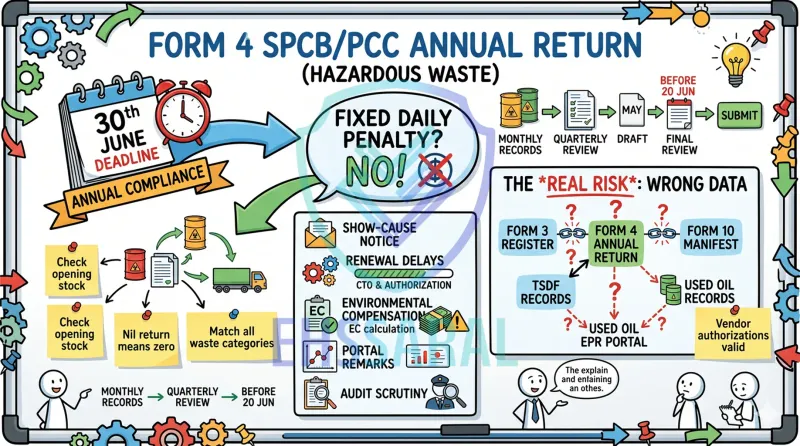
Form 4 is the annual return for hazardous waste submitted to the State Pollution Control Board or Pollution Control Committee.
The standard filing deadline is 30 June every year for the previous financial year from April to March.
There is usually no single fixed “daily late fee” for Form 4 across all SPCBs, unlike income tax or MCA filings.
The practical consequences of late filing may include portal remarks, compliance observations, SPCB queries, show-cause notices, renewal delays, environmental compensation in suitable cases, or further action in serious or repeated cases.
In many cases, the bigger risk is not only late filing. The bigger risk is filing incorrect hazardous waste data that does not match Form 3, Form 10 manifests, TSDF / recycler records, used oil records, and actual closing stock.
Every year, around June, many EHS officers and plant teams start asking the same question:
“What is the late filing penalty for Form 4 SPCB?”
This is a genuine concern.
Form 4 is not a casual internal report. It is a statutory annual return connected with hazardous waste generation, storage, transport, recycling, co-processing, disposal, and closing stock.
But in day-to-day operations, Form 4 delay usually does not happen because the EHS team simply forgot the date.
In many Indian plants, delay happens because the underlying records are not ready.
For example:
This is where confusion usually starts.
The plant wants to file before 30 June, but the data is still not fully reconciled. Then the team starts worrying about penalty, notice, renewal delay, and inspection questions.
This article explains the issue from a practical compliance standpoint.
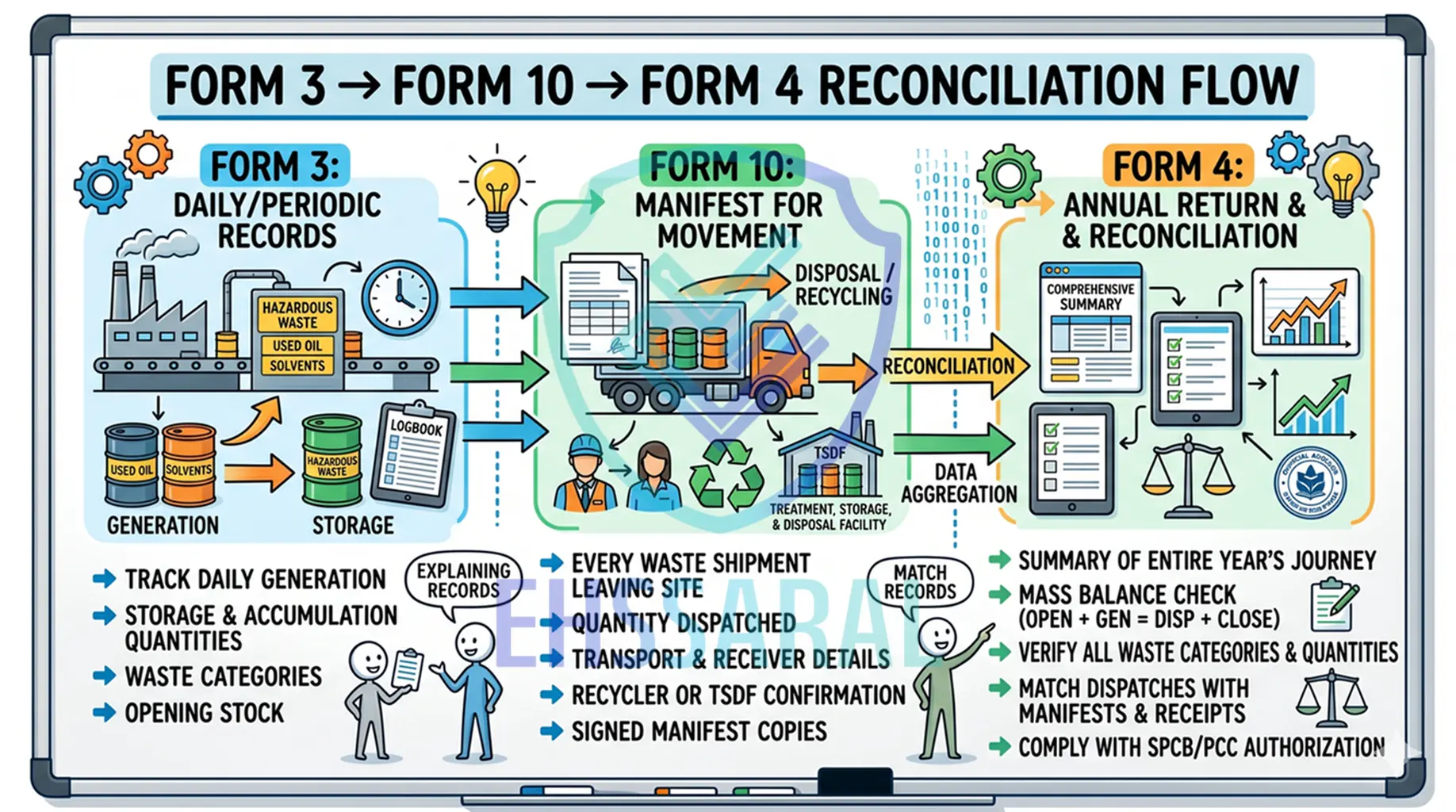
Form 4 is the annual return for hazardous and other waste.
It is submitted by occupiers, operators and other applicable entities to the respective State Pollution Control Board or Pollution Control Committee.
For most manufacturing plants, Form 4 is used to report hazardous waste handled during the financial year.
It generally captures:
From a practical standpoint, Form 4 is not just a form. It is an annual summary of the hazardous waste journey inside and outside the plant.
It connects three important records.
| Record Type | Operational Interval | Primary Regulatory Purpose |
|---|---|---|
| Form 3 Register | Daily / Monthly | Internal tracking of hazardous waste generation, storage and movement |
| Form 10 Manifest | Per Dispatch | Proof of custody transfer from occupier to transporter to TSDF / recycler / co-processor |
| Form 4 Return | Annually, by 30 June | Annual reconciliation submitted to the SPCB / PCC |
If Form 4 does not match Form 3 and Form 10, the issue becomes more serious than a simple delay.
Read more about Hazardous and Other Wastes Rules, 2016
The standard deadline for filing Form 4 is:
On or before 30 June every year
The return covers the previous financial year from 1 April to 31 March.
For example:
| Financial Year | Period Covered | Form 4 Filing Deadline |
|---|---|---|
| FY 2025–26 | 1 April 2025 to 31 March 2026 | 30 June 2026 |
| FY 2026–27 | 1 April 2026 to 31 March 2027 | 30 June 2027 |
Many SPCBs now require online submission through their state portal, OCMMS, XGN, or other state-specific systems.
For example, industries in Maharashtra generally deal with MPCB Maharashtra systems, industries in Gujarat deal with GPCB Gujarat systems, and industries in Tamil Nadu deal with TNPCB Tamil Nadu systems. Similarly, other states such as Karnataka, Rajasthan, Haryana, Madhya Pradesh and Telangana may have their own portal workflows and document requirements.
The filing route may differ from state to state, but the annual return logic remains broadly the same: Form 4 should reflect the hazardous waste generated, stored, dispatched, recycled, co-processed, utilised or disposed during the previous financial year.
This is the most important point.
In practice, industries should not assume that Form 4 late filing works like income tax or MCA filing, where a standard late fee is calculated automatically for each day of delay.
For Form 4, there is usually no single fixed late filing fee that applies uniformly across all SPCBs in the same manner.
The consequence depends on several factors, such as:
So the better question is not only:
“What is the penalty amount?”
The better question is:
“How will the SPCB view this delay in the overall compliance record of the unit?”
That is how most practical compliance issues are assessed.
The Form 4 deadline comes from the hazardous waste annual return requirement, but the actual filing experience is often state-specific.
For example, an industry in Maharashtra may search for MPCB Form 4 late filing, while a unit in Gujarat may search for GPCB Form 4 annual return penalty, and a plant in Tamil Nadu may look for TNPCB hazardous waste Form 4 return.
From a practical standpoint, the core compliance expectation remains similar across major industrial states:
| State / Board | What Industries Commonly Need to Check |
|---|---|
| MPCB Maharashtra | Form 4 filing status, hazardous waste authorization, Form 3 records, Form 10 manifests, disposal proof and renewal queries |
| GPCB Gujarat | Annual hazardous waste return status, waste category consistency, recycler / TSDF records and authorization compliance |
| TNPCB Tamil Nadu | Online return submission status, hazardous waste quantity reconciliation, manifest records and compliance history |
| KSPCB Karnataka | Hazardous waste authorization, portal filing, disposal records and annual return consistency |
| HSPCB Haryana | Form 4 return status, authorized recycler / TSDF records and supporting documents during renewal or inspection |
So while the due date and basic Form 4 purpose are common, the portal process, document review style, query format and renewal-stage scrutiny may differ from one SPCB to another.
This is why industries should not rely only on a generic national checklist. They should also check the latest instructions, portal workflow and document expectations of their own State Pollution Control Board.
Form 4 obligations arise under the Hazardous and Other Wastes framework, which operates under the wider environmental law structure in India.
So non-filing, repeated delay, incorrect filing, or false reporting should not be treated as a simple office paperwork gap.
It can be viewed as a contravention of environmental compliance requirements.
Depending on the facts of the case, the board may consider action under:
This does not mean that every late Form 4 automatically leads to a heavy penalty.
A short one-time delay with accurate records may be viewed differently from repeated non-filing, false quantity reporting, unauthorized disposal, or hazardous waste storage mismatch.
The legal framework gives the regulator power to act. The practical outcome depends on the seriousness of the non-compliance and supporting facts.
Learn about Form V Environmental Statement
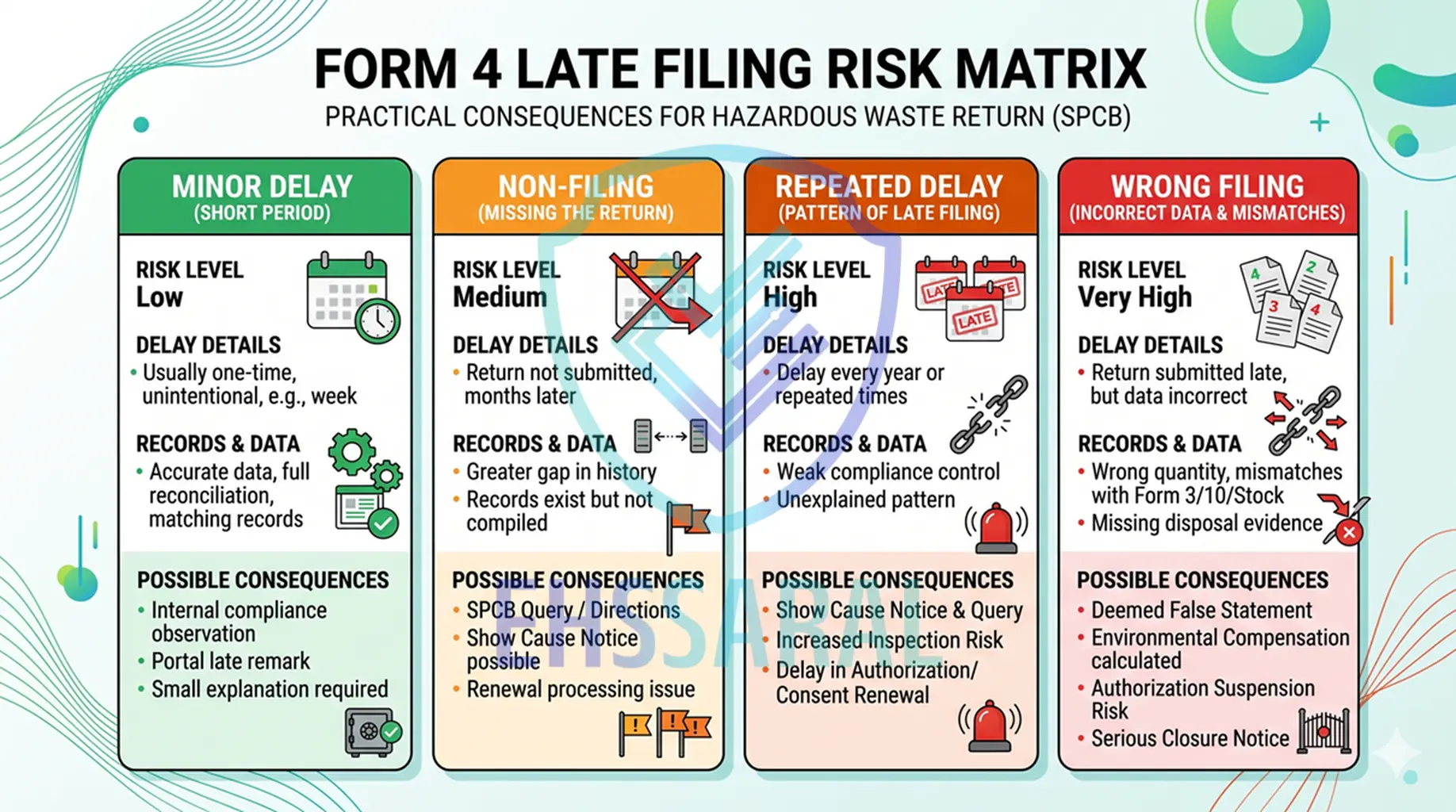
Late filing can lead to different outcomes depending on the situation.
A small delay with complete records may be handled differently from repeated non-filing with poor hazardous waste documentation.
Here is a practical view:
| Situation | Possible Practical Consequence |
|---|---|
| Minor delay, return filed correctly | Internal compliance observation, portal delay record, or no major issue in some cases |
| Delay noticed during inspection | SPCB officer may ask for explanation and supporting documents |
| Delay during authorization renewal | Clarification may be asked before renewal processing |
| Return not filed at all | More serious non-compliance issue |
| Repeated late filing every year | Weak compliance history and higher scrutiny |
| Late filing with incorrect data | Bigger concern than delay alone |
| Form 4 mismatch with Form 3 / Form 10 | Detailed query, correction requirement or inspection observation |
| Hazardous waste stored without proper disposal | May lead to serious regulatory concern |
| Delay along with other violations | Matter may escalate to show-cause notice or further direction |
| Serious or repeated non-compliance | Environmental compensation may be considered depending on applicable methodology |
This is why industries should treat Form 4 as a record discipline issue, not only a date issue.
In recent years, many environmental enforcement discussions have shifted from only prosecution-based language to environmental compensation-based action.
Environmental Compensation, commonly called EC, is a financial mechanism used in suitable cases to address environmental non-compliance.
For industries, this is important because the financial impact may not look like a standard “late fee”.
It may be considered based on factors such as:
A simple delay in filing Form 4 may not automatically mean EC.
But if late filing is connected with unauthorized storage, missing disposal proof, unexplained hazardous waste quantity, repeated non-filing, or mismatch between actual stock and reported stock, the issue can become more serious.
From a senior management point of view, this distinction is important.
The costliest issue is not usually the form delay alone.
The costliest issue is weak hazardous waste control that becomes visible through the delayed or incorrect return.
These three situations are different.
Late filing means the return was submitted after the due date.
This is not ideal, but if the data is accurate and records are available, it is usually easier to explain.
Non-filing means the return has not been submitted at all.
This creates a bigger gap in the compliance record. During renewal, inspection, audit, or internal review, the unit may not be able to show annual hazardous waste reporting for that year.
Wrong filing means the return was submitted, but the data is incorrect.
This can be more damaging than late filing.
| Violation Category | S.No | Financial Penalty & Compensation Risk | Operational & Regulatory Impact | Key Influencing Factors |
|---|---|---|---|---|
| Late Filing (Post-June 30 Submission) | 1 | No standard daily auto-fee (unlike Income Tax/MCA). Section 15 EPA Fine: Statutory fines up to ₹1 Lakh. Daily Accruing Fines: Up to ₹5,000/day for continuing non-compliance. Environmental Compensation (EC): Formula-based financial penalties calculated by SPCB. | Portal Flags: Automatic "Late Submission" remark logged in XGN/OCMMS. Inspection Red Flags: Higher probability of surprise physical audits. Query Escalation: SPCB officials may issue immediate clarification letters. | Total number of days/months delayed. Industry category (Red / Orange / Green).Matching status of Form 3, Form 10, and TSDF records. |
| Non-Filing (Complete Omission) | 2 | Maximum Statutory Fines: Strict application of Section 15 EPA penalties. Heavy EC Levies: Substantial Environmental Compensation backdated to June 30. Personal Liability: Potential imprisonment terms up to 5 years for responsible plant heads. | Show-Cause Notice: Formal legal notice demanding explanation. Authorization Freeze: Suspension or cancellation of the Hazardous Waste Authorization. CTO Blocks: Immediate stalling of Consent to Operate (CTO) renewals. Closure Orders: Threat of disconnection of electricity/water supply under section 5 of EPA. | Total duration of complete non-compliance. Willful negligence vs. technical portal downtime. History of ignoring past SPCB warning notices. |
| Wrong Filing (Data Mismatch / Incorrect Reporting) | 3 | False Declaration Penalties: Treated as a deliberate attempt to mislead the board. Compounded Fines: Penalties for false reporting plus late fees for subsequent corrected filing. EPR Penalties: Financial liabilities under the Used Oil/Battery EPR portals due to data mismatches. | Return Rejection: SPCB portal marks the submission invalid. Mass Balance Audit: Immediate scrutiny of physical closing stock vs. book records. Vendor Re-verification: Cross-checks initiated with your TSDF/Recycler facilities. Trust Deficit: Strict conditional approvals on future CTO applications. | Materiality of error (e.g., small typo vs. massive underreporting of waste). Used Oil Mismatch: Variations between Form 4 and CPCB EPR portal logs. Discrepancy between Form 10 manifest dispatches and Form 4 totals. |
| Repeated Violations (Habitual Offender) | 4 | Escalated EC Formulas: Exponentially higher Environmental Compensation rates applied. No Compounding Allowances: Denial of lenient fine options; direct prosecution. | Blacklisting: Facility flagged as a "Habitual Non-Compliant Unit". Long-term Shutdowns: Permanent cancellation of Hazardous Waste Authorization. Criminal Prosecution: Formal criminal cases filed against top management in environmental courts. | Frequency of past late or missed filings. Status of overall plant compliance (Air, Water, and Hazardous Waste). |
For example:
Over the years, we’ve seen that many plants worry about late filing penalty, but the real issue starts when numbers do not reconcile.
A late but correct return is usually easier to defend than an on-time but incorrect return.
Know more about Form V Late Filing Penalty & Steps After 30 September
Form 4 is not an isolated form.
It sits at the end of the hazardous waste documentation chain.
If monthly hazardous waste records are weak, Form 4 becomes difficult to prepare in June.
The problem usually starts much earlier.
Read about Why Form IV Filing Becomes Difficult for Indian EHS Teams: A Field-Level Analysis
| Reason for Delay | What Usually Happens |
|---|---|
| Form 3 not updated regularly | Full-year data has to be recreated in June |
| Form 10 copies missing | Dispatch quantities cannot be verified |
| TSDF / recycler certificates pending | Disposal proof is incomplete |
| Multiple waste categories | Team gets confused between consent, authorization and actual waste |
| Manual Excel tracking | Version mismatch between EHS, stores and production |
| Vendor data not received | Final disposal quantity remains unclear |
| Opening stock ignored | Closing balance becomes incorrect |
| Used oil records not reconciled | Form 4 and used oil records may show different quantities |
| Portal access issue | Filing gets delayed despite data being ready |
In many Indian plants, the EHS officer knows the compliance requirement. The challenge is data collection from production, stores, maintenance, TSDF, recycler and management.
That is why Form 4 should not be prepared only in June.
It should be built month by month.
For many engineering units, automobile workshops, maintenance-heavy factories, DG set users and machinery-based plants, used oil is one of the most common hazardous waste streams.
Used oil is generally reported under hazardous waste records, and in many cases it also intersects with the newer Used Oil EPR ecosystem.
This creates a practical compliance point.
If your unit generates, stores, sells, sends or disposes used oil, the same broad quantity trail may appear in different places:
The important point is consistency.
Do not treat used oil as a small side entry.
If used oil quantity appears differently across hazardous waste records, recycler documents and EPR-related records, it may invite additional clarification during audit, inspection, portal review or renewal discussion.
From a practical standpoint, used oil should be reconciled separately before Form 4 submission.
A simple used oil reconciliation should check:
| Record | What to Verify |
|---|---|
| Opening stock | Used oil available at start of year |
| Generated quantity | Used oil generated from maintenance / machinery / DG sets |
| Dispatched quantity | Quantity sent to authorised recycler / re-refiner / user |
| Supporting proof | Invoice, manifest, recycler receipt, weighment or other record |
| Closing stock | Quantity physically stored at year-end |
| EPR-related records | Consistency with applicable portal records, wherever relevant |
This extra check can avoid unnecessary mismatch later.
Before filing Form 4, the EHS team should reconcile the following records:
| Record | What to Check |
|---|---|
| Hazardous Waste Authorization | Waste category, quantity, disposal mode and validity |
| Form 3 Register | Monthly generation, storage and dispatch |
| Form 10 Manifest | Waste movement quantity and date |
| TSDF / Recycler Certificate | Actual receipt and disposal / recycling quantity |
| Weighbridge Slip | Physical quantity dispatched |
| Production Data | Whether waste generation is reasonable compared to production |
| Used Oil Records | Generation, sale, dispatch and recycler details |
| Opening Stock | Should match previous year’s closing stock |
| Closing Stock | Should match actual stored quantity at year-end |
| Storage Area Records | Physical stock should support declared quantity |
The basic logic is simple:
Opening Stock + Waste Generated = Waste Dispatched / Utilised + Closing Stock
This may look simple on paper, but in actual plants, mismatches are common.
This is a very practical issue.
Many EHS teams keep the Form 4 filing for the last few days of June. Then they face portal slowness, login errors, payment issues, digital signature issues, file upload errors or draft saving problems.
State portals such as OCMMS, XGN or other SPCB systems may become slow during peak filing days because many users are trying to submit returns at the same time.
A saved draft should not be treated as a submitted return.
The return should be considered filed only when final submission is completed and acknowledgement or submitted copy is available.
If there is a genuine portal issue near the deadline, keep internal evidence:
This does not automatically remove compliance responsibility. But it helps show that the delay was not due to neglect.
From a practical standpoint, industries should aim to complete Form 4 filing before the last week of June.
Yes, late filing or non-filing can be treated as a compliance issue.
However, the type of action depends on the facts.
SPCBs generally look at the overall picture:
In suitable cases, the matter may lead to:
From a practical standpoint, a one-time delayed but accurate filing is different from repeated non-filing with poor hazardous waste control.
The second situation is far more serious.
It can.
When a unit applies for hazardous waste authorization renewal, the SPCB may check past compliance records.
Form 4 annual returns are part of that compliance history.
If annual returns are missing, delayed or inconsistent, the officer may ask for:
Late filing may not automatically stop renewal in every case. But it can create avoidable queries.
If the delay is repeated, unexplained, or connected with data mismatch, renewal processing may become more difficult.
It may create questions during Consent to Operate renewal, especially where hazardous waste handling is a major part of the unit’s environmental compliance.
During CTO renewal, the board may review:
SPCBs may also review hazardous waste compliance along with Water Act, Air Act and consent-condition compliance.
So a pending Form 4 return can become part of the broader renewal discussion.
Again, the issue is not only delay. The issue is whether the plant can demonstrate proper hazardous waste management for the full year.
Read more about difference between Form 4 and Form 5
This is another common area of confusion.
Some units assume that if no hazardous waste was generated, no return is needed.
This assumption can create problems.
If your unit has hazardous waste authorization, or if the SPCB portal / authorization condition expects annual return submission, then a nil or zero return should be properly recorded instead of ignored.
A nil return is also a compliance statement.
It tells the board that no hazardous waste was generated, stored, transported or disposed during the reporting year.
Before filing a nil return, the EHS team should check:
Sometimes a plant files nil return because major process waste was not generated, but small quantities of used oil, discarded containers or ETP sludge were present.
That can create mismatch later.
If the deadline is already missed, avoid panic filing.
The priority should be to file correctly and keep the supporting records ready.
Many portal issues arise because the form was saved but not finally submitted.
Check:
Do not assume draft saved means return filed.
Check the full financial year from April to March.
Verify:
If Form 3 is not updated, prepare the register before finalising Form 4.
For every hazardous waste dispatch, check Form 10.
Verify:
If manifest copies are incomplete, follow up with the vendor immediately.
Do not rely only on internal dispatch records.
Check whether the authorised facility has provided receipt, disposal, recycling or co-processing confirmation, wherever applicable.
Used oil is common in many plants and is often missed during annual reconciliation.
Check:
Ensure that the waste category reported in Form 4 matches the hazardous waste authorization.
If a waste category appears in records but not in authorization, it should be reviewed carefully.
If the filing is late, prepare an internal explanation.
Keep it factual and simple.
Avoid emotional language.
For example:
Once data is reconciled, submit the return without further delay.
Download and save:
A one-time delay can be explained more easily.
Repeated delay every year indicates weak compliance control.
Use this only if an explanation is required by the SPCB, consultant, auditor or internal management.
Subject: Submission of Form 4 Hazardous Waste Annual Return for FY [Year]
Respected Sir / Madam,
We are submitting the Form 4 Hazardous Waste Annual Return for FY [Year] for our unit located at [Factory Address].
The return has been prepared based on our hazardous waste records, Form 3 register, Form 10 manifests, disposal / recycling records and internal verification.
The submission was delayed due to [brief factual reason, such as reconciliation of disposal records / pending confirmation from authorised facility / portal-related issue / internal verification of annual data].
The return has now been submitted for your records.
We will take care to complete the annual return filing within the prescribed timeline in future years.
Thanking you,
For [Company Name]
Authorized Signatory
Name:
Designation:
Date:
After missing the deadline, many plants try to complete the filing quickly.
That is understandable, but it can create further issues.
Avoid these mistakes:
Do not file rough figures just to close the return.
Hazardous waste records should be based on actual generation, storage and disposal documents.
Opening stock should generally flow from the previous year’s closing stock.
If this link is broken, year-wise reconciliation becomes difficult.
If closing stock is shown as zero, the records should show where the waste went.
There should be Form 10, weighbridge record, and authorised disposal / recycling evidence.
Even if process waste was not generated, check used oil, spent oil, discarded containers, ETP sludge, chemical residue and contaminated waste.
Solid waste, plastic waste, e-waste, battery waste and hazardous waste may have different reporting routes.
Do not club everything into Form 4 unless it belongs there.
Separate EPR systems for plastic packaging, e-waste, batteries, tyres and used oil may have their own returns and records. Do not mix those filings with Form 4, but keep quantities consistent wherever the same waste stream appears in more than one compliance system.
Always save the submitted return and acknowledgement.
During renewal or inspection, “we filed it” is not enough. The acknowledgement is important.
Waste should be sent only to authorised recyclers, co-processors, pre-processors or TSDFs, as applicable.
If the vendor authorization is expired or not suitable for that waste category, the issue can become bigger than Form 4 delay.
Portal issues, login errors, missing vendor records and internal approval delays are common in the last week of June.
The safer approach is to finish the data review before 20 June and submit before the final rush.
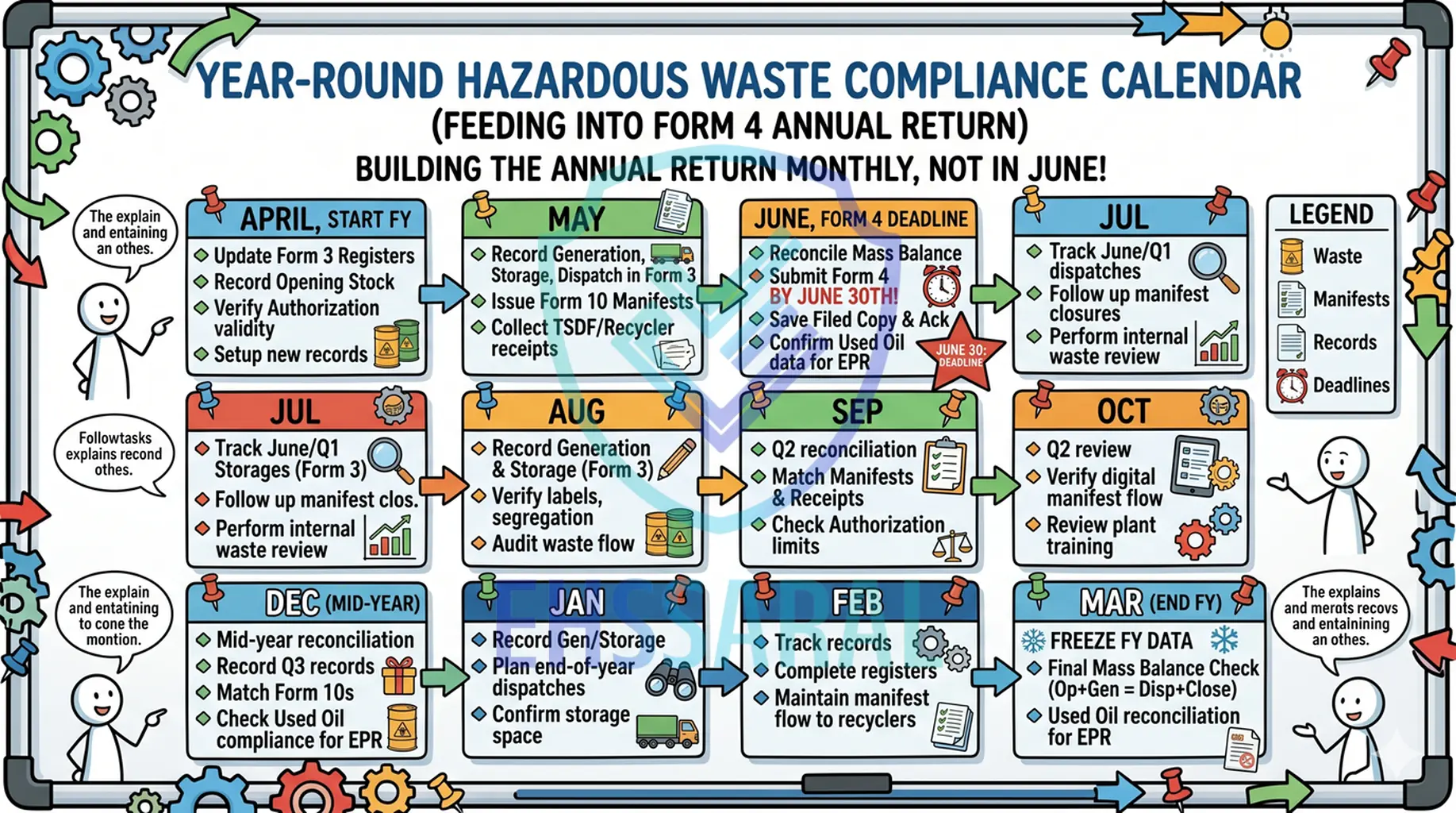
Good Form 4 filing starts from April, not June.
A simple system can reduce most last-minute pressure.
| Timeline | Action |
|---|---|
| Every month | Update Form 3 register category-wise |
| After every dispatch | Save Form 10, weighbridge slip and vendor receipt |
| Quarterly | Reconcile generated, dispatched and closing stock |
| October / November | Check whether authorization quantity is sufficient |
| January | Review pending disposal before year-end |
| April | Freeze previous FY hazardous waste data |
| May | Prepare draft Form 4 |
| Before 20 June | Complete internal review |
| Before 25 June | Keep final documents ready |
| Before 30 June | Submit Form 4 and save acknowledgement |
This approach avoids the common June panic.
Before final submission, check the following:
| Checkpoint | Yes / No |
|---|---|
| Is hazardous waste authorization valid? | |
| Are all waste categories correctly listed? | |
| Does opening stock match previous year closing stock? | |
| Is Form 3 updated for all months? | |
| Are all Form 10 manifests available? | |
| Are TSDF / recycler / co-processor records available? | |
| Are used oil records reconciled separately? | |
| Does closing stock match physical stock? | |
| Are units consistent across records? | |
| Are quantities category-wise and not lumped together? | |
| Is final Form 4 downloaded after submission? |
This checklist is useful for EHS officers, plant heads, consultants and internal auditors.
For plant managers, Form 4 should not be seen only as an EHS department form.
It reflects how well the plant controls hazardous waste.
A plant manager should ask three simple questions:
If the answer is yes, Form 4 filing becomes easier.
If the answer is no, the issue is deeper than late filing.
EHS teams can reduce risk by creating a monthly hazardous waste discipline.
A practical monthly routine can include:
This reduces last-minute dependence on memory, WhatsApp messages and scattered Excel files.
Late filing of Form 4 is a compliance gap.
Non-filing is more serious.
Wrong filing can be even more risky.
The safest approach is to file the correct return as early as possible, maintain proper supporting records, and avoid repeating the delay in future years.
Most Form 4 issues do not begin on 30 June.
They begin when hazardous waste data is not reconciled month by month.
Good compliance starts with understanding the waste movement clearly, not only with submitting the form.
The standard last date is 30 June every year for the previous financial year from April to March.
There is generally no single fixed daily late fee that applies uniformly across all SPCBs like income tax or MCA filings. The consequence depends on the state, delay period, compliance history, records, and facts of the case.
In many cases, delayed filing may still be submitted through the relevant portal or through the process allowed by the concerned SPCB. If portal submission is blocked, the unit should check the state-specific procedure or contact the board / consultant.
Non-filing creates a gap in the hazardous waste compliance record. It may lead to queries, show-cause notice, renewal issues, inspection observations, environmental compensation in suitable cases, or further regulatory action depending on the facts.
In many practical situations, yes. Late but accurate filing can be explained. But incorrect data, wrong category, missing disposal proof or mismatch with Form 3 and Form 10 can create deeper compliance concerns.
Yes, the annual quantity reported in Form 4 should be supported by the hazardous waste records maintained in Form 3.
Yes. Hazardous waste dispatch quantities in Form 4 should be supported by Form 10 manifests and disposal / recycling records.
Yes. Used oil is a common hazardous waste stream and should be reconciled separately with storage records, dispatch records, recycler documents and EPR-related records wherever applicable.
If a unit has hazardous waste authorization or annual return filing requirement under its SPCB portal / authorization condition, a nil or zero-generation year should be properly recorded. The unit should not assume that no waste means no reporting.
It can create queries during renewal, especially if annual returns are missing, delayed repeatedly or inconsistent with other records.
It may create questions during CTO renewal because hazardous waste compliance is part of the overall environmental compliance record of the unit.
Keep submitted Form 4 copy, acknowledgement, Form 3 register, Form 10 manifests, weighbridge slips, TSDF / recycler certificates, used oil records, authorization copy and internal reconciliation sheet.
Take screenshots with date and time, save draft copies, keep internal approval records, email the helpdesk or concerned contact if applicable, and submit as soon as the portal allows. Do not treat a saved draft as final submission.
Update hazardous waste records monthly, reconcile dispatches quarterly, collect vendor documents immediately after disposal, prepare draft Form 4 in May and submit before the last week of June.
The basic Form 4 annual return requirement is common, but the portal process, document checks, query style and renewal-stage review may differ between SPCBs such as MPCB Maharashtra, GPCB Gujarat and TNPCB Tamil Nadu. Industries should check their own state portal and latest board instructions before filing.
There may not be one uniform fixed late fee across all states. The practical consequence of late filing can differ depending on the concerned SPCB, delay period, compliance history, data accuracy, hazardous waste authorization status and whether supporting records such as Form 3, Form 10 and disposal proof are available.
Form 4 is not difficult when records are maintained throughout the year.
It becomes difficult when the plant tries to reconstruct one full year of hazardous waste movement in the last few days of June.
Clarity at the process level avoids confusion later.

Founder, EHSSaral
Founder - EHSSaral | Partner - Perfect Pollucon | ISO 14001 Lead Auditor | GHG Protocol Scope 2 | Chemist | Data Scientist | Second-generation environmental professional simplifying EHS compliance for Indian industries through practical, automated, tech-enabled, data driven compliance workflows.
Why We Wrote The Indispensable EHS Officer Book (A Realist Guide for India) | EHSSaral
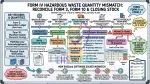
Form IV Quantity Mismatch: Hazardous Waste Reconciliation | EHSSaral
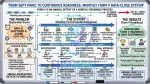
Form V Late Filing Penalty: Steps After 30 September

Battery Waste Management Rules India - Factory Guide (2026) | EHSShala
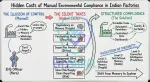
The Hidden Costs of Manual Environmental Compliance in India
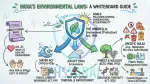
Environmental Laws in India (Complete Guide) | EHSShala
Water & Effluent Sampling Basics for Indian Factories | EHSSHala

Why EHS Experience Is Being Filtered Out - The Real Hiring Logic | EHSSaral
Environmental Compliance Data for BRSR & GRI Reporting in India | EHSSaral Research

EHSShala Start – Begin Your EHS Learning Journey in India