
Blog
Hazardous Waste Management Software India | EHSSaral
EHSSaral is an Environmental Compliance Intelligence Platform for Industries. Consent Intelligence • Alerts & Tasks • Incident Reporting • Form IV & V • Audit-Ready Records
See how EHSSaral works
20 Mar 2026
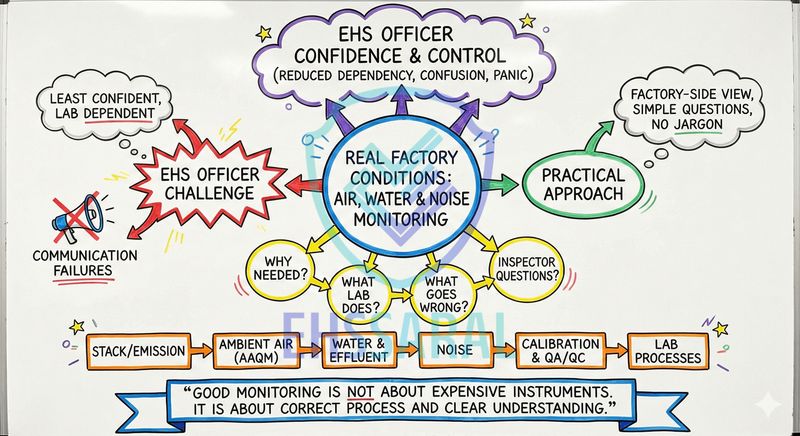
Environmental monitoring is where most EHS officers feel least confident and most dependent on labs.
Not because the topic is difficult.
But because it is rarely explained from the factory side.
On ground, questions are simple:
Why is this sampling needed?
What exactly will the lab do inside my plant?
What can go wrong during monitoring?
What inspectors usually question later?
This section exists to answer those questions calmly and practically.
No textbook language.
No lab marketing talk.
Only what an EHS officer actually needs to know to stay in control.
By the end of Level 5, you should be able to:
Understand why monitoring is required - not just what is done
Speak confidently with labs, auditors, and inspectors
Identify wrong sampling before it becomes a compliance issue
Check reports with a basic technical eye
Avoid common monitoring-related non-compliances
“Most monitoring problems are not technical failures.
They are communication failures.”
This level covers all major monitoring types handled by Indian factories:
Stack / Emission Monitoring
Ambient Air Quality Monitoring (AAQM)
Water & Effluent Sampling
Noise Monitoring
Calibration & QA/QC
Lab processes and common mistakes
Each article is written assuming you are standing on the shop floor - not in a classroom.
A single reference article that connects air, water, and noise monitoring.
Use this when:
You are new to monitoring
Management asks, “Explain monitoring in simple words”
You want the big picture before details
Explains:
What stack monitoring actually checks
Why sampling location matters
What inspectors usually question
Good for:
Boilers, furnaces, DG sets, process stacks
This topic scares many EHS officers unnecessarily.
This article explains:
What “isokinetic” really means
Why labs insist on it
Where things usually go wrong
Written in plain language - no formulas overload.
Covers:
Why locations matter more than number of samples
Boundary vs inside plant confusion
Common objections raised by neighbours and officers
Explains:
Grab vs composite sampling
Why timing matters
What usually causes report mismatch with ETP performance
Very useful before consent renewal.
Helps you understand:
Day vs night noise logic
Boundary vs workplace noise confusion
Why noise reports get rejected sometimes
Especially useful for urban and residential-adjacent units.
One of the most ignored topics.
This article explains:
Why calibration certificates matter
What QA/QC means in real terms
What inspectors quietly verify
Based on patterns seen across many sites.
Covers:
Small mistakes that later become big issues
Lab-side and factory-side gaps
What usually triggers inspection queries
No blame. Only learning.
Ready-to-use checklists for:
Pre-sampling preparation
During sampling
After report receipt
Designed for busy EHS officers.
👉 Read Article →
This article helps you see monitoring from the lab’s side.
Explains:
How lab teams plan visits
What constraints they face
How better coordination avoids mistakes
Very useful for improving lab relationships.
👉 Read Article →
Start with the Complete Guide
Then read articles based on your plant activities
Save checklists for repeat use
Share relevant links with juniors and plant teams
This level is not meant to impress anyone.
It is meant to reduce dependency, confusion, and panic.
“Good monitoring is not about expensive instruments.
It is about correct process and clear understanding.”
That is what this section aims to build.
Environmental monitoring means checking pollution levels from factory activities to confirm they are within permitted limits.
It usually covers:
Air emissions from stacks and DG sets
Ambient air quality around the factory
Water or effluent discharge
Noise levels at boundary and workplace
Monitoring is done to prove control, not just to “do a test”.
Because pollution is judged by measured data, not appearance.
Many non-compliances happen when:
Pollution is low but sampling is wrong
Data is missing or inconsistent
Reports don’t match consent conditions
Monitoring creates evidence, not assumptions.
The factory is always responsible.
The lab is only a service provider.
In inspections, officers usually ask:
Who arranged the sampling?
Who verified the report?
Who ensured compliance with consent conditions?
Saying “lab handled everything” rarely works.
Frequency depends on:
Consent to Operate conditions
Industry category
Process type and scale
In practice:
Stack and effluent monitoring are usually quarterly or half-yearly
Ambient air and noise may be quarterly or yearly
Always follow what is written in your consent, not assumptions.
Stack monitoring checks pollution leaving the chimney.
It measures:
Dust or particulate matter
Gases like SO₂, NOx, CO
Flow and temperature
It proves whether pollution control equipment is working properly.
Because it ensures accurate dust measurement.
If sampling speed does not match gas speed:
Dust results can be wrong
Reports can be questioned
Monitoring becomes unreliable
Isokinetic sampling is about correct method, not complexity.
AAQM checks air quality around the factory, not inside stacks.
It helps assess:
Impact on nearby areas
Boundary compliance
Public exposure concerns
Location selection matters more than the number of samples.
Grab sample: One-time sample at a specific moment
Composite sample: Mixed sample collected over time
Composite samples usually represent actual discharge better, especially for ETP outlets.
Wrong sampling type often causes report mismatch.
Because people mix up:
Workplace noise
Boundary noise
Day and night limits
Noise reports get questioned when:
Time slot is wrong
Location is unclear
Limits are misunderstood
Clarity avoids unnecessary arguments.
QA/QC means quality checks to ensure data is reliable.
It includes:
Calibration of instruments
Field blanks and duplicates
Proper documentation
Officers may not ask directly, but they verify indirectly.
Calibration shows that instruments are:
Working correctly
Within acceptable error limits
Without valid calibration:
Data credibility reduces
Reports can be rejected
Monitoring becomes weak during audits
Common patterns seen:
Wrong sampling location
Last-minute sampling rush
Reports not reviewed by EHS
Old calibration certificates
Monitoring not aligned with consent conditions
Most issues start small and grow over time.
Only if:
Parameters match
Locations match
Time period is acceptable
Using one report everywhere without checking details is risky.
You don’t need to be a scientist.
Basic checks:
Date and location
Parameters as per consent
Units and limits
Calibration details
Lab accreditation
This alone catches many issues early.
Yes - significantly.
Clear monitoring:
Builds confidence
Reduces questioning
Shows seriousness
Saves explanation time
Inspectors usually respond better to clarity than excuses.
No.
It also helps:
Track equipment performance
Identify early issues
Support upgrades and decisions
Compliance is the minimum benefit. Control is the real value.
This section is for:
Junior and mid-level EHS officers
Plant engineers handling compliance
Anyone coordinating with labs
It is written for real factory situations, not exams.

Founder, EHSSaral
Founder - EHSSaral | Partner - Perfect Pollucon | ISO 14001 Lead Auditor | GHG Protocol Scope 2 | Chemist | Data Scientist | Second-generation environmental professional simplifying EHS compliance for Indian industries through practical, automated, tech-enabled, data driven compliance workflows.
Hazardous Waste Management Software India | EHSSaral
EHSShala Foundations - Core Environmental Basics for EHS Officers
Chemical Accidents Rules, 1996: A Practical Guide for Indian EHS Officers
Why BMW Inspections Feel Stricter Today (India) | EHSSaral
Environmental Consultancy Software: Beyond Excel & WhatsApp
Battery Waste Management Rules India - Factory Guide (2026) | EHSShala
How MoEFCC, CPCB & SPCB Work in India: Expert Guide | EHSShala

Is There Truly Free Environmental Compliance Software in India? (An Honest Answer) | EHSSaral
 ehssaral.webp)
50 mg/Nm³ Emission Limit in India: Is Your Chimney Ready? (SME Guide)
 List, Rules & Compliance Guide ehssaral.webp)
Orange Category Industries in India (2026): List, Rules & Compliance Guide