
Blog
Hazardous Waste Stored Beyond 90 Days: What to Do
EHSSaral is an Environmental Compliance Intelligence Platform for Industries. Consent Intelligence • Alerts & Tasks • Incident Reporting • Form IV & V • Audit-Ready Records
See how EHSSaral works
18 Mar 2026
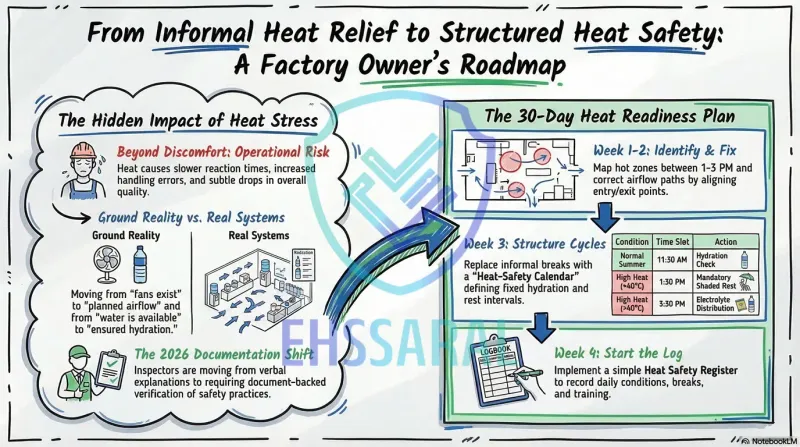
If you read only one section, read this.
Heat on the shop floor is no longer just a seasonal discomfort-it is slowly becoming an operational and compliance concern.
Most factories are already doing something about it. The gap is structure, not intent.
Start with three simple actions:
Identify your hottest work zones during peak afternoon hours
Set fixed water and rest cycles instead of informal breaks
Maintain a basic daily log of what is being followed
In many Indian plants, 60-70% of heat management already exists informally.
The shift now is towards making it visible, consistent, and trackable.
In most parts of India, working through summer heat has always been part of industrial life.
April to June conditions-especially in Maharashtra, Gujarat, and southern belts-are not new.
What is changing is not the temperature alone.
It is the way heat is being looked at inside factories.
Recent discussions, including studies from institutes like Tata Institute of Social Sciences (TISS), are increasingly pointing towards heat exposure as a workplace risk, not just a weather condition. There is also a gradual push to view heat stress in the same category as other occupational health concerns.
This does not immediately change rules on paper.
But it does change expectations during inspections, audits, and internal reviews.
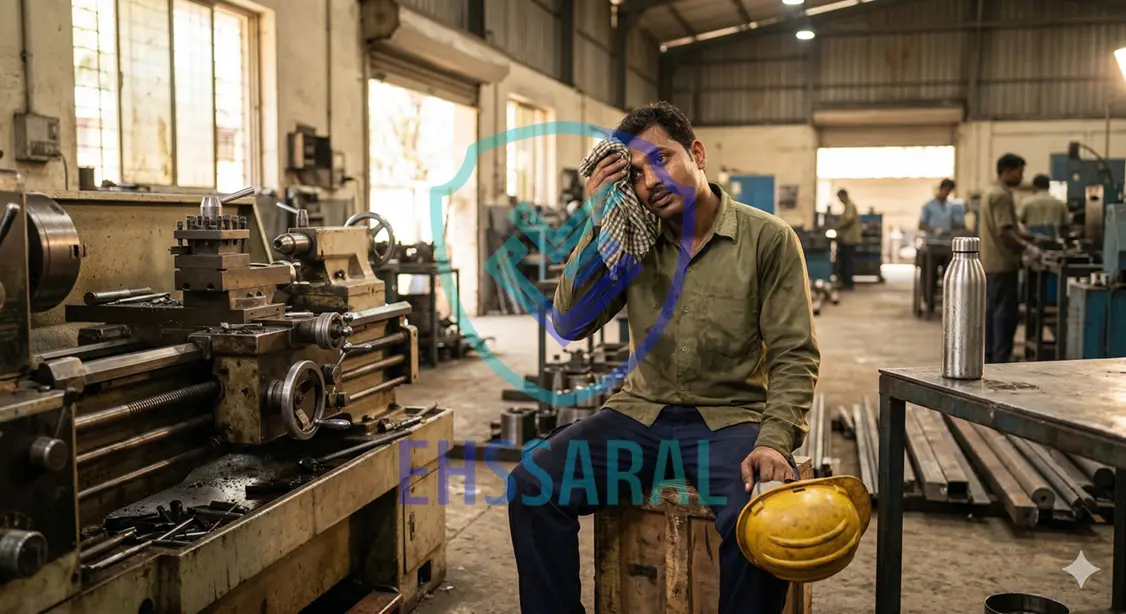
In day-to-day operations, heat usually shows up quietly.
Workers slow down slightly
Small mistakes increase
Fatigue sets in earlier in the shift
These are rarely linked directly to heat. They are seen as “normal summer effects.”
But over the years, we’ve seen that heat does not act alone.
It affects:
Human performance → slower reactions, reduced attention
Machine handling → more handling errors during manual operations
Overall productivity → output drops without a clear visible reason
This is where the shift begins.
What was earlier seen as discomfort is now slowly being understood as a factor that influences safety, quality, and output together.
In many Indian MSME plants, heat is not ignored.
It is handled-but in an unstructured way.
You will typically see:
Pedestal or wall-mounted fans added over time
Drinking water available at one or two locations
Workers adjusting their pace during peak afternoon hours
Supervisors allowing informal short breaks when needed
These are not wrong steps.
In fact, they show that the plant is already trying to manage real conditions.
But this is where confusion usually starts.
Because while actions exist, systems do not.
When you look slightly deeper, a pattern becomes visible.
Fans are installed, but airflow direction is not planned
Heat from machines accumulates, but no hotspot identification is done
Water is available, but hydration is not ensured or tracked
Breaks happen, but there is no defined timing or consistency
In many cases, the shop floor adapts on its own.
But operationally, this creates variability:
One shift manages better than another
One supervisor is proactive, another is not
One area is tolerable, another becomes a heat pocket
This inconsistency is where both productivity and compliance gaps start forming.
The effect of heat is rarely sudden.
It builds up quietly during the day.
You may notice:
Slight increase in rework: Quality begins to drop later in the shift
Slower cycle times: The same task starts taking longer
Visible fatigue: Workers take more time to recover between activities
Minor safety lapses: Small near-misses may happen but go unrecorded
Individually, these do not look serious.
But collectively, they affect:
Output
Worker comfort
Long-term reliability of operations
Over the years, we’ve seen that many factories try to solve this by adding more fans or increasing supervision.
But without addressing the underlying structure, the improvement is limited.
Earlier, many inspections relied heavily on:
Visual observation
Verbal explanations
General compliance understanding
Now, there is a gradual shift.
Inspections are increasingly moving towards:
Document-backed verification
Recorded practices instead of verbal assurance
Consistency across time, not just on the inspection day
In reality, undocumented safety measures are often treated as non-existent.
This does not mean factories are not doing the right things.
It means those efforts are not visible during evaluation.
Another subtle change is happening on the shop floor.
Workers today:
Are more aware of workplace conditions
Are more willing to speak about discomfort
Share experiences more openly across teams and networks
This is not about conflict.
It is about changing expectations.
A worker today does not always accept heat as “part of the job” in the same way as before.
Across industry discussions and safety forums, heat stress is gradually entering structured conversations.
Alignment with global practices is being discussed
Occupational health frameworks are expanding
Seasonal risk planning is gaining attention
This does not mean immediate strict enforcement everywhere.
But it does indicate a direction:
👉 Moving from informal management → structured approach
Heat stress is often misunderstood as just “feeling hot.”
In simple terms:
It is the condition where the body is not able to cool itself effectively while working.
This happens when:
External heat (environment + machines) is high
Air movement is insufficient
Hydration is not adequate
Work intensity remains constant despite rising temperature
Heat stress rarely appears as a major incident immediately.
It starts with small signs:
Increased sweating
Tiredness earlier than usual
Reduced focus
Slower response to instructions
In many Indian plants, these signs are normalized.
Workers continue working. Supervisors adjust informally.
But these are early indicators, not routine behavior.
Heat does not only affect how a person feels.
It affects how a person works.
Over time, this leads to:
Higher chances of handling errors
Reduced alertness in critical tasks
Increased dependence on supervision
This is why heat is gradually being seen as an operational factor, not just a seasonal inconvenience.
You may come across the term WBGT (Wet Bulb Globe Temperature) in discussions or audits.
In simple terms:
WBGT is a way to understand heat by combining temperature, humidity, airflow, and radiation.
You do not need to calculate it daily in most MSME setups.
But being aware of it helps in understanding:
Why two areas with the same temperature may feel different
Why airflow and humidity matter as much as temperature
It is best understood as a reference concept, not something to overcomplicate daily operations with.
In many Indian plants, improvements begin when something goes wrong.
But with heat, the pattern is different.
The impact builds slowly-and by the time it becomes visible, it has already affected productivity, comfort, and sometimes safety.
From a practical standpoint, preparing for heat is not about adding one solution.
It is about understanding a few realities and structuring what already exists.
In most factories, the first reaction to heat is:
“Roof is metal/asbestos, so it is getting hot”
While this is true, it is only part of the picture.
Heat on the shop floor typically comes from a combination of:
Roof exposure to direct sunlight
Heat generated by machines
Poor air movement or trapped airflow
Focusing only on roofing often leads to partial improvement.
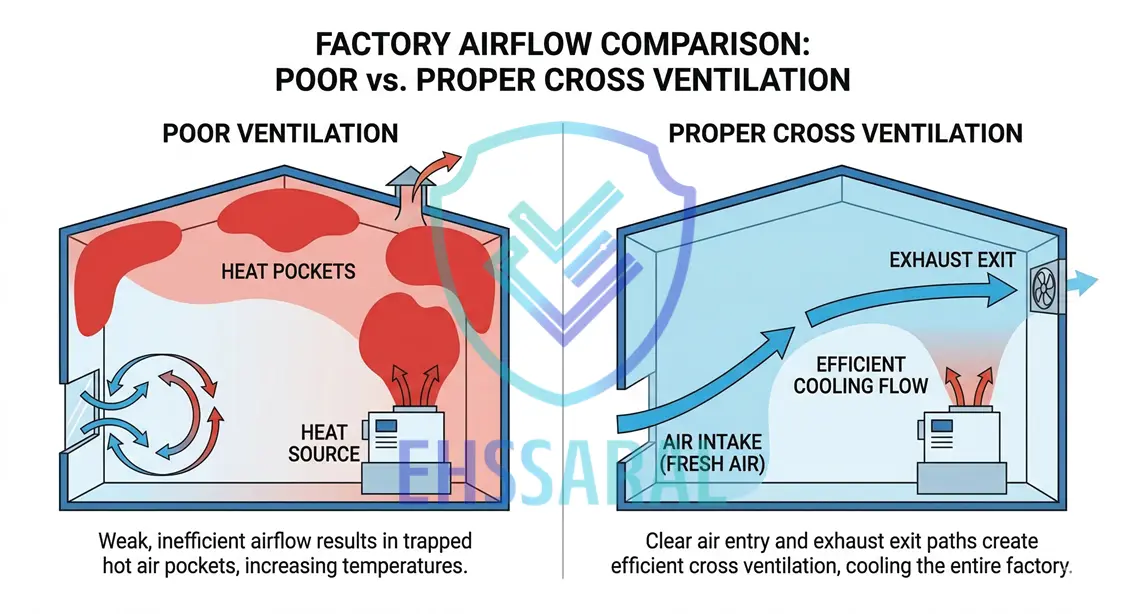
Over the years, we’ve seen that heat rarely spreads evenly.
It collects in specific zones:
Around high-temperature machinery
Corners with no airflow exit
Areas where air enters but does not leave
These become heat pockets, even if the rest of the shop floor feels manageable.
In many plants, additional fans are installed to solve the problem.
This creates movement-but not always relief.
Fans circulate air
Exhaust systems remove air
If hot air is only circulated and not removed, the overall temperature may not reduce significantly.
This is where confusion usually starts-more fans are added, but conditions remain largely the same.
From a practical standpoint, improvements do not always require major investment.
Some effective steps include:
Installing roof insulation or reflective coatings
Placing exhaust fans at heat accumulation points, not randomly
Creating cross ventilation paths (entry and exit of air)
Aligning openings to allow natural airflow
In many MSMEs, simple changes have shown visible impact:
Using shade nets above heat-exposed areas
Adjusting machine layout slightly to avoid trapped zones
Keeping certain pathways open to improve air movement
Over the years, we’ve seen that airflow direction often matters more than airflow quantity.
Most factories already provide drinking water.
But the pattern is usually:
Workers drink when they feel like
Breaks happen when fatigue is visible
No defined timing or consistency
From a human standpoint, this works to some extent.
From a system standpoint, it creates gaps.
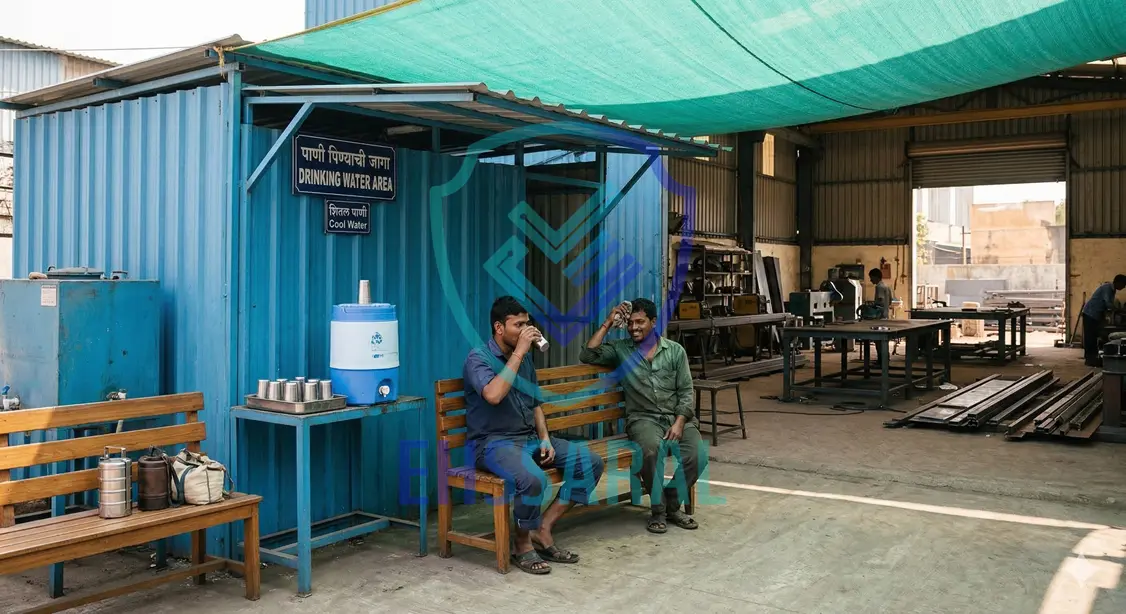
There is a gradual shift towards:
Ensuring regular hydration, not just availability
Defining rest cycles during peak heat hours
Making these practices consistent across shifts
This is not about adding complexity.
It is about making existing practices predictable and repeatable.
Instead of reacting daily, some factories are starting to follow a simple seasonal structure.
During peak summer:
Breaks are slightly increased
Work pacing is adjusted
Supervisors monitor fatigue more actively
This can be thought of as a Heat-Safety Calendar.
| Condition | Time | Action |
|---|---|---|
| Normal Summer | 11:30 AM | Hydration Check |
| High Heat (>40°C) | 1:30 PM | Mandatory Shaded Rest |
| High Heat (>40°C) | 3:30 PM | Hydration / Electrolytes |
This does not need to be rigid.
But having a basic structure ensures:
All workers get equal attention
Supervisors follow a common approach
Practices remain consistent even on busy days
Providing water is not the same as ensuring hydration.
Allowing breaks is not the same as structuring recovery.
In many plants, actual practices are better than what records show.
But during reviews or inspections, what matters is:
What can be seen
What can be verified
If an activity is not recorded, it becomes difficult to demonstrate consistency.
Why most non-compliance is a system failure?
You do not need complex systems.
Basic documentation can include:
Daily temperature or general heat condition notes
Break schedules followed
Worker awareness sessions
Any heat-related discomfort or first-aid cases
Instead of digital folders or complex formats, many MSMEs manage effectively with one physical register.
A Heat Safety Register with three sections:
Daily Logs
General conditions
Breaks followed
Training Records
Toolbox talks
Awareness sessions
Incident Notes
Any dizziness, fatigue, or minor case
Many factories already maintain logs for other compliance areas. Extending the same discipline to heat management is usually easier than starting something new.
Form 3 logbook and compliance records
This is simple, visible, and easy to maintain.
From a practical standpoint:
It shows consistency
It reflects intent clearly
It helps supervisors stay aligned
In many cases, the difference between “managed” and “well-managed” is documentation.
Many PPEs are designed primarily for protection:
Thick gloves
Heavy coveralls
Closed helmets
During peak summer, these become uncomfortable.
As a result, workers may:
Loosen PPE
Remove it temporarily
Avoid using it consistently
From a compliance standpoint, PPE may be available.
From a practical standpoint, it may not be usable.
A PPE that is not worn is not a safety measure.
Factories are gradually exploring:
Breathable fabrics for uniforms
Ventilated helmets where applicable
Lightweight alternatives that still meet safety needs
The goal is not to reduce protection.
It is to ensure protection is actually followed.
Instead of replacing everything at once:
Identify areas where heat impact is highest
Evaluate PPE options for those zones
Introduce changes gradually
This allows both safety and comfort to improve together.
Even with infrastructure, water, and PPE:
Heat stress often shows first at the individual level
Early signs are noticed by workers, not systems
If workers do not recognize these signs, response gets delayed.
Awareness does not need to be technical.
Simple understanding is enough:
When to pause work
When to inform supervisor
Basic symptoms like:
Dizziness
Excessive sweating
Unusual fatigue
In many cases, awareness is not the problem. The challenge is translating understanding into consistent daily practice across shifts.
Why good people still struggle with compliance?
In many Indian plants, this is already done informally.
It can be strengthened through:
Short toolbox talks
Visual posters in local language
Supervisor reminders during peak hours
Supervisors play a key role in:
Observing early signs
Encouraging timely breaks
Maintaining balance between output and well-being
From a practical standpoint, awareness is often the fastest and most effective control available.
Factories Act 1948: Download Compliance Checklist & Rules PDF
Most factories do not struggle because they lack intent.
They struggle because solutions are often copied without adapting to actual conditions.
Over the years, across different types of plants-fabrication units, food processing, small engineering setups-one pattern becomes clear:
Expensive solutions do not always solve heat.
Correctly placed simple solutions often do.
When heat becomes uncomfortable, the usual actions are:
Adding more pedestal or wall-mounted fans
Installing air coolers in isolated areas
Increasing supervision during peak hours
These steps do provide temporary relief.
But in many cases, the improvement is limited or uneven.
In many Indian plants, air enters the shop floor-but has no clear exit path.
Fresh air comes in
Hot air keeps circulating
This creates a trapped condition.
A simple correction often works:
Define entry points for air
Define exit points (exhaust or openings)
Even a small alignment between openings can improve conditions significantly.
In practice, removing hot air is more effective than just moving it.
For example, in one small fabrication setup, multiple pedestal fans were already running across the shop floor, but workers still complained most during mid-afternoon hours. The issue was not lack of fans. Hot air was circulating without a proper exit path. After one exhaust point was aligned with an existing air entry opening and one blocked ventilation route was cleared, worker discomfort reduced noticeably without adding new equipment. The temperature did not change dramatically on paper, but conditions on the floor became easier to manage.
Trying to cool the entire factory uniformly is difficult and often unnecessary.
What works better:
Identify 2-3 hottest zones
Focus improvements there first
For example:
Machine cluster areas
Corners with no airflow
Roof-exposed sections
This targeted approach gives faster and visible results.
In several MSMEs, especially those with partial outdoor exposure:
Shade nets have shown immediate impact
Even temporary shading reduces direct heat load
This is a low-cost intervention that can be implemented quickly without structural changes.
Some plants informally adjust work patterns:
Slightly slower pace during peak hours
Heavy work shifted to morning or late afternoon
When this is structured:
It reduces fatigue
Improves consistency across shifts
This is often more effective than trying to “fight the heat” continuously.
In some cases, minor adjustments make a difference:
Moving heat-generating machines slightly apart
Keeping airflow paths open
Avoiding storage that blocks ventilation routes
These are not major redesigns-but they improve conditions noticeably.
From a practical standpoint, most improvements come from:
Better understanding of airflow
Small structural adjustments
Consistent practices
Not from large, one-time investments.
Over the years, we’ve seen that improving heat conditions is less about adding equipment-and more about using space and airflow correctly.
In many factories, preparation for inspection focuses on:
Cleanliness
Documents
Equipment condition
Heat management is often assumed to be secondary.
But the way inspections are evolving, the focus is slightly shifting.
In reality, inspections are less about isolated checks and more about patterns.
Instead of asking only:
“Is water available?”
The focus may be:
Is it accessible across work zones
Is it used regularly
Is there any structure to breaks
Similarly, ventilation is not just about presence of fans.
It is about:
Whether airflow is effective
Whether conditions are manageable during peak hours
In many cases, the initial discussion itself gives direction:
“What do you do during peak summer?”
“Do you follow any system for breaks?”
“Is anything recorded?”
These are not difficult questions.
But they highlight one key expectation:
👉 A defined approach, not just ad-hoc response
This pattern is already visible across different compliance areas where verbal assurance is slowly being replaced by structured evidence.
Why inspections feel stricter today?
Earlier, informal management was often accepted if conditions looked reasonable.
Now, with increasing focus on consistency:
What is followed daily matters
What can be shown matters
From a practical standpoint, a simple system is always stronger than a good explanation.
A simple register, a visible break routine, and a supervisor who can explain the system clearly often create more confidence than a long verbal explanation. In many cases, inspectors are not only checking whether something exists. They are checking whether it is followed consistently.
For many MSMEs, the first reaction is:
“This will increase cost”
“We may need major changes”
This concern is valid.
But in most cases, heat management improvements do not begin with large investments.
Many MSMEs face similar challenges when transitioning from informal to structured compliance systems.
Hidden cost of manual compliance
Instead of seeing it as a compliance cost, it helps to look at:
Work pace during peak summer
Fatigue levels
Small errors or rework
Even minor improvements in these areas can:
Stabilize output
Reduce supervision load
Improve overall working conditions
In many plants, initial improvements come from:
Adjusting airflow
Structuring breaks
Improving hydration practices
These require more planning than spending.
Instead of making large changes at once:
Start with low-cost adjustments
Observe impact
Expand gradually
This allows:
Better decision-making
Controlled spending
Sustainable improvements
From a practical standpoint, heat management is not a one-time investment-it is an evolving system.
If the entire system feels too much, start here.
1. Identify your hottest zones
Walk the shop floor between 1 PM and 3 PM
Observe where discomfort is highest
2. Structure water and rest
Fix 2-3 time slots
Ensure all workers follow the same routine
3. Start a basic log
Note daily conditions
Record breaks and observations
This alone creates a strong foundation.
Do you know which area of your factory gets the hottest during the day?
Are breaks structured or dependent on supervisor discretion?
Is there any record of what is being followed?
Is PPE actually used during peak heat hours?
If most answers are unclear, the system is still informal.
Assuming more fans will solve the problem
Providing water without ensuring regular intake
Ignoring early signs of fatigue
Treating heat as a seasonal issue instead of a recurring pattern
Not maintaining any record of practices
These are not failures.
They are simply gaps in structure.
Walk the shop floor between 1 PM and 3 PM
Mark the 2-3 hottest zones
Note where workers feel maximum discomfort
Observe where air enters and where it gets trapped
Ensure drinking water is available close to active work zones
Set basic hydration and rest timings for all shifts
Improve easy airflow corrections such as opening blocked paths or repositioning one exhaust point
Review whether any area needs temporary shading
Introduce a simple heat-safety routine for supervisors
Conduct one short toolbox talk on heat symptoms and response
Align all shifts on the same water and rest approach
Review whether PPE is actually being used during peak heat hours
Start one Heat Safety Register
Record daily observations, break timing, and any worker discomfort
Review what improved and what still feels unmanaged
Decide the next low-cost improvement based on actual shop-floor feedback
This approach keeps things practical, visible, and manageable.
Heat in factories is not new, but expectations are changing
Most plants already manage heat informally
The shift now is towards structure and consistency
Small changes in airflow, hydration, and awareness create visible impact
Documentation helps make these efforts visible
In many Indian factories, heat management is already happening-just not in a structured way.
The change ahead is not about doing something completely new.
It is about doing the same things more consistently, more visibly, and with clearer ownership.
Good heat readiness starts with simple structure, not complicated systems.
Clarity at the process level avoids confusion later.
👉 EHSShala’s 2026 Factory Heat-Safety Checklist can help you turn these ideas into a simple, usable routine for your team.
Heat stress is increasingly being discussed in occupational health contexts. While structured definitions are evolving, expectations around managing heat are clearly increasing.
There is no single number that applies equally to every factory. Heat risk depends on temperature, humidity, airflow, work intensity, and exposure time. On the shop floor, visible fatigue, discomfort, and reduced alertness are often the first signs that conditions need attention.
In many cases, structured breaks are recommended during high heat conditions. Even where not explicitly defined, they are considered good operational practice.
Simple records are sufficient:
Daily conditions
Break schedules
Awareness sessions
Any heat-related observations
Yes. Heat affects operations regardless of size. Smaller factories can often implement improvements faster due to simpler layouts.
Start with:
Airflow correction
Structured breaks
Basic documentation
These require minimal cost and create immediate improvement.

Founder, EHSSaral
Founder - EHSSaral | Partner - Perfect Pollucon | ISO 14001 Lead Auditor | GHG Protocol Scope 2 | Chemist | Data Scientist | Second-generation environmental professional simplifying EHS compliance for Indian industries through practical, automated, tech-enabled, data driven compliance workflows.
Hazardous Waste Stored Beyond 90 Days: What to Do

EHSShala Foundations - Core Environmental Basics for EHS Officers
Form V Data Variation: Explain Water, Waste & Pollution Changes
CPCB OCEMS Flatline Notice: How Industries Should Respond (Safely) | EHSSaral
Stack Monitoring Basics for Indian Factories | EHSShala
 EHSSaral.webp)
Environmental Monitoring Mistakes in Indian Factories (Real Issues Explained)

Why Safety Culture Fails in Indian SMEs: People & Compliance Challenges | EHSSaral Research
Form V Data Collection: Monthly System for Factories
Hazardous Waste All Forms Form 1 to Form 12 Guide

MSIHC Rules, 1989: Practical Guide for Indian Factories