
Blog
Environmental Compliance Management in India: Systems vs Consultants Explained
EHSSaral is an Environmental Compliance Intelligence Platform for Industries. Consent Intelligence • Alerts & Tasks • Incident Reporting • Form IV & V • Audit-Ready Records
See how EHSSaral works
9 Feb 2026
This level makes much more sense once you understand:
how waste is classified
why documentation matters
how inspectors connect different rules together
Explore our previous levels if you have not gone through:
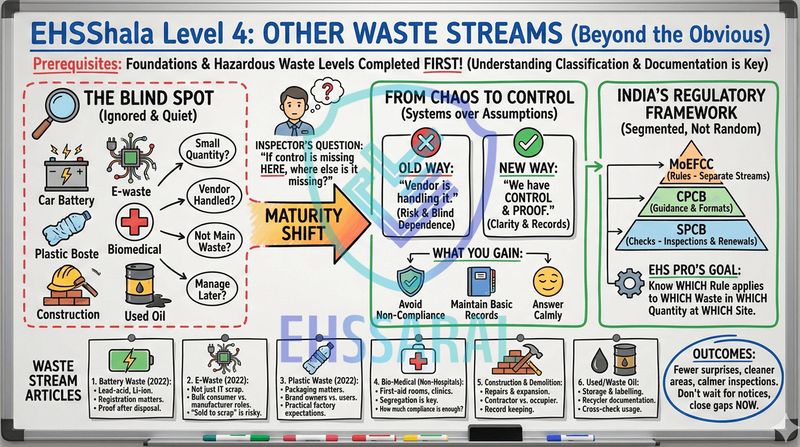
In most factories, compliance problems do not come only from hazardous waste.
They come from “other” waste streams that are quietly ignored.
Battery waste.
E-waste.
Plastic waste.
Used oil.
Biomedical waste.
Construction debris.
These are often treated as:
“small quantity”
“vendor handled”
“not our main waste”
“will manage later”
That is where trouble starts.
During inspections, officers do not look at waste in isolation.
They look at systems.
If hazardous waste is managed properly,
but battery or e-waste has no clarity,
it raises one simple question:
“If control is missing here, where else is it missing?”
This level exists to remove that blind spot.
This level is designed to help you:
understand which non-hazardous / special wastes apply to your factory
avoid accidental non-compliance due to ignorance
stop depending blindly on vendors and recyclers
maintain basic records without panic
answer inspection questions calmly
This is not about memorising rules.
It is about knowing what applies to you and what does not.
By the end of this level, you will clearly understand:
Which waste rules apply to manufacturing units vs offices vs service units
Difference between authorization, registration, and simple record-keeping
What recyclers are responsible for - and what you are still responsible for
Which wastes inspectors commonly ask about even in small factories
How different waste streams connect during audits
You will stop saying:
“Vendor is handling it.”
And start saying:
“We have control and proof.”
That is the maturity shift.
India’s waste rules are segmented, not random.
At a high level:
MoEFCC issues separate rules for each waste stream
CPCB issues guidance and formats
SPCBs check implementation during inspections and renewals
As an EHS professional, you are expected to know:
which rules apply
to which waste
in which quantity
at which type of site
This level gives you that clarity - without legal language.
These articles together form the complete practical coverage of non-hazardous and special wastes.
Read them fully once.
Use them as reference forever.
Covers lead-acid, lithium-ion, and industrial batteries.
You will learn:
Which batteries fall under the rules
What registration actually means for users
Common mistakes in storage and handover
What proof to keep after disposal
E-waste is not just IT scrap.
You will learn:
What qualifies as e-waste in factories
Difference between bulk consumer and manufacturer roles
Why “sold to scrap” is risky without documentation
What inspectors usually ask for
Often misunderstood and wrongly ignored.
You will learn:
Which plastics are covered
Why packaging material matters
Role of brand owners vs users
What is expected practically from factories
Applicable even if you are not a hospital.
You will learn:
Why factories generate biomedical waste
Common sources like first-aid rooms and clinics
What segregation is actually required
How much compliance is “enough”
Triggered during repairs, expansion, and civil work.
You will learn:
What qualifies as C&D waste
Why temporary projects still matter
Who is responsible - contractor or occupier
What records to keep during site work
A very common inspection question.
You will learn:
Difference between used oil and waste oil
Why storage and labelling matters
What recyclers must provide you
How inspectors cross-check oil usage
This level is essential for:
EHS officers in manufacturing units
Plant engineers handling maintenance waste
Admin teams managing vendors and scrap
Factories expanding or modifying facilities
Professionals facing repeat inspection queries
If inspectors keep asking:
“Battery ka kya?”
“E-waste ka record?”
“Used oil ka disposal proof?”
This level is for you.
After completing this level, you will notice:
Fewer surprise questions
Cleaner waste areas
Better vendor control
Calmer inspection conversations
Less last-minute scrambling
Because inspections don’t fail due to big gaps.
They fail due to small ignored ones.
Other waste streams are called “other”
only because they are quiet.
But silence does not mean safety.
Good EHS professionals do not wait for notices.
They close gaps before they are questioned.
This level is built to help you do exactly that.
Clarity over chaos.
Systems over assumptions.
Control without fear.
No.
Small and medium units face more queries because systems are informal.
No.
This level helps you identify what applies and what doesn’t.
No.
Some need registration, some need authorization, some need only records.
Yes.
These waste streams are often checked indirectly during renewals.
After Level 4, you are ready for:
Audits & inspections
Compliance systems
Digital tracking
Advanced EHS decision-making

Founder, EHSSaral
Founder - EHSSaral | Partner - Perfect Pollucon | ISO 14001 Lead Auditor | GHG Protocol Scope 2 | Chemist | Data Scientist | Second-generation environmental professional simplifying EHS compliance for Indian industries through practical, automated, tech-enabled, data driven compliance workflows.
Environmental Compliance Management in India: Systems vs Consultants Explained
Hazardous Waste Packaging & Labelling in India (Inspector Guide) | EHSShala
Environmental Inspection India: What Inspectors Check | EHSSaral
Form V Late Filing Penalty: Steps After 30 September
 List, Rules & Compliance Guide ehssaral.webp)
Orange Category Industries in India (2026): List, Rules & Compliance Guide
Why BMW Inspections Feel Stricter Today (India) | EHSSaral
Form 4 Hazardous Waste Annual Return: Filing Guide & Format

Chemical Accident Emergency Response Guide for Indian Factories | EHSShala
Environmental Incident Response Guide for Indian EHS Professionals | EHSShala

Form 4 vs Form 5: Why Hazardous Waste Numbers Don't Match